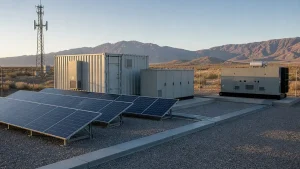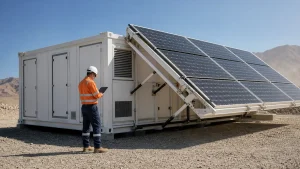
If you are a mining project manager, I know how your day goes. You are constantly balancing the need for massive power against the absolute nightmare of fuel logistics. When you look at a HighJoule solar container, you probably see the “fuel displacement”—how much daytime diesel you won’t have to burn.
But I’m here to tell you that’s only half the story. The biggest financial weapon in a solar-plus-storage hybrid system isn’t the solar panels; it’s the BESS Peak Shaving capability.
If you are currently running your mine on 100% diesel, you are overpaying for your energy spikes. Here is the insider look at how a battery saves you more money after the sun goes down.
1. The “Starting Grid” Problem: Understanding Your Load Profile
Most heavy mining machinery—crushers, massive conveyors, winding engines—doesn’t start slowly. It needs a massive, instantaneous surge of electricity just to get moving.
Think of your diesel generator like a small engine in a big car. To handle that momentary starting spike, you have to do one of two very expensive things:
Oversize your generators: Buy a 2 MW generator even if you only need 800 kW for 90% of the day. You’re paying for 1.2 MW of “capacity insurance” you rarely use.
Run multiple generators: Keep three units running just so they can handle the load if a crusher starts up. They all run inefficiently at low loads, which is the fastest way to glaze an engine and triple your maintenance costs.
This inefficient operating zone is what we call the “Diesel Maintenance Trap.”
2. Peak Shaving: Let the Battery Do the Heavy Lifting
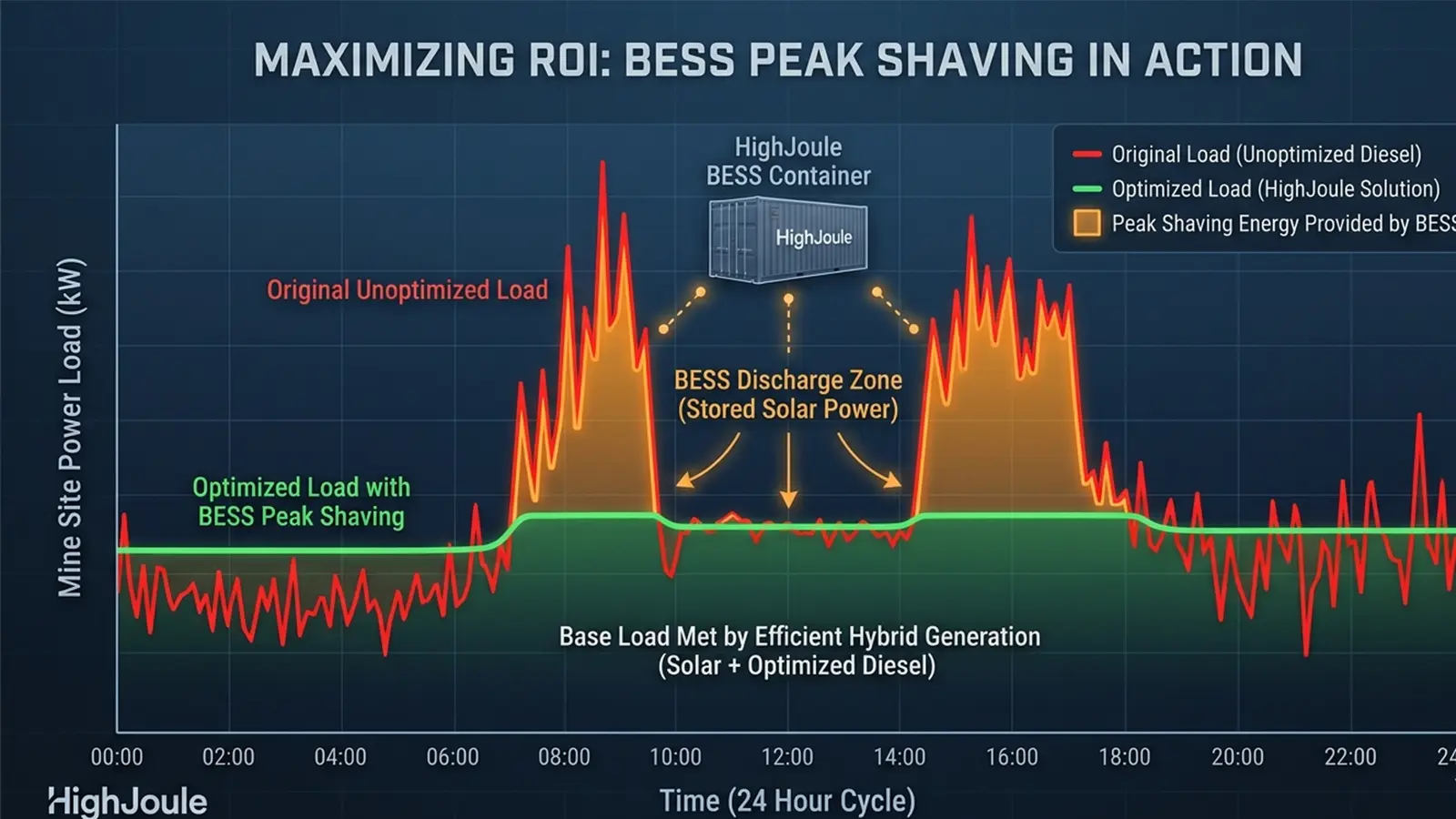
This is where the HighJoule BESS (Battery Energy Storage System) is a game-changer. In a hybrid microgrid, the BESS acts like a massive energy buffer or sponge.
When a crusher starts and needs that 200% power surge for 30 seconds:
The diesel generator stays off (or continues running efficiently at its “sweet spot”).
The HighJoule battery instantly discharges the required burst of power.
Once the machine is up to speed and the load stabilizes, the battery pulls back and prepares for the next surge.
We’re not just “replacing fuel”; we are optimizing the entire engine management strategy. We are shaving off the peaks so you can keep the core generation system running like a well-oiled machine.
3. The Math: Where the Savings Actually Hide
How does this look on your balance sheet? Peak shaving usually delivers savings in three main categories:
| Hidden Saving Category | Description | ROI Impact |
| Generator Downsizing | You can deploy a smaller total diesel capacity. | Lower initial CAPEX. |
| Fuel Efficiency (BSFC) | Engines run at 75–85% load (their most efficient zone) instead of 30–50%. | 10–20% lower fuel burn per kWh produced. |
| Extended Maintenance Intervals | Fewer starts, fewer surges, and optimal running temps. | Major overhauls delayed by years. Significant OPEX reduction. |
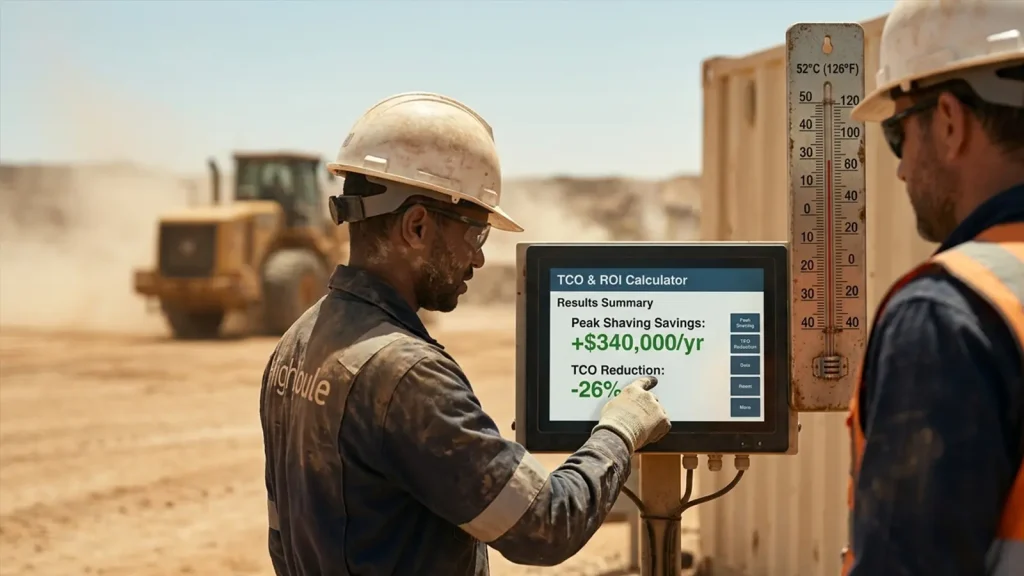
By using our integrated TCO (Total Cost of Ownership) & ROI Calculator, we often find that the Peak Shaving optimization saves clients as much money on maintenance and fuel efficiency per year as the solar panels save in total fuel displacement.
Summary for Decision Makers
In 2026, investing in a solar container is not just an environmental statement; it is the single most effective way to protect your mine from operational cost volatility. Peak shaving is the technical driver that makes the financial model work.
We’ve already analyzed the load profiles of major sites in the Andes and Africa. If you want us to run your specific load data through our calculator to see where your hidden savings are, just send us a DM. We’re ready when you are.
Last Updated on 07/30/2026