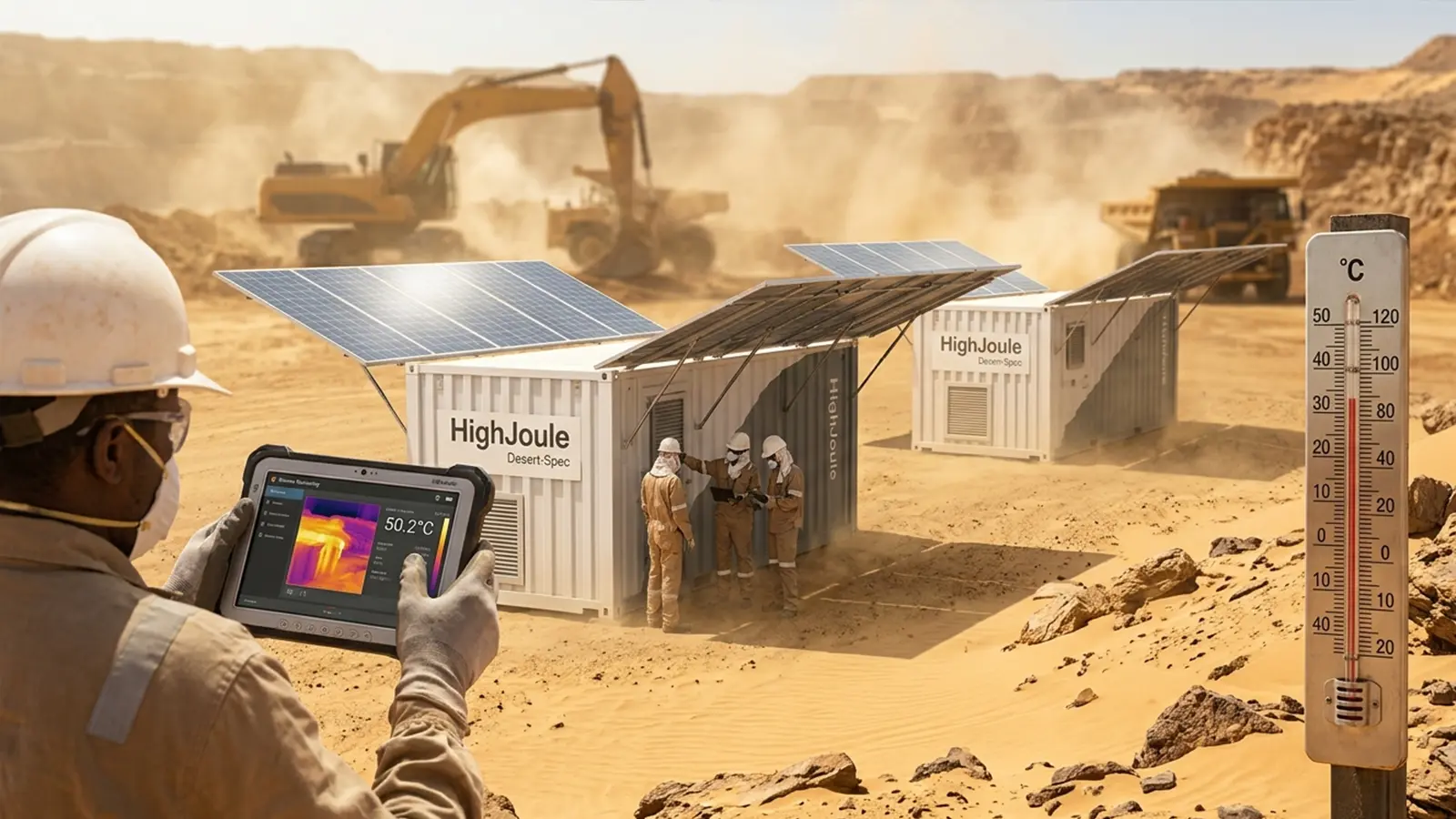
I’ve stood in the middle of an open-pit mine in Mauritania in July. Let me tell you, “50°C in the shade” isn’t just a headline—it’s a physical assault. The air is so hot it burns your throat, and dust gets into everything. Now, imagine putting a multi-million dollar box of sensitive electronics into that environment and expecting it to run perfectly, 24/7.
That is the reality of modern mining power. As we deploy more solar containers to replace diesel in 2026, we have to be brutally honest about the hardware. If you choose the wrong battery chemistry for these extreme environments, you aren’t just risking a power outage; you are risking a catastrophic fire.
At HighJoule, we have made a definitive choice. For remote, high-heat industrial sites, we only use Lithium Iron Phosphate (LiFePO4). Here is why NMC (Nickel Manganese Cobalt) tech—the stuff in most electric cars—doesn’t get anywhere near our desert specs.
1. Thermal Runaway: The Science of Not Catching Fire
The biggest enemy of a battery is heat. When a battery gets too hot, it can enter “thermal runaway.” This is a scary scientific term that basically means it self-heats uncontrollably until it bursts into flames.
This is where the difference between chemistries is life and death.
- NMC (Standard Tech): These batteries start to break down and become unstable at around 150°C to 170°C. In a metal container sitting in 50°C desert heat, that safety margin is uncomfortably thin if the AC unit fails for even an hour.
- LiFePO4 (HighJoule Standard): This chemistry is inherently stable. It doesn’t even begin to break down until it hits 270°C or higher. It has a much robust chemical structure that simply refuses to let go of its oxygen, which is what fuels battery fires.
We had a client tell us about a competitive unit (not ours) that had an AC failure in 2026 in Chile. Within three hours, the internal temps spiked, the NMC cells swelled, and the site had to be evacuated. That is a mistake you only make once.
2. Longevity: Why We Don’t Want to See You in 5 Years
We don’t build temporary solutions. We want our solar container systems to last 15 to 20 years, matching the life of the mine.
High heat kills standard batteries fast. A conventional battery kept in constant 40°C+ conditions will see its lifespan cut in half, easy. LiFePO4, however, has an incredible cycle life. It can handle being charged and discharged 6,000 to 8,000 times (NMC is usually closer to 2,000).
When you are spending weeks mobilizing a power plant into the Andes, the last thing you want is to have to replace the “big battery” in five years. LiFePO4 gives us the confidence that the asset will still be delivering ROI long after the initial investment is paid off.
3. Passive Safety vs. Active Safety
A lot of companies brag about their advanced BESS (Battery Energy Storage System) software that manages temperature. That is called “active safety.” If the software works, you are safe.
We prefer “passive safety.” LiFePO4 is physically safer. Even if the software fails, even if the container is punctured, even if the cooling system is clogged with desert dust, the core chemical structure of a LiFePO4 cell resists ignition.
In a hybrid microgrid scenario where you are combining solar with big diesel spikes, you need that rugged dependability. You need power that doesn’t need to be coddled.
The Desert Specs Count
I’m not saying NMC doesn’t have its place. It’s light and energy-dense, which is great for a Tesla. But we aren’t building sports cars; we are building mobile power plants for the toughest industry on earth.
If you are a mining project manager looking at energy options this year, don’t just ask about the price per kWh. Ask about the “thermal stability limit.” If they give you a number lower than 250°C, keep looking.
Anyway, if you want to talk about how we keep our containers cool without burning through your Opex budget, drop me a message. We’ve seen it all.
Last Updated on 04/08/2026