Look, if you’re trying to land a solar container in Rotterdam or Hamburg this month, I hope your paperwork is ready. We’ve spent the last few weeks at HighJoule dealing with panicked calls from site managers who thought they could just “figure it out later.”
Well, “later” is now. As of February 18, 2026, the new EU Battery Regulation (2023/1542) has officially kicked in with full force. It’s no longer a suggestion—it is a gatekeeper. If your documentation isn’t perfect, your expensive energy storage system is going to sit on a dock gathering dust (and racking up storage fees).
Here’s the reality of what we’re seeing on the ground right now.
1. The Carbon Footprint: More Than Just a “Green” Sticker
For years, everyone just said their batteries were “eco-friendly.” In 2026, the EU doesn’t care about your marketing. You now need a verified Carbon Footprint Declaration.
This is a massive pain for manufacturers who don’t have their supply chain under control. You need to prove exactly how much CO2 was emitted—from the lithium mine all the way to our assembly line. We had one client recently who almost lost a deal because their previous supplier couldn’t provide the the specific “kg of CO2 per kWh” data.
Quick Tip: If your supplier hesitates when you ask for “Scope 3 emissions data,” they probably aren’t ready for 2026. Run.
2. Labels, QR Codes, and “Digital Passports”
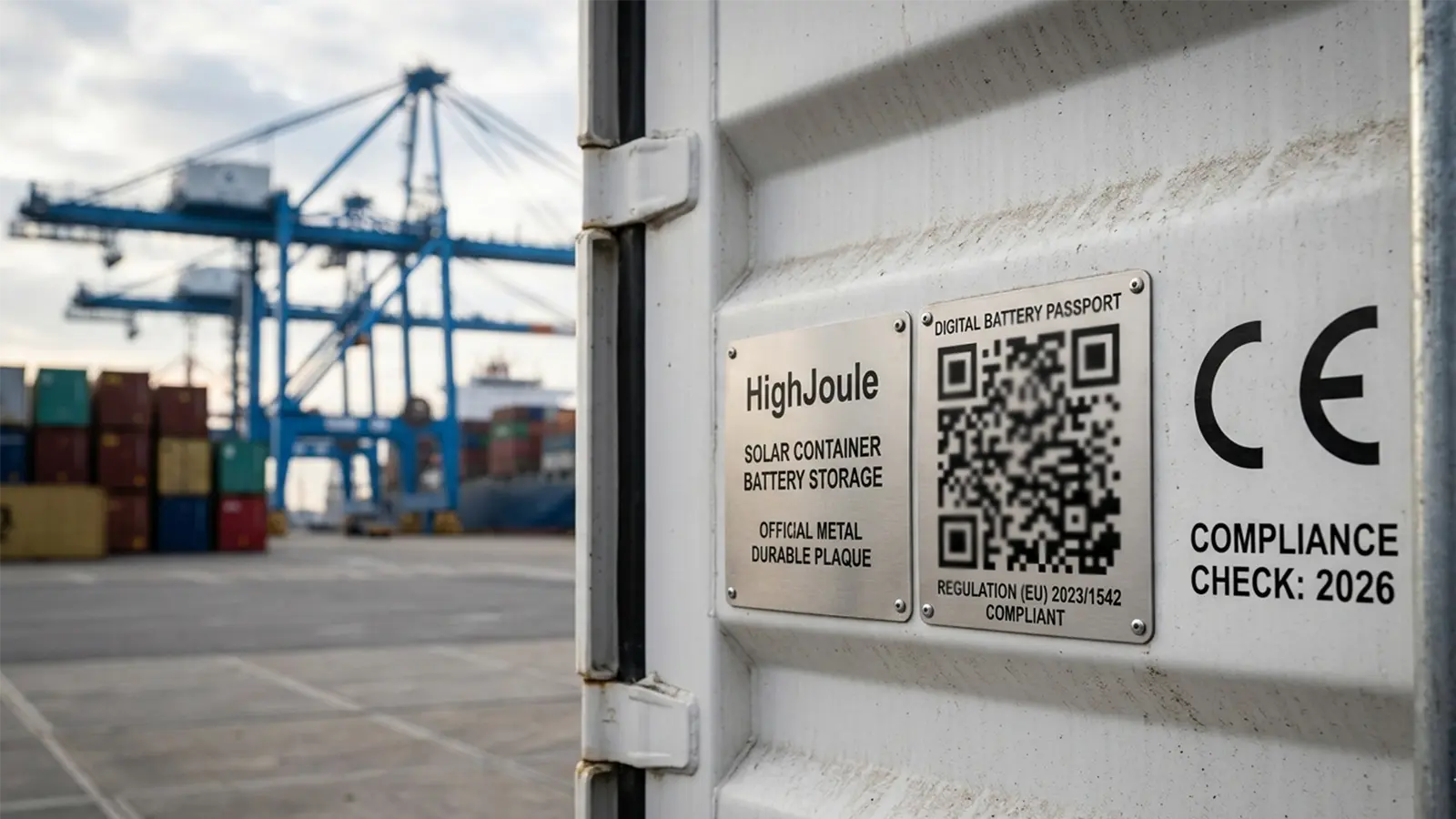
If you look at the side of a HighJoule container today, it looks a lot more crowded than it did two years ago. Every industrial battery now has to carry clear, physical labels showing:
- The “Real” Lifespan: None of that “up to 10,000 cycles” nonsense without proof.
- Chemical Hazards: Total transparency on the LiFePO4 mix.
- The QR Code: This is the big one. Most units are now shipping with a Digital Battery Passport. You scan it, and you see the battery’s entire “birth certificate.”
3. The “Producer Responsibility” Trap
One thing people keep forgetting is EPR (Extended Producer Responsibility). If you’re the one importing these containers into an EU member state, the law now says you are responsible for what happens to them in 15 years.
You can’t just walk away. You need a legally binding plan for recycling. At HighJoule, we’ve built our containers for “Second Life” use—meaning when they’re done at your mine, they can be repurposed for a less demanding grid job. This makes your end-of-life costs way lower.
4. Why This Matters to Your Bottom Line
I’ve seen it happen: a project gets delayed by 6 weeks because the customs officer didn’t see the updated CE Marking that refers to the 2026 performance standards. In our industry, time is literally fuel money.
Navigating the EU Battery Regulation 2026 is honestly a full-time job. That’s why we’ve integrated all this compliance directly into our solar container design. We don’t just sell you a box of batteries; we sell you a box that is actually legal to use.
Final
The rules changed while most of the industry was sleeping. If you aren’t 100% sure your current setup meets the new standards, ask your supplier for their 2026 Compliance Roadmap. If they look at you blankly, give us a call.
Anyway, stay safe out there—and keep your paperwork closer than your toolbox.
Last Updated on 03/30/2026