If you’ve been working in the European renewable sector for more than five years, you’ve probably realized the “honeymoon phase” of simple solar is over. It’s no longer just about how many panels you can cram onto a roof; it’s about whether your system can survive a German winter or a Spanish heatwave without the local grid operator (DSO) breathing down your neck.
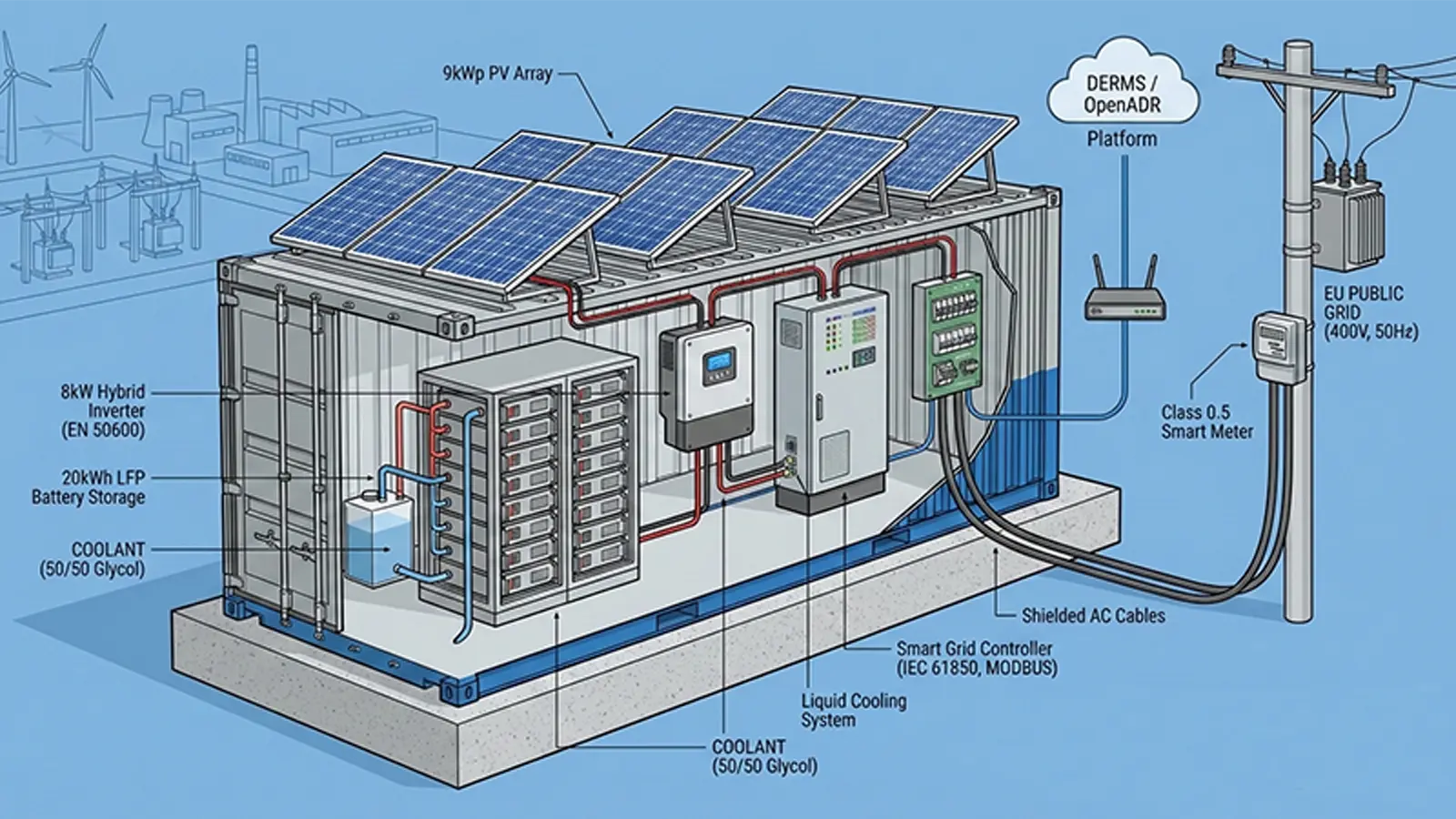
At HighJoule, we’ve spent the last 14 months “breaking” our HJ-20D-P009E020—our flagship 20ft shipping container solar power plant with inverter. We didn’t just run simulations in a cozy office in Berlin. We actually hauled this 10-ton beast to test sites in Bavaria, bounced it over some truly terrible roads in rural Poland, and watched the telemetry during a 44°C heatwave in Seville.
Here is the “no-nonsense” truth about why this unit is built the way it is, and why a “cheap” container is often the most expensive mistake a business can make.
1. “Smart Grid Ready” is no longer optional
By 2030, the EU wants 69% of our power from renewables. For grid operators, that’s a technical nightmare. If you’re a business owner, you might think “Smart Grid Ready” is just marketing fluff. It’s not. It’s the difference between your interconnection being approved in two weeks or being stuck in a six-month bureaucratic loop.
Our 20ft shipping container solar power plant with inverter acts as an active participant in the grid:
-
Bidirectional Communication: It listens to frequency signals. If the grid is stressed, it throttles back. This DERMS compatibility is now a hard requirement for KfW subsidies in Germany.
-
Fault Ride-Through (FRT): I’ve seen budget inverters trip the moment a nearby factory starts a heavy motor. Our system is tuned to “ride through” those minor voltage dips, keeping your facility stable.
2. The “Alphabet Soup” of EU Regulations
Let’s be honest: reading EN standards is a great cure for insomnia. But if you ignore them, the insurance companies will ignore you.
We’ve done the heavy lifting on compliance so you don’t have to. When we say the unit meets EN 50600 and EN 50160, it means our 8kW hybrid inverter isn’t going to send harmonic distortion through your lines and fry your expensive CNC machines or server racks.
Pro Tip from the Field: Even with all our certifications, local DSO rules can still be… quirky. We recently had a project in Eastern France where they demanded an extra physical disconnect relay. It’s always worth a 10-minute call to your local provider before the crane arrives.
3. What’s Actually Inside? (The “Liquid” Secret)
Specs sheets often hide more than they show. Here is what actually makes the HJ-20D-P009E020 different from the generic units currently flooding the market:
The LFP Advantage
We use Lithium Iron Phosphate (LFP). Yes, it’s heavier than NMC, but it doesn’t catch fire if something goes wrong. In a contained shipping container, safety beats energy density every single day.
Liquid Cooling is Non-Negotiable
If a salesperson tells you air cooling is “fine” for a 20ft container, walk away. In our Seville tests, ambient temps hit 55°C inside the housing. Air-cooled units throttled their output by nearly 30% to avoid overheating. Our liquid-cooled system (using a standard water-glycol mix) kept the cells at a steady 25°C. That’s how you get a 15-year lifespan instead of 5.
4. Real Stories: It’s Not Always “Plug-and-Play”
I hate the term “plug-and-play.” Nothing involving 400V 3-phase power is ever that simple.
Case: The Stuttgart Automotive Supplier They were paying €0.38/kWh during peak hours last winter. We installed three units to shave those peaks.
-
The Reality Check: We promised a fast install, but we had to coordinate a 50-ton crane during a rainy Saturday shift to avoid stopping their production line.
-
The Result: They cut peak demand by 38%. Our marketing brochure said 40%, but real-world cable losses and HVAC loads always take a bite. Still, they are saving roughly €8,200 a month.
5. Installation: Lessons Learned the Hard Way
We’ve made mistakes so you don’t have to. Here are three things we now insist on:
-
Leveling: You need a 150mm concrete slab. We once saw a client try to use gravel; the container settled unevenly, putting stress on the internal coolant piping.
-
The Coolant Pressure: Even though we pre-fill at the factory, shipping vibrations can cause minor settling. Always do a 10-minute pressure test before first startup.
-
HMI & IP Settings: Getting the unit to talk to your local company’s firewall usually requires a dedicated IT person for 30 minutes. Have their phone number ready.
Is it worth the investment?
If you want the cheapest price per kWh, HighJoule isn’t for you. You can find generic “batteries in a box” for 20% less.
But if you need a 20ft shipping container solar power plant with inverter that won’t degrade in three years, that qualifies for MITECO or KfW grants, and actually keeps your business running—that’s what we built this for. We’re aiming for an 18-year operational life, and we’ve got the data to back it up.
Thinking about making the switch? Reach out to our engineering team. We don’t just sell boxes; we help you figure out if this fits your specific load profile.
Last Updated on 05/28/2026