If you’ve ever stood in the Namib desert at high noon, you know the heat doesn’t just shimmer—it vibrates. It gets inside your boots. At HighJoule, we’ve spent enough time sweating through shirts in the field to know that a spec sheet printed in a climate-controlled office in Munich or Shenzhen means next to nothing when the ground temperature hits 60°C.
We see it all the time. A mining client in Mauritania or a telecom operator in Chad buys what they think is a solution—a “standard” solar container. Six months later? The LFP batteries are thermal-throttling, the inverters are choked with that fine, red Saharan dust that feels like flour, and the system is basically a very expensive metal oven.
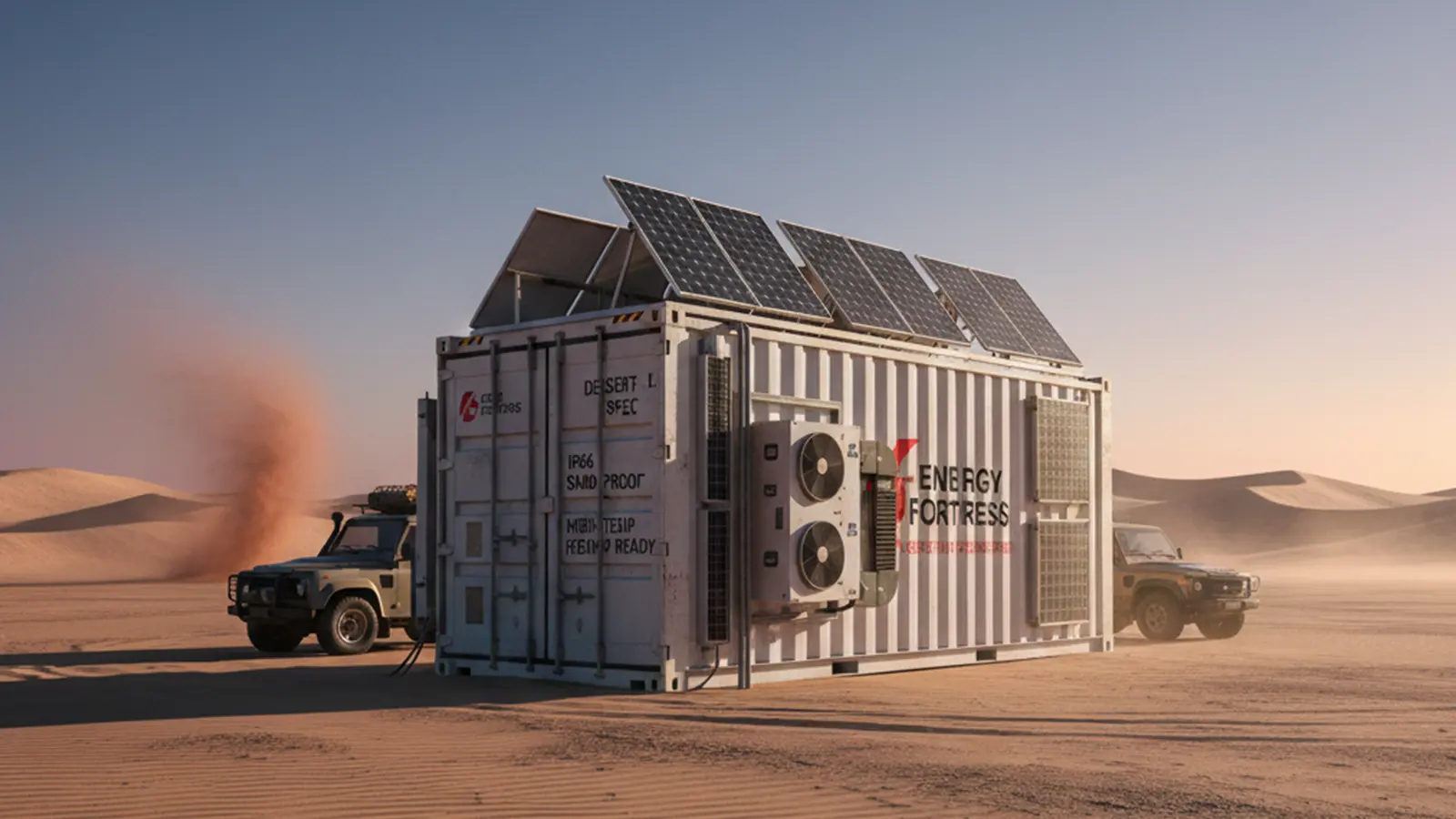
In Africa, the sun is your greatest asset, but the environment is your primary enemy. We had to stop thinking about these as simple “solar boxes” and start engineering what we now call a weatherproof solar container for extreme environments. It’s less of a shed and more of an energy fortress.
Here is why the off-the-shelf stuff fails, and how we fixed it after some painful lessons.
1. The Heat Trap: Why “Ventilation” is a Death Sentence
Most off-the-shelf containers rely on passive ventilation or simple exhaust fans. In a temperate climate, that’s fine. But in Northern Mali—where we spent a grueling three weeks last year fixing a competitor’s failed install—blowing 50°C ambient air into your battery room is institutional suicide for your hardware.
We learned the hard way. Clients trying to shave CAPEX by skipping active cooling end up paying for it 3x over in battery degradation. Heat doesn’t just age batteries; it kills them. Fast.
How we do it differently:
-
The “Thermos” Effect: We line our ISO containers with 100mm high-density mineral wool. You have to stop the radiant heat from the steel skin before it ever reaches the interior.
-
DC-Coupled Cooling: We don’t rely on fragile AC units that need an inverter to wake up. Our heavy-duty DC air conditioners pull straight from the busbar. If the sun is hitting 50°C outside, the batteries stay at a rock-solid 25°C inside.
-
LFP is Non-Negotiable: We exclusively use Lithium Iron Phosphate (LFP). If a supplier tries to sell you NMC for a desert deployment, run away. LFP handles the thermal stress without the “thermal runaway” nightmares.
2. Dust Acts Like a Liquid (Treat it That Way)
In a Sahelian sandstorm, dust doesn’t act like a solid; it behaves like a pressurized liquid. It finds every microscopic gap in a seal. Once inside, it coats PCB boards, creates conductive paths (shorts), and acts as a thermal blanket that fries components.
A true weatherproof solar container for extreme environments needs more than a “tight door.”
The HighJoule Solution: We use a Positive Pressure System. Think of it like a cleanroom. We use fans to keep the internal air pressure slightly higher than the outside. If there’s a tiny gap in a seal, air blows out, meaning dust can’t drift in. Combine this with multi-stage, washable sand-trap filters, and you extend your maintenance intervals from months to years.
3. The “Sun-Rot” and Corrosion Factor
In high-altitude deserts, the UV index is off the charts. We’ve seen standard “outdoor-rated” cable jackets turn brittle and snap like crackers within 14 months. We call it “sun-rot.”
At HighJoule, every external lead is double-jacketed with specialized UV-resistant coatings. Furthermore, if your site is near the coast—think Namibia or the Gulf of Guinea—we upgrade the entire exterior to a C5-M marine-grade coating. Salt fog will eat a standard ISO container for breakfast; you need the same protection used on offshore oil rigs.
4. Security: Because “Remote” Means Vulnerable
Let’s be real—theft is a design constraint. Copper and batteries are high-value targets in remote areas. Our containers are hardened:
-
Internal hinges (so they can’t be ground off).
-
Multi-point locking bars and zero external bolt heads.
-
Satellite-linked monitoring: Even if the local 4G tower goes down, you can sit in Johannesburg or London and get instant alerts if a door is breached or a filter is clogged.
Finally
Investing in a weatherproof solar container for extreme environments isn’t about buying the cheapest “price per watt.” It’s about buying the assurance that your rural clinic’s vaccines stay cold and your mine’s comms stay live.
In the African sun, your power system should be the last thing on your mind. We build them so you can forget they’re even there.
Need a reality check on your current setup? If you are currently dealing with thermal throttling or dust ingress, [reach out to our engineering team]. We’ve likely seen your specific problem before.
Last Updated on 03/09/2026