Europe is moving fast—maybe too fast for its own good. The 2035 ban on new combustion engine cars isn’t just a policy headline; it’s a ticking clock that’s reshaping our industry overnight.
But here’s the reality check we deal with every day at HighJoule: while millions of EVs are hitting the roads, the public charging infrastructure is, frankly, struggling to keep up.
This gap is exactly where pre-configured plug and play solar container systems come into their own. They’re the “heroes” of rapid deployment, promising power in weeks instead of years. However, let me be blunt: if you think buying a container, dropping it on-site, and flipping a switch is enough, you’re headed for a massive headache.
The Reality Check: Europe is the most regulated market on the planet. To survive here, your system needs to be more than just high-performance—it has to be “compliance-armored.”
Why Compliance Isn’t Just Red Tape (It’s Your Business Lifeline)
In the EU, regulations aren’t “suggestions”—they are the ultimate gatekeepers. I’ve personally seen multi-million euro projects stall for six months just because of a single missing certificate. It’s painful to watch.
-
The “Fine Trap”: We all talk about GDPR for websites, but for a charging container? It’s just as brutal. Violating data privacy here can cost you a percentage of global turnover.
-
Unlocking the Money: This is what most operators miss. EU grants—like Germany’s KfW programs—are incredibly specific. If your equipment doesn’t hit every single standard on the list, you can kiss that subsidy goodbye.
-
The Customs Wall: No valid CE Mark? Your container won’t even leave the port. I’ve seen units sit in Rotterdam for weeks, racking up storage fees, because the paperwork was “almost” right.
The “Big Three” Hurdles We Navigate Daily
When we’re on the drawing board at HighJoule, we don’t just focus on kilowatts. We focus on these three deal-breakers:
1. The Battery “Passport” is No Longer Science Fiction
Starting in 2025, the EU Battery Regulation is basically demanding a digital DNA profile for every industrial battery.
-
Traceability: You’ve got to prove where your lithium and cobalt came from. We prefer LFP (Lithium Iron Phosphate) because it’s inherently safer, but you still need the paper trail.
-
Carbon Footprint: You now have to disclose the $CO_2$ emitted during production.
-
Safety (UN 38.3): This isn’t optional. Without this test, shipping companies won’t touch your cargo.
2. The CCS2 Standard: It’s Not Just a Plug
In Europe, CCS2 is the law of the land. But “fitting the plug” is the bare minimum.
-
Interoperability: Your station has to “handshake” with everything from a 2018 VW e-Golf to a brand new Tesla. If the software communication protocol is off by a hair, the car won’t charge.
-
Smart Grid Reality Check: Everyone loves talking about V2G (Vehicle-to-Grid). But let’s be real: true bidirectional charging is a regulatory nightmare in many regions right now. At HighJoule, we tell our clients to focus on Smart Charging first—adjusting the load based on solar availability. It’s better to have a system that works today than a V2G promise that’s stuck in permit-hell.
3. Data Privacy: Keeping it Local (and Legal)
Your pre-configured plug and play solar container system is essentially a giant data collector. It knows who is charging, where they are, and how they pay.
-
Server Location: If that data bounces to a server in a non-compliant country before coming back to Europe, you’re in trouble. We always keep data on EU-based servers.
-
The “Opt-in” Rule: No pre-ticked boxes. The user interface (UI) must be crystal clear about what data is being taken.
Real-World Lessons: The A7 Highway Project
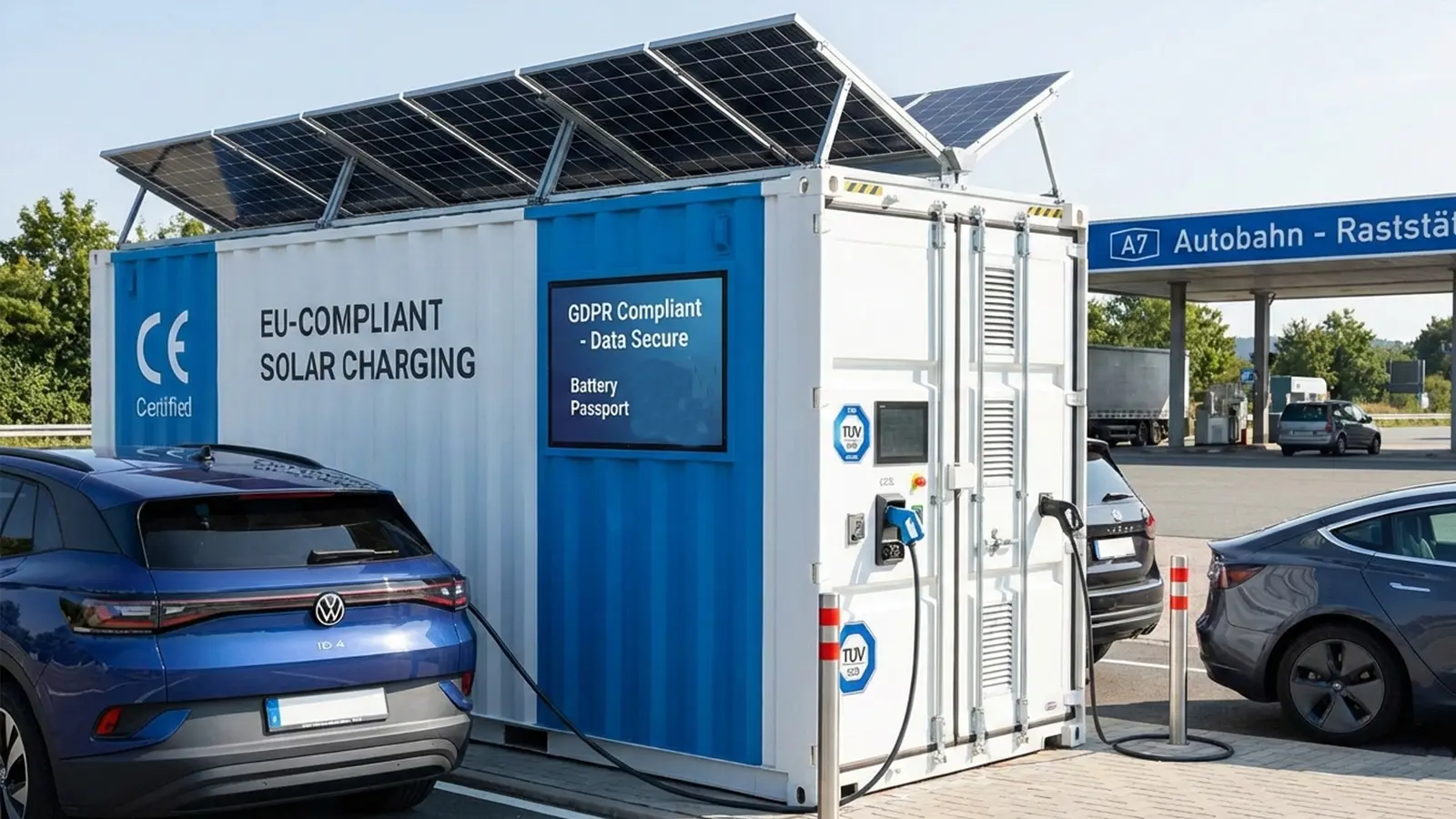
Theory is easy; the field is hard. Take the deployment along the German A7 Autobahn. They dropped 24 solar containers to fix a massive grid congestion problem.
Why did it actually work?
-
Speed: The CCS2 ports let drivers get a meaningful charge in about 15-20 minutes.
-
Certification: They didn’t “self-certify.” They went through TÜV. It was expensive, but it unlocked over €6M in subsidies.
-
Grid Independence: They avoided digging up the Autobahn. Have you ever tried to get a permit to dig under a German highway? It takes years.
Field Checklist: Don’t Sign Without These Answers
If you are evaluating a pre-configured plug and play solar container system, run this list by your vendor:
| Feature | Requirement | Why it matters |
| CE Marking | Full LVD & EMC reports | Prevents customs seizure & legal liability. |
| Weather Proofing | True IP65+ Rating | Europe’s weather ranges from snow to heatwaves. |
| Payment UI | Contactless + Local Language | Mandatory in France; critical for user trust. |
| Battery ID | Pre-2025 Compliance Ready | Ensures your asset isn’t obsolete in 12 months. |
Finally
The European EV market is a gold rush, but it’s one with very strict rules. At HighJoule, we’ve learned that compliance is actually a competitive advantage. When you can show a client a fully compliant, data-secure system, you’re not just selling a box—you’re selling peace of mind.
Ready to deploy? [Contact our engineering team today] to discuss how we can get your site live without the regulatory headaches.
Last Updated on 03/09/2026