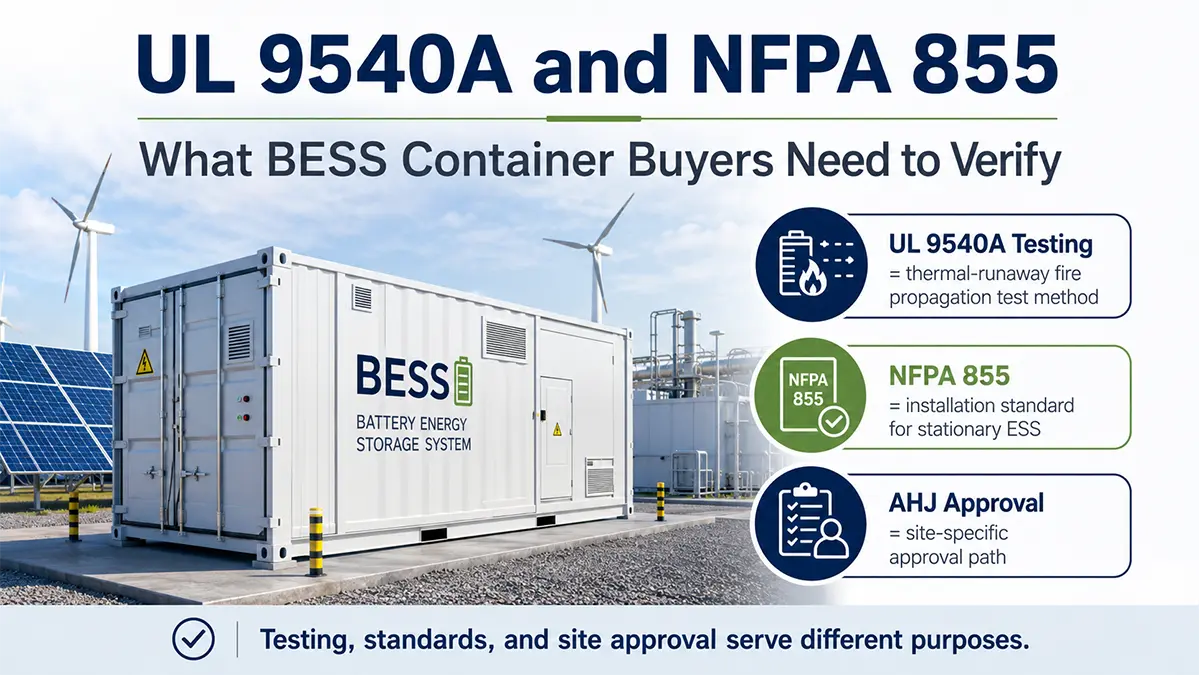
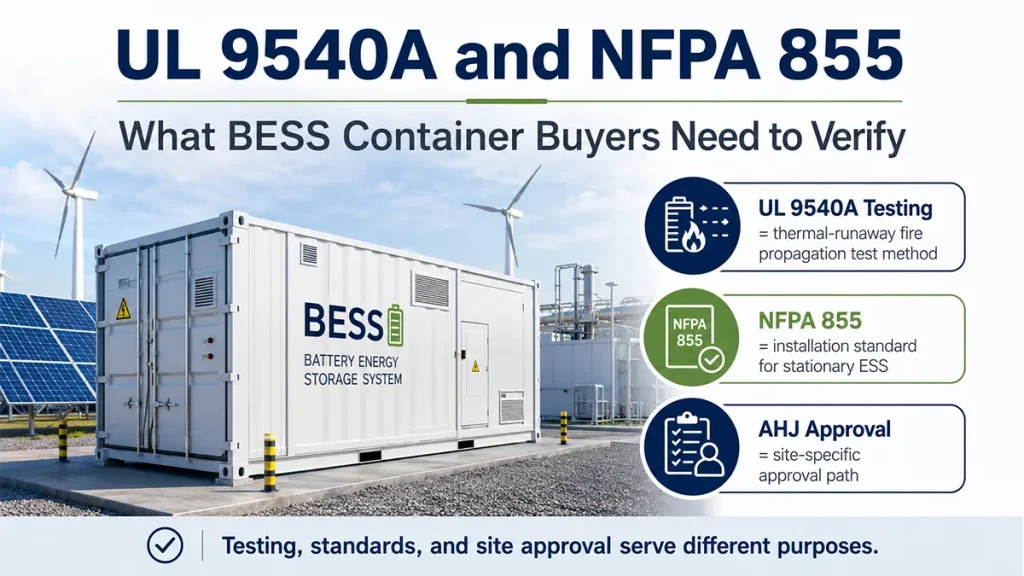
UL 9540A testing and NFPA 855 are both important in North American battery energy storage discussions. However, they answer different questions. UL 9540A is a test method used to evaluate thermal-runaway fire propagation and related hazards. NFPA 855 is an installation standard for stationary energy storage systems. Neither document, by itself, tells a buyer that a quoted container is approved for every site.
For the wider technical context, read our Container BESS Engineering Guide. A buyer should separate the equipment evidence, the site design, the adopted local code, and the approval process before comparing two supplier quotations.
The useful question is not “Do you have UL?” It is “Which exact system configuration was evaluated, what does the evidence cover, and what still needs project-level approval?” For UL 9540A testing, that distinction prevents a common procurement error: treating a cell test, a unit-level fire test, a product listing, and a fire-marshal approval as interchangeable documents.
1: Separate the Evidence Types Before You Compare Suppliers
A container BESS project may involve several document categories. Each can be valid, but each has a limited purpose. A test report describes an evaluated configuration and test method. A product certification or listing addresses a defined product standard. An installation code guides how a stationary ESS is sited and integrated. Transport documents address shipment. A declaration for an EU market has a different legal role again.
| Evidence category | What it can establish | What it does not establish | Buyer should request |
| Product listing / certification | Conformity to the stated product standard and scope | Approval for every building, site layout, or jurisdiction | Certificate, model list, scope, issuing body, expiry or revision status |
| UL 9540A test evidence | Thermal-runaway and fire-propagation behavior for the tested configuration | A universal approval claim for every site | Full report scope, test level, cell/rack/enclosure match, mitigation assumptions |
| NFPA 855 / local code path | Installation questions such as siting, separation, fire protection, and emergency planning where adopted | A product certificate | Code analysis from the EPC or responsible design professional; AHJ requirements |
| International / China / EU documents | Market-specific product and conformity evidence | Automatic equivalence with North American fire-test evidence | Destination-market compliance matrix, declarations, applicable test reports |
| UN 38.3 transport evidence | Battery transport-test documentation | Stationary ESS installation approval | Transport documents and carrier-specific requirements |
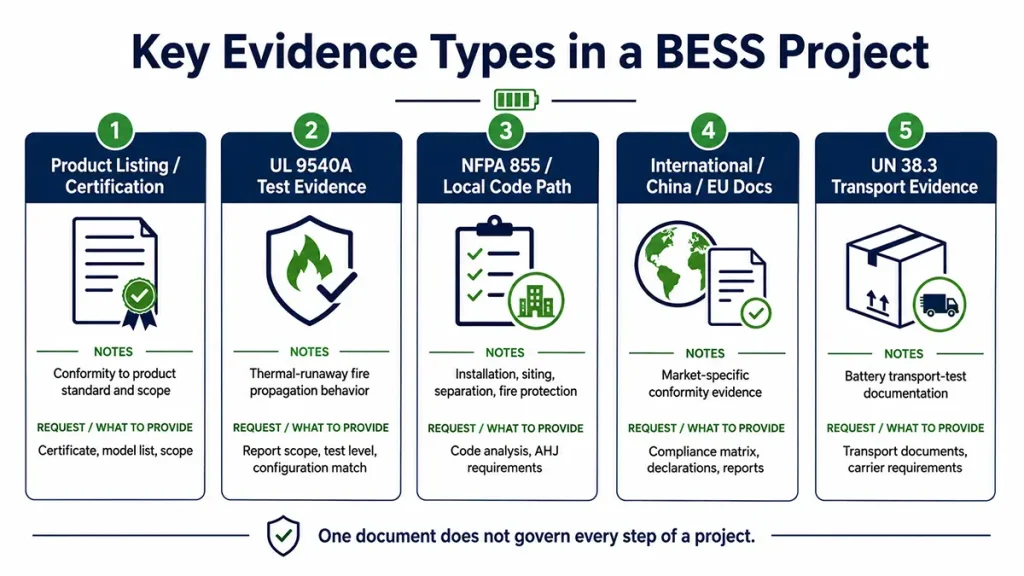
This framework is useful for solar containers because a system may cross several boundaries. It can be manufactured in China, shipped internationally, then installed at a North American mine, a European island resort, or a disaster-relief location. It also gives UL 9540A testing a defined role instead of treating it as a universal approval document. One document does not govern every step of that journey.
2: Read UL 9540A Testing Evidence as Configuration-Specific
UL 9540A testing is a method, not a blanket product certification. It evaluates thermal runaway, fire propagation, and related hazards at one or more levels, such as cell, module, unit, and installation. The report is only as transferable as the similarity between the tested system and the system being offered to the buyer.
UL explains the UL 9540A test method as a way to evaluate thermal-runaway fire propagation in battery energy storage systems. When reviewing a report, start by identifying the tested cell, module arrangement, rack layout, enclosure, ventilation, suppression or mitigation measures, and test level. Then compare those items with the quotation line by line.
The UL 9540A standard listing identifies Edition 6 as active and lists March 13, 2026 as its publication date. UL has indicated an effective date of January 1, 2027 for the sixth edition. During the transition, the edition accepted or required for a project may depend on the applicable code path, AHJ, certification strategy, insurer requirements, and project schedule.
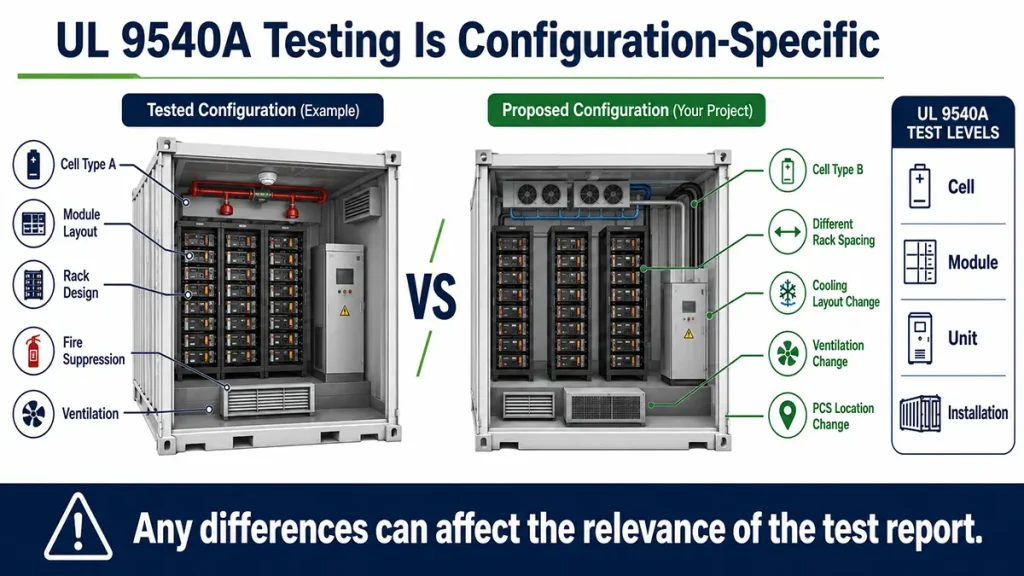
Ask a supplier a simple question: “Is the quoted configuration identical to the tested configuration?” A useful response identifies any differences in cell supplier, battery capacity, rack spacing, container dimensions, cooling layout, venting, fire protection, or PCS placement. A vague statement that the platform is “based on” a tested design is not enough for a high-consequence project.
What UL 9540A Testing Does Not Resolve by Itself
UL 9540A testing does not replace the project drawings, emergency-response planning, utility interface design, maintenance plan, or installation review. It also does not establish that every available battery duration, cell source, ventilation option, or suppression arrangement is covered. A report may be highly relevant to a project and still leave site-specific questions for the design team.
This is why an RFQ should not ask only for a report number. Ask for a configuration comparison. The supplier should identify the report, the tested equipment, the proposed equipment, any differences, and the engineering conclusion for each difference. If the supplier cannot make that comparison clearly, the buyer should treat the evidence as incomplete rather than assume it transfers automatically.
The test result also needs a decision context. A fire-protection engineer may use it differently from an insurer, and an AHJ may request additional information based on the proposed installation. UL 9540A testing is therefore one input to a safety case, not a shortcut around the site-approval process.
3: Understand Where NFPA 855 Enters the Approval Path
NFPA 855:2026 addresses installation of stationary energy storage systems. It belongs in the site-approval conversation, alongside adopted building and fire codes, the project design, and the authority having jurisdiction (AHJ). It is not a product certificate, and it does not replace configuration-specific test evidence.
The NFPA 855 standard-development page is the official starting point for the standard. In practice, the EPC, fire-protection engineer, owner, insurer, and AHJ may each have document requests. Their requirements can vary by jurisdiction, site type, installed capacity, separation distance, occupancy, and local code adoption.
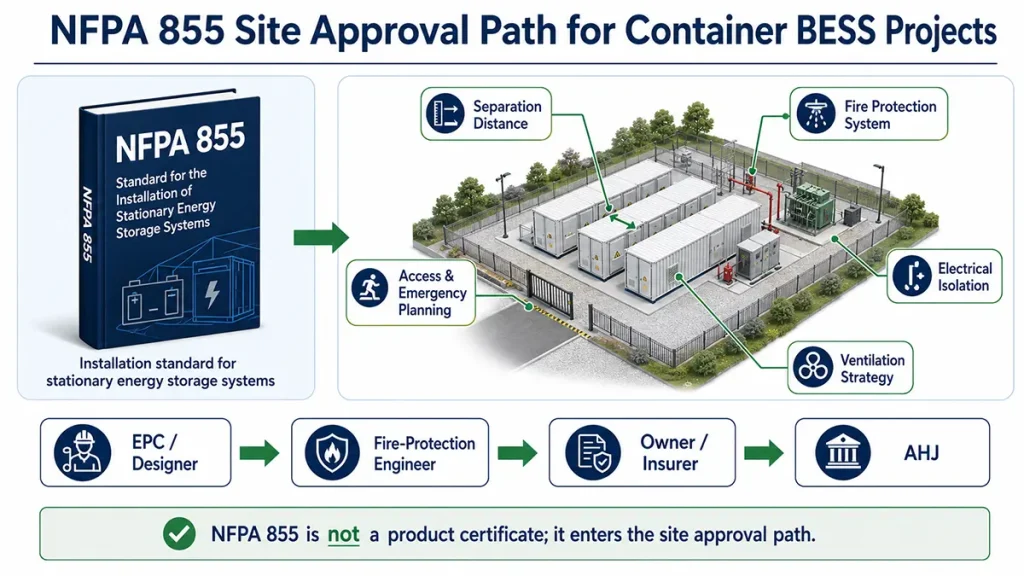
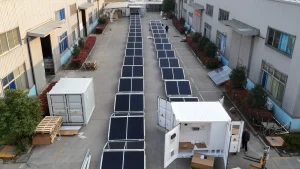
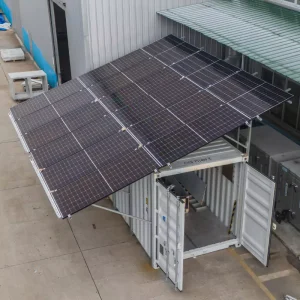
For a solar container, the approval discussion often includes the container location, access for responders, separation from occupied buildings, electrical isolation, ventilation strategy, fire detection, emergency procedures, and the relationship between PV, PCS, battery, and backup generation. A supplier can support that discussion with drawings and test evidence. The project team and AHJ decide whether the installation path is acceptable.
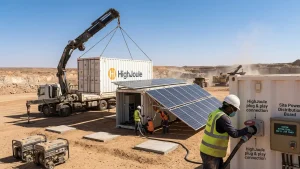
Early coordination matters because container mobility does not necessarily remove stationary-installation questions. A container may arrive as transport equipment, but once it is placed, energized, connected to PV or the grid, and operated at a site, the project team still needs to confirm the installation assumptions that apply there. The answer can differ between a temporary emergency base, a mine, a port, and a permanent commercial facility.
4: Keep Global Compliance Pathways Separate
North American requirements should not be presented as universal requirements. Likewise, a Chinese or international document package should not be presented as a substitute for North American site review. Buyers need a destination-specific matrix that identifies which evidence applies to the battery, BMS, enclosure, PCS, fire-safety equipment, transport, and final installation.
| Standard / regulatory requirement | Scope | Typical context | Request from supplier |
| UL 9540A, 6th Ed. (2026), or edition required by AHJ | Thermal-runaway test method | North American fire-safety review | Report scope and match to quoted configuration |
| NFPA 855:2026 where adopted | Stationary ESS installation | North American project approval | Site code analysis, AHJ and insurer input |
| IEC 62933-5-1:2024 and IEC 62933-5-2:2025, plus applicable parts | Grid-integrated EES safety considerations and electrochemical EES safety requirements | Grid-integrated international projects; EU projects also require an EU-specific review | Applicable parts, test basis, and declared scope |
| Applicable GB/T documents | China-market and project-specific product scope | China / destination-market assessment | Current standards matrix from supplier |
| Applicable EU CE-marking legislation and harmonised standards, where applicable | EU conformity framework | European Union | EU Declaration of Conformity and identified applicable legislation/standards |
| UN 38.3 | Lithium battery transport testing | International shipment | Transport documents and carrier requirements |
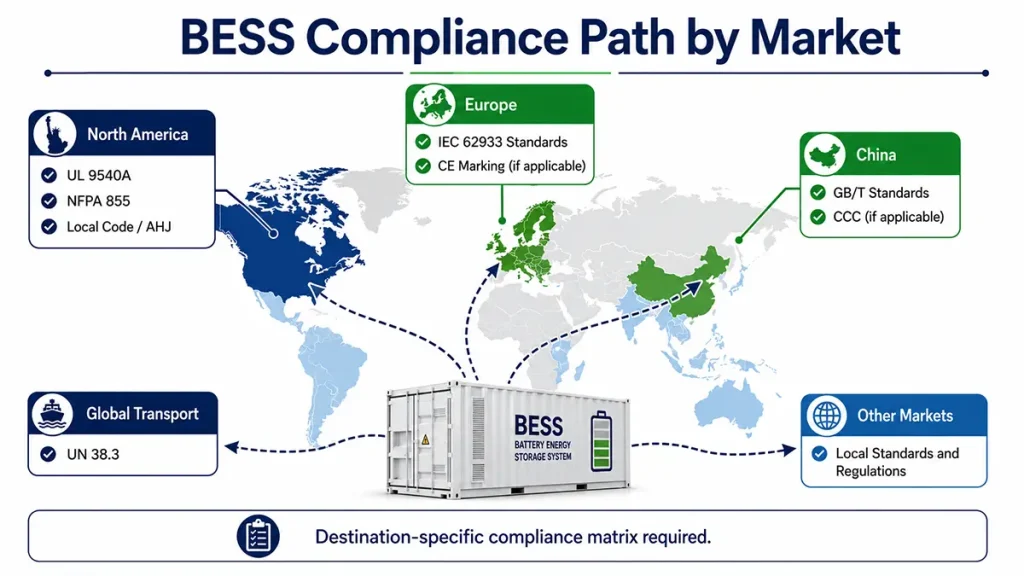
CE marking is not a test standard. UL 9540A is not a blanket certification. IEC is an international standards body, not an EU-only requirement. IEC 62933-5-1 addresses grid-integrated EES safety considerations, while IEC 62933-5-2 addresses electrochemical EES safety requirements. These distinctions matter when a procurement team turns a compliance claim into a contract requirement.
For official international references, see IEC 62933-5-1:2024 and IEC 62933-5-2:2025. Confirm the relevant part and edition with the destination-market engineer before using either in a specification.
For a Shanghai manufacturer working with global buyers, this separation is also a transparency issue. We should provide the actual document pathway for the destination market, rather than framing one North American test method as a universal measure of safety. A buyer in every jurisdiction still needs to confirm local adoption, project scope, and the authority responsible for approval.
5: Put These Seven Questions Into the RFQ
- Which exact configuration does each report cover? Ask for the cell, module, rack, enclosure, ventilation, suppression, PCS, and cooling configuration, not only the product family name.
- Which UL 9540A test level applies? UL 9540A testing at cell, module, unit, and installation levels provides different types of evidence. Ask the supplier to state the tested level and any limits on applying it to the quoted system.
- Which edition applies to this project? Request the applicable edition and the reason it applies. The adopted code, AHJ, permit timing, and insurer requirements can affect the answer.
- What site assumptions sit outside the report? Ask about spacing, ventilation, detection, fire suppression, ambient conditions, maintenance access, and emergency response assumptions.
- What will the EPC and AHJ receive? Request drawings, a document index, equipment data, test-report scope, installation assumptions, and the contact point for technical questions.
- Which international or China documents apply? Request a destination-market compliance matrix. Do not accept a generic list of logos or standard names without model and scope information.
- What happens if the configuration changes? A change in cell, rack, enclosure, or mitigation design can change the relevance of existing evidence. Require a documented review before approving substitutions.
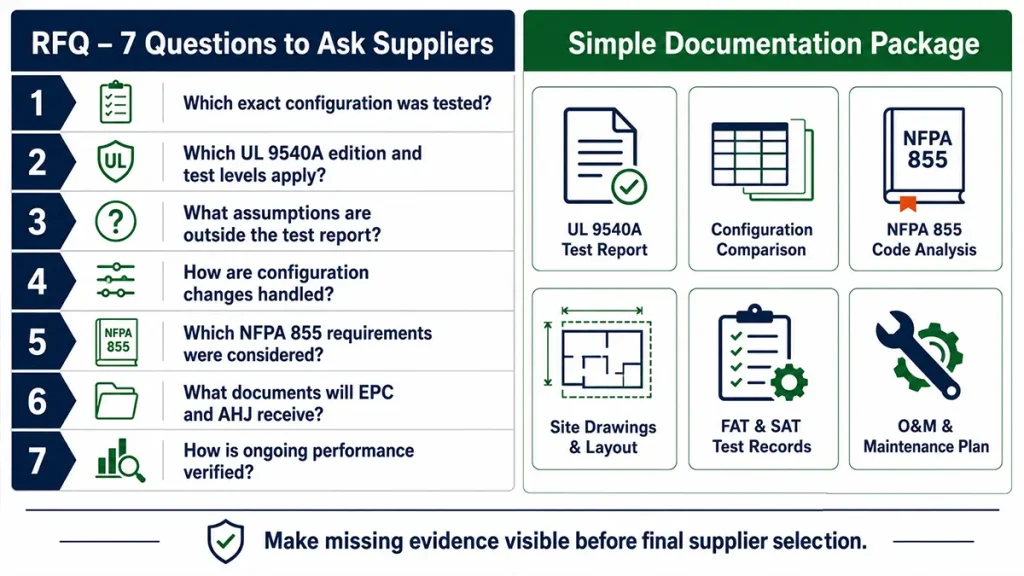
A Simple Documentation Package for Technical Evaluation
Before comparing price, ask each shortlisted supplier for a document index. It should identify the product model, revision, cell and battery configuration, applicable test evidence, scope limitations, installation assumptions, transport documentation, and destination-market declarations. The index does not need to solve the final permit. It makes missing evidence visible while there is still time to resolve it.
The index shall specify the UL 9540A test tier and supporting configuration comparison records. For NFPA 855 compliance, it must clarify the responsible stakeholder tasked with installation code assessment. For cross-border projects, the document list needs to clearly distinguish applicable GB/T, IEC and EU conformity certificates from irrelevant ones. This unified file inventory aligns all stakeholders—procurement, engineering, underwriting and operation teams—with a single source of reference.
Documentation Review for a Container BESS Project
We can help buyers organize a configuration-specific document review before an RFQ is finalized. The review starts with destination country, system size, site type, grid or off-grid operating mode, and any insurer or AHJ requirements already known. It then identifies the evidence categories, open assumptions, and technical questions that need resolution before the project proceeds.
For an integrated equipment reference, see the HJ-FBESS solar container. For emergency-use planning, see our Emergency Energy Solution. We do not treat this review as a substitute for the project’s responsible engineer, fire-protection professional, EPC, insurer, or AHJ.
FAQ
Does a UL 9540A report mean the container is approved everywhere?
No. The report describes the tested configuration and method. The project still needs a site-specific approval path based on adopted codes, AHJ requirements, design, and local conditions.
Is NFPA 855 mandatory for every North American project?
Not automatically. Its relevance depends on local adoption, project conditions, insurer requirements, and AHJ interpretation. Ask the project team to identify the adopted code path early.
Can CE marking replace UL evidence for a U.S. project?
No. CE marking is an EU regulatory conformity framework. It does not replace evidence requested for a North American fire-safety or installation review.
Should a buyer request documents before or after choosing a supplier?
Before final selection. Documentation gaps are easier to resolve during technical evaluation than after a contract locks in the equipment configuration.
Does a smaller container need the same review?
The documentation scope may differ with capacity, installation conditions, and local rules, but the evidence categories remain useful. Buyers should still confirm what configuration was tested, what site assumptions apply, and who will address the local approval path.
Can a supplier use one report for several markets?
A report can support multiple technical discussions, but it does not replace market-specific declarations, transport documents, adopted-code analysis, or AHJ review. The supplier should state the intended use and limits of each document.
Standards and Source Notes
Source note: Official UL, NFPA, IEC, and testing-laboratory sources are linked beside the statements they support. These references explain test methods and standards pathways; they are not evidence that every HighJoule configuration holds a particular certification or approval.
Disclaimer: Standards, editions, adopted codes, and AHJ practice can change. This article reflects sources checked in July 2026 and provides procurement guidance only. Confirm the applicable requirements with the responsible project engineer, fire-protection professional, EPC, insurer, carrier, and AHJ before contracting or installing a system.
Last Updated on 07/30/2026