When the grid fails at a hospital, a water treatment plant, or an emergency coordination center, the clock starts immediately. For these facilities, backup emergency power systems are not a convenience. They are the difference between continuity and catastrophe. The standard answer for decades has been the diesel generator. It works — it is proven technology. Diesel does, however, have structural weaknesses that disasters specifically exploit. Fuel supply chains break. Floodwaters submerge tank farms. Resupply convoys cannot reach cut-off sites.
We are the engineering team behind the HJ-FBESS series of containerized solar and battery storage systems, designed and manufactured in Shanghai and deployed across extreme environments from the Tibetan Plateau to the Sahara. A 20-foot backup emergency power system can deploy in under two hours. It produces zero on-site emissions during solar-battery operation and can operate for extended periods on solar recharge — without any fuel deliveries. If you are an emergency planner evaluating alternatives to diesel-only backup, or a procurement officer writing an RFQ for resilient power infrastructure, this guide covers what you need to know.
We also cover when a solar container is not the right choice. If you need millisecond-level switchover for data center UPS applications, that is a different category of equipment. For facilities that need sustained, fuel-independent, multi-day outage resilience, these backup emergency power systems are worth a serious look.
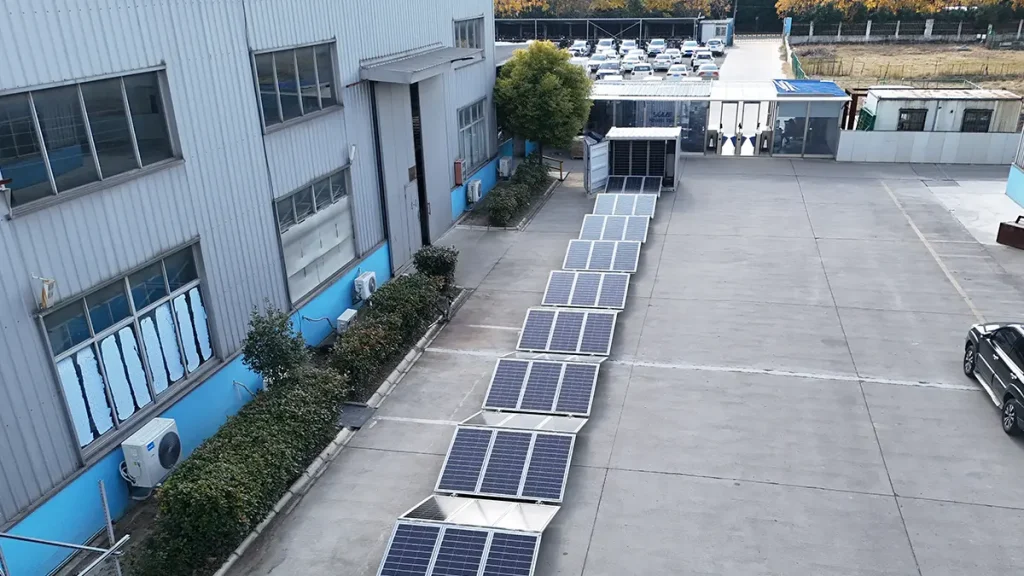
Critical Infrastructure Power Failure: The Real Landscape
When a hospital loses power, surgeons do not finish the operation “when the grid comes back.” They finish it on backup power, or they do not finish it at all. The same urgency applies to water treatment plants, telecom hubs, and emergency coordination centers. These are critical infrastructure facilities — and when their power fails, the consequences cascade quickly. Four scenarios dominate the landscape for backup emergency power deployment.
Disaster-Driven Grid Collapse
Hurricanes, earthquakes, floods, and wildfires destroy transmission lines and substations. After Hurricane Maria in 2017, parts of Puerto Rico went without grid power for 11 months. For hospitals, water pumps, and emergency shelters in the affected zone, waiting for grid repair is not an option. Containerized emergency power systems must bridge weeks or months — not hours. This is exactly where diesel fuel logistics become the single point of failure. If the roads are gone, the fuel truck is not coming.
Grid Instability and Rolling Blackouts
In regions with fragile grids, planned and unplanned outages are regular occurrences. This includes parts of Sub-Saharan Africa, South Asia, and even sections of California and Texas during extreme weather. Telecom towers, cold-chain storage, and water treatment plants in these areas need power that does not depend on grid availability or fuel delivery schedules. Solar battery backup systems that generate their own energy from sunlight transform a recurring operational crisis into a manageable logistics exercise.
Conflict and Humanitarian Crisis
In conflict zones or refugee camp settings, fuel convoys are targets. Diesel generator noise also broadcasts your position. Silent, fuel-independent backup power systems that arrive pre-assembled in a shipping container change the logistics equation entirely. One delivery, greatly reduced need for resupply, and long-duration operation on solar recharge.
Remote Critical Facilities
Mountain-top telecom relays, desert pumping stations, and Arctic research outposts share a common problem: the cost and risk of fuel delivery dominate their operational budgets. A single fuel resupply to a remote site can cost more than the generator itself over a few years. For these facilities, solar-plus-storage is not an alternative to diesel. It becomes the primary power system, with diesel relegated to deep-winter backup only. This is one of the fastest-growing applications for backup emergency power systems.
Beyond Diesel: Containerized Solar and Battery Storage for Emergency Power
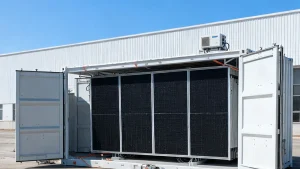
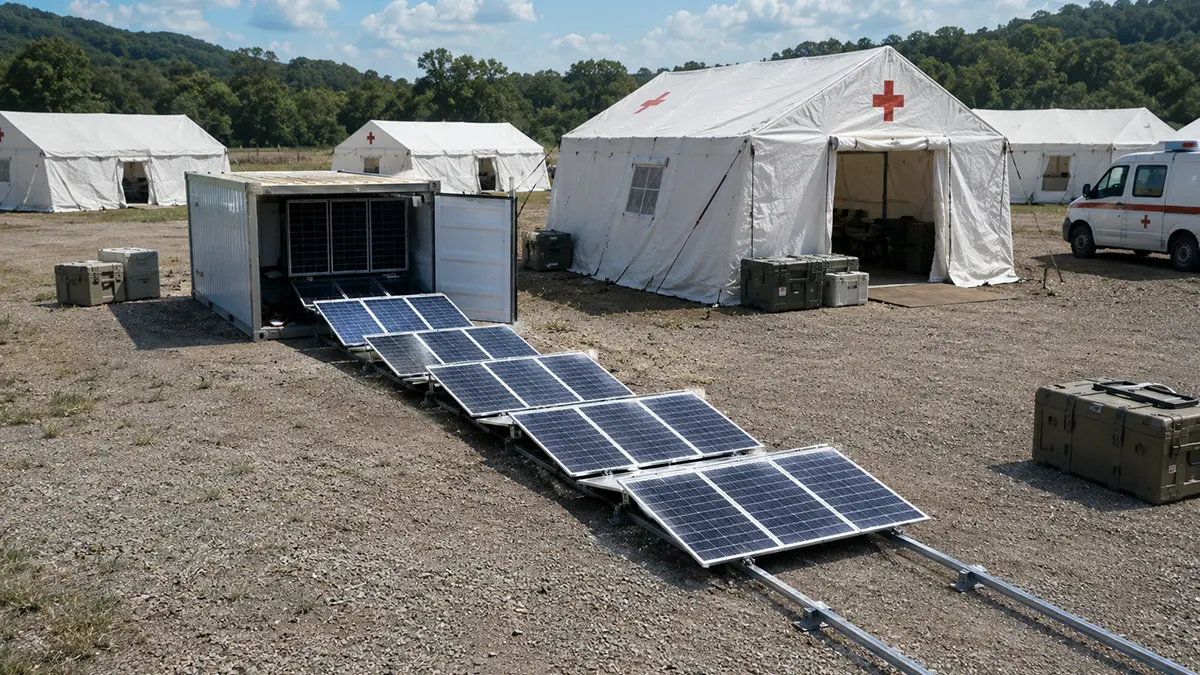
Imagine a standard 20-foot ISO shipping container. All core equipment for a standalone power station — solar panels, lithium iron phosphate (LFP) batteries, inverters, and smart energy management system (EMS) — is pre-wired and fully tested inside the unit at our factory before global shipment. Upon delivery, simply unfold the foldable PV array and connect load cables. The whole unit can be fully operational within two hours, eliminating on-site construction work, complicated fuel supply logistics, and the need for professional commissioning crews.
Why This Architecture Fits Emergency Scenarios
Diesel generators convert about 35% of fuel energy into electricity. The rest becomes heat and noise. A DC-coupled solar container system takes DC power from the photovoltaic panels, stores it directly in DC batteries, and inverts to AC only at the point of use. Round-trip efficiency runs 88 to 95%, compared to the diesel generator at roughly 35%. For a field hospital drawing 50 kW continuously, the diesel would burn roughly 400 liters of fuel per day. The solar container, once deployed, consumes no diesel fuel.
For emergency planners, three attributes of backup emergency power systems matter most. First, fuel independence — after deployment, the system generates its own power with no supply convoy, no fuel storage on site, and no risk of fuel theft or contamination. Second, dispatchability — the battery bank provides instant power on demand with no ramp-up time and no warm-up cycle. Medical equipment and communications gear cannot tolerate the voltage sag of a generator starting under load; the battery bank avoids this entirely. Third, silent operation. In tactical, humanitarian, or hospital settings, the absence of generator noise is an operational asset, not just a comfort feature.
Where Diesel Still Wins
Diesel generators remain the right choice for short-duration outages at sites with reliable fuel supply. They also work well when the peak power draw exceeds what a practical battery bank can deliver, such as multi-megawatt industrial loads. A solar container is not a UPS — it does not provide millisecond-level failover. For those applications, we recommend a layered approach: a UPS for instantaneous bridging, combined with a solar container handling the sustained load after the first 30 seconds. This architecture works well for hospital and data center backup emergency power applications.
Four Emergency Deployment Scenarios
Over the past five years, our engineering team has configured systems for a wide range of emergency applications. Four patterns keep recurring — from government agencies, humanitarian organizations, and infrastructure operators. Each pairs a real facility type with a specific configuration sized for that application.
Field Hospital and Medical Facility
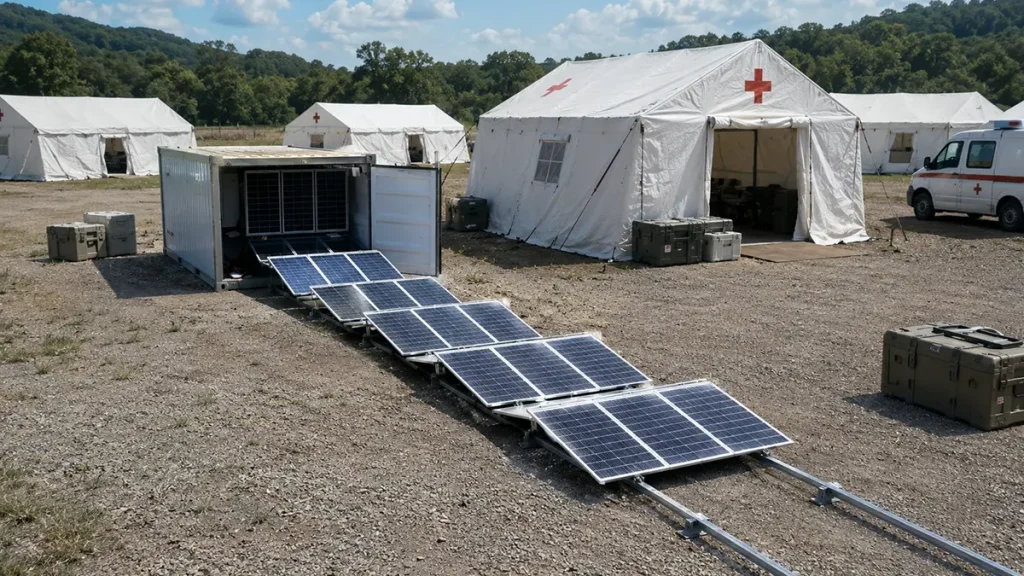
A field hospital needs clean, stable power for ventilators, monitors, refrigeration, lighting, and communications — typically 30 to 80 kW continuous. Our HJ-20G-P057E241 container delivers 57 kWp of solar, 241 kWh of storage, and a 50 kW inverter. It deploys from truck to full operation in about two hours and provides enough storage for overnight operation with daytime solar recharge. For larger facilities, two containers can be paralleled. The system produces pure sine-wave output with stable frequency, compatible with sensitive medical electronics without additional power conditioning.
Water Treatment and Pumping Station
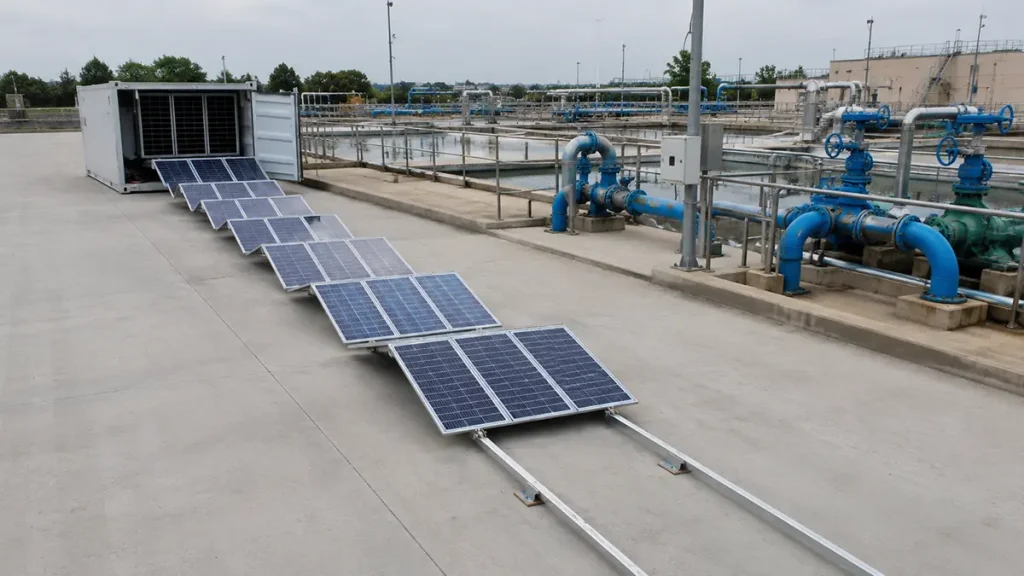
Water infrastructure is energy-intensive. Pump motors draw high starting currents, and treatment processes must run 24 hours a day. A single containerized backup emergency power system can maintain chlorination, UV disinfection, and distribution pumps at a small-to-medium treatment plant through an extended outage. Because water systems are often in flood-prone locations, the container IP55-rated enclosure and elevated internal equipment mounting provide flood protection that a pad-mounted diesel generator typically lacks.
Emergency Communications Hub
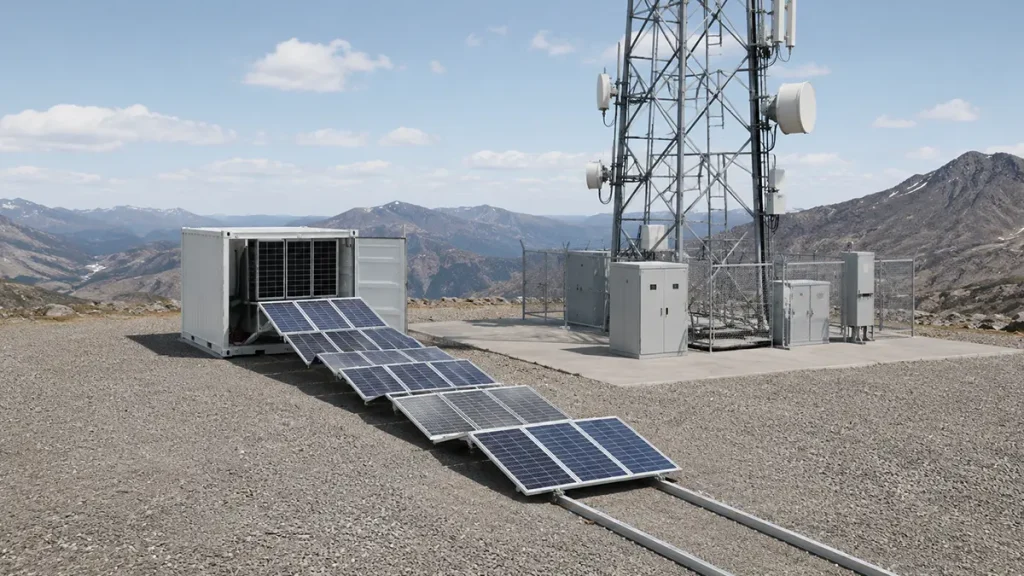
When cellular towers and radio relays lose power, first responders lose coordination. Our HJ-10G-P024E040 is a compact 10-foot container with 24 kWp of solar, 40 kWh of storage, and a 20 kW inverter. It can power a communications hub for extended periods. The integrated satellite and 4G/5G connectivity also provides data backhaul, so the power container and the communications infrastructure arrive as a single integrated unit. For emergency management agencies, this collapses two separate logistics problems into one: one container, one truck, done.
Humanitarian Base Camp
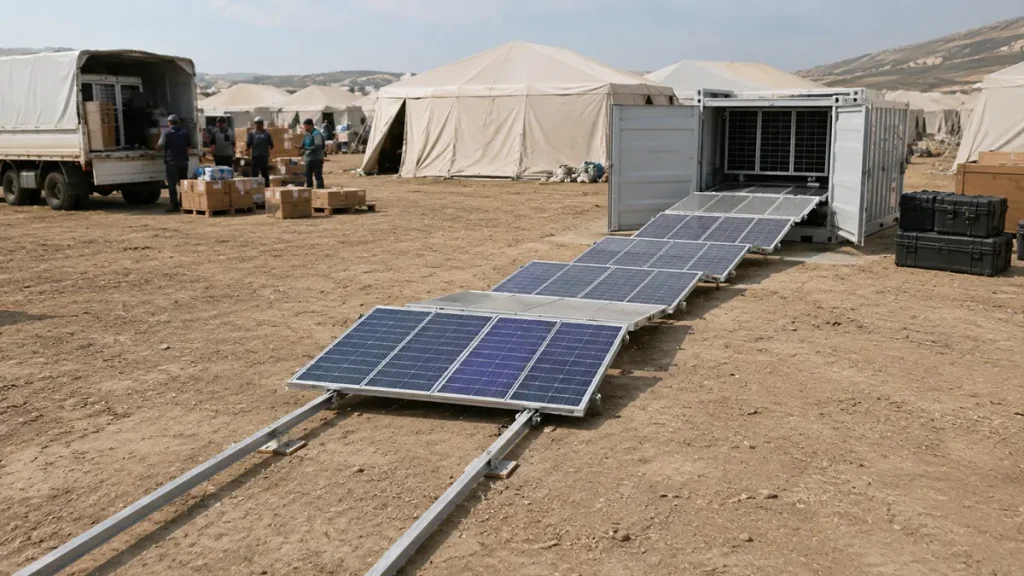
Large-scale humanitarian operations — refugee camps, forward operating bases, and multi-agency coordination centers — need power at the 100 to 200 kW scale. Our HJ-40H-P136E482 is a 40-foot high-cube container with 136 kWp of solar, 482 kWh of storage, and dual 60 kW inverters. It provides enough energy for lighting, water pumping, kitchen operations, medical triage, and administrative functions for 500 to 1,000 people. The system arrives as a single ISO-container shipment and deploys in about four hours with a small crew and a forklift. No concrete foundation, no fuel storage depot required.
Rapid Deployment: Anatomy of a Two-Hour Power-Up
When we say a backup emergency power system deploys in two hours, here is what that timeline looks like on the ground, drawn from our field deployments across three continents.
| Phase | Time | What Happens | Personnel |
| Transport arrival | 0:00 | ISO-container truck arrives. Forklift offloads to prepared ground (compacted earth, gravel, or asphalt). | 1 operator + 1 spotter |
| Positioning | 0:10 | Container leveled with integrated jack stands. Twist-locks released. Access doors opened. | 2 technicians |
| Array deployment | 0:20 | Foldable PV wings extended via hydraulic assist — no crane needed. Panels unfold in 10-15 minutes per wing. | 2 technicians |
| Load connection | 0:50 | Main AC output cable connected to facility distribution panel. Cable pre-installed in container on a reel. | 1 electrician |
| System activation | 1:10 | EMS self-diagnostic runs (30-90 seconds). Battery SOC verified. Inverter syncs. Load transferred. | 1 technician |
| Full operation | 1:30-2:00 | System delivering rated power. Remote monitoring established via satellite or cellular. GPS geo-fence active. | 0 (automated) |
The key to this speed is factory pre-fabrication. Every component — panels, batteries, inverters, cabling, and the EMS controller — is assembled, wired, and tested at our Shanghai facility before shipping. The on-site crew does not build anything; they unfold, plug in, and press start. A traditional solar installation requires panels, mounting structures, inverters, and batteries to arrive as separate components and be integrated on site over days or weeks. Factory pre-fabrication is what makes these systems genuinely rapid-deployment assets, not just solar equipment in a box.
Multi-Hazard Resilience: Built for the Worst Conditions
Emergency backup power systems face conditions that commercial solar installations never see. The steel ISO container frame provides the first layer of protection, tested for stacking, lifting, and corner-impact loads that far exceed any weather event. Inside, we design for the specific failure modes that disasters create.
Flood and Water Ingress
After hurricanes and tsunamis, the ground is saturated and often submerged. Diesel generators at ground level flood — and that is the end of backup power. Our container systems use IP55-rated enclosures with cable entries positioned at mid-height, not at the base, so floodwater cannot enter through the wiring ports. Internal equipment mounts on raised platforms, and the battery compartment is sealed separately from the inverter compartment. For flood-prone deployments, we offer an optional elevated base frame that adds 600 mm of clearance above ground level.
Extreme Temperatures
Our systems operate from -30°C to 50°C ambient. The LFP battery cells use a liquid cooling system that maintains optimal internal temperature regardless of external conditions. In desert deployments, the cooling loop keeps cells below 35°C even when ambient air hits 50°C. In Arctic conditions, integrated battery heaters draw less than 3% of system capacity to maintain cells above 0°C before charging begins. A diesel generator in the same conditions would require a block heater, a battery warmer, and winterized fuel — and may still fail to start at -30°C.
Transport and Handling
ISO CSC-certified containers are the global standard for shipping. They fit on standard trucks, rail cars, and container ships without special permits or escort vehicles. The same backup emergency power system that powers a field hospital can be shipped from Shanghai to Mombasa, trucked inland to Juba, and deployed — all within the container that protected it during transit. We have delivered systems to landlocked African sites where the container traveled by ship, train, and truck across three countries. The containerized design is engineered to withstand multi-modal transport without components loosening in transit.
Hybrid Strategy: Solar and Battery Working With Existing Diesel
In most real-world deployments, the question is not “solar or diesel.” It is “how do solar and diesel work together?” Most critical facilities already own diesel generators. The right strategy keeps them — but relegates the diesel to a last-resort role.
Here is how the hybrid architecture works in practice. The solar container serves as the primary power source. During the day, the PV panels charge the batteries and supply the load simultaneously. At night, the batteries discharge to cover the load. Throughout all of this, the diesel generator stays off — not idling, not consuming fuel, not accumulating runtime hours. The diesel only starts when two conditions are both met: battery state-of-charge must drop below 20%, and the next 24-hour solar forecast, based on satellite weather data integrated into the EMS, predicts insufficient recharge. At that point, the generator starts, runs at optimal load for maximum fuel efficiency, and shuts down once batteries reach 50% or solar production resumes.
This strategy typically reduces diesel consumption by 70% to 90%. For emergency planners, the bigger win is fuel autonomy. A facility with a 5,000-liter diesel tank burning 400 liters per day normally has about 12 days of autonomy. With a solar container handling the primary load, that same tank only needs to cover the rare occasions when both solar and battery are insufficient. Autonomy extends to 60 days or more. For a hospital in a disaster zone where resupply is uncertain, that extension is operationally decisive. This is the core value of backup emergency power systems that incorporate solar generation: they turn a finite fuel reserve into a genuine strategic buffer rather than a countdown clock.
Standards and Certifications: Multi-Jurisdiction Compliance
For backup emergency power systems deployed internationally, certification requirements span multiple jurisdictions. A system acceptable in one country may be non-compliant in another. Our approach is to test and certify to the relevant standard in each jurisdiction, so the same system model can deploy in North America, Europe, Africa, or Asia without re-engineering.
Fire Safety and Thermal Runaway Protection
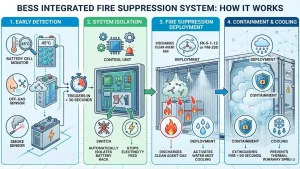
For the North American market, our systems are tested in accordance with UL 9540A, the standard method for evaluating thermal runaway fire propagation at the cell, module, unit, and installation levels. NFPA 855 governs the installation of energy storage systems and specifies separation distances, ventilation, and fire suppression requirements. Our containers include integrated aerosol fire suppression systems that activate automatically at temperature thresholds well below thermal runaway onset.
For the Chinese domestic market, our battery systems comply with GB/T 36276 for lithium-ion battery safety in power storage, and GB/T 34131 for battery management systems. These are independent, rigorous frameworks developed for China’s own energy storage industry, which deployed over 40 GW of new storage in 2025 alone. A system tested to both UL 9540A and GB/T 36276 has passed two of the world’s most demanding fire safety evaluation regimes. A credential worth specifying in any international RFQ for backup emergency power systems.
International Transport and Electrical Safety
For global shipping, all our battery modules carry UN 38.3 certification, covering altitude simulation, thermal cycling, vibration, shock, external short circuit, impact, overcharge, and forced discharge testing. The complete systems are CE-marked for the European market and carry CCC certification for China. For international tenders, we recommend referencing IEC 62933, the standard for electrical energy storage systems, as the neutral international benchmark in your RFQ.
Case Evidence: Backup Emergency Power Systems in the Field
Xinjiang Desert — Extreme Heat and Unattended Operation
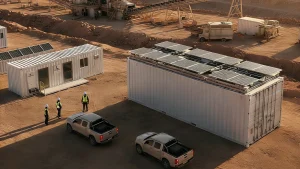
In the Xinjiang desert, a 54 kWp bifacial plus 36 kWp array with 241 kWh of storage powers a remote industrial facility. Summer ambient temperatures exceed 50°C, yet the liquid cooling system maintains battery cell temperature below 35°C at all times. The system operates unattended for months between inspection visits, with the EMS transmitting performance data, fault alerts, and battery state-of-health reports via satellite link to our engineering team in Shanghai. In three years of operation, the system has required no on-site maintenance beyond scheduled panel cleaning.
Humanitarian and Emergency Deployment Capability
While specific humanitarian deployment details are often confidential, our containerized backup emergency power systems are designed from the ground up for rapid-response scenarios. The standard configuration includes an emergency load connection panel, pre-terminated output cables with universal connectors, and a deployment manual written for non-specialist crews. In a real emergency, the operator may be a logistics officer who has never seen the system before; the manual covers that scenario. We also maintain a rotating inventory of pre-configured emergency-response containers at our Shanghai factory, available for immediate shipment to humanitarian agencies and government buyers.
HJ-FBESS Systems for Emergency and Backup Power
The following table shows our standard configurations most commonly specified for emergency backup applications. All models share the DC-coupled architecture, foldable N-Type TOPCon PV array, liquid-cooled LFP batteries, and integrated EMS.
| Model | Container | PV Capacity | Storage | Inverter | Deploy Time | Application |
| HJ-10G-P024E040 | 10 ft | 24 kWp | 40 kWh | 20 kW | ~1 hour | Comms hub, field office, clinic |
| HJ-20G-P057E241 | 20 ft | 57 kWp | 241 kWh | 50 kW + 100 kW PCS | ~2 hours | Field hospital, water station |
| HJ-20H-P068E241 | 20 ft HC | 68 kWp | 241 kWh | 60 kW + 100 kW PCS | ~2 hours | Large field hospital, multi-service |
| HJ-40H-P136E482 | 40 ft HC | 136 kWp | 482 kWh | 60 kW×2 + 100 kW PCS×2 | ~4 hours | Base camp, multi-building microgrid |
All models are ISO/CSC certified for global shipping, factory pre-assembled and tested, and available with an optional diesel generator integration kit for hybrid operation.
For detailed specifications and current availability, visit our HJ-FBESS Solar Container.
Decision Framework: Which Configuration Fits Your Scenario
The right configuration depends less on budget than on two things: what kind of disaster you are planning for, and what kind of facility you need to keep running. The matrix below maps the most common combinations. Start with your primary threat scenario, then match it to the facility type and deployment speed you need.
| If Your Scenario Is… | Your Facility Is… | Consider | Why |
| Hurricane / Flood Zone | Hospital or clinic | HJ-20G-P057E241 + elevated base | 50 kW covers essential medical load. Elevated frame protects against flood ingress. |
| Earthquake Zone | Emergency coordination center | HJ-10G-P024E040 + satcom | Compact 10 ft unit deploys from a single truck. Integrated satcom provides data backhaul. |
| Extended Grid Outage | Water treatment plant | HJ-20H-P068E241 + diesel hybrid | 68 kWp gives margin for pump starting surges. Hybrid kit covers extended cloudy periods. |
| Humanitarian Base Camp | Multi-agency operations hub | HJ-40H-P136E482 | 136 kWp and 482 kWh support 500-1,000 people across multiple functions. |
| Remote Telecom Tower | Unmanned relay station | HJ-10G-P024E040 | 40 kWh covers 24/7 low-power load with solar recharge. No scheduled maintenance visits needed. |
| Forward Operating Base | Tactical command post | HJ-20G-P057E241 + GPS geo-fence | Silent operation. GPS geo-fence alerts if the container is moved without authorization. |
If your scenario does not match any of these profiles, our engineering team provides custom configuration assessments at no charge. Send your load profile, site conditions, and deployment timeline requirements. We return a specific system recommendation within three business days.
To discuss your specific emergency power needs, visit our emergency energy solutions.
Frequently Asked Questions
How fast can an emergency power system deploy?
A 10-foot container deploys in about one hour. A 20-foot container takes roughly two hours. A 40-foot high-cube unit deploys in about four hours. These times assume a level surface, a forklift or reach stacker for offloading, and two technicians following the deployment checklist. For comparison, a traditional ground-mount solar installation of similar capacity takes two to four weeks of on-site construction.
What happens in extreme weather — can the system handle a hurricane?
The container is a steel ISO structure rated for stacking and corner-impact loads far exceeding any wind event. The foldable PV wings have a stowed transport configuration that is fully enclosed within the container envelope. In a hurricane warning, the wings retract in under 10 minutes. Once the storm passes, they redeploy just as fast.
How does the system integrate with our existing diesel generator?
The container includes a generator input port with automatic transfer logic. Under normal operation, the solar and battery system handles the full load. If battery state-of-charge drops below 20% and the solar forecast is unfavorable, the EMS starts the diesel generator and runs it at optimal load for best fuel efficiency. It shuts the generator down once batteries reach 50% or solar production resumes. The diesel never idles — it runs at efficient load or not at all.
Can these systems ship internationally? How long does delivery take?
Yes. All systems are built in ISO/CSC-certified containers with UN 38.3 battery transport certification. Sea freight from Shanghai takes 25 to 45 days to most ports. Air freight is available for emergencies at roughly 4 to 7 days. For humanitarian agencies, we keep a limited inventory of pre-configured containers ready for immediate shipment.
What maintenance do these systems require in the field?
Routine maintenance consists of quarterly panel cleaning — more often in dusty environments — plus an annual inspection of connectors, cable glands, and battery cell voltages. The liquid cooling system is a sealed loop requiring no field maintenance. The EMS performs continuous self-diagnostics and transmits alerts by satellite or cellular if any parameter drifts outside specification. The system can operate unattended for extended periods; our Xinjiang desert installation has gone over 12 months between inspection visits with no intervention required.
What certifications should I specify in an RFQ for international deployment?
Specify UL 9540A (fire safety) and NFPA 855 (installation standards) for North America, and CE marking aligned with IEC 62933 for Europe. Every battery module requires UN 38.3 certification for international transportation. Chinese domestic or China-standard projects need GB/T 36276 for battery safety and GB/T 34131 for BMS. We suggest incorporating UL, IEC, GB/T and UN 38.3 standards together in international RFQs to meet all regional compliance rules.
For additional guidance, the U.S. Cybersecurity and Infrastructure Security Agency (CISA) publishes a Resilient Power Best Practices for Critical Facilities and Sites guide covering certification and planning for emergency power at critical facilities.
Can the system be expanded if our power needs grow?
Yes. The DC-coupled architecture is inherently modular. Additional PV capacity can be connected through the auxiliary DC input, and additional battery cabinets can be paralleled. Multiple containers can also operate together through the EMS, which coordinates load sharing and charge-discharge cycles across all units. A site that starts with one HJ-20G-P057E241 can add a second unit later to create a 114 kWp, 482 kWh microgrid — without replacing any existing equipment.
What is the lifespan of the battery system in emergency-use scenarios?
Our LFP battery cells are rated for 6,000-plus cycles at 80% depth of discharge, which translates to approximately 15 years of daily cycling. In emergency backup applications, where the system may cycle less frequently, calendar life becomes the limiting factor — typically 15 to 20 years. For comparison, a diesel generator in standby service has a design life of 20 to 30 years but requires engine overhauls at 10,000 to 15,000 hours and annual load-bank testing to prevent wet-stacking and fuel system degradation.
About the Engineering Team
Shanghai HighJoule Energy Technologies Ltd. has designed and manufactured distributed energy systems since 2005. Our engineering team includes specialists in power electronics, battery thermal management, structural engineering for ISO container integration, and remote microgrid control systems. We hold certifications across UL, CE, CCC, and GB/T frameworks, and we participated in drafting the Technical Specification for Energy Management Systems of Commercial and Industrial Energy Storage. Our containerized backup emergency power systems have been deployed on the Tibetan Plateau at 4,500 meters, in the Xinjiang desert at 50°C, and across sites in Europe, Africa, and Southeast Asia.
Disclaimer
The deployment timelines, fuel savings estimates, and performance data cited in this article are based on HighJoule’s own field measurements and customer-reported data from specific deployments. Actual results vary with site conditions, solar irradiance, load profile, and ambient temperature. Certification and standards information reflects requirements as of July 2026; buyers should verify current requirements with their local authority having jurisdiction. Fuel savings percentages assume a specific diesel generator model and load profile. Your actual savings depend on your existing generator’s efficiency, fuel type, and operating pattern. External references, including the CISA Resilient Power Best Practices guide, are provided for informational purposes and do not constitute endorsement by those organizations. This article is for educational purposes and does not constitute engineering or procurement advice for any specific facility.
Last Updated on 07/30/2026