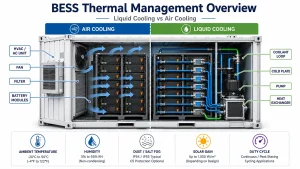
An engineering, procurement, and construction (EPC) team should not treat a containerized battery energy storage system (BESS) as a supplier-selection exercise alone. The decisive question is who owns each interface as the proposed configuration moves through design, site integration, delivery, commissioning, and handover. Without that ownership, an undocumented change can become a project risk after award.
For an early procurement baseline, the U.S. Department of Energy’s BESS procurement checklist is useful because it frames storage procurement as a set of decision tasks rather than a brochure comparison. For a containerized project, the EPC needs an additional control: each answer must be tied to the proposed configuration, a responsible party, and a project gate.
This article gives EPC managers, owners’ engineers, and procurement leads a practical way to evaluate containerized BESS offers before award. It is not a substitute for the responsible engineer’s design, local authority review, utility requirements, fire-protection design, transport review, or contract advice.

Start with the decision the EPC actually owns
The EPC is rarely deciding whether a battery container is “good” in the abstract. It is deciding whether a defined system can be integrated into a defined project. That distinction prevents a common failure: selecting an attractive factory package, then discovering that the civil design, grid interface, control architecture, emergency plan, logistics route, or acceptance process was never part of the same decision.
Before comparing suppliers, lock a one-page project basis of evaluation. At minimum, it should state the operating use case, required power and usable energy at the project boundary, ambient and altitude envelope, grid or off-grid operating mode, site footprint, delivery route constraints, target energization date, and the named parties who own design approval, installation, commissioning, and operation. If any of these are unknown, record them as open assumptions—not as facts hidden in a supplier quote.
The five gates before an EPC can call two offers comparable
The following five-gate matrix is designed for use in bid reviews, clarification logs, and award recommendations. It separates a supplier’s equipment offer from the project interfaces that can change its meaning. A “pass” means the stated evidence has been reviewed for the proposed configuration; it does not mean that a permit, utility connection, insurance placement, shipment release, or site acceptance is automatic.
| Gate | Question the EPC must close | Evidence to request | Typical owner | What not to assume | Award disposition and control |
|---|---|---|---|---|---|
| 1. Project basis | Does the offered power, energy, duty cycle, ambient envelope, and operating mode match the approved project basis? | Controlled datasheet revision, single-line diagram, duty-cycle assumptions, derating information, and exclusion list. | Owner’s engineer / EPC design lead | A nominal kWh figure does not prove usable energy at the project duty cycle or site temperature. | Hold if a material basis is unknown. Otherwise issue an award exhibit listing assumptions, risk impact, escalation owner, and closure date. |
| 2. Site and interfaces | Can the container, transformer, switchgear, communications, access routes, and civil works be installed as designed? | General arrangement, foundation and point-load inputs, cable/interface schedule, access and maintenance envelope, and communications architecture. | EPC civil, electrical, and controls leads | A factory-built container does not remove foundation, trench, earthing, protection-coordination, or SCADA responsibilities. | Conditional award only when each unresolved interface has a named owner, contractual exhibit or interface register, and closure deadline. |
| 3. Evidence and compliance path | Which project requirements apply, and what evidence is relevant to the exact configuration and destination? | Requirement-to-evidence matrix, report scope, declarations, controlled bill of materials, and exceptions. | EPC compliance lead with supplier and local specialists | A standard reference, test report, CE marking, EU Declaration of Conformity, or transport document is not universal evidence of site approval. | Hold where an essential requirement has no evidence path or no responsible local approval route. Record the escalation owner. |
| 4. Delivery and configuration control | Will the shipped system remain the reviewed system, and are logistics responsibilities explicit? | Configuration baseline, approved-substitution process, packing and handling requirements, transport classification inputs, document schedule, the selected Incoterms® 2020 rule and named place, transport responsibilities, risk-transfer point, and project-specific shipment-release requirements. | Supplier project manager / EPC procurement and logistics | Factory acceptance testing (FAT) is not shipment release, carrier acceptance, import clearance, or site acceptance. | Award only with a change-control clause, document schedule, and a delivery-release authority stated in the contract. |
| 5. Commissioning and handover | What is tested at factory and site, who witnesses it, and what remains open at handover? | FAT protocol, site acceptance testing (SAT) protocol, cause-and-effect matrix, punch-list process, training plan, warranty-start definition, and document index. | EPC commissioning manager with owner and supplier | A completed FAT does not demonstrate site communications, local protection settings, utility approval, or operator readiness. | Conditional award only with agreed FAT/SAT exhibits, handover criteria, a punch-list escalation path, and closure deadlines. |
Use a responsibility matrix alongside the technical matrix
The five gates identify what must be resolved. This RACI matrix identifies who drives the resolution. “Accountable” is the party that accepts the outcome for that project decision; it is not a claim that one party can approve decisions reserved for a utility, AHJ, insurer, or carrier.
| Decision or deliverable | Responsible | Accountable | Consulted | Informed |
|---|---|---|---|---|
| Project operating basis, site data, and acceptance criteria | EPC design lead / owner’s engineer | Owner / project developer | Supplier, operator, utility where applicable | Commissioning and procurement teams |
| Proposed equipment configuration and controlled technical documents | Supplier engineering team | Supplier project manager | EPC design lead, owner’s engineer | Procurement and commissioning teams |
| Civil, electrical, controls, and communications interfaces | EPC discipline leads | EPC project manager | Supplier, owner, local engineers, utility where applicable | Commissioning team |
| Destination compliance, permitting, emergency-response, and insurance inputs | Named project specialists | Owner / project developer | EPC, supplier, AHJ, insurer, fire-protection professional as applicable | Construction and operations teams |
| Shipment release and logistics documentation | Supplier logistics lead | Party expressly named in the contract or shipment-release procedure | EPC procurement, buyer, carrier, freight forwarder, and the party responsible under the agreed Incoterms® 2020 rule | Site and commissioning teams |
| FAT execution and factory-scope closure | Supplier engineering and quality teams | Supplier project manager | EPC commissioning lead, owner’s engineer, and witness parties named in the FAT procedure | Procurement and site teams |
| SAT, site integration, and punch-list coordination | EPC commissioning team | EPC project manager | Supplier, owner’s engineer, operator, utility, or AHJ where their separate actions apply | Procurement and maintenance teams |
| Provisional and final operational acceptance | EPC and supplier within their agreed scopes | Owner under the contract acceptance provisions | Owner’s engineer, operator, and project parties named in the acceptance procedure | Insurer, carrier, and maintenance team as applicable |
Use the matrix in the award meeting. If a decision has no accountable project party, or if the same party is being asked to supply, self-verify, and approve an interface without an agreed review path, keep it open rather than treating it as resolved.
Gate 1: make the offer traceable to the project basis
Require every bidder to identify the exact revision of the commercial offer, technical schedule, general arrangement, and single-line diagram that form its baseline. Ask the supplier to distinguish guaranteed values from indicative values, operating assumptions, and exclusions. The point is not to demand one universal data sheet. It is to make changes visible before award.
For example, a quoted energy value may depend on state-of-charge limits, end-of-life assumptions, auxiliary consumption, ambient conditions, or a defined discharge duration. An EPC should place those conditions next to the number being compared. The same applies to power: a converter rating, a grid-support mode, and an off-grid capability are different project questions.
Gate 2: test interfaces before you negotiate price
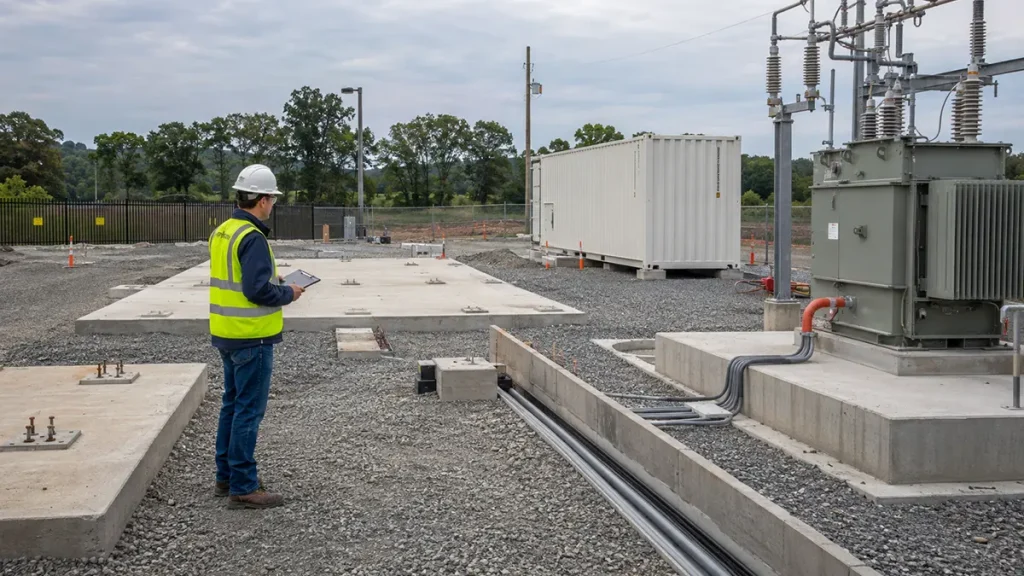
Many late-stage cost changes are interfaces that were left outside the equipment quote. Review the container location, lifting and service clearances, foundation loads, drainage, cable routes, auxiliary power, earthing, transformer arrangement, protection philosophy, communications ownership, and emergency access as one interface register. Link each line to a drawing or a named open item.
For U.S. interconnection work, IEEE 1547-2018, including applicable amendments and the utility’s project-specific requirements, may be part of the applicable interface path. It does not replace the utility study, protection settings, commissioning requirements, or approval process. Outside that context, use the applicable grid code and the responsible local engineering path instead.
A useful EPC question is: “What has to be true outside the container before this function can be demonstrated?” That question exposes dependencies on site communications, transformer settings, protection relays, generator controls, PV inverters, utility witness testing, and operator access.
Gate 3: ask for an evidence path, not a certificate collage
Standards, tests, and declarations serve different purposes. The EPC should map each project requirement to the evidence requested, the configuration it covers, its stated conditions, and any remaining project action. This is especially important where a product family, battery cell, rack arrangement, thermal system, enclosure layout, or destination market may differ from the evidence scope.
For North American stationary energy-storage projects, buyers may encounter UL 9540, UL 9540A, adopted code provisions, utility requirements, insurer requests, and authority having jurisdiction (AHJ) review. These are not interchangeable. UL describes UL 9540A as a test method for evaluating thermal-runaway fire propagation and related hazards. A relevant configuration may be tested in accordance with that method; it is not accurate to describe UL 9540A as a product certification. The project team must confirm what applies locally and how the submitted evidence relates to the proposed installation.
Use the same discipline for transport, structural-container, electrical, and market-access documentation. A container safety approval, for example, addresses a different question from electrical safety, dangerous-goods classification, or site fire review.
Gate 4: control the configuration from award through delivery
The award recommendation should identify the configuration lock: the controlled equipment schedule, battery and control architecture, major subassemblies, design drawings, and evidence set reviewed at award. It should also define how a proposed substitution is submitted, assessed, accepted or rejected, and recorded.
Without this, an apparently minor change in cells, rack arrangement, cooling equipment, enclosure features, firmware, or electrical equipment can detach the delivered system from the assumptions used for layout, evidence review, FAT, and site planning. The solution is not to prohibit every change. It is to make the impact review contractual and visible.
The delivery gate should separately name shipment documentation, dangerous-goods responsibilities, packing and handling limits, route constraints, insurance interfaces, inspection points, and who may release the equipment for shipment. These are commercial and logistics controls; they are not proof of commissioning completion.
Gate 5: define acceptance as a chain of evidence
Acceptance should be divided into factory proof, delivery condition, installation verification, functional commissioning, and owner handover. Our containerized BESS technical specification checklist provides the corresponding supplier-response matrix for configuration, evidence, deviations, FAT/SAT points, and open-item ownership.
At FAT, verify the agreed factory scope and record the test conditions, results, exceptions, and witness status. At SAT, demonstrate the site-specific scope after installation: interfaces, communications, alarms, shutdown logic, operating modes, and the agreed document set. The U.S. Department of Energy’s construction and commissioning guidance similarly treats commissioning as an implementation activity with defined project coordination, rather than a checkbox at the end of delivery.
Keep one open-item register through every stage. Each item needs a description, impact, responsible owner, due date, closure evidence, and explicit decision on whether it blocks shipment, energization, provisional handover, or final acceptance.

A short EPC award checklist
- Confirm the project basis and identify every unvalidated assumption.
- Compare offers against the same controlled technical schedule, not supplier-specific headings.
- Map each requirement to configuration-specific evidence and an owner for remaining project actions.
- Review civil, electrical, controls, logistics, emergency-response, and commissioning interfaces before award.
- Lock the reviewed configuration and require documented impact review for substitutions.
- Separate FAT, shipment release, SAT, site acceptance, utility approval, AHJ review, and insurer decisions in the responsibility matrix.
- Make the open-item register part of the award and handover process, not an informal email list.
When an EPC should pause rather than award
Pause when two offers cannot be compared on a common operating basis; when a key requirement has no stated evidence path; when an interface has no owner; when an assumed approval is being treated as obtained; or when the supplier will not state the proposed configuration and exclusions in a controlled revision. A cheaper offer is not comparable if the project team must discover these gaps after the equipment is committed.
Headquartered in Shanghai, HighJoule manufactures containerized solar and energy storage systems through its production facilities in Jiangsu Province. Our role is to provide configuration information, factory evidence within the agreed scope, and technical input for the project team. The EPC, owner, local engineers, utility, AHJ, insurer, carrier, and other responsible parties retain decisions within their own scopes.
If you are preparing a bid comparison or award recommendation, send the project basis, site country, operating mode, required power and energy, target delivery window, and the open interfaces. We can help structure a configuration-and-evidence response for the proposed system.
Request an EPC Interface Review
Last Updated on 08/04/2026