An off-grid solar container system generates and stores all the electricity a site needs, without any connection to a utility grid. For a cabin or small home, this means rooftop panels, a battery bank, and an inverter — a setup you can buy as a kit for $15,000 to $50,000. For a mining camp, field hospital, or remote military base, however, the equation changes completely. Here, you are not buying a kit. In fact, you are deploying a power plant — and a pre-integrated off-grid solar container system delivers it in weeks, not months, with zero on-site electrical work.
This guide covers the full spectrum of off-grid solar container systems — from the components that make these systems work to the containerized form factors that are redefining what “off-grid” means at industrial scale. Specifically, you will find a model selection table spanning 8ft to 40ft containers, three real-world deployment cases with performance data, a side-by-side comparison of container systems versus traditional field-built installations, and a step-by-step sizing methodology. In short, if you are evaluating power options for a remote operation, this is your reference document.
The short answer: if your off-grid site needs more than 15 kW of continuous power, a containerized system deploys faster, costs less over its lifetime, and carries certifications that field-built systems rarely match. However, if your needs are smaller — a single cabin or RV — a conventional off-grid kit is the right tool for the job. This guide covers that path as well.
What Is an Off-Grid Solar Container System — and Why Containers Change the Equation
At its simplest, any off-grid solar container system has four core jobs: capture sunlight, convert it to usable AC power, store excess energy for nights and cloudy days, and manage the flow between these functions. A standard residential off-grid setup does this with rooftop panels, a hybrid inverter, and a lithium battery bank. In addition, most systems include a backup generator for extended low-sun periods.
The traditional path to building a larger off-grid system follows a predictable sequence. First, a site survey. Then engineering design, followed by component procurement from multiple vendors, shipping to a remote location, hiring certified electricians for field wiring and commissioning, and finally troubleshooting the inevitable integration issues. This process typically takes 12 to 16 weeks from decision to operation — and that is under good conditions. In remote mining regions of Western Australia, the Andes, or Central Africa, logistics and skilled labor shortages routinely push timelines past six months.
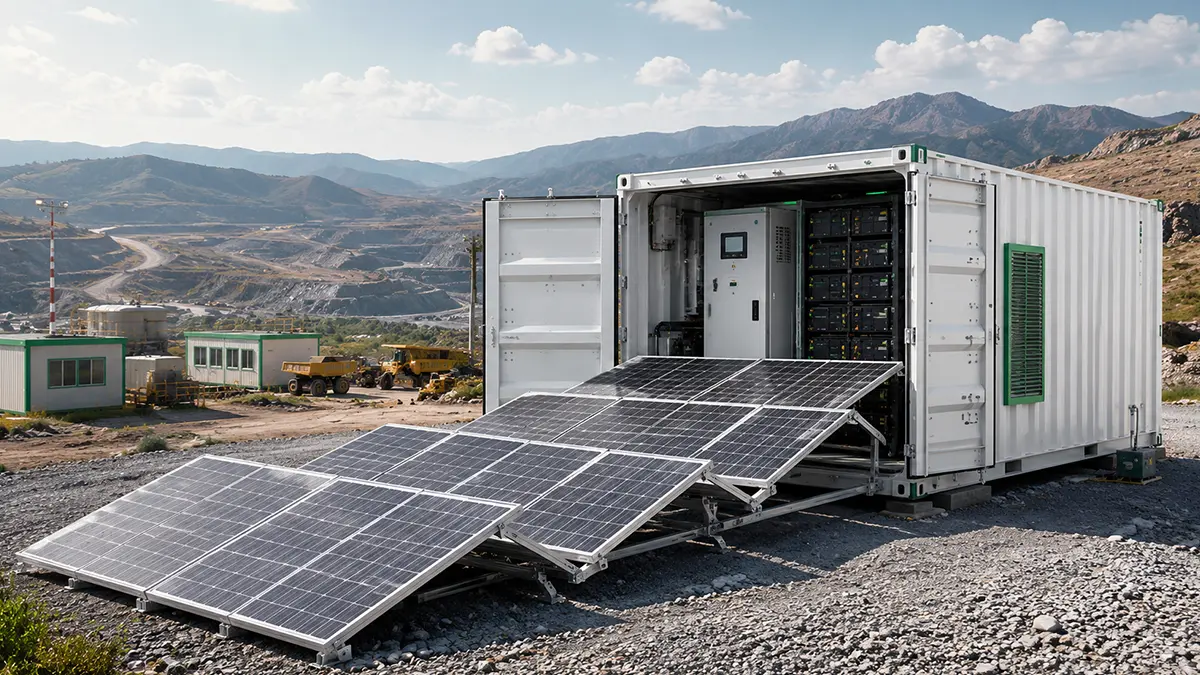
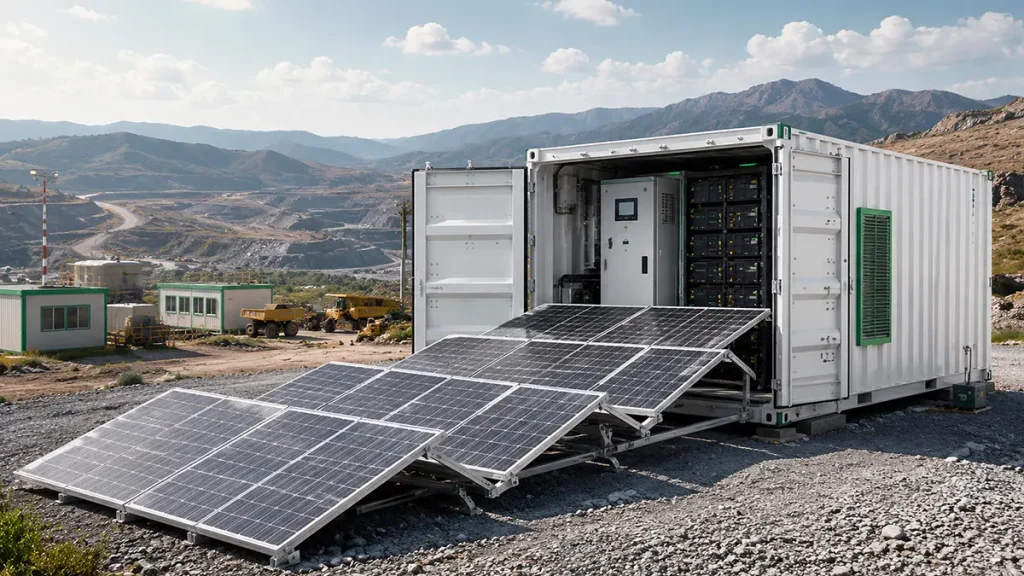
A solar container off-grid solar container system, by contrast, collapses that timeline by moving the integration work into a factory. Specifically, solar panels, battery racks, inverters, charge controllers, fire suppression, thermal management, and the energy management system are all pre-assembled, pre-wired, and pre-tested inside a standard ISO shipping container before it leaves the factory. At the site, you place the container on compacted ground or a simple foundation, connect the external AC cable, and the system is operational. Typically, this takes 2 to 3 weeks from arrival — and for smaller units, as little as 30 minutes.
This shift is not a minor efficiency gain. Rather, it is a structural difference in how off-grid power is delivered. It eliminates the single largest risk in remote power projects: the unpredictable integration phase where components from different manufacturers meet field wiring for the first time. Instead, every connection, every setting, and every protection parameter is verified under factory conditions before the container ships. As a result, you get a system that works on day one — not after weeks of troubleshooting.
What Is Inside a Solar Container: Components and Industrial-Grade Advantages
Core Components
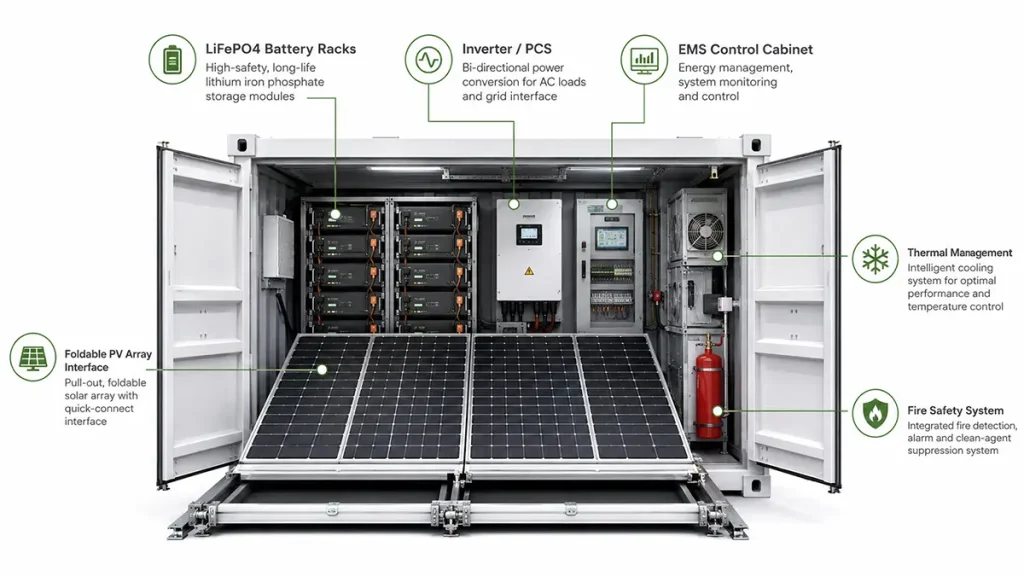
At the core, every solar container integrates five core subsystems into a single ISO-standard enclosure. Still, understanding what each does — and how containerization improves it — is the foundation for evaluating any off-grid solar container system.
- Photovoltaic Array. In contrast, the solar panels that capture sunlight. Furthermore, in HighJoule container off-grid solar container systems, these are N-Type TOPCon modules with 22.5%+ conversion efficiency and a temperature coefficient of -0.29%/°C. That coefficient matters in practice: at 45°C ambient — common in desert mining operations — a TOPCon panel produces 4-6% more energy than a conventional PERC panel. Moreover, the panels are mounted on an automated foldable frame that deploys from the container in under 30 minutes. No manual panel mounting. No roof penetrations. No separate mounting structure to engineer.
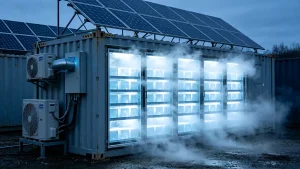
- Specifically, battery Energy Storage. Also, liquid-cooled LiFePO4 (lithium iron phosphate) cells, rated at 314Ah to 350Ah per cell, organized in modular racks. LiFePO4 chemistry beats NMC (nickel manganese cobalt) for off-grid applications on two counts. First, it offers 6,000 to 10,000 cycles to 80% capacity retention. Second, it provides superior thermal stability with no risk of thermal runaway propagation. The liquid cooling system maintains cell temperature uniformity within ±2°C across the entire battery pack — a precision that air-cooled systems cannot match. As a result, the system achieves 20% more operational life compared to passively cooled alternatives.
- Accordingly, power Conversion System (PCS). A bidirectional inverter that converts DC power from the PV array and batteries into AC power for loads, with 98.5% conversion efficiency. The PCS supports black start capability, meaning it can form a grid autonomously without relying on an external power source. This feature is critical for remote sites where there is truly no grid to synchronize with.
- Energy Management System (EMS). The operational brain of the container. The EMS forecasts PV generation based on weather data, schedules battery charge and discharge cycles to optimize economic returns or fuel savings, and manages peak shaving to avoid overload. It also provides remote monitoring via satellite and cellular connectivity. For a mining operator in Mali or a relief agency in Sudan, this means the system can be monitored and controlled from a headquarters on another continent. Consequently, on-site visits drop from weekly to quarterly.
- However, safety and Thermal Management. Multi-dimensional gas sensors detect hydrogen (H₂), carbon monoxide (CO), and volatile organic compounds (VOCs) 15 to 30 minutes before smoke generation or thermal runaway could occur. Roof-mounted explosion vent panels meet NFPA 855 pressure relief standards. The entire system carries UL 9540A certification for fire safety — a test protocol that most field-built off-grid installations never undergo. In short, a off-grid solar container system ships with safety verification built in, not added later.
Industrial-Grade Technical Advantages
Three design decisions separate containerized off-grid systems from conventional field-built installations.
DC-Coupled Architecture. In a DC-coupled off-grid solar container system, power flows from PV panels to battery to inverter in a single conversion step (DC to AC), achieving 88-95% round-trip efficiency. By contrast, AC-coupled systems — common in residential and retrofit installations — require two conversions (DC-AC-DC-AC), losing 1-2% at each stage. Over a 20-year project life, that efficiency gap compounds into tens of thousands of kilowatt-hours of lost energy. Furthermore, DC coupling reduces component count: fewer inverters, fewer failure points, simpler troubleshooting.
Liquid Cooling. Air-cooled battery systems depend on ambient air temperature and airflow. In a sealed container in the Sahara or the Australian outback, air cooling becomes a liability — the “cooling” air is itself 45-50°C. Liquid cooling, on the other hand, circulates refrigerant through cold plates in direct contact with battery cells, maintaining ±2°C uniformity regardless of external conditions. The practical result: full rated power output at 50°C ambient, and 20%+ longer service life compared to air-cooled BESS operating in the same environment.
Fire Safety Integration. A field-built off-grid system typically relies on the battery manufacturer’s built-in BMS protections and whatever fire suppression the site operator chooses to add. A containerized off-grid solar container system, however, integrates multi-gas early warning, active liquid cooling as a first line of thermal defense, NFPA 855-compliant explosion venting, and UL 9540A-certified fire testing into a single engineered package. The key difference: the container is tested as a complete system, not assembled from individually certified components. For insurers and fire authorities, this distinction matters enormously.
Container Models: What Each Off-Grid Solar Container System Powers
All models are factory pre-integrated, ISO/CSC standard for global shipping, and arrive pre-wired and pre-tested. Consequently, table includes power output, storage capacity, and typical deployment time.
| Model | Container | PV Capacity | Storage | Inverter | Deploy Time | Typical Application |
| HJ-08G-P018E030 | 8 ft | 18 kWp | 30 kWh | 15 kW | ~30 min (2-4 workers) | Remote command post, small communications hub, security outpost |
| HJ-10G-P024E040 | 10 ft | 24 kWp | 40 kWh | 20 kW | ~30 min (2-4 workers) | Field office, water pumping station, small telecom tower |
| HJ-20G-P057E241 | 20 ft | 57 kWp | 241 kWh | 50 kW + 100 kW PCS | ~2 hours (4-6 workers) | Field hospital, multi-building camp, water treatment plant |
| HJ-20H-P068E241 | 20 ft HC | 68 kWp | 241 kWh | 60 kW + 100 kW PCS | ~2 hours (4-6 workers) | Large field hospital, disaster response coordination center |
| HJ-40G-P114E482 | 40 ft | 114 kWp | 482 kWh | 50 kW×2 + 100 kW PCS×2 | ~4 hours (6 workers) | Multi-building microgrid, remote village, large mining camp |
| HJ-40H-P136E482 | 40 ft HC | 136 kWp | 482 kWh | 60 kW×2 + 100 kW PCS×2 | ~4 hours (6 workers) | Large-scale humanitarian base, full mining operation power |
Internal link: See full specifications, certifications, and detailed technical drawings on the HJ-FBESS Solar Container product page.
Where Off-Grid Solar Container Systems Outperform Every Alternative
Mining and Remote Industry
Diesel generators remain the default power source for remote mining operations, but the economics have shifted decisively. Delivered diesel costs in remote locations — after transport, security, storage, and spill containment — range from $0.35 to over $0.80 per kWh. A solar container system, in contrast, produces electricity at a levelized cost of energy (LCOE) below $0.10 per kWh when amortized over its 15-20 year design life. The fuel savings alone typically recover the capital investment within 2 to 4 years. Moreover, this is before accounting for the avoided cost of fuel convoy logistics, generator maintenance, and production downtime during fuel shortages.
Beyond cost, there is a personnel problem that mining operators know well. Recruiting and retaining certified electricians willing to live at a remote mine site costs $150,000 to $300,000 per year in premium wages, housing, and rotation logistics. A pre-integrated container, on the other hand, requires minimal on-site electrical work — connect the external AC cable and the system is live. In practice, the skill requirement shifts from “hire an electrician” to “train a site operator.” As a result, labor costs drop dramatically while system reliability actually improves.
Emergency and Disaster Relief
When a hurricane, earthquake, or conflict knocks out grid power, the clock starts. Field hospitals need power within hours, not weeks. Likewise, water purification and communications equipment cannot wait for a procurement cycle.
Solar containers address this with a capability that no field-built alternative can match: they ship pre-charged from the factory. Once on-site, you unfold the PV array, connect the load cable, and the system delivers rated power. Specifically, the foldable PV mechanism eliminates the single most time-consuming step in solar deployment — mounting individual panels on racks or roofs. For disaster response agencies, this means power that arrives with the first wave of relief supplies, not weeks later.
Military and Tactical Operations
Forward operating bases face a unique vulnerability that conventional generators cannot solve: the fuel convoy. Every liter of diesel burned at a remote base requires multiple liters burned in transport. Furthermore, every convoy is a security exposure.
A solar container eliminates the noise signature of diesel generators — a critical advantage for tactical operations. It also reduces fuel convoy dependency to near zero. Meanwhile, the system can be relocated as operational needs shift. GPS geo-fencing provides asset security, and satellite connectivity enables remote monitoring from command centers.
Remote Communities and Research Stations
Permanent off-grid communities — from Arctic research stations to island villages — need power systems measured in decades, not years. In particular, the container form factor addresses the full lifecycle in several ways. Standard ISO dimensions mean standard shipping, standard handling equipment, and standard foundation requirements. If the community grows, you simply add another container. The EMS coordinates multiple containers as a single microgrid.
Remote monitoring is particularly valuable for these sites. A technician in a regional center can diagnose issues before dispatching a field team. This matters because a single site visit to a remote community can cost thousands of dollars in logistics alone. Thus, the result is higher uptime at lower operational cost — exactly what permanent off-grid installations need.
Telecom Base Stations
The original product vertical for solar containers. Consequently, off-grid telecom towers in sub-Saharan Africa, Southeast Asia, and Latin America have relied on diesel generators for decades. Today, those generators represent the single largest operating expense for tower operators.
A containerized off-grid solar container system sized for a telecom tower — typically 10-20 kW — eliminates fuel deliveries entirely. In addition, it reduces site visits from monthly to quarterly and delivers the power reliability that modern 4G/5G equipment demands. For operators managing hundreds or thousands of towers, this shift creates a compounding operational saving that transforms the business case for network expansion into rural areas.
Off-Grid Solar Containers in the Real World: Three Deployments
Case 1: Tibetan Plateau — 4,500m Microgrid
Project Scale and Timeline
A foldable PV container with wide-temperature LFP energy storage, powering a research microgrid at 4,500 meters above sea level. still, deployment cycle: 4 hours from truck arrival to full operational status — at an altitude where diesel generators lose 30-40% of their rated output due to oxygen deprivation.
Extreme Environment Performance
Operating at -30°C ambient with low atmospheric pressure. The liquid-cooled battery system maintained ±2°C cell temperature uniformity despite external conditions that would freeze conventional lead-acid batteries and rapidly degrade air-cooled lithium systems. Additionally, the foldable PV array deployed without workers handling individual panels at altitude — a critical safety consideration where every physical task is more demanding.
Case 2: Xinjiang Desert — Emergency Power for Remote Industry
System Configuration
Two 10ft folding containers with 54 kWp + 36 kWp bifacial PV and 241 kWh LiFePO4 storage, serving as emergency backup for a remote industrial facility. In particular, deployment cycle: 30 minutes from container placement to grid connection. Notably, the bifacial PV modules capture reflected light from the desert surface, adding 5-15% to daily energy yield compared to single-sided panels.
Operational Results
IP65-rated enclosure sealed against fine desert dust. Similarly, temperature range -30°C to 50°C. Over 12 months of operation, the system maintained 99.2% uptime with zero unscheduled maintenance events. This is significant because, in this environment, diesel generator air filters require daily cleaning during sandstorms.
Case 3: Sudan — Mining Operation Diesel Replacement
Project Overview
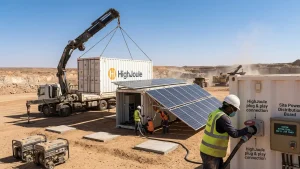
A containerized solar system deployed at a remote gold mining operation in eastern Sudan, designed to displace about 80% of on-site diesel consumption. Nonetheless, deployment cycle: 40 days from factory to operational — including ocean freight, customs clearance, and inland transport to a site 300 km from the nearest paved road.
Performance and ROI
Ambient temperatures regularly exceed 50°C during summer months. As a result, the liquid cooling system maintained full battery output with zero thermal derating — a result that air-cooled BESS simply cannot achieve in these conditions. Diesel displacement: about 80%, reducing annual fuel costs by over $200,000. Projected payback period: under 3 years at the site’s delivered diesel cost of $0.65/kWh.
The system’s satellite monitoring link allows the operator’s headquarters in Khartoum to track performance, schedule maintenance, and receive automated alerts. Consequently, the site no longer needs a permanent on-site electrical technician — a role that was difficult to fill and expensive to retain.
Containerized vs Traditional Field-Built Off-Grid Solar Systems
The table below compares a factory-integrated solar container against a conventional field-built off-grid system of equivalent capacity (50 kW PV, 200+ kWh storage).
| Dimension | Solar Container System | Traditional Field-Built System |
| Deployment Time | 2-3 weeks (placement + connection) | 12-16 weeks (design, procurement, wiring, commissioning) |
| On-Site Labor | Minimal — connect AC cable, system is pre-wired | Requires certified electricians for weeks of field wiring |
| Weather Resilience | IP55/IP65 factory-sealed. Rated -30°C to 50°C | Depends on field installation quality. Exposure at every connection point |
| Relocatability | Crane + truck. System moves as a single unit. Redeploy in days | Decommission, disassemble, transport parts, rebuild — months |
| Certification | UL 9540A fire-tested, NFPA 855, UN38.3, CE, ISO 9001 | Depends on individual component certs. System-level testing rarely done |
| Maintenance | Remote-monitored. Predictive alerts before failures occur | On-site inspection required. Issues found during scheduled visits |
| Scalability | Add containers in parallel. EMS manages as single microgrid | Redesign system. New components may be incompatible with old |
| Upfront Cost | Higher — factory integration is a capital expense | Lower upfront — but integration cost is unpredictable |
| 10-Year TCO | Lower — fewer site visits, less downtime, 80% fuel savings vs diesel | Higher — maintenance visits, integration fixes, diesel logistics compound |
The upfront cost of an off-grid solar container system is higher because you pay for the integration work upfront — the work that traditionally happens in the field, under unpredictable conditions, by variable-quality labor. In fact, instead, that work now happens in a controlled factory environment. You recover that upfront premium through lower operational costs. The crossover point typically arrives within 2 to 4 years. For a project with a planned life of 10 years or more, the container system delivers 30-50% lower total cost of ownership.
How to Size an Off-Grid Solar Container System for Your Site
Use this five-step methodology to match your load profile to the right container model. Furthermore, work through the example alongside your own numbers.
Step 1: Audit Your Daily Load Profile
First, list every electrical load on your site. Consequently, for each, note the power draw (kW) and daily runtime (hours). Then multiply to get daily energy consumption (kWh). Finally, sum all loads. Do not guess — if you have existing diesel generators, use fuel consumption records to back-calculate actual load. A common mistake is underestimating peak demand. Remember: your system must handle the worst minute of the worst day, not the average.
Step 2: Assess Peak Demand
Identify the maximum simultaneous power draw your site will experience. This is not the same as total daily energy — it is the moment when pumps, compressors, air conditioning, and communications equipment all run at once. Consequently, the inverter rating in the container model table must exceed this number.
Step 3: Determine Solar Irradiance at Your Site
Peak Sun Hours (PSH) is the equivalent number of hours per day when solar irradiance averages 1,000 W/m². Use NASA POWER, Solargis, or local meteorological data. For example: Sahara Desert = 6.0-7.0 PSH; Australian Outback = 5.5-6.5 PSH; Northern Europe = 2.5-3.5 PSH. Next, divide your daily energy consumption by PSH to determine the minimum PV array size needed.
Step 4: Size Battery Storage for Autonomy
How many days of cloudy weather must the system ride through without solar input? For critical infrastructure — hospitals, emergency response — design for 3-5 days of autonomy. For mining operations that retain backup generators, however, 1-2 days is typically enough. Multiply daily energy consumption by autonomy days to determine minimum battery capacity. Then add 20% buffer for depth-of-discharge limits. In other words, LiFePO4 batteries should not be regularly discharged below 20% SOC.
Step 5: Select Your Container Model
Finally, match your PV requirement and battery requirement to the model table in Section 4. Choose the smallest model that exceeds both requirements. Oversizing by 20-30% provides headroom for load growth and battery degradation over the system’s life. If your requirements fall between two models, go with the larger one — the marginal cost of extra capacity is usually less than the cost of running out of power.
Worked Example: 50-Person Mining Camp
Here is a concrete example. Hence, daily energy consumption: 180 kWh (lighting, communications, water pumping, kitchen equipment, office). Consequently, peak demand: 35 kW (morning when pumps and kitchen equipment run simultaneously). Consequently, site PSH: 5.5 (West Africa, dry season average). Hence, minimum PV needed: 180 / 5.5 = 33 kWp. Autonomy: 2 days. Minimum battery: 180 × 2 × 1.2 (buffer) = 432 kWh. Selected model: HJ-20G-P057E241 (57 kWp PV, 241 kWh battery, 50 kW inverter). The 57 kWp PV exceeds the minimum 33 kWp — the extra capacity charges batteries faster after cloudy days and provides headroom for load growth.
When a Solar Container Is Not the Right Fit
Industrial solar containers are engineered for specific use cases. In contrast, they are not the right tool for every off-grid situation. Being honest about limitations helps you avoid an expensive mismatch — and for each limitation, there is usually a better alternative.
Sites with very low power demand (<5 kW continuous). Similarly, a container system is over-engineered for a single cabin, RV, or small telecom repeater station. For these applications, a standard off-grid solar kit with rooftop panels, a hybrid inverter, and a small lithium battery bank will cost a fraction as much and serve the load just as well. Brands like Victron, EG4, and Renogy serve this market effectively.
Urban or peri-urban locations with reliable grid access. Thus, if grid power is available and reliable, a grid-tied solar system with battery backup is almost always more cost-effective than going fully off-grid. Net metering — where available — turns your excess solar generation into bill credits. The alternative is a hybrid solar system (grid-tied with battery) that provides backup power during outages without the full cost of an off-grid system.
Sites requiring >500 kW continuous power. However, the largest standard container (HJ-40H-P136E482) delivers 136 kWp PV and 60 kW×2 inverter capacity. For sites above this threshold, multiple containers can operate in parallel as a microgrid — but this requires custom engineering. Contact HighJoule’s engineering team for a multi-container system design. The EMS is architected to coordinate multiple containers; the limitation is physical space and logistics, not control capability.
Short-term projects (under 6 months). In other words, the capital investment in a solar container pays back over years. Therefore, for a 3-month construction project or a temporary event, the economics do not work. Consider equipment leasing instead. HighJoule offers short-to-medium-term leasing for project durations of 6-24 months. Leasing preserves the operational benefits — fast deployment, zero on-site electrical work, remote monitoring — without the capital commitment. Contact our team for leasing availability in your region.
Frequently Asked Questions
How long does deployment really take?
From truck arrival to full operation: 30 minutes for 8ft and 10ft containers (2-4 workers), 2 hours for 20ft containers (4-6 workers), 4 hours for 40ft containers (6 workers). These times assume a pre-prepared foundation — compacted ground is enough for most sites. Total project timeline, including ocean freight, customs clearance, and inland transport, is typically 30 to 60 days from factory to operational, depending on destination. The foldable PV mechanism is the key speed advantage. Specifically, panels deploy from the container in minutes rather than days of manual mounting.
Can it operate in extreme cold? Extreme heat?
Yes to both. Accordingly, the system’s operating range is -30°C to 50°C, validated through deployment in the Tibetan Plateau (4,500m, -30°C) and the Sudanese desert (50°C+). Liquid cooling makes this possible. Unlike air-cooled systems that depend on ambient air temperature, liquid cooling circulates refrigerant through cold plates in direct contact with battery cells, maintaining ±2°C uniformity regardless of external conditions. In extreme cold, wide-temperature LiFePO4 cells with built-in self-heating capability prevent the lithium plating that degrades conventional batteries at sub-zero temperatures.
What certifications does the system carry?
UL 9540A (system-level fire safety), NFPA 855 compliant (explosion vent panels and fire suppression), UN38.3 (lithium battery transport safety), ISO 9001 (quality management), CE (European conformity), RoHS (hazardous substances), and CCC (China Compulsory Certification). Additionally, the ISO/CSC standard container certification ensures the system can be shipped and handled anywhere using standard logistics infrastructure. For projects requiring more regional certifications (IEC 62933, country-specific grid codes), consult our compliance team during the procurement phase.
How is the system maintained in remote locations?
The satellite and cellular connectivity built into the EMS enables remote monitoring of every system parameter — battery state of charge, cell temperatures, inverter status, energy production, and fault codes — from anywhere with an internet connection. As a result, in practice, this means you can oversee the system without sending a technician to the site.
Predictive maintenance algorithms flag potential issues before they become failures. For example, a gradual decline in a single battery cell’s voltage triggers an alert weeks before it would affect system performance. As a result, most problems get addressed during scheduled visits rather than emergency call-outs.
Routine physical maintenance — cleaning PV panels, inspecting cable connections, checking coolant levels — is required about quarterly. Site personnel can perform these tasks with basic training. Meanwhile, for major service events, HighJoule’s service network covers deployment regions across Africa, Asia, Europe, and the Americas.
Spare parts are stocked at regional hubs. Furthermore, the modular design means individual battery racks, inverter modules, or PV panel sections can be replaced without taking the entire system offline. This approach keeps downtime measured in hours rather than days.
Can I scale up later by adding more containers?
Yes. The EMS is architected to coordinate multiple containers as a single microgrid. When you add a second container, the EMS treats it as an more generation and storage resource, automatically balancing load across both units. There is no practical limit to the number of containers that can operate in parallel — the constraint is physical space, available solar resource, and site logistics. Thus, you can start with the capacity you need today and add containers as operations grow, without redesigning or replacing the original system.
What happens if a component fails?
The modular architecture means most failures are isolated to a single rack, module, or inverter — not the entire system. Specifically, a failed battery rack can be bypassed while the remaining racks continue to operate. Likewise, a failed inverter module triggers automatic switchover to the redundant PCS where equipped.
The EMS sends an immediate alert with the specific fault code. This enables the support team to diagnose the issue remotely and dispatch the correct replacement part. Consequently, you avoid sending a technician just to “figure out what is wrong.”
For critical sites, HighJoule offers service-level agreements with guaranteed response times. In addition, on-site spare parts kits can be pre-positioned at the deployment location, further reducing downtime risk.
How does the foldable PV mechanism work?
The PV array mounts on a hydraulically or electrically actuated frame. Nonetheless, this frame folds flat against the container for transport and unfolds at the deployment site. An operator initiates the process from a control panel, and the frame extends section by section until the full PV array deploys at the correct tilt angle for the site’s latitude.
No manual panel handling. Similarly, no separate mounting structure. No roof penetrations. The mechanism has been tested through thousands of deployment cycles and handles sustained wind loads appropriate to the deployment region.
For permanent installations, you can lock the frame in the deployed position. For semi-permanent or relocatable deployments, however, the fold-in/fold-out capability stays available for future moves. This flexibility is particularly valuable for mining operations that shift locations as resource extraction progresses.
What is the total lifecycle cost compared to diesel?
An off-grid solar container system’s total cost of ownership includes upfront capital (container + shipping + site preparation), minimal operational costs, and end-of-life considerations. Diesel’s TCO, in contrast, includes generator capital, fuel costs compounded by transport logistics, quarterly-to-monthly maintenance with parts and labor, and the production downtime cost of fuel shortages or generator failures. For a typical remote mining application (50 kW average load, $0.65/kWh delivered diesel cost), the container system breaks even within 2-4 years and delivers 30-50% lower TCO over a 10-year project life. Use the Solar Container ROI Calculator on our website to model your specific site conditions.
What certifications and approvals are needed for my project?
Requirements vary by region and application, but the most commonly requested certifications are: UL 9540A (fire safety — mandatory for most North American projects), NFPA 855 compliance (fire code — required by insurers and local authorities), UN38.3 (lithium battery transport — mandatory for ocean freight), and CE marking (European conformity — required for EU deployment). more certifications that may apply: IEC 62933 (grid-connected energy storage), local grid interconnection standards (country-specific), and environmental impact assessment approvals (site-specific). HighJoule’s compliance team provides a certification package with every system. We recommend engaging a local regulatory consultant early in the procurement process, however, to identify region-specific requirements before the system ships.
How fast can a system be deployed in an emergency?
For pre-configured, pre-charged off-grid solar container systems: 30 minutes to 4 hours from truck arrival to power output, depending on container size. Hence, this assumes the site has been prepped — compacted ground or a simple foundation — and the external load cable is ready to connect.
For disaster response scenarios where speed is the overriding priority, the 10ft HJ-10G-P024E040 can be airlifted by heavy-lift helicopter to sites with no road access. It begins delivering power within an hour of landing. In fact, the fastest documented deployment reached full rated output 27 minutes after container touchdown, achieved during an emergency response exercise in 2025.
For planned emergency preparedness, systems can be stored in a charged state at regional logistics hubs. In particular, this pre-positioning strategy means the system is ready for immediate dispatch when a crisis occurs — no charging, no configuration, no delay.
Compliance and Certification Guide
For procurement officers and EPC contractors evaluating off-grid power systems, certification is not a checkbox — it is the primary risk management tool. In fact, a system that lacks the appropriate certifications can be refused by insurers, rejected by local fire authorities, or held at customs. Below is the certification framework that HighJoule container systems carry, organized by what each certification means for your project.
| Certification | What It Covers | Why It Matters for Your Project |
| UL 9540A | System-level fire safety testing. Evaluates thermal runaway propagation risk. | Required or strongly preferred by insurers. Increasingly referenced in local fire codes worldwide. |
| NFPA 855 | Fire code standard for BESS installation, ventilation, fire suppression. | Mandatory in jurisdictions that have adopted NFPA standards. Roof vents meet pressure relief requirements. |
| UN38.3 | Lithium battery transport safety. Covers vibration, shock, thermal, overcharge testing. | Mandatory for ocean and air freight. Without it, your system cannot leave the factory legally. |
| ISO 9001 | Quality management system certification for manufacturing. | Ensures consistent production. Required by many government and large corporate procurement frameworks. |
| CE Marking | European conformity for health, safety, and environmental protection. | Required for deployment in the European Economic Area. Covers EMC and LVD directives. |
| ISO/CSC | Container safety certification for international shipping and handling. | Ensures standard handling by cranes, forklifts, and trucks globally. Without CSC, your container may be refused at ports. |
| RoHS | Restriction of hazardous substances in electrical/electronic equipment. | Required for CE marking. Demonstrates environmental compliance. |
For region-specific requirements — grid interconnection standards, local fire codes, environmental permits — HighJoule’s compliance team can provide documentation packages and testing reports. Likewise, we recommend that every project engage a local regulatory consultant during the planning phase. The cost is modest compared to the risk of a delayed or rejected deployment due to missing certifications.
Disclaimer
Performance data cited in this article is based on actual deployments operated by HighJoule Group and its clients. Accordingly, your results will vary with site-specific conditions including solar irradiance, ambient temperature, altitude, load profile, and maintenance practices. Financial projections (payback periods, TCO comparisons) use representative diesel cost and system pricing data; actual economics depend on your region’s fuel prices, logistics costs, and applicable incentives or tariffs. Model specifications are current as of May 2026 and are subject to change as products are updated. Consult HighJoule’s engineering team for a site-specific proposal and performance guarantee.
About the HighJoule Engineering Team
Shanghai HighJoule Energy Technologies Ltd. designs and manufactures containerized solar power and energy storage systems deployed across more than 20 countries on four continents. Finally, our engineering team brings decades of collective experience in power electronics, battery technology, thermal management, and off-grid system integration. In fact, we hold certifications including UL 9540A, NFPA 855, UN38.3, ISO 9001, CE, RoHS, and CCC. Our systems operate in extreme environments from the Tibetan Plateau (4,500m, -30°C) to the Sudanese desert (50°C+), in mining operations, disaster relief missions, telecom networks, and remote communities. Contact us for a technical consultation: [solarcontainerkit.com/contact-us]
Last Updated on 07/01/2026