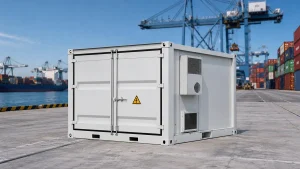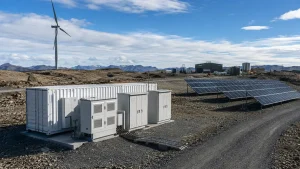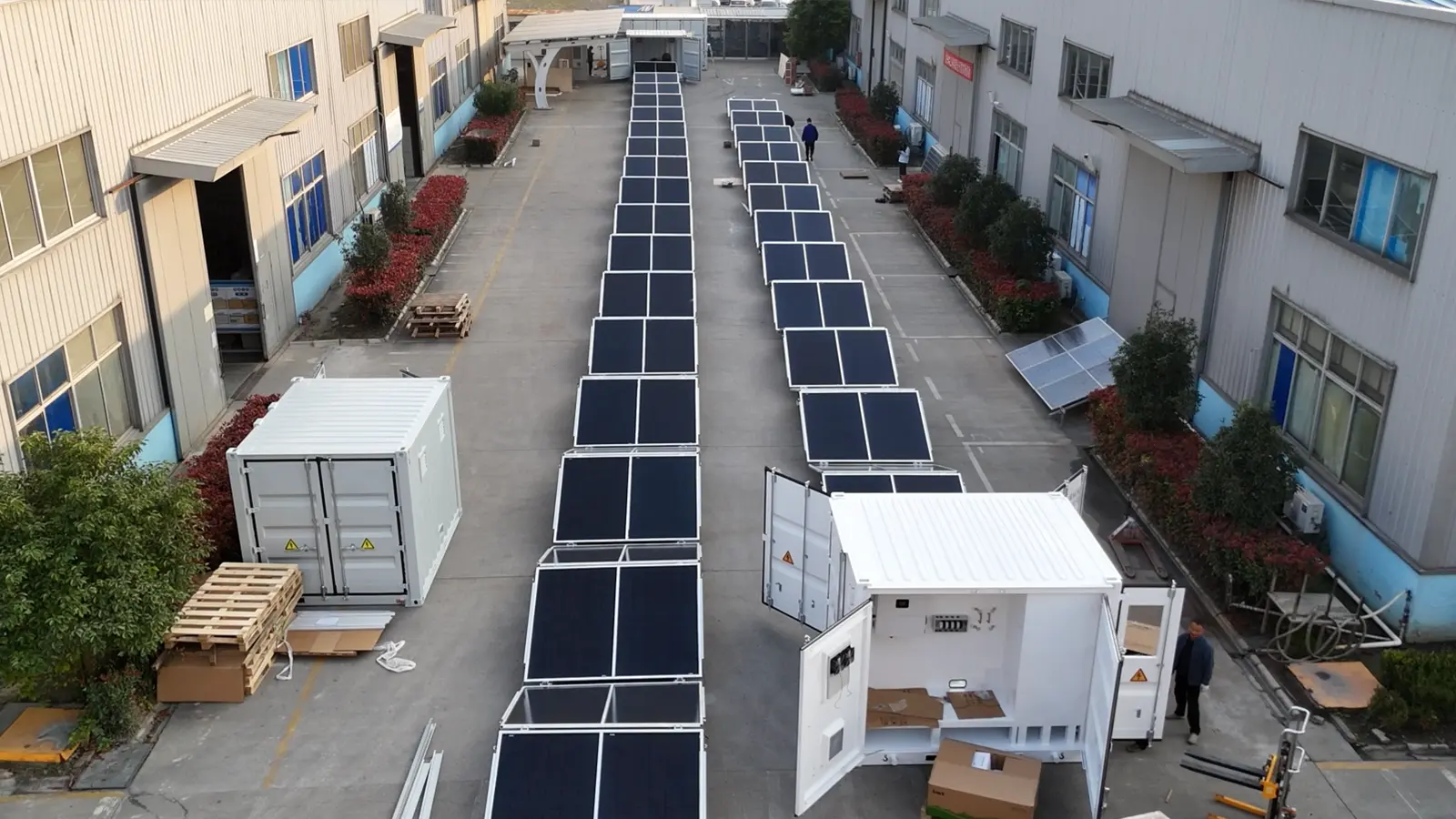
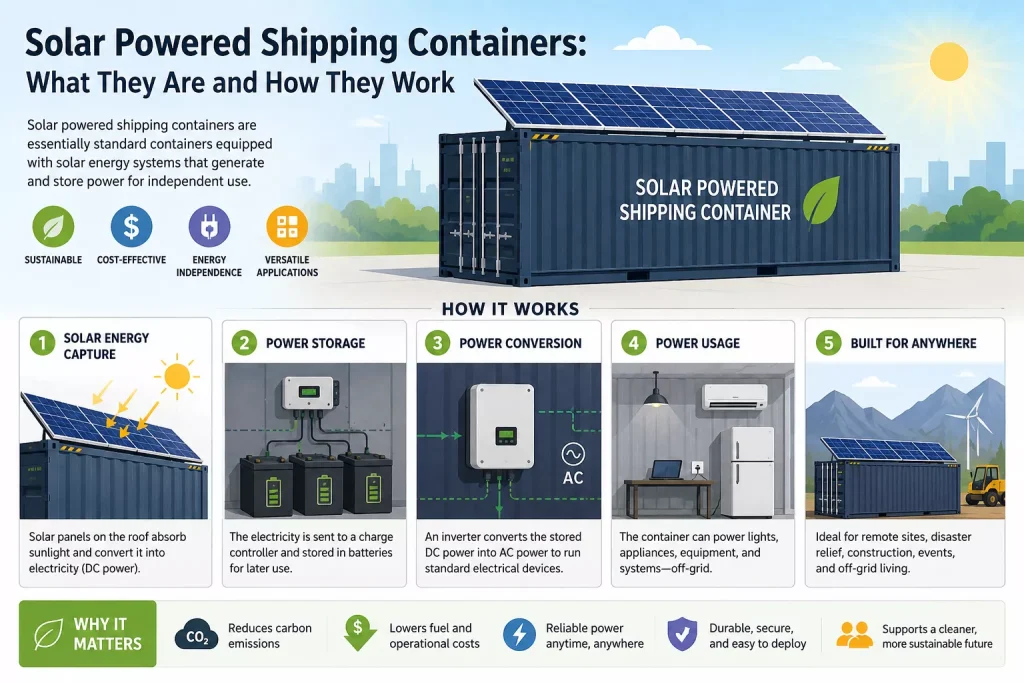
A solar powered shipping container is a standard ISO container with fold-out solar panels, batteries, and power electronics built into it at the factory. You ship it on a regular flatbed truck, crane it off, unfold the panels, connect your cables, and it produces power. No concrete pad, no separate equipment shed, no field wiring between components from different manufacturers. The whole system was tested as one unit before it left the factory.
Deployment takes 30 minutes for small units and 2 to 4 hours for the largest ones. These systems are used at remote mines that want to burn less diesel, at disaster sites where the grid is down, at military forward bases that need silent power, and at eco-lodges where generator noise kills the guest experience. They are not the right answer for every site — a six-month construction project in a low-sun region should rent a generator instead. But if you plan to operate for two or more years in a location with decent sunlight, the numbers usually work.
What Is Inside a Solar Shipping Container?
A solar shipping container packs four things into one steel box: the PV array, the battery bank, the power electronics, and the control system. What makes it different from a traditional solar installation is that all four are factory-integrated. You are not buying panels from one vendor, batteries from another, inverters from a third, and paying an integrator to make them talk to each other on site.
The PV Array
The solar panels are mounted on a fold-out racking system inside the container. When the container arrives, the side panels open and the array unfolds — no tools, no field mounting. HighJoule’s solar container products uses N-Type TOPCon (Tunnel Oxide Passivated Contact) modules with 22.5%+ conversion efficiency. Compared to standard PERC cells, TOPCon degrades slower — roughly 0.4% per year versus 0.55% — and loses less power as temperatures climb. In a desert or tropical deployment, that temperature coefficient difference adds up over a 15-year system life.
The Battery Bank
The container houses LFP (Lithium Iron Phosphate) batteries, typically 314 to 350 amp-hour cells. LFP was chosen over other lithium chemistries because it is more stable under thermal stress — a real concern when the container ships through tropical ports or sits in direct sun at 50°C. The batteries are liquid-cooled, which keeps cell temperatures within a 2 to 3°C band across the entire pack. Air-cooled systems, by comparison, commonly see 8 to 12°C gradients from the center cells to the edge cells. A cell running 10°C hotter than its neighbor degrades faster, and in a series string the weakest cell determines the pack’s usable capacity.
Power Electronics and Controls
The PCS (Power Conversion System) handles DC-to-AC conversion at 98.5% efficiency. An integrated EMS (Energy Management System) decides when to charge from solar, when to discharge to the load, and when to start the backup generator. The EMS connects via satellite or cellular for remote monitoring and includes GPS geo-fencing.
The Architecture: DC-Coupled, Not AC-Coupled
HighJoule Solar powered shipping containers use a DC-coupled design. The PV array and batteries share a common DC bus, so power flows from panels to batteries without converting to AC and back. Round-trip efficiency on DC-coupled systems runs 88 to 95%, compared to 80 to 88% for AC-coupled configurations where panels feed an inverter, then a battery charger, then another inverter for the load. Over 15 years, that efficiency gap means tens of thousands of dollars in recovered energy. DC coupling is the better choice for off-grid and diesel-hybrid applications; AC coupling has advantages in large multi-inverter grid-tied setups.
How Fast Can You Get One Running?
The key number is zero construction. A traditional solar installation at a remote site needs a concrete pad, a foundation, a mounting structure, a separate enclosure for batteries and inverters, and field wiring between all of it. This process takes weeks and requires skilled labor that may not be available locally.
A containerized solar powered system skips all of that. The container IS the foundation. It sits on compacted earth or a gravel pad. Deployment times from actual HighJoule field data:
- 8 to 10 foot units: approximately 30 minutes from truck-off to power-on
- 20 foot units: approximately 1 to 2 hours
- 40 foot units: approximately 2 to 4 hours
The system was fully tested at the factory. What arrives is a power plant, not a pile of parts with a manual. This matters most at sites where you cannot fly in an integration team — disaster zones, conflict areas, remote exploration camps.
Where Solar Shipping Containers Get Used
Mining and Remote Industry
Mines in Africa, South America, and Central Asia burn enormous amounts of diesel. A 100 kW generator at a site 200 kilometers from the nearest fuel depot can cost $80,000 to $120,000 a year in fuel alone, before maintenance and logistics surcharges. A solar container paired with the existing generator as backup cuts that fuel bill by 60 to 80%. The generator goes from workhorse to insurance policy.
Disaster Response and Humanitarian Aid
After an earthquake or flood, the grid may be down for weeks. Diesel generators need fuel deliveries — and fuel supply chains often collapse alongside the grid. A foldable solar container arrives on a truck and produces power the same day, with no ongoing fuel logistics. In Ukraine, HighJoule deployed 46 kWp foldable PV container systems to power field clinics, humanitarian shelters, and communication centers during widespread grid disruptions.
Military and Forward Operating Bases
Fuel convoys have been a leading cause of casualties in modern military logistics. The RAND Corporation documented that fuel logistics accounted for roughly 30% of casualties in Iraq and Afghanistan operations. A solar container reduces convoy frequency. It also runs silently — no acoustic or thermal signature from a diesel generator running 24/7.
Eco-Lodges and Remote Tourism
A diesel generator at 75 to 85 dBA kills the experience at an eco-lodge. Guests did not travel to a remote location to listen to an engine. Solar containers produce zero noise. For resorts on islands or in protected areas, the fact that the system fits in a standard container and ships on regular freight routes also simplifies logistics.
Two Deployments That Show What These Systems Can Do
Sudan: 129.6 kWp Desert Deployment
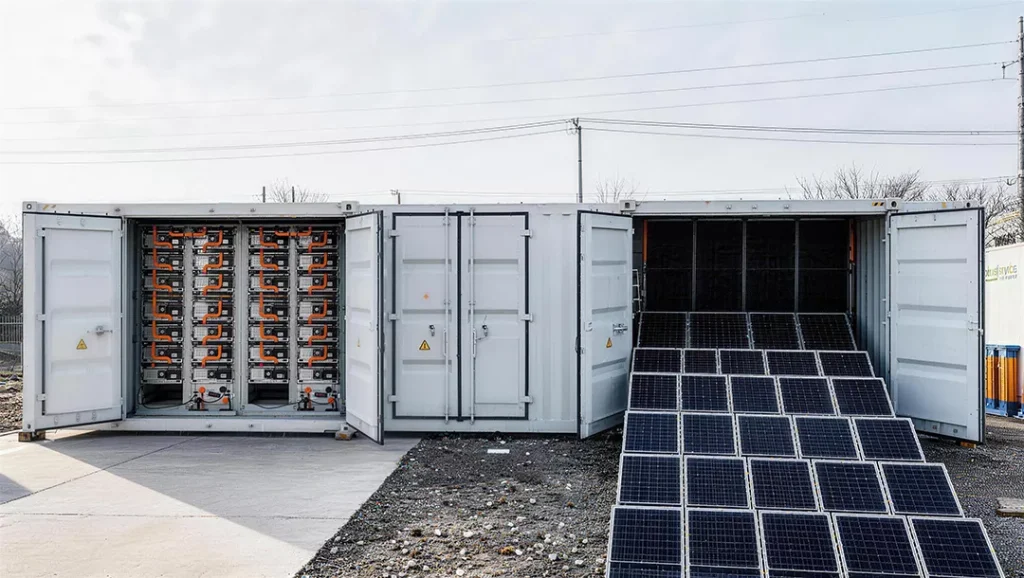
In Sudan, where grid power is unreliable and temperatures regularly exceed 45°C, HighJoule deployed a 40-foot solar powered shipping container with 129.6 kWp of solar and 450 kWh of LFP storage. The system runs in a self-generation, self-consumption mode — it powers critical infrastructure loads directly from solar during the day, stores excess in the batteries, and discharges overnight. When the grid drops, the system switches to off-grid mode automatically, with no interruption to the load. The container’s liquid-cooled batteries maintain temperature uniformity despite ambient heat that would degrade air-cooled packs within months.
Ukraine: 46 kWp Emergency Power for Field Clinics
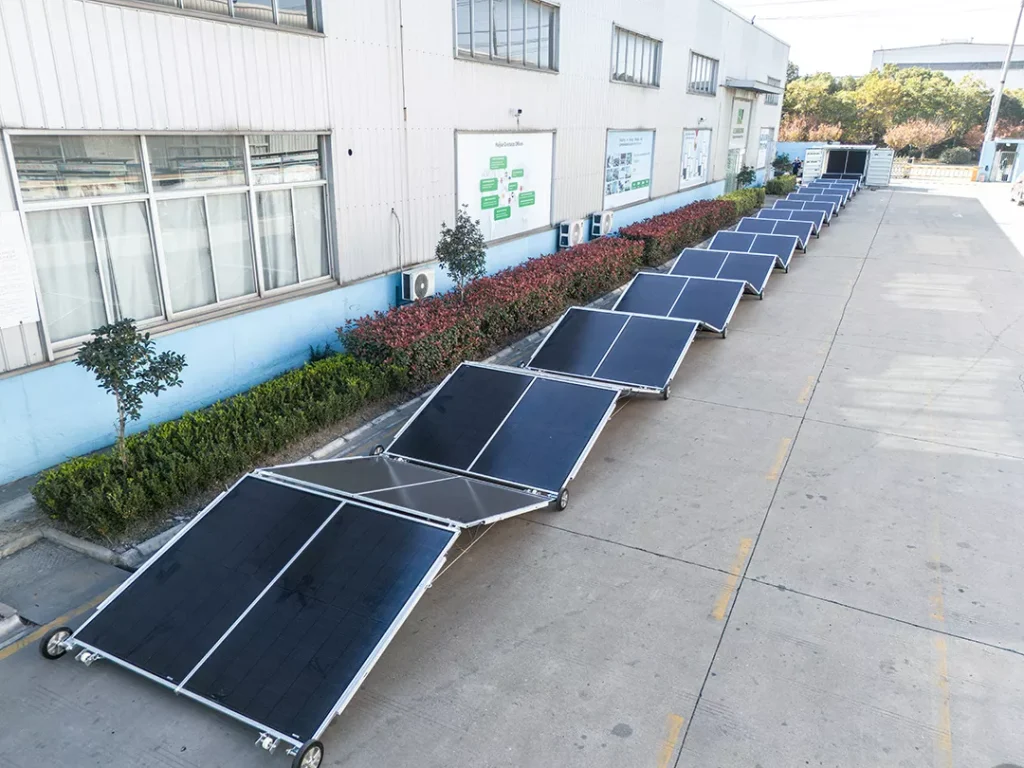
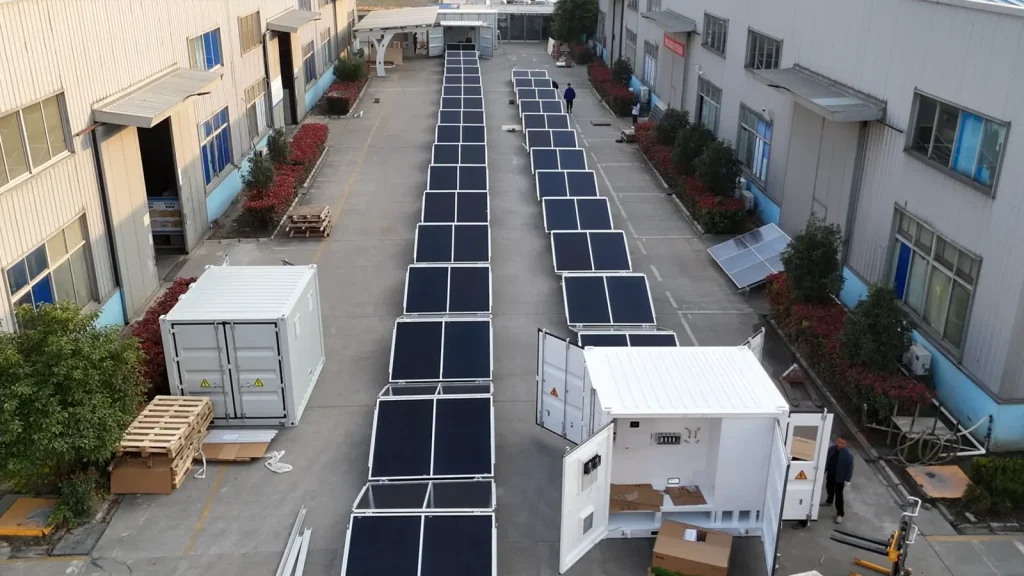
During widespread grid outages caused by conflict, HighJoule shipped foldable solar container systems to Ukraine — 46 kWp of solar with 50 kWh of off-grid battery storage, rated for 6,000 cycles. The 92 monocrystalline panels unfold on a wheeled slide mechanism with a 15-degree tilt angle. These units powered field clinics running ventilators, infusion pumps, and sterilizers; humanitarian shelters providing lighting, refrigeration, and device charging; and temporary communication centers. A single container deploys in under an hour on any flat surface. When the power comes back, the system transitions seamlessly. When it goes out again — which it does — the batteries carry the load without a flicker.
The HJ-FBESS Product Line
The HJ-FBESS is HighJoule’s foldable PV-storage container series. All models are factory pre-fabricated, ISO/CSC standard, and UL 9540A certified for fire safety at the unit level — the large-scale thermal runaway propagation test. Six models cover everything from a small communications post to a multi-building industrial microgrid.
| Model | Container | PV | Storage | Inverter | Best For |
| HJ-08G-P018E030 | 8 ft | 18 kWp | 30 kWh | 15 kW | Remote monitoring, single-building backup |
| HJ-10G-P024E040 | 10 ft | 24 kWp | 40 kWh | 20 kW | Field office, remote clinic, small eco-lodge |
| HJ-20G-P057E241 | 20 ft | 57 kWp | 241 kWh | 50 kW + 100 kW PCS | Field hospital, water pumping, medium resort, mining camp |
| HJ-20H-P068E241 | 20 ft HC | 68 kWp | 241 kWh | 60 kW + 100 kW PCS | Large field hospital, processing site, high-sun deployment |
| HJ-40G-P114E482 | 40 ft | 114 kWp | 482 kWh | 50 kW×2 + 100 kW PCS×2 | Multi-building microgrid, large mining camp, disaster base |
| HJ-40H-P136E482 | 40 ft HC | 136 kWp | 482 kWh | 60 kW×2 + 100 kW PCS×2 | Humanitarian base camp, large off-grid industrial |
All models ship on standard container logistics — container ship, flatbed truck, standard crane. No oversized-load permits, no special handling equipment.
How to Figure Out Which Model You Need
Start with two numbers from your site: average load in kilowatts and overnight energy consumption in kilowatt-hours. Multiply average load by 1.2 to get the inverter capacity you need. Multiply overnight consumption by 1.5 to get the battery capacity — the buffer accounts for depth-of-discharge limits and degradation over the system’s life.
A mining camp drawing 45 kW average with 280 kWh of overnight load (lighting, security, comms, refrigeration) maps to an HJ-20G-P057E241: 50 kW inverter and 241 kWh storage. Send your numbers plus your site coordinates to HighJoule and you will get a technical proposal with the model match, irradiation analysis, and payback estimate within 48 hours.
When a Solar Container Is Not the Right Call
These systems are not the answer for every site. Here is when diesel still makes more sense:
- Your project runs under six months and you are buying, not leasing. The capital cost of a purchased container system needs about two years of operation to reach breakeven. For short projects, ask about lease options or rent a generator.
- Your site has very low solar irradiation year-round and cheap, reliable diesel access. Northern latitudes with continuous winter cloud cover and fuel at $0.50 per liter — the math does not flip.
- Your load requires extremely high surge current — starting a 500 HP rock crusher direct-online, for example. Soft starters, variable-frequency drives, or supercapacitor banks can solve this, but they add $5,000 to $25,000 to system cost depending on motor size.
For most other sites, the hybrid approach wins: let the solar container handle daytime base load, keep a diesel generator for peaks and backup, and adjust the split once you have real data from your own site.
Frequently Asked Questions
Do I need a concrete foundation?
No. The container sits on compacted earth or a gravel pad. It is its own foundation. This is one of the main reasons the system deploys in hours instead of weeks.
Can the system handle extreme weather?
Yes. Our Solar Containers have been deployed at 4,500 meters on the Tibetan Plateau at -30°C and in desert environments at 50°C. The enclosures are IP65-rated. Liquid cooling works regardless of dust loading — fan-cooled systems pull dust through the enclosure, but liquid cooling loops are sealed.
How long do the batteries last?
LFP batteries are warrantied for 10 years or 6,000 cycles, whichever comes first, at 80% retained capacity. After that, they continue operating at reduced capacity. Battery replacement can be done on site without returning the container to the factory.
What happens on cloudy days?
The batteries carry the load through short cloudy stretches. If clouds persist for multiple days, the system starts the backup diesel generator automatically. In a hybrid setup, the generator runs far fewer hours than it used to — it is there for insurance, not as the primary power source.
Can I add more containers later?
Yes. The solar systems are modular. The EMS can coordinate multiple containers on the same microgrid. Several mining clients started with one 20 ft unit for camp power and added a second for processing loads a year later.
How do I ship it to my site?
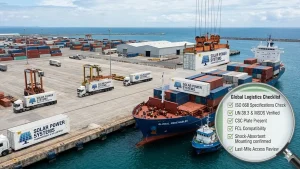
The container is ISO/CSC standard. It fits on any container ship, any standard flatbed truck, and any standard crane. No oversized-load permits. No specialized handling equipment. You ship it the same way you ship any 20 ft or 40 ft container.
Is financing available?
Purchase is standard for deployments of two or more years. Leasing options exist for shorter projects. Contact Us with your project timeline and location for terms available in your region.
About the Engineering Team
This article was written by the HighJoule Engineering Team — power systems engineers, renewable energy project designers, and field deployment specialists with experience across mining electrification, humanitarian microgrids, and off-grid industrial power. Our team has commissioned solar-plus-storage systems in desert, high-altitude, tropical, and conflict-zone environments. Engineers hold certifications including IEC 62446 (PV system documentation) and IEC 62109 (power converter safety). Every technical proposal is reviewed by a registered professional engineer with direct field deployment experience.
Disclaimer: Cost estimates and deployment times reflect actual HighJoule field data as of May 2026 and vary by site conditions and location. Product warranty terms: PV modules 25-year linear power output warranty; LFP batteries 10-year or 6,000-cycle warranty (80% retained capacity); PCS/inverter 5-year warranty. Extended warranties and service-level agreements available. UL 9540A certification applies to HJ-FBESS systems as configured and factory-tested; field modifications may affect certification status. Case studies reflect real operational data from HighJoule deployments.
Last Updated on 06/03/2026