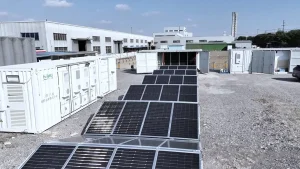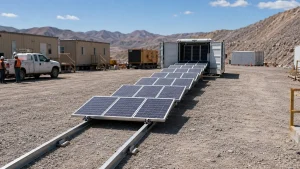
A useful solar container quotation starts with the job the system must perform, not a preferred container size or a target price. Send the supplier your load profile, operating objective, electrical interface, site conditions, deployment space, delivery constraints, scope boundary and required response format. If some information is not yet available, identify it as an open item so the quotation separates confirmed inputs from supplier assumptions.
This solar container quote checklist is for EPC teams, distributors, facility owners and project developers preparing an initial supplier enquiry. It sits before a formal RFQ: use it to assemble the project data, then use the existing containerized solar BESS RFQ guide to write supplier obligations, technical clauses and acceptance requirements. Buyers who are still defining the system category can begin with the explanation of how a solar-powered shipping container works.

Choose the Right Quotation Stage
Not every enquiry needs contract-level detail. The first decision is how much confidence the buyer expects from the response. A budgetary estimate can tolerate stated assumptions. A technical proposal needs enough measured data to select an architecture. A contract-ready quotation needs frozen interfaces, responsibilities and acceptance criteria.
| Quotation stage | Minimum useful inputs | Appropriate use | Do not treat it as |
|---|---|---|---|
| Budgetary estimate | Application, location, rough peak load, daily energy, operating hours and preferred scope | Feasibility screening and early budget approval | A fixed price or final design |
| Technical proposal | Measured load data, operating modes, electrical interface, environmental conditions, site layout and logistics basis | Architecture selection and comparable supplier review | A construction-ready package |
| Contract-ready quotation | Frozen design basis, responsibility matrix, approved interfaces, required evidence, acceptance criteria and commercial terms | Negotiation, award and purchase order preparation | Permission to install, energize or connect to the grid |
The distinction matters because an incomplete scope can move cost from the visible equipment price into later clarifications, exclusions or change orders. The U.S. Department of Energy’s distributed-energy procurement guidance identifies site conditions, defined project requirements, pricing structure, evaluation criteria, operations and maintenance, and repair or replacement requirements as solicitation inputs. It also warns that work omitted from the scope may be omitted from bids. That guidance is written for U.S. federal projects, but the scope-control principle is useful for commercial enquiries in other markets as well. See the DOE procurement process.
Solar Container Quote Checklist: Eight Input Groups
A practical enquiry package is a short project brief with referenced attachments. Keep units, dates and file revisions visible. The eight groups below give a supplier enough context to identify missing decisions without turning the first email into a full engineering specification.
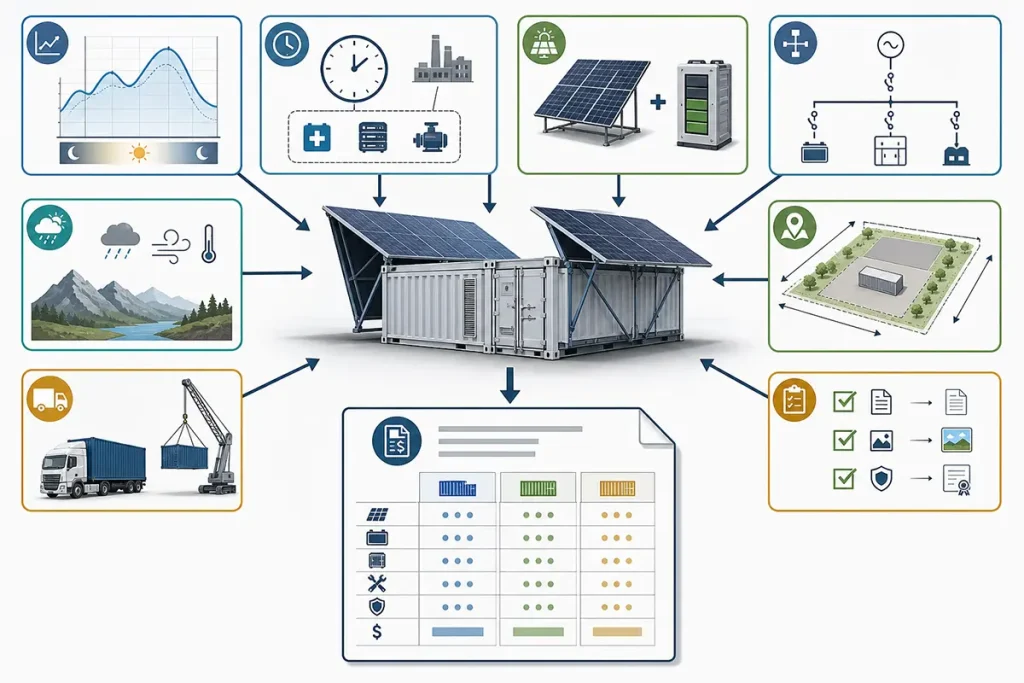
1. Operating objective and success criterion
Describe what the system must accomplish in operational language. Examples include supplying daytime construction loads, reducing generator runtime, carrying selected loads through an outage, supporting a remote telecom site, or shifting solar energy into evening hours. State whether the site is grid-connected, off-grid or hybrid, and list every energy source that may operate with the container.
Define success in measurable terms where the project has enough data: critical-load power, required operating window, acceptable generator hours, reserve requirement or target solar-energy use. Avoid asking for a “100 kW system” before establishing whether 100 kW is a PV rating, continuous AC power, PCS power, generator rating or peak load.
2. Load profile and operating schedule
Peak power in kW and energy use in kWh answer different questions. Suppliers need both. Provide interval data when available, plus the equipment schedule that explains the peaks. A one-day profile may be sufficient for a stable temporary load; seasonal operations may need representative weekday, weekend and high-demand periods.
| Load input | What to provide | Why it changes the quote |
|---|---|---|
| Peak and continuous demand | Measured kW, expected coincidence and duration | Influences inverter, PCS, generator and protection sizing |
| Daily energy | Representative kWh per day and operating days | Influences PV and storage energy requirements |
| Starting loads | Motor rating, starting method, starting current or equipment data sheet | Reveals short-duration power and voltage-drop requirements |
| Critical loads | Separate list with required support time and permitted interruption | Defines backup boundary and switching requirements |
| Growth and seasonality | Known expansions, seasonal profiles and target commissioning date | Prevents a proposal based only on today’s average |
If the project only has monthly bills, send them and label the missing interval profile. The supplier may prepare a preliminary assumption set, but the buyer should not compare that result with a proposal based on measured interval data as if the two carried equal design confidence. The solar container output calculation guide explains the distinction between rated power and energy production.
3. Preferred architecture without premature sizing
State whether the project is considering foldable PV generation, PV with battery storage, or PV-battery-generator integration. If the architecture is still open, give suppliers permission to propose alternatives and require each alternative to use the same load and site basis.
Do not choose battery capacity by multiplying a guessed load by a guessed number of hours. Identify the loads that need storage, the required support period, allowed state-of-charge reserve, charging opportunities and generator or grid role first. The guide on when a solar container needs battery storage can be used before completing this part of the brief.
4. Electrical interface and controls
Provide nominal voltage, phase, frequency, grounding arrangement and the intended point of connection. Attach the latest single-line diagram when one exists. Identify transformers, switchgear, generator ratings, transfer equipment, existing PV, protection boundaries, cable distances and the party responsible for final settings.
For monitored or dispatchable systems, add the required communications protocol, remote-access restrictions, SCADA or EMS interface, available network connection and control authority. The DOE provides customizable on-site PV technical specifications; buyers should adapt any template to the actual array type, jurisdiction and site rather than copying it unchanged.
5. Location and environmental design basis
Give the country and project coordinates, then provide the environmental inputs that can change equipment selection or derating: minimum and maximum ambient temperature, altitude, humidity or condensation, dust, salt exposure, wind, snow, flooding, seismic conditions and any site-specific noise limit. Identify whether values are measured, taken from a named design standard, supplied by the local engineer or still provisional.
Environmental adjectives are not design inputs. “Desert,” “coastal” and “cold climate” should be translated into values and exposure conditions. Civil information belongs in the same package: soil or foundation basis, drainage, slope, flood level and buried-service constraints. Use the solar container site requirements checklist to organize those records.
6. Transport and operating footprint
A foldable array has at least two relevant geometries: transport state and deployed state. Send a site plan showing the proposed container position, array orientation, clear operating envelope, maintenance access, emergency access, cable routes and any boundary that the equipment must not cross. Note overhead lines, buildings, trees, fences and traffic routes.
If the final model is not selected, state the maximum area available rather than assuming a container size. Ask the supplier to return both transport dimensions and deployed dimensions for the offered configuration.
7. Delivery, offloading and destination constraints
List the destination country, preferred port or delivery point, requested trade basis, target arrival window and importer-of-record responsibility if known. For the site approach, provide road width, bridge or axle restrictions, turning space, gradients, gate dimensions, ground bearing concerns and seasonal access limits.
State whether a crane, side-loader, forklift or another offloading method is planned, but let the selected equipment data determine the final lift plan. The project team should obtain the supplier’s transport mass, center-of-gravity information, lifting instructions and release conditions before booking the lift. The solar container delivery checklist covers route, crane and offloading preparation in detail.
8. Supply boundary, evidence and quotation format
Define what the requested price should include. Separate the containerized equipment from transport, customs, foundations, external cables, transformer or switchgear, installation, communications, commissioning, training, spare parts, maintenance and local approvals. Assign each interface to the buyer, supplier, EPC, logistics provider or local engineer.
Then prescribe a response structure. Ask every supplier to state the offered model and revision, included equipment, assumed inputs, deviations, exclusions, optional items, delivery basis, schedule, warranty scope and required buyer actions. Evidence requests should identify the purpose and the offered configuration; a certificate name or test report from a different model is not automatically proof for the proposed system.
Do Not Freeze Unknowns Just to Make the Form Look Complete
A blank field is safer than an invented requirement, provided the blank has an owner and closure date. At the early quotation stage, buyers often lock a container length, battery chemistry, IP rating, exact PV capacity or named standard before the load, site and authority requirements are known. That can force suppliers to price the wrong boundary or hide a valid alternative.
Describe the required outcome and known constraint first. Ask the supplier to identify its proposed configuration, the evidence that applies to it and the decisions still needed. DOE’s lithium-ion BESS technical specification template is expressly customizable, reinforcing that a procurement template must be adapted to the project rather than treated as a universal product requirement.
HighJoule Product Routes Need Different Inputs
HighJoule’s published configuration tables distinguish three product roles. This does not replace project sizing, but it helps buyers direct the initial enquiry to the right review path.
| Published product route | Use it as a starting point when | Inputs that become especially important |
|---|---|---|
| HJ-FESS Solar Container | The enquiry is primarily for foldable PV generation; the published table does not list battery storage for its variants | Daytime load, grid or external-system interface, solar resource, export limit and deployed footprint |
| HJ-FBESS Solar Container | The enquiry needs a published foldable PV-plus-storage starting configuration | Load profile, backup duration, reserve, charging source, operating modes, PCS interface and storage duty |
| HJ Solar Container | The enquiry concerns a site-energy or communication/base-station application using PV, storage and diesel generation | DC and telecom loads, autonomy target, generator data, communications equipment and site-service boundary |
These are HighJoule’s published product routes, not a claim that every operating mode or interface is included. The final offer should identify the exact configuration and any project-specific engineering.
A One-Page Quote-Ready Brief
The following format is sufficient for a first structured review. Attach source files rather than compressing interval data or drawings into screenshots.
| Brief field | Buyer entry |
|---|---|
| Project and location | Country, coordinates, application and target operating date |
| Operating objective | Daytime supply, backup, generator reduction, off-grid operation or another measurable task |
| Load | Peak kW, daily kWh, interval-data period, critical loads, motors and growth allowance |
| Existing sources | Grid, PV, generator, battery and their ratings or attached data sheets |
| Electrical interface | Voltage, phase, frequency, grounding, point of connection and latest single-line revision |
| Site and environment | Available footprint, access, foundation status, temperature, altitude, dust, wind, snow, salt and flood basis |
| Delivery | Destination, trade basis, route constraints, offloading assumption and requested arrival window |
| Requested scope | Equipment, transport, civil/electrical work, commissioning, training, spares, warranty and documentation |
| Response format | Base offer, options, assumptions, deviations, exclusions, evidence references, schedule and price breakdown |
Make Every Supplier Answer the Same Boundary
Issue the same dated brief to each bidder and require a revision-controlled response. A simple status vocabulary makes differences visible: confirmed, supplier assumption, proposed alternative, excluded, or requires study. Do not compare only the headline kW, kWh or container price when the bids use different load data, site conditions or supply boundaries.
Once the project brief is stable, turn it into the formal RFQ and a specification-to-evidence matrix. The existing containerized BESS technical specification checklist provides the next level of model, interface, document and FAT/SAT control. EPA’s current solar procurement resources likewise organize an RFP around scope and deliverables, specific requirements, submission process and key dates; see its renewable-energy contract development guidance.
Prepare the Enquiry Package
Before requesting a price, combine the completed brief, load file, site plan, photographs, single-line diagram and delivery information into one revision-controlled package. Mark every provisional value. Ask the supplier to return its assumptions and exclusions beside the relevant input instead of burying them in commercial notes.
For a HighJoule configuration review, send the project location, interval or representative load data, critical-load requirement, existing grid or generator information, voltage and phase, available deployed footprint, environmental conditions, delivery destination and requested supply boundary through the SolarContainerKit project enquiry page. That information is enough to begin a product-route and missing-input review.
Last Updated on 08/10/2026