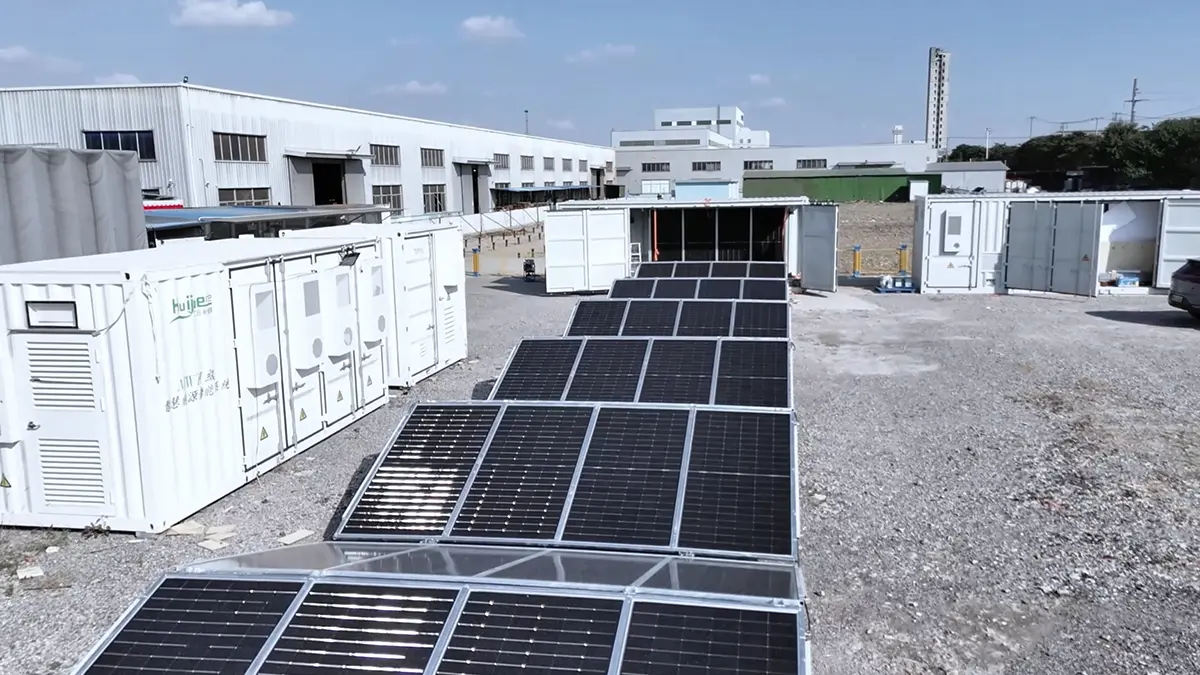
Ask how much power a solar container can produce and you will often be shown a single large number. That number may describe the panels, the inverter or the battery – and those are not the same thing. Container length alone tells you very little about useful output.
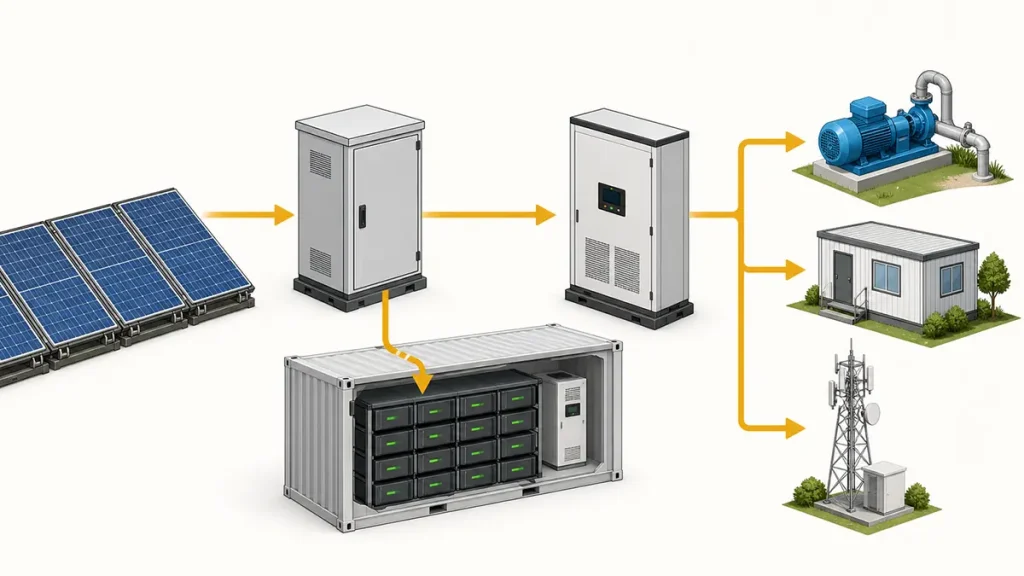
The honest answer needs four figures: PV capacity in kWp, inverter output in kW, battery capacity in kWh and expected production in kWh per day. Start with the site’s load and local sunlight, not the size of the steel box. If the system architecture is still unfamiliar, this guide to solar powered shipping containers shows how the fold-out array, storage and power electronics work together.
First, Find Out Which “Output” the Supplier Means
A specification sheet can be technically correct and still leave a buyer with the wrong impression. The usual problem is not the number itself; it is the missing unit or context.
| Measure | What it means | Question it answers |
|---|---|---|
| PV capacity, kWp | Rated direct-current power of the deployed solar array under standard test conditions | How large is the solar generator? |
| Inverter output, kW | Power the inverter can deliver at one moment, subject to its operating limits | Which loads can run at the same time? |
| Battery capacity, kWh | Stored energy before usable-capacity and conversion limits are applied | How much energy can be shifted to night or low-sun periods? |
| Solar production, kWh/day | Energy expected from the PV array over a day at a stated location and set of assumptions | How much daily consumption can solar replenish? |
Here is the practical distinction. A 60 kW inverter may be able to serve a 60 kW load at one moment, but it does not promise 60 kWh in every hour of the day. A 241 kWh battery stores energy supplied by solar, a generator or the grid; it does not create that energy. Once those two ideas are clear, catalogue comparisons become much harder to misread.
Estimate Daily Energy Before You Compare Models
For an early feasibility check, one short calculation is enough:
Estimated daily AC energy = PV capacity in kWp x peak-sun-hours x performance factor
Peak-sun-hours is not daylight duration. It converts the day’s solar irradiation into an equivalent number of hours at 1 kW per square metre. The performance factor accounts for what happens between nameplate conditions and delivered AC energy: heat, dust, mismatch, wiring, inverter conversion, shading and downtime. The NREL PVWatts calculator combines location and weather data with stated system assumptions, which makes it a better starting point than a country-wide “sun hours” figure.
Do not bury the performance factor. Write it beside the result. A buyer should be able to see immediately whether the estimate used 0.82, 0.75 or another value – and why. At a dusty mine or a hot, partially shaded site, changing the inputs is more useful than adding a vague safety margin at the end.
A 57 kWp Example, Without Sales-Deck Arithmetic
Take the HJ-20G-P057E241 configuration listed on the verified HJ-FBESS Solar Container. The published specification gives a 57 kWp PV array, a 50 kW inverter plus 100 kW PCS, and 241 kWh of storage. They belong in separate columns. Adding them together would produce a large but meaningless total.
Assume the project has 4.5 peak-sun-hours for the selected representative day and uses a preliminary performance factor of 0.82:
57 kWp x 4.5 hours x 0.82 = 210.3 kWh/day
About 210 kWh is therefore a reasonable result for that assumed day. It is not a 210 kW power rating, an all-season promise or evidence that the full 241 kWh battery nameplate is available to the load.
| Illustrative case | Peak-sun-hours | Performance factor | Estimated daily AC energy |
|---|---|---|---|
| Lower-resource screening day | 3.0 | 0.78 | 133.4 kWh |
| Worked base case | 4.5 | 0.82 | 210.3 kWh |
| Higher-resource screening day | 6.0 | 0.84 | 287.3 kWh |
The spread is the point. One attractive daily figure is not enough to size an off-grid system. Replace these screening cases with monthly or hourly results for the actual coordinates, array geometry and equipment. NREL’s System Advisor Model photovoltaic guidance recommends detailed modelling once module and inverter specifications are known; PVWatts remains useful earlier in the project.
Avoid multiplying the best daily case by 365 to create an annual forecast. That shortcut erases seasonal weather, maintenance and any period when the array must be stowed or curtailed.
Now Put the Site Load Against the Estimate
A daily-energy result can look comfortable while the design still fails in operation. Check three things together.
- Compare expected solar production with the site’s daily kWh consumption, including auxiliary equipment and losses.
- Total the loads that can run together and compare that peak with continuous inverter output.
- Map when production and consumption occur. The gap between them is what the battery, generator or grid must cover.
Suppose a site uses 180 kWh per day. The 210 kWh base-case estimate appears sufficient on energy alone, but that conclusion can still fail. A 65 kW coincident peak may exceed a 50 kW inverter. Heavy use after sunset may require more usable storage than the selected battery can provide. Several motors starting together may also create a short-duration demand that the continuous-load total does not reveal.
This is why a 24-hour load profile is worth more than a year of utility totals. It should capture steady demand, motor starts, power factor, phase, voltage and the loads that cannot be interrupted. The monthly bill tells you how much energy the site bought. It does not reveal the ten-minute peak that may decide the inverter and generator size.
The Battery Moves Energy Through Time
That is the battery’s real job. It holds midday surplus for evening use, bridges short cloud events and gives the controls time to start a generator. It cannot make a poorly sized PV array generate more energy.
Nameplate battery capacity is not delivered energy either. The usable amount depends on the permitted state-of-charge window, conversion losses, operating reserve, temperature and power limits. For a first autonomy calculation, use:
Required nominal battery energy = energy required during the no-solar period / usable fraction / discharge-path efficiency
A 20 kW critical load running for six hours needs 120 kWh at the load. With an assumed 80% usable fraction and 92% discharge-path efficiency, the preliminary nameplate requirement becomes 163 kWh: 120 / 0.80 / 0.92. The arithmetic is simple. Choosing defensible percentages for the proposed battery, PCS and operating policy is the engineering work.
The Same Container Will Not Produce the Same Energy Everywhere
Module nameplate power comes from a defined test point. A working array spends almost none of its life at that exact point. Irradiance, temperature, spectrum and sun angle keep moving. The IEA Photovoltaic Power Systems Programme explains why energy yield, rather than a single power rating, matters when climate and location change.
- Location and season: monthly solar resource can vary enough to make an annual average unsafe for an off-grid design.
- Array geometry: tilt, azimuth, row spacing and the deployed mechanism affect irradiation and self-shading.
- Temperature: higher module temperature generally reduces output relative to nameplate conditions.
- Dust, snow and shading: site-specific obstruction and cleaning conditions change available energy.
- Electrical limits: inverter clipping, wiring, mismatch, curtailment and auxiliary consumption reduce delivered energy.
- Operating availability: maintenance, protective shutdowns and weather-related stow conditions can remove generating hours.
For a critical off-grid load, design around the difficult relevant period – not the best-looking annual average. Where generator support is acceptable, define when it starts and which loads it carries. Where the grid is present, settle the export and outage rules before modelling the energy flow.
Only Then Choose the Container Configuration
The container is packaging and logistics. It is not a sizing shortcut. On the verified HJ-FBESS table, PV configurations run from 9 kWp roof-mounted units to 136 kWp fold-out systems, while storage spans 15 kWh to 482 kWh. That range exists because projects have different loads – not because every larger site automatically needs a longer container.
Use the table to narrow the field, then have the actual project reviewed. A published rating does not settle array orientation, usable battery energy, seasonal yield, motor compatibility or local requirements. The site must also have room and suitable conditions for the planned deployed geometry. Check the solar container site requirements before a catalogue configuration turns into a logistics problem.
Bring One Difficult Day to the Sizing Review
A good supplier can do far more with one honest load profile than with a request for “a 20-foot solar system.” Include:
- Project coordinates and required operating months
- Hourly or interval load profile in kW and kWh
- Largest motors, starting method and surge requirements
- Voltage, frequency, phase and power-quality requirements
- Critical and non-critical load priorities
- Required battery autonomy and minimum reserve
- Available grid or generator capacity and operating rules
- Shading, dust, temperature, wind, snow and stow conditions
- Available deployed footprint and any seasonal relocation plan
The difficult day should show the highest credible simultaneous load, total energy use and the longest period without useful solar. HighJoule can compare those three demands with a verified configuration and identify what still needs site engineering. Submit the profile through the technical consultation form rather than asking for a container size in isolation.
Last Updated on 07/31/2026