Remote Monitoring Is Not Remote Maintenance
Remote BESS maintenance works when the project is designed for it before equipment is purchased. A battery energy storage system (BESS) can send operating data, alarms, and event logs to a remote team. However, that connection does not inspect a damaged cable, replace a failed fan, clear a blocked air path, verify a site hazard, or complete a physical isolation. The owner needs a clear division between what the system can detect remotely, what a trained local person can do, and what requires a specialist visit.
For equipment-selection context, start with our Container BESS Engineering Guide, then review the Containerized Solar BESS RFQ Guide. The procurement question is not whether a dashboard exists. It is whether the whole support chain can act on the dashboard’s information.
Buyer conclusion: A remote site should have an O&M design, named escalation path, communications-failure plan, and spares strategy before commissioning. If one of those is missing, “remote maintenance” is only a product feature, not an operating model.
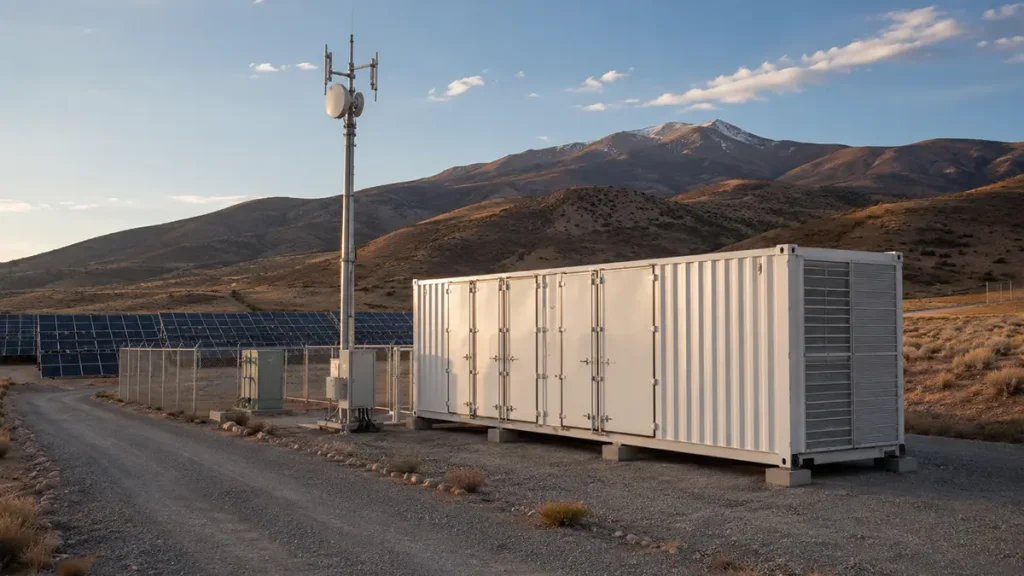
What Remote BESS Maintenance Actually Includes
| Layer | Remote contribution | What still needs a site plan |
| BMS / EMS data | Shows battery, power-conversion, alarm, and operating trends when communications are available. | Data interpretation, alarm ownership, data retention, and an action threshold. |
| Remote technical support | Reviews logs, identifies likely fault paths, and guides approved troubleshooting. | An authorized person, safe access, language coverage, and a defined handoff. |
| Preventive work | Can trigger inspection reminders and identify changing conditions. | Physical inspection, cleaning, torque checks where specified, and service records. |
| Corrective work | Can help isolate the fault and select parts before dispatch. | Lockout, replacement work, functional test, and return-to-service authorization. |
| Emergency interface | Can notify named contacts and preserve event information. | Local response plan, responder access, and local authority requirements. |
A site can have cellular telemetry and still be unprepared to operate if nobody can safely inspect the enclosure, receive a spare part, or follow the approved escalation procedure. Communications can shorten diagnostic delay. They do not replace an accountable field response. Define that field-response boundary before handover.
Design the Communications Path for Failure, Not Only Normal Operation
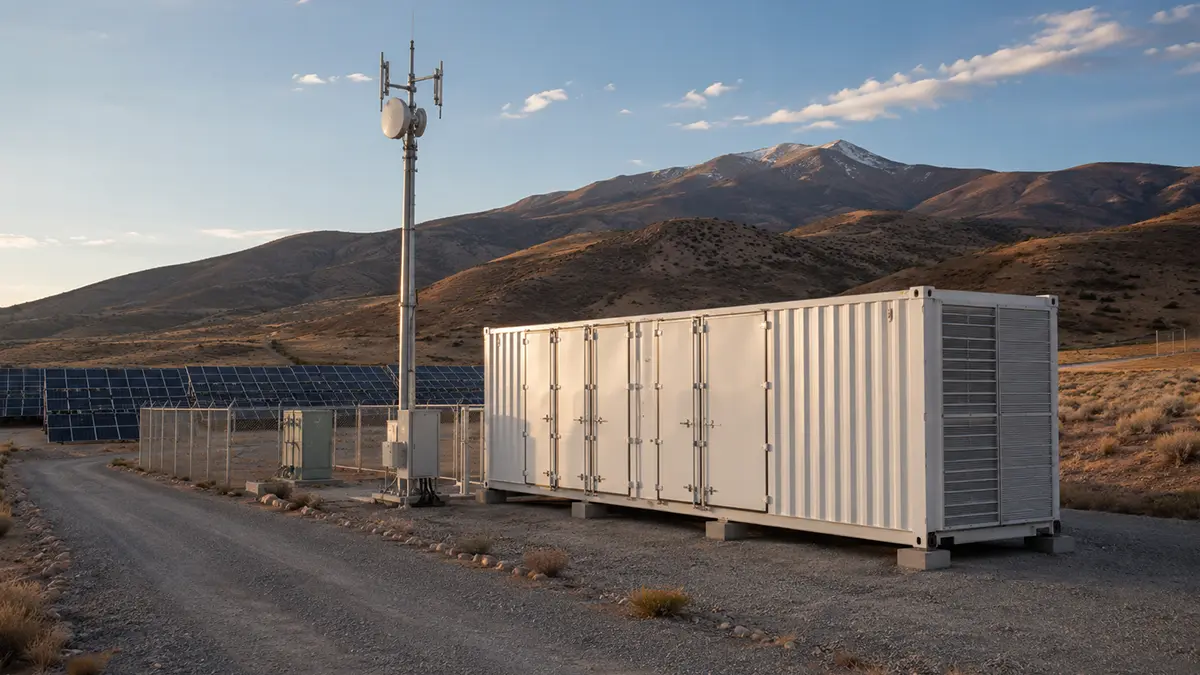
Remote BESS maintenance depends on a communications route from the site to the agreed operating team. Depending on the project, that route may use fiber, cellular data, satellite, radio, or a local network with a managed backhaul. The right choice depends on coverage, latency, data cost, ownership, cyber controls, and how the system behaves when the connection is unavailable.
The RFQ should identify the primary connection and its fallback. It should also state whether alarms are stored locally, how event logs are recovered after an outage, and who is notified when communications are lost. Treat “no data” as an operational event, not as normal operation.
Confirm the physical boundary as well. Antennas, routers, Ethernet switches, SIM contracts, power supplies, and cable pathways belong in the delivered documentation. At a remote site, one small communication component can make a much larger system invisible to the operator.
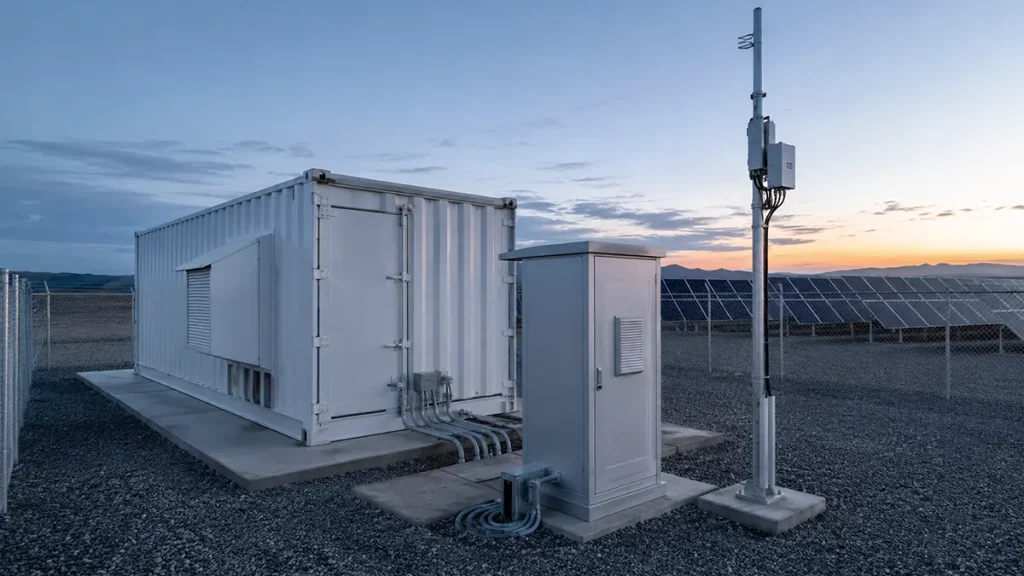
A practical review of remote BESS maintenance by MSI TEC identifies travel to difficult locations, harsh environmental conditions, and software vulnerability management as separate long-term O&M constraints. Treat those as planning prompts, not as universal cost or availability claims.
Turn Alarms into an Escalation System
An alarm creates value only when a named person owns the next action. Request an alarm matrix that separates information notices, maintenance warnings, operating limits, faults, safety-related alarms, communications loss, and emergency escalation. For each event, identify the recipient, review window, evidence to capture, and the person authorized to change the operating state.
| Example event | Remote action | On-site action / decision |
| Communications loss | Confirm last received data, log the outage, test the approved fallback channel. | Check local communications equipment if the escalation plan requires it. |
| Temperature trend warning | Review the trend and operating context; apply only the approved control logic. | Inspect when the project plan requires physical verification. |
| PCS or inverter fault | Collect fault code, event log, and recent operating data for technical review. | Use the approved isolation and service process before any repair. |
| Safety-related alarm | Notify the defined emergency and technical contacts. | Follow the site emergency plan and direction of local responders. |
Do not copy an alarm matrix from a generic article. Match it to the delivered battery configuration, power conversion system (PCS), cooling arrangement, control logic, project language, and the responsibilities accepted by the owner and service parties. Review the final delivered configuration, not a generic template.
Plan for the Work a Remote Team Cannot Do
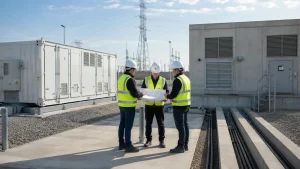
Some work remains physical by nature. It includes visual condition checks, site security review, enclosure cleaning where required, damage assessment, cable and connector inspection, replacement of approved service parts, and confirmation that a repaired system has safely returned to service. Additionally, local access can be essential after storms, flooding, vandalism, transport damage, or an alarm that cannot be diagnosed from data alone.
For this reason, the project should name a competent local contact or contracted service partner. The role does not need to be presented as a substitute for a qualified battery technician. Instead, it can cover agreed first-level tasks: receive an alarm call, check whether access is safe, share photos or readings, protect the site, and coordinate a specialist visit under the project procedure.
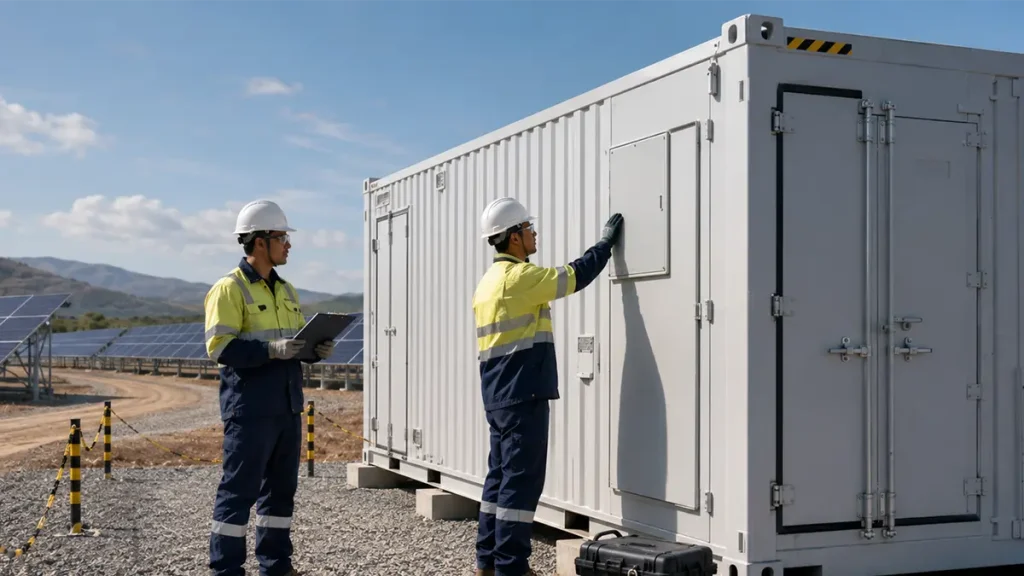
Continuous monitoring can complement inspections by capturing conditions between site visits. Systems With Intelligence notes that periodic inspection can miss intermittent faults and that supporting AC and DC equipment deserves attention alongside battery enclosures. Its monitoring guidance does not remove the need for project-specific maintenance or safety procedures.
Spares, Consumables, and Warranty: Put the Boundary in Writing
A remote project does not need a warehouse full of parts. It does need a deliberate spares decision. Begin with components that can stop monitoring, cooling, control, or safe operation and that have a realistic replacement route. Then distinguish consumables, owner-held critical spares, supplier-held spares, and components that require an authorized technician or factory approval.
The service agreement should identify part numbers, revision control, packing and shipping responsibility, import documentation, warranty conditions, and who decides whether a failed part is replaced before it is returned for analysis. Otherwise, an avoidable logistics question can extend an outage at the exact moment that the owner expects remote support to help.
Do not accept a vague phrase such as “spares available on request.” Request the part category, expected procurement route, technical authorization requirement, and the responsible party for each critical support item.
Remote Access Needs Cybersecurity Governance
Remote access is an operational capability and a cybersecurity boundary. The owner should know which party manages user accounts, permissions, multi-factor authentication where applicable, software updates, remote-support sessions, logs, backups, and the revocation of access at handover or contract end. In addition, the operating team should know which changes require formal approval and whether a patch can affect control-system compatibility.
For the control-system side of this conversation, use CISA’s ICS recommended practices as a starting point for an owner’s cybersecurity review. They are general guidance, not a substitute for a project risk assessment, local legal requirements, or the system supplier’s approved change process.
Cybersecurity requirements should be specified early because they can affect network architecture, remote-access hardware, acceptance tests, service workflows, and the buyer’s own IT policies. A remote connection that is technically possible but not contractually or securely governable is not a dependable O&M channel.
What to Verify in the RFQ, FAT, and SAT
Before contract award
| Evidence request | Why it matters |
| Remote O&M responsibility matrix | Separates owner, EPC, supplier, local partner, and emergency responsibilities. |
| Communications architecture and loss-of-comms behavior | Shows how normal monitoring, fallback, alarm retention, and outage notification are handled. |
| Alarm matrix and escalation workflow | Allows the buyer to test who sees each event and what authorized action follows. |
| Spares and warranty schedule | Makes logistics, ownership, revision control, and service limits visible before shipment. |
| Cybersecurity and remote-access plan | Defines accounts, approval, patching, logging, and handover expectations. |
At factory acceptance testing (FAT)
Witness the agreed alarm pathways, remote-log retrieval, user roles, loss-of-communications behavior where feasible, and the documents needed by the operating team. FAT confirms the agreed functional logic before shipment; it does not prove that a remote site has adequate connectivity or local response capacity.
At site acceptance testing (SAT)
Confirm that installed communications, power supplies, alarms, contacts, documentation, access routes, and named escalation contacts work in the actual project environment. Subsequently, conduct a controlled handover of credentials, drawings, software versions, warranty contacts, and the latest operating procedures.
When Remote-First O&M Is Not Enough
A remote-first model may be unsuitable when the site has no reliable communications path, no safe access after foreseeable weather events, no trained or contracted local support, or no redundancy for a critical load. It may also be the wrong choice if the owner cannot accept the time needed to dispatch a specialist or clear customs for a critical part.
In those cases, the better answer may be a different site layout, redundant power architecture, a local support arrangement, additional stocked spares, or a more frequent planned-visit schedule. However, that decision should be made from the risk assessment and service model, not from a promise that a dashboard will solve every operational problem. A realistic remote BESS maintenance plan makes those limitations visible before procurement.
Our Deployment Context: Remote Power Needs an Operations Plan
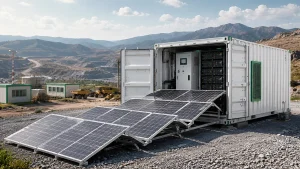
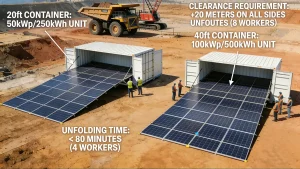
We manufacture containerized solar and storage systems in Shanghai for projects with different logistics routes, climates, and power-access conditions. Our documented Ukraine 46 kWp / 50 kWh foldable photovoltaic container project supported community, medical, emergency, and communications applications in an unstable-grid context. Our Sudan 40-foot foldable photovoltaic energy-storage project addressed unreliable grid conditions for critical local loads. These project descriptions show why the operating model matters alongside equipment selection; they are not evidence of a particular maintenance outcome, uptime figure, or service level.
For related planning decisions, review our deployment risk assessment guide, container BESS fire-safety guide, and emergency energy solution.
Next step: Send us the project country, site communications options, critical-load profile, access constraints, preferred support model, and expected local support capability. We will identify the remote O&M evidence that should be resolved before procurement.
Disclaimer: This article provides general procurement and engineering information, not legal, cybersecurity, emergency-response, insurance, or operating advice. System configuration, local law, site access, network conditions, service contracts, and Authority Having Jurisdiction requirements vary. Use the approved project documents and qualified professionals for project decisions.
Last Updated on 07/30/2026