Start With the Date That Actually Matters
There is no responsible universal answer in days. For a buyer, the relevant date is not when a container leaves the factory or reaches a port; it is when the system has passed the agreed site acceptance tests and the operator can take it over. A workable solar container deployment timeline therefore separates engineering, site readiness, manufacturing, FAT, transport, installation, energization, commissioning, and handover. Several of these streams can move at the same time, but an unresolved gate can hold the whole project.
Ask every shortlisted supplier for separate planning windows and assumptions for each phase—not one headline “delivery time.” The final calendar depends on the destination, site status, authority and interconnection path, contract scope, carrier availability, and the local installation team.
For the broader system-selection context, start with our Off-Grid Solar Container Systems guide. This article addresses the project path after a buyer decides that a containerized system may fit the site.
Buyer conclusion: Treat the quoted manufacturing window as only one workstream. Ask for a critical path that shows design freeze, site readiness, FAT, shipment release, logistics, installation, energization, performance testing, and final handover—with an accountable owner for each gate.
The Project Does Not Start When the Container Arrives
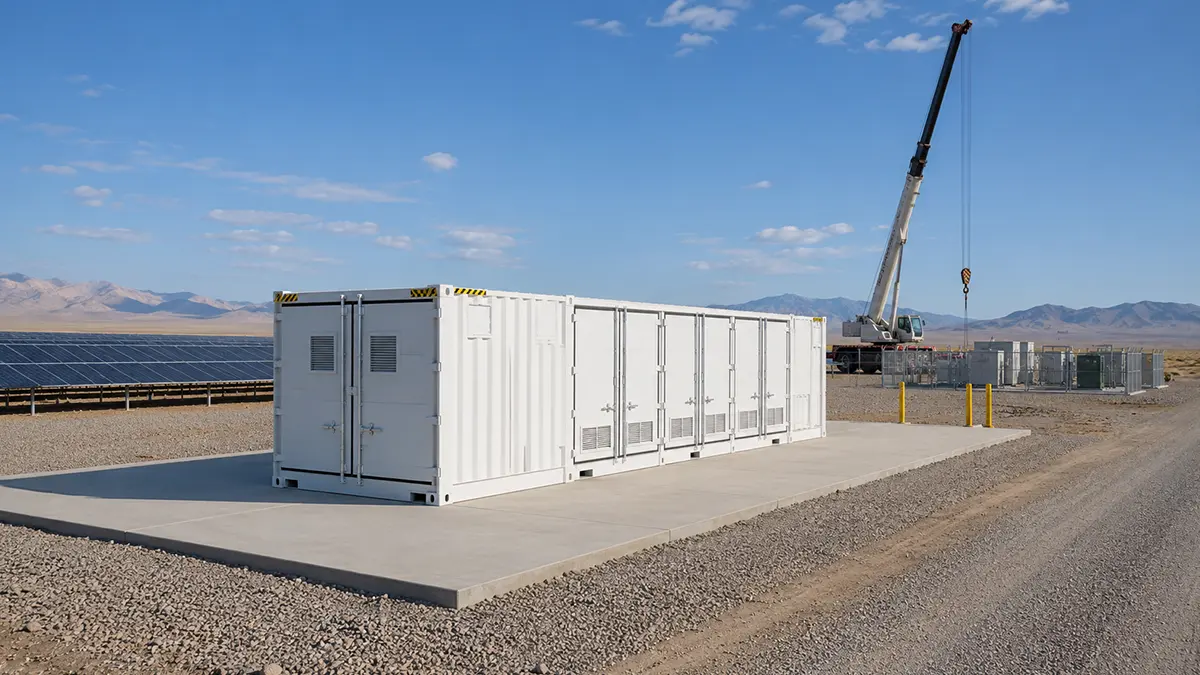
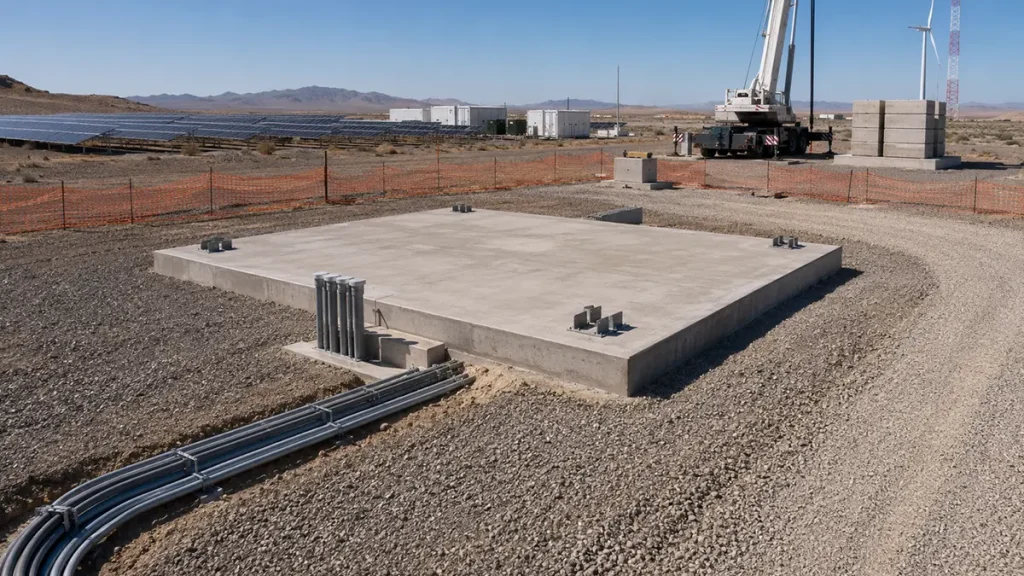
Containerization can reduce field assembly because major equipment is integrated and tested before shipment. It does not remove the work that belongs to the destination project. Foundation design, crane access, local electrical scope, permit path, shipping documents, commissioning roles, and an approved operating handover can still determine the date on which the asset becomes usable.
As a general BESS construction sequence, Enel describes permitting and land suitability before foundations, container and crane arrival, installation, inverter wiring, safety devices, grid connection, and entry into operation. That sequence is useful because it makes the site interface visible. It is not a universal duration model for a solar container project.
| Project state | What has happened | What it does not prove |
| Design frozen | The configuration, site inputs, interfaces, and delivery responsibilities are agreed. | That permitting, civil works, or logistics are complete. |
| FAT released | The agreed factory test evidence and shipment documents are accepted. | That the destination site is ready or that site acceptance testing is complete. |
| Delivered to site | The system reaches the destination and is placed or staged. | That it has been installed, connected, energized, or accepted. |
| Mechanically and electrically complete | Physical installation and agreed electrical work are complete. | That controls, protection, communications, operating modes, and performance are accepted. |
| Operational handover | SAT evidence, issue closure, training, documents, and responsibility transfer are completed as agreed. | That every future operational or regulatory issue is eliminated. |
Build the Timeline Around Five Workstreams
| Workstream | Typical gates | Who commonly owns the next action |
| 1. Engineering and scope | Load profile, PV/storage configuration, grid parameters, foundation loads, single-line diagram, responsibility matrix. | Buyer and EPC confirm site inputs; we document the agreed equipment boundary. |
| 2. Site and approvals | Land/access review, civil works, lifting plan, permits, local code and authority interface. | Owner, EPC, civil contractor, local engineer, and relevant authority. |
| 3. Factory and shipment | Design release, procurement, assembly, FAT, packing, shipping documents, carrier booking. | We manage agreed factory deliverables; buyer and logistics parties confirm commercial and import interfaces. |
| 4. Transport and installation | Port/route planning, customs, last-mile delivery, crane coordination, placement, local connections. | Freight parties, buyer, EPC, site contractor, and local installer. |
| 5. Commissioning and turnover | Mechanical checks, energization readiness, controls, communications, performance tests, SAT, training, document handover. | Supplier, EPC, owner, operator, and grid or local authority participants as applicable. |
Some workstreams can run in parallel. For example, a buyer may complete civil design, import planning, and the communications plan while the factory is building the system. The hard gates are different: a site cannot be energized before the required physical, electrical, control, and safety conditions have been accepted for that project.
FAT Is a Shipment Gate, Not the Finish Line
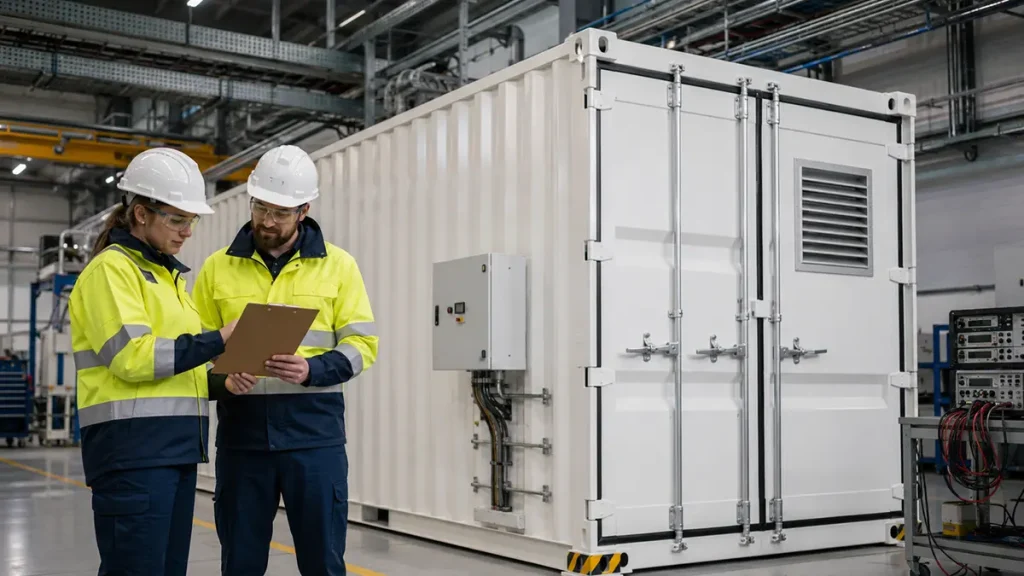
Factory acceptance testing (FAT) should confirm the agreed functions and documentation before shipment. It is where the buyer can witness or review the defined equipment logic, alarm paths, operating modes, records, and outstanding issues within the factory test scope. The final FAT agenda must match the delivered configuration and contract—not a generic checklist.
For RFQ structure and evidence requests, use our Containerized Solar BESS RFQ Guide. For transport documents and classifications, use our Lithium Battery Shipping Compliance Guide. Both should be resolved before a supplier, buyer, and carrier treat the system as shipment-ready.
FAT cannot prove that the concrete pad has been built correctly, a port will clear cargo without delay, a local network will work, or a local grid interface has been approved. Those are destination-project gates. A schedule that calls FAT “commissioning complete” hides risk rather than removing it.
Commissioning Is an Evidence Chain
The Sandia / DOE energy-storage commissioning chapter provides a primary technical reference for commissioning. A practical industry guide from Bluerithm also separates pre-commissioning, mechanical/safety readiness, electrical checkout, controls and communications validation, integrated performance testing, and turnover. These are useful evidence categories; their exact order, tests, and acceptance criteria must be set by the project documents.
| Commissioning layer | Evidence the buyer should expect | Schedule risk if unresolved |
| Mechanical and safety readiness | Installed-condition checks, access, clearances, labeling, cooling and safety-interface checks where applicable. | Energization may be delayed or unsafe to attempt. |
| Electrical readiness | Approved drawings, grounding and polarity checks as applicable, protection/settings verification, authorized energization sequence. | Equipment may not connect or operate as designed. |
| Controls and communications | BMS, PCS, EMS/SCADA signals, alarms, permissions, time sync, remote-support boundary. | The system may be electrically live but not operable or supportable. |
| Integrated performance | Agreed charge/discharge, operating modes, fault response, and site-interface tests. | Contractual or operational capability remains unproven. |
| Turnover | Open-issue process, as-built records, training, warranty contacts, spares and operating documents. | The owner receives hardware without an accountable operating handover. |
Use Project Evidence, Not Generic “Fast Deployment” Claims
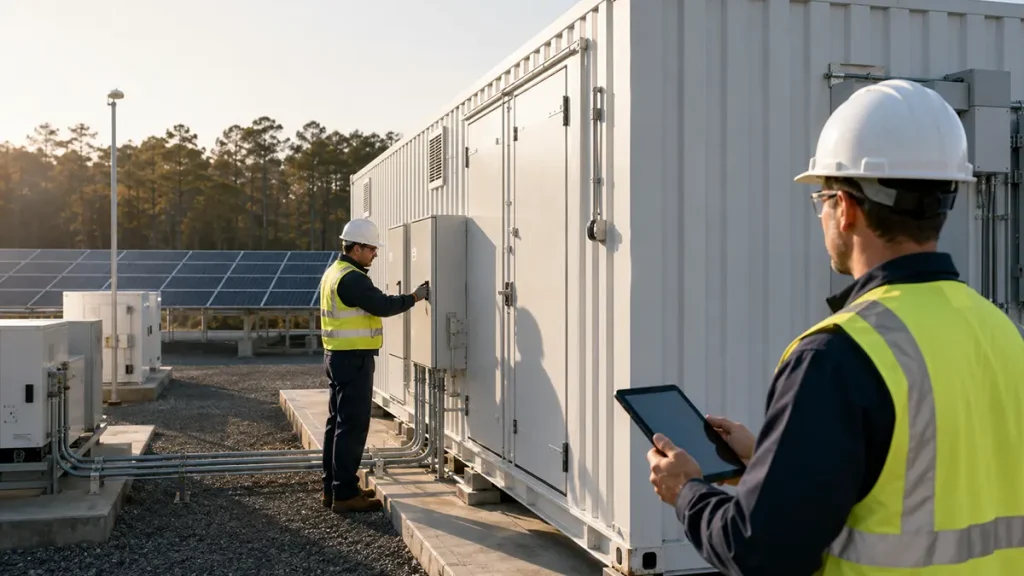
Our foldable PV energy storage containers have been deployed in Sudan, Romania and Ukraine for off-grid, emergency and unstable grid scenarios. Detailed full-cycle project schedules are not available on public case pages.
The missing calendar is itself a useful procurement lesson. Site access, import procedure, civil scope, local labor, weather, grid interface, and authority requirements can differ materially between projects. A credible supplier should explain the assumptions behind its submitted schedule instead of borrowing an attractive number from another deployment.
What to Put in the RFQ Schedule Pack
| Request | Why it belongs in the RFQ | Responsible review |
| Milestone plan with assumptions | Separates supplier manufacturing dates from buyer, EPC, logistics, and authority dependencies. | Buyer project manager and supplier. |
| Responsibility matrix (RACI) | Names who is Responsible, Accountable, Consulted, and Informed for every critical interface. | Buyer, EPC, supplier, logistics provider. |
| Site-readiness checklist | Captures foundation, lifting access, electrical interface, communications, safety access, and local support requirements. | Owner, EPC, civil/electrical contractors. |
| FAT plan and release criteria | Defines test scope, witness points, punch-list handling, shipment documents, and design-change controls. | Supplier and buyer technical team. |
| Logistics and import document list | Identifies classification, carrier inputs, consignee details, customs responsibility, route constraints, and timing dependencies. | Buyer, freight forwarder, supplier. |
| SAT and handover plan | Defines test evidence, energization prerequisites, training, open-item closure, documentation, and acceptance signatures. | Owner, EPC, supplier, operator. |
Use our Solar Container Deployment Risk Assessment alongside this list. A project schedule should visibly carry its logistics, site-readiness, technical, and operational risks; it should not hide them in a supplier note.
Five Situations Where You Should Not Promise “Fast Deployment”
- The foundation, ground condition, crane route, or last-mile delivery route has not been checked for the actual container and lifting arrangement.
- The site has not confirmed voltage, frequency, phase arrangement, earthing, generator interface, grid-code obligations, or the entity responsible for electrical design.
- Permitting, local authority, fire-service, environmental, import, or interconnection interfaces are still undefined.
- The project has not assigned FAT, shipment release, site acceptance testing (SAT), training, punch-list closure, and final-handover responsibilities.
- There is no realistic local installation, access, communications, or support plan after delivery.
For the operating model after handover, read our remote BESS maintenance guide. A delivered container is not a finished project if no one owns alarms, access, spares, communications, and escalation.
Our Role: Make Assumptions Visible Before the RFQ Is Issued
We design and manufacture containerized solar and storage systems from Shanghai for international projects with different logistics routes, climates, grid conditions, and operating models. Our role is to provide an agreed equipment configuration, factory evidence, shipment documentation within the contract scope, and technical input for the project plan. The owner, EPC, local engineers, carriers, insurers, and relevant authorities retain responsibilities within their own scope.
Next step: Send us the destination country, required energization date, site status, load profile, grid or generator interface, intended logistics route, and local installation capability. We will identify the delivery assumptions and evidence that should be resolved before you issue the RFQ.
Project schedules, permits, freight, customs, and energization dates remain project-specific. Before contract award, confirm the schedule with the responsible owner, EPC, qualified local engineers, logistics providers, carriers, and relevant authorities.
Last Updated on 07/30/2026