A battery energy storage system (BESS) insurance submission is stronger when it makes the project legible: the proposed configuration, site context, responsible parties, evidence scope, operating plan, and unresolved risks should be easy for a broker or insurer to trace. That preparation does not guarantee coverage, price, terms, or an underwriting outcome. The broker and insurer decide what information they need and whether a particular risk is acceptable.
For an owner, developer, engineering, procurement, and construction (EPC) team, or risk manager, the practical task is not to assemble a certificate folder. It is to build a revision-controlled information pack that distinguishes evidence already available from open project actions. A factory test record, for example, can support a defined factory-scope question; it does not establish site acceptance, authority approval, or insurance approval.

Start with the insurance question that the project team can actually answer
Before submission, agree whether the information request concerns construction, permanent operations, or both. An insurer may frame coverage differently across project phases. For example, Travelers describes BESS coverage categories that can apply across installation and permanent operations, including builders’ risk, permanent property and operations, and equipment breakdown. That description does not prescribe a coverage package: availability, terms, limits, exclusions, and suitability are policy-specific and project-specific.
The pack should also make the project boundary visible. State the intended site and operating use, the proposed equipment configuration and revision, the named project parties, and whether the submission is based on design-stage information, an installed asset, or an operating asset. Do not allow a generic product brochure to stand in for those project facts.
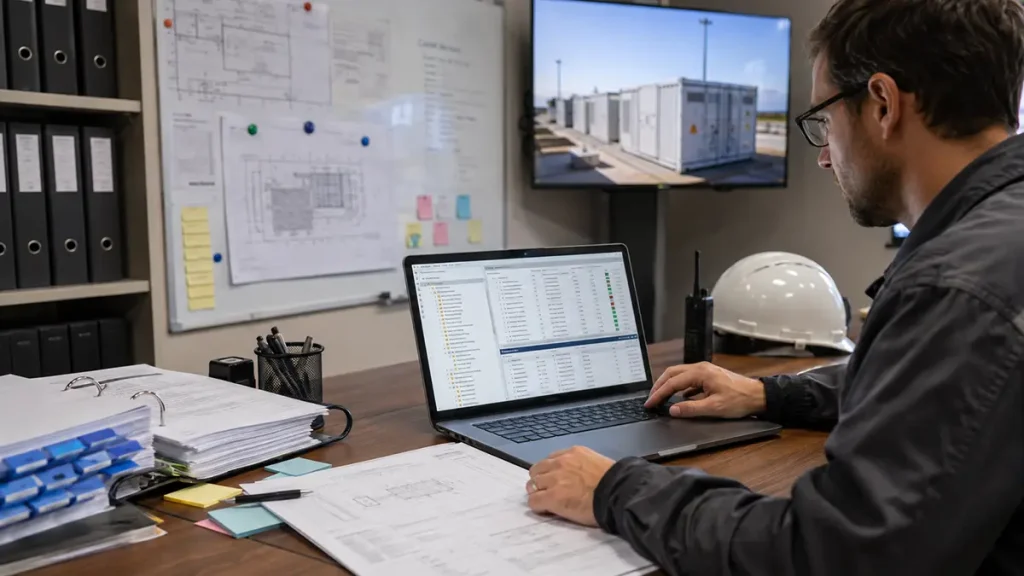
Use an Insurance Evidence Readiness Gate before submission
The gate below helps a project team organize information for broker or insurer review. It is not a universal insurer checklist. It is designed to expose missing evidence, unclear ownership, and unclosed changes before a request is sent.
| Evidence group | Submission-ready question | Useful controlled inputs | Readiness status | Named owner | Required action before submission | What it does not establish |
|---|---|---|---|---|---|---|
| Project basis and site context | Can the reviewer identify the location, intended use, project phase, interfaces, and responsible project parties? | Project basis, site plan, operating-use statement, responsibility list, controlled revision register | Ready / Open / Not applicable | Name the contracted party | State the missing controlled record, decision, or closure evidence. | That the insurer has accepted the risk or that a local authority has approved the installation |
| Configuration and design | Can the proposed equipment and site design be traced to the same controlled revisions? | Offer revision, equipment schedule, single-line diagram, general arrangement, interface schedule, deviation log | Ready / Open / Not applicable | Name the contracted party | State the missing controlled record, decision, or closure evidence. | That a product family document applies to every configuration or site |
| Safety and test evidence | Does each record identify the configuration and conditions it actually covers? | Report scope, test level, configuration comparison, stated assumptions, destination-market matrix | Ready / Open / Not applicable | Name the contracted party | State the missing controlled record, decision, or closure evidence. | Universal compliance, site approval, or a coverage decision |
| Construction and installation | Are site works, interfaces, commissioning scope, and open items assigned to named parties? | Civil/electrical scope, installation plan, interface register, commissioning plan, open-item register | Ready / Open / Not applicable | Name the contracted party | State the missing controlled record, decision, or closure evidence. | That construction risk is covered by a particular policy |
| Operation and response | Are monitoring, maintenance, alarm escalation, emergency response, and continuity responsibilities documented? | Operations plan, maintenance plan, alarm/escalation matrix, emergency-response plan, training and record plan | Ready / Open / Not applicable | Name the contracted party | State the missing controlled record, decision, or closure evidence. | A loss-prevention result or a guaranteed operational outcome |
| Changes and exceptions | Can the team show which changes, exceptions, and outstanding actions remain open? | Management-of-change log, exception register, due dates, closure evidence, decision owner | Ready / Open / Not applicable | Name the contracted party | State the missing controlled record, decision, or closure evidence. | That an insurer will accept an exception or deferred action |
This gate aligns with the kinds of questions in Aviva’s public BESS checklist, which addresses competent design and installation parties, standards and testing, site conditions, management of change, insurer/broker notification, emergency response, and business continuity. Those are Aviva’s public risk-control themes, not a universal insurer rule. Local requirements and individual insurance submissions can differ.
Keep evidence scope separate from an approval statement
A useful submission pack states what each document can support and what remains outside its scope. This prevents a common mistake: treating a test, certificate, commissioning record, or supplier statement as a complete answer to an insurer’s project-risk question.
For North American fire-safety discussions, a report may be tested in accordance with UL 9540A for the configuration and conditions stated in that report. It is not accurate to treat that test method as a blanket product certification or a universal approval. The project team should compare the tested configuration and stated assumptions with the proposed installation, then identify the remaining design, local-code, authority, and insurance actions.
The same distinction applies across the delivery chain. Factory evidence, contract-defined shipment release, site acceptance testing (SAT), operational acceptance, authority decisions, and insurer decisions are separate gates. A complete factory acceptance testing (FAT) record may be useful evidence, but it does not establish insurance approval. For the factory-to-site boundary, see our BESS factory acceptance testing guide.
Build a document pack around project decisions, not document names
A submission is easier to review when each document is attached to a clear project question. The U.S. Department of Energy’s BESS Procurement Checklist provides early-stage tasks, questions, and reference points for commercial-scale lithium-ion BESS procurement. It is not insurance underwriting guidance, but it is a useful reminder to define the project before treating documents as comparable.
- Project and site basis: Describe the intended use, location, project phase, key interfaces, and controlled design assumptions.
- Configuration control: Identify the offered configuration, document revisions, known deviations, and the process for approving substitutions or changes.
- Evidence register: For every report, test record, declaration, and drawing, state what configuration and condition it covers, who issued it, and what it does not answer.
- Installation and commissioning status: Separate planned work, completed work, site verification, outstanding prerequisites, and closure records.
- Operating controls: Record the named operator, maintenance responsibilities, monitoring and escalation path, emergency-response roles, and continuity planning inputs.
- Open-item control: List exceptions, their risk effect, responsible owner, due date, required closure evidence, and whether they block construction, energization, handover, or submission.
Do not fill gaps with unqualified statements such as “compliant,” “insurable,” or “approved.” If a document is still being requested, an engineering assumption remains unverified, or a site action belongs to another party, identify it as open.

Underwriting Submission Responsibility Map
The map below separates information ownership from the decision to insure. Replace generic role labels with the parties named in the project contract and insurance process.
| Submission activity | Responsible project party | Accountable decision owner | Key boundary |
|---|---|---|---|
| Define project use, site context, risk assumptions, and the insurance relationship | Owner / developer with risk manager | Owner / developer | The supplier cannot decide the insurance placement or accept project risk for the owner. |
| Provide site design, construction, interfaces, commissioning evidence, and project open-item status | EPC and responsible project specialists | Party named by the project delivery arrangement | Factory documents do not replace installed-site evidence or statutory review. |
| Provide controlled equipment information and contract-scope factory evidence | Supplier engineering and quality teams | Supplier project manager within contractual scope | Supplier evidence should identify its scope; it is not an insurer approval statement. |
| Define maintenance, monitoring, emergency operation, and recordkeeping in service | Operator / operations and maintenance provider | Owner / operator under the operating arrangement | An intended maintenance plan is not proof that a future operating control has been performed. |
| Compile the controlled evidence index, confirm document revisions and open items, coordinate broker submission, and track information requests | Owner / developer risk manager or named submission coordinator | Owner / developer | The coordinator controls pack completeness and traceability; the broker and insurer retain their respective advice, information-request, and underwriting roles. |
| State information requirements, assess risk, and make coverage decisions | Broker and insurer within their respective roles | Insurer for underwriting and policy decision | Neither EPC nor supplier can promise the insurer’s decision. |
| Review statutory, permit, or local safety matters where applicable | Authority having jurisdiction (AHJ) / local authority and named project specialists | Authority or other legally responsible party | Authority action and insurance action may inform each other but are not the same decision. |
For award-stage interface control before this insurance pack is assembled, use our containerized BESS EPC interface review. It separates configuration, site interfaces, evidence, delivery, and commissioning decisions before the project treats an equipment offer as an integrated project solution.
When to pause a submission
Pause and clarify when the proposed configuration cannot be matched to its evidence, when site, installation, or operating roles have no named owner, or when a material change has not been assessed. Pause as well when an emergency-response or maintenance input is assumed but undocumented, or when a team asks a supplier record to prove a decision reserved for an insurer, authority, or responsible project professional.
Pausing does not mean the project cannot proceed. It means the submission should identify the open item, its owner, the evidence required for closure, and whether the broker or insurer needs that closure before further review.
Prepare a BESS insurance evidence pack for broker review
For a supplier-facing response, keep configuration information and any factory-scope records clearly identified by revision, configuration, and contractual scope. The owner, EPC, operator, broker, insurer, AHJ, and responsible project professionals retain decisions within their respective scopes.
Send the project location, intended operating use, project phase, proposed configuration, current evidence index, and open-item register (or the known open items if no register exists). Use the resulting evidence register to structure a broker or insurer discussion. This discussion does not constitute insurance placement, legal advice, site approval, or fire-protection design approval.
Request a BESS Configuration & Evidence Review
Last Updated on 08/14/2026