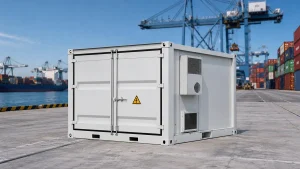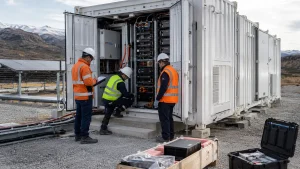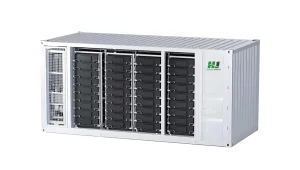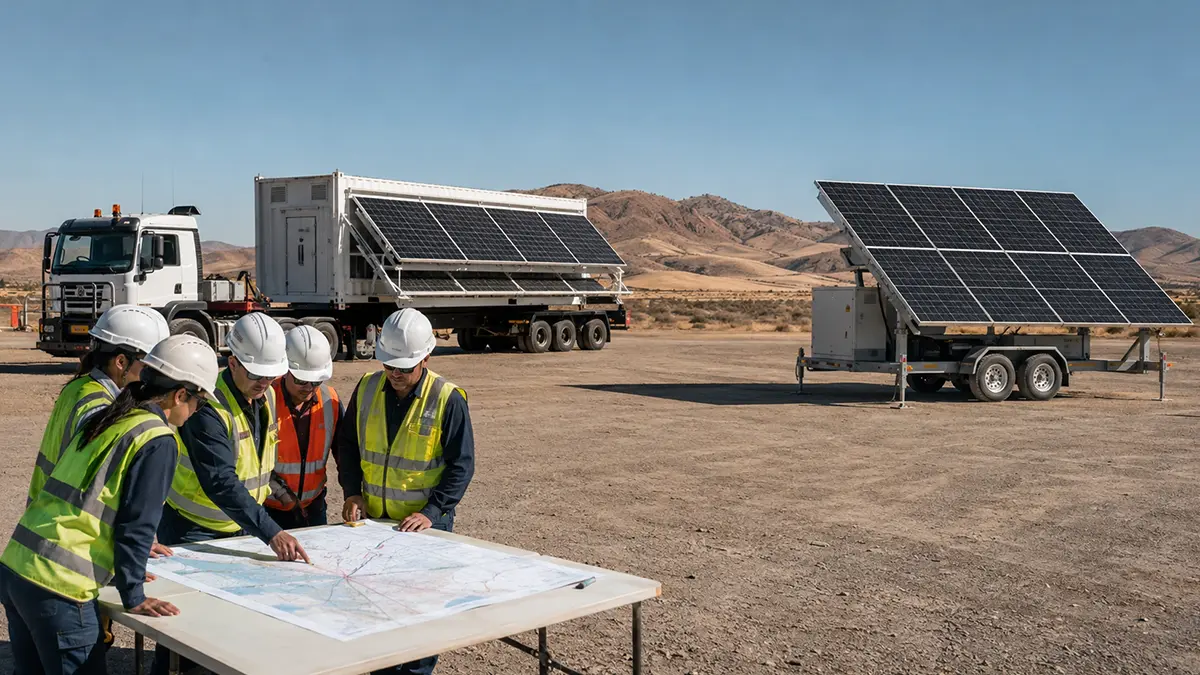
Choose a foldable solar container when the project needs an equipment package managed through freight, lifting, placement, and on-site integration workstreams. Choose a trailer-mounted solar system when road towing, tow-vehicle availability, repeat short-distance moves, parking geometry, and trailer-specific operating conditions are already defined. Neither form factor settles the power design on its own. The project still has to define the load, critical loads, PV and storage scope, site electrical interface, deployment area, weather operating rules, and responsibility for transport through acceptance.
For many temporary or remote sites, the strongest answer is not a generic preference for a container or a trailer. It is a documented choice of asset form for a defined operating role: construction power, temporary field power, an expandable microgrid module, emergency reserve, or a relocatable support asset. Start by comparing the work the project must perform—not a brochure label.
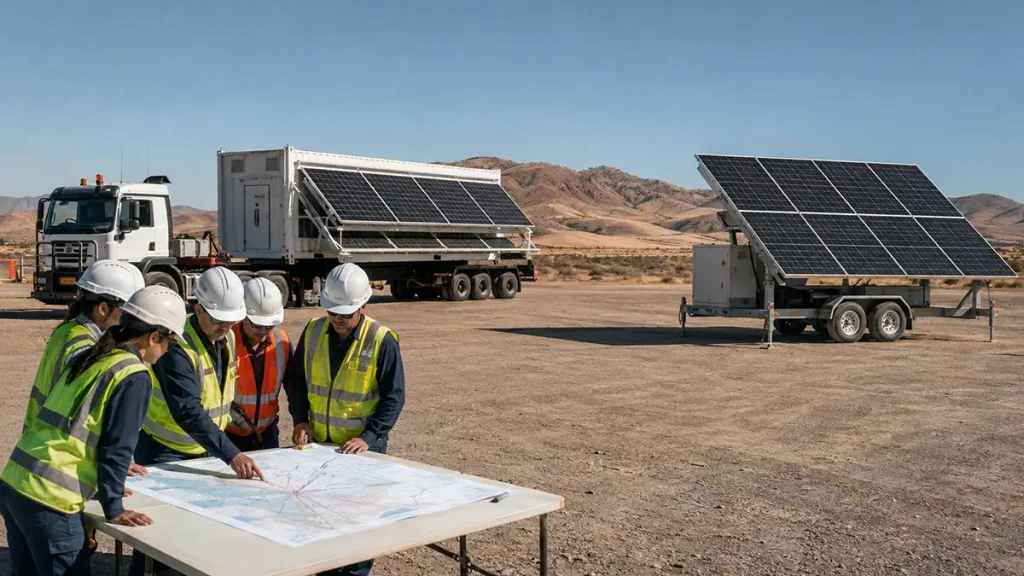
First, separate the equipment form from the power-service scope
A trailer can carry PV equipment, storage, distribution, surveillance equipment, charging equipment, or a combination. A container can house or transport PV, power conversion, storage, controls, protection, and auxiliary equipment in several different arrangements. The word mobile does not tell a buyer what is actually included, what must be supplied at site, or how the system will serve the load after placement.
Before comparing price or transport method, define the same power-service boundary for both alternatives:
- Which loads must be supplied, and which are critical?
- What PV capacity, energy storage, inverter or power-conversion capacity, backup generation, and distribution are included?
- What remains a site scope: foundations or hardstand, cabling, earthing, trenching, transformer, switchgear, fuel, communications, testing, and commissioning?
- What operation is required during daylight, after dark, under low solar resource, and during a generator or grid outage?
- What happens to the asset after the project changes location or the permanent power arrangement changes?
A product comparison is unreliable when one supplier quotes PV hardware and transport only while another includes storage, distribution, controls, field electrical works, and a commissioning visit. Put every inclusion, exclusion, allowance, and dependency in the same supplier-response sheet. Our containerized energy-storage technical specification checklist and RFQ guide for containerized solar BESS can help define that boundary without turning an early assessment into a fixed engineering design.
Use the Mobility-and-Site Fit Screen
Answer the following questions before selecting a form factor. A “yes” does not produce an automatic recommendation; it identifies the input that must be verified in the transport plan, site assessment, quotation, or operating procedure.
| Decision input | Why it matters | What to request before selection |
|---|---|---|
| Primary transport route | Road towing, truck transport, sea freight, and mixed-mode logistics impose different constraints on the asset and its supporting equipment. | Origin-to-site route review, transport mode, loading method, responsible carrier, and any unresolved route constraints. |
| Move frequency and distance | A one-time placement, seasonal redeployment, and repeated short-distance moves create different handling, labor, inspection, and outage requirements. | Expected moves, distance, timing, demobilization rule, and who restores the former site. |
| Towing and road boundary | A trailer route depends on an appropriate tow vehicle, driver, roads, parking, turning space, and applicable local requirements. | Vehicle and coupling compatibility, responsible towing party, route suitability, and confirmation of applicable local requirements. |
| Lifting and placement boundary | A container route may depend on crane or forklift access, unloading geometry, a hardstand, and safe placement work. | Lift plan, equipment capacity, set-down location, ground condition, access route, and named responsible party. |
| Deployed footprint | Fold-out PV needs clear space, access, drainage, cable protection, and a planned stow condition; these are site-specific inputs. | Stowed and deployed layout, ground and drainage review, shading review, access corridor, and wind/storm operating procedure. |
| Power-service boundary | Mobility does not establish whether storage, backup, distribution, controls, or site commissioning are included. | Single-line basis, equipment schedule, interface list, operating modes, exclusions, and acceptance scope. |
| Asset role after the project | A retained backup asset, a transferred unit, a rental asset, and an end-of-life asset have different commercial and operating consequences. | Ownership after use, relocation plan, maintenance responsibility, residual role, and end-of-life allocation. |
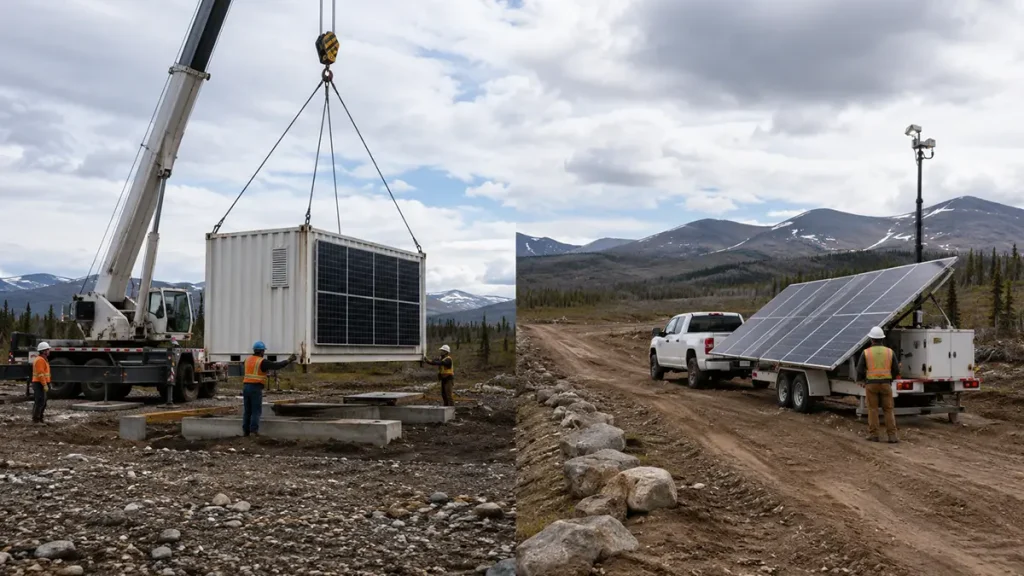
What foldable deployment does—and does not—mean
Foldable PV deployment packages modules and supporting structures for compact transport and subsequent unfolding or extension at site. It also creates its own engineering questions: deployed geometry, ground conditions, wind limits, hinges, rails, cables, connectors, earthing, repeated deployment cycles, and storm-stow conditions. The U.S. Department of Energy Federal Energy Management Program construction and commissioning guidance is useful general context for why construction, testing, and acceptance remain project activities rather than equipment labels.
Do not infer a universal deployment time from the word foldable. Any deployment-time statement needs a defined start and end point, crew, handling equipment, site preparation, weather condition, electrical test boundary, and commissioning rule. Transport, deployed operation, and storm stow may also have different structural limits.
For product-specific context, the published HJ-FESS solar-container configuration table lists six foldable-PV variants across 8–40 ft container sizes, 24–182 kWp PV, and 20–200 kW string-inverter configurations. Its published energy-storage field is shown as “/” for every listed variant. Treat HJ-FESS as a foldable PV-generation product unless separate verified documentation defines storage or another operating capability for the configuration under review.
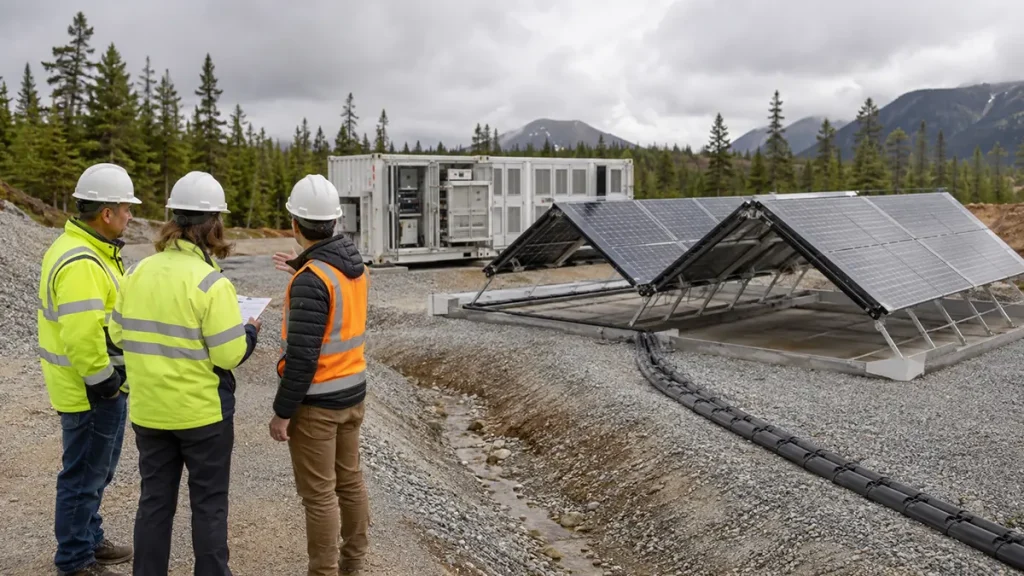
Trailer choice needs its own transport and operating evidence
Trailer-mounted equipment may be appropriate when a project has a defined towing route, suitable vehicle, available driver, established parking and deployment locations, and a short-move operating pattern. Those conditions should be verified for the particular trailer and jurisdiction. They cannot be assumed from an image of a solar trailer or from a supplier statement that a unit is “road-ready.”
Ask the trailer supplier for the exact equipment configuration, stowed and deployed dimensions, coupling and vehicle requirements, axle and braking information where applicable, operating and stow conditions, required stabilizers or ground supports, maintenance requirements, and the division between delivered equipment and site electrical work. Then ask the project transport owner to confirm the actual route and operating plan. This does not replace applicable local road, safety, electrical, or site-approval processes.
Compare the two forms by project pattern
The following directions are not universal recommendations. They are prompts for which alternative should enter a controlled technical and commercial comparison first.
| Project pattern | Form factor to investigate first | Why the project should investigate it | What could reverse the preliminary direction |
|---|---|---|---|
| Site is reached through freight or mixed logistics, then remains in one location for a defined work phase. | Foldable solar container | This route lets the project assess the asset as a freight and placement package rather than a towing asset. | Lifting access, hardstand availability, available deployment area, or the need for frequent short road moves. |
| Site makes repeated short road moves using a defined towing operation and has predictable parking locations. | Trailer-mounted solar system | The project may benefit from an asset form built around towing and repeat placement. | Tow-vehicle availability, route constraints, extended stationary operation, required power-service scope, or sea-freight needs. |
| Remote temporary site requires power but transport, lifting, towing, and electrical interfaces are not yet assigned. | Neither—complete the route review first | The major risk is purchasing equipment before the logistics and service boundary are defined. | Written route plan, site survey, load basis, responsibility map, and comparable supplier inputs. |
| Semi-permanent site needs a power asset that may later become backup, peak support, or a relocated asset. | Both, with a staged power plan | The final choice depends on how the asset will be transported, retained, and electrically integrated after the initial phase. | Actual future ownership, permanent-power schedule, maintenance plan, and project-life assumption. |
A container and trailer can both be part of a staged site plan. For example, an owner may use a temporary mobile asset during construction and later retain it for critical-load support while permanent infrastructure changes. That decision must include the same utility, generator, site-distribution, maintenance, and acceptance boundaries that apply to any other power route.
Assign responsibilities from transport through acceptance
The route is not complete when the system reaches the gate. The owner should name the party responsible for each activity before equipment release.
- Owner or developer: project load basis, commercial route, scope decisions, site access authority, budget authorization, and acceptance requirements.
- Carrier or towing party: agreed transport method, loading/transport actions within contract scope, and route execution; this does not make the carrier responsible for site electrical integration.
- EPC or electrical contractor: site electrical design and works assigned by contract, cable and earthing interfaces, testing, and commissioning support.
- Supplier: contracted equipment and factory deliverables, subject to the agreed specification and delivery scope.
- Site operator: operating procedure, access control, planned inspections, stow actions, and maintenance responsibilities assigned after handover.
- Authorities and utilities: their respective determinations, permits, approvals, road requirements, utility authorizations, or site conditions through the applicable processes.
For the container-side portion of the comparison, use the solar-container delivery checklist to review route, crane, and offloading inputs, and the site requirements guide to review access, ground, drainage, and foundation considerations. These pages do not provide a trailer approval or substitute for a trailer-specific route review.
Use published projects as configuration context, not a shortcut
Our published Romania solar-container case records four 10 ft foldable PV containers totaling 184 kWp and five 215 kWh energy-storage cabinets totaling 1,075 kWh. It is a project-specific configuration record, not a standard HJ-FESS model and not evidence that any trailer, container, transport route, deployment timeline, cost, approval, or operating result will fit another site.
If your decision is primarily about fixed versus foldable PV mounting on a remote industrial site, see our foldable versus fixed solar-panel guide. This article instead addresses the earlier mobile-equipment question: what asset form, logistics route, and power-service scope should be compared before a supplier is selected.
What to submit for a mobile power configuration review
Pause before requesting final prices if the site cannot yet state its transport route, expected move frequency, load profile, critical loads, deployment area, site electrical interface, or project duration. The appropriate next step may be a scoped configuration review rather than a product order.
Request a Mobile Power Configuration Review
Last Updated on 08/11/2026