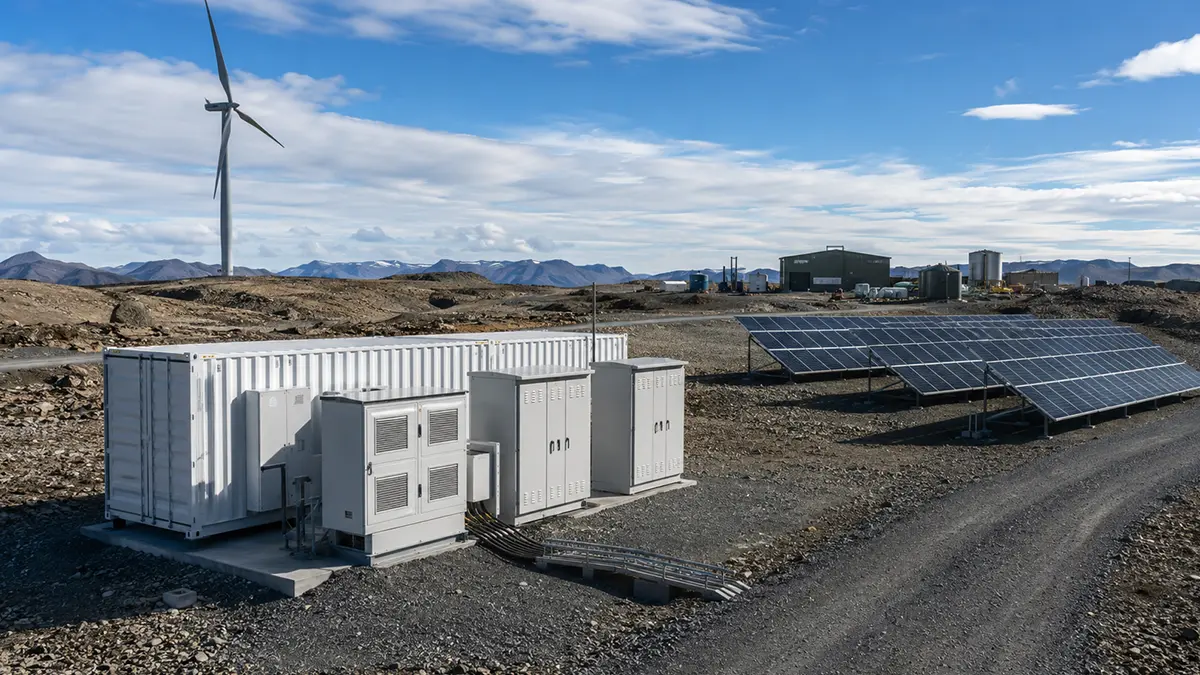
For a remote industrial site, wind should remain a pre-award architecture option until the project can show what it changes in the operating concept—and who owns the resulting site, controls, maintenance, and approval interfaces. A turbine is not simply a second renewable input beside PV.
This page helps industrial buyers assess wind solar BESS integration at remote sites before award. It covers the decision to add wind, not turbine procurement or wind-resource services. For the specific site, the responsible project parties must establish turbine selection, yield modelling, electrical design, controls, installation, permitting, maintenance, and any commitments on operating results, runtime, or savings.
Start with the existing remote-power route: industrial mobile-power infrastructure explains the broader choices. Then decide whether site-specific wind evidence changes the PV-storage architecture enough to justify a wind workstream.
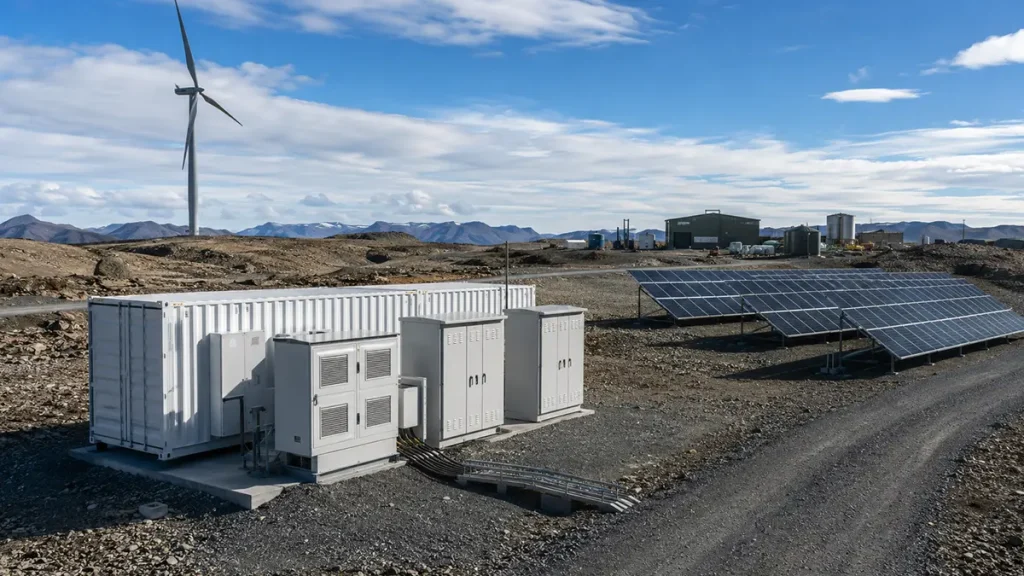
First decide what wind is meant to change
The decision is not whether wind and solar can coexist. It is whether wind has a defined job that changes the project’s energy, reserve, operating, or end-state logic. If the team cannot write that job down, the wind route is still a proposal to investigate, not an architecture to procure.
For a remote industrial site, begin with four questions:
- Which load is critical, continuous, shift-based, flexible, or allowed to interrupt?
- What is the PV and BESS arrangement already expected to do?
- What evidence supports the local wind-resource assumption at the intended turbine location and height?
- Which party will carry the wind-specific civil, electrical, control, access, maintenance, authority, and end-of-project work?
This keeps the wind question connected to a real site decision rather than to a generic hybrid-system label. The related solar-container battery architecture guide can help separate the battery decision from the decision to add another generation source.
Illustrative operating concepts — not design recommendations
These three concepts show possible source roles, not dispatch instructions, sizing rules, performance forecasts, or recommended architectures. The project team must set the actual sequence, protection, controls, equipment selection, and acceptance criteria using its load study, wind-resource work, equipment documentation, contract, applicable requirements, and responsible authority.
| Operating concept | Possible source roles | Wind workstream is worth advancing when | Questions to close before procurement |
|---|---|---|---|
| PV-led operation with a wind contribution | PV may serve the defined daytime contribution; wind may contribute when actual site conditions permit; BESS may have a defined transition or reserve duty. | The resource basis identifies a defined contribution or reserve role that materially changes the PV-storage operating concept. | What evidence supports the wind assumption? Which load or reserve duty changes when wind is unavailable? Who approves the control and protection sequence? |
| Mixed wind-PV generation with BESS buffering | PV and wind may each contribute under project-defined conditions; BESS may be assigned a defined mismatch, transition, or reserve duty. | The team can assign one owner for the cross-source controls, protection, curtailment, and commissioning interfaces. | Which party owns communications, curtailment logic, alarms, protection coordination, and commissioning evidence? What remains the backup route? |
| BESS-led short-duration critical-load window | BESS may supply a defined short-duration duty; PV and wind may be charging inputs when available; the project must identify its separate backup or exceptional-condition route for longer events. | The critical-load window and exceptional-condition backup route are defined; wind is not being used as an unspecified resilience assumption. | What starts the exceptional-condition response? What evidence defines critical-load priority, handover, testing, and return-to-service? |
Wind-Addition Fit-Test Checklist
Use this as an owner-led pre-award checklist. Transfer each row into the project’s bid-clarification or interface log, assign an accountable party, and record its project status there. It is a decision aid, not a completed engineering design or legal allocation.
| Decision area | Evidence to request | Accountable party to assign | Suggested project status | Decision consequence |
|---|---|---|---|---|
| Resource basis | Location, intended turbine position and height, assessment method, data period, terrain context, and seasonal limitations | Owner to assign | Ready / Open / N/A | Without a defined basis, the project cannot tell whether wind changes the architecture or only adds an untested assumption. |
| Load boundary | Critical-load definition, operating schedule, peak and transition conditions, interruption tolerance, and any separate backup route | Owner to assign | Ready / Open / N/A | Prevents a renewable-generation discussion from standing in for a duty definition. |
| Site works | Layout, access, lifting, foundation or anchoring route, cable route, setbacks, drainage, and construction interfaces | Owner to assign | Ready / Open / N/A | Shows whether turbine works fit the site plan rather than being added after container placement. |
| Control and protection | Single-line boundary, communications ownership, protection study responsibility, curtailment or alarm assumptions, commissioning and acceptance records | Owner to assign | Ready / Open / N/A | Makes the integration handoff visible before vendors price incompatible scopes. |
| Operations and maintenance | Inspection access, safety process, service responsibility, spare-parts documentation, fault-response route, and operator handover | Owner to assign | Ready / Open / N/A | Tests whether the project has a workable operating boundary after site acceptance. |
| Authority route and end state | Applicable planning, environmental, aviation, electrical, utility, or local review questions; retain, relocate, decommission, or permanent-power transition decision | Owner to assign | Ready / Open / N/A | Keeps a temporary or remote deployment from assuming its own approval or end-state path. |
Use the result: Continue the wind workstream only when the resource basis, operating role, site route, controls owner, and authority/end-state route are Ready or have a named, bid-closeable owner. If any of those items remains Open without an owner and closure record, keep wind outside the awarded PV-storage scope and log it as a separate investigation item.
The site-selection issues are not limited to wind speed. DOE’s WINDExchange identifies wind-resource potential, proximity to power lines, and potential environmental impacts among the considerations for a wind location. Those are starting prompts, not a universal approval checklist.
Ask for evidence by interface, not by component
A turbine data sheet, PV proposal, and BESS proposal can each be useful within their own boundaries. The buyer still needs to see how the boundaries meet. Ask each bidder to identify the documents it will provide and the party that will close each interface.
| Interface | Pre-award question | Record to name |
|---|---|---|
| Wind-resource and site route | Who supplies the assessment basis and identifies the site-work assumptions? | Resource/siting record and interface register |
| PV, wind, BESS, and backup-source roles | What normal, transition, and exceptional-condition roles are assumed? | Operating-concept record and load-boundary schedule |
| Controls and protection | Who is responsible for the final controls, communications, protection, test sequence, and change control? | Responsibility matrix and commissioning plan |
| Site acceptance and handover | What demonstrates that the agreed scope has been installed, tested, documented, and handed to the operator? | Project-specific acceptance and handover record |
For a commercial-scale microgrid, DOE describes its Microgrid System Project Development Checklist as a resource spanning planning, design, procurement, and implementation. DOE also publishes a customizable template for on-site wind-turbine installations for federal agencies. These resources can inform an evidence request; they do not replace the project’s specification, engineering, contractual responsibilities, or local approvals.
When wind is not yet an award-ready route
Keep wind as an investigation item rather than an awarded scope when the resource basis is incomplete, the turbine location has no workable site plan, or the operating role is still generic. The same applies when the controls owner is unassigned, the maintenance route is unknown, or the authority path is unresolved. In those cases, the PV-storage route may still be evaluated on its own evidence. The wind, snow, and weather verification guide is a separate check for the container and PV installation; it does not establish turbine suitability.
Request a Remote Hybrid Architecture Review
Share the country and operating scenario, load profile and critical-load definition, existing PV-storage assumptions, the current wind-resource assessment basis and any candidate-turbine interface information, site-access and authority constraints, and the permanent-power end state. Use those inputs to identify how they affect the PV-storage architecture, evidence request, and interface record. Wind-resource assessment, turbine selection or supply, installation design, approvals, and commitments on yield, runtime, savings, or performance require project-specific responsible parties.
Where the submitted information is sufficient, use it to prepare a project-specific architecture-input summary: the proposed PV-storage operating role, the wind-related evidence and interface questions still open, and a responsibility-record format for bid clarification. Any supplier review scope and deliverable must be agreed for the project. This page is not a turbine recommendation, design package, permit submission, or performance study.
Request a Remote Hybrid Architecture Review
Last Updated on 08/14/2026