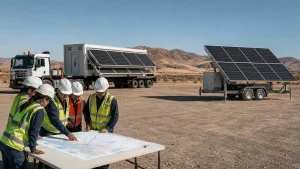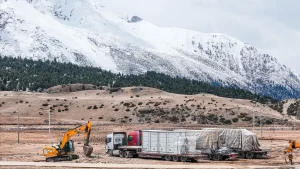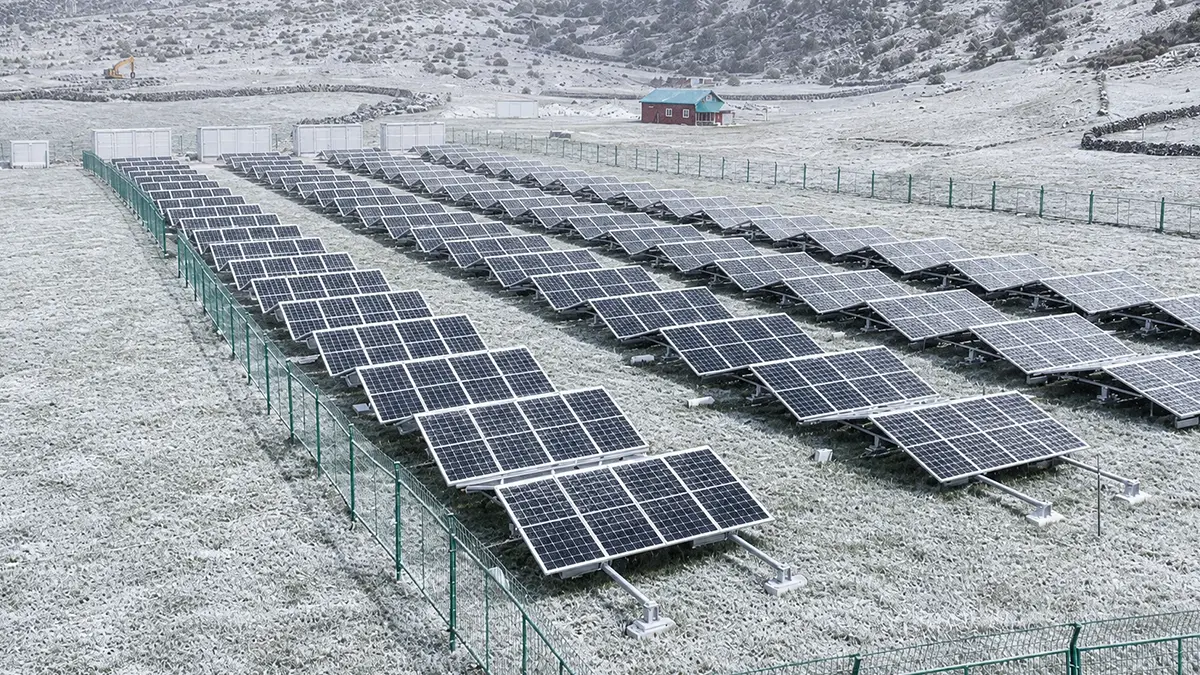
A solar container has no single weather rating. Verify wind and snow limits separately for each operating state—transport, stowed, unfolding and running—and ask for design values in wind speed (m/s or km/h) and load (Pa or kN/m²) with their test basis, not a marketing “level.” If a supplier cannot state those numbers in writing, treat the weather performance as unverified until a site-specific engineering review is completed. For how a solar container is packaged and deployed, see how solar powered shipping containers combine a transportable enclosure with fold-out generation and, in some configurations, battery storage.
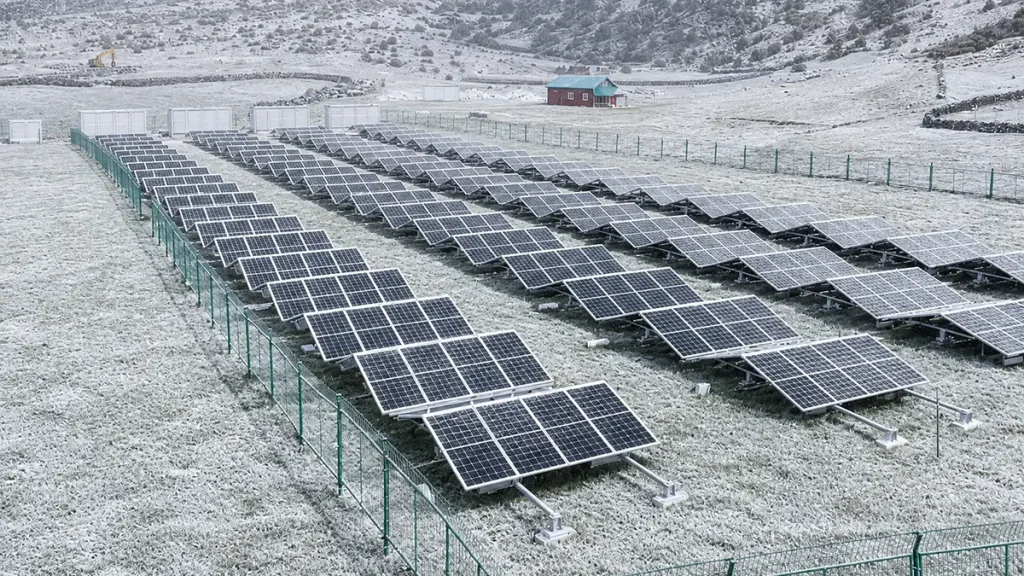
Why “Level 8 Wind Resistance” Is Not a Specification
Spec sheets and FAQ pages sometimes describe containers as “Level 8 wind resistant.” If that claim refers to Beaufort Force 8, it corresponds to a mean wind speed of approximately 63–75 km/h (34–40 knots), a gale, according to the Hong Kong Observatory Beaufort scale table. But the phrase “Level 8” by itself is not a structural design specification unless the referenced scale, averaging period and design basis are stated. A claim expressed in levels cannot tell you whether the array can operate in your site’s design wind, whether the folded container can survive a storm, or whether the unfolding procedure is limited to a lower speed.
Convert every wind claim into the wind metric used by the applicable design basis. Record the averaging time, reference height, terrain or exposure condition, topography and return-period basis. For example, ASCE 7 uses a 3-second gust basis for mapped wind speeds, while EN 1991-1-4 uses a 10-minute mean basic wind velocity framework. The same regional reference wind speed can produce different design actions after terrain, reference height, topography, turbulence, structural geometry and pressure coefficients are applied.
Module Tests Prove Modules, Not Containers
The load values buyers usually quote come from module qualification. IEC 61215-2:2021 defines the static mechanical-load test procedure, while the IEC 61215 qualification framework applies a test load above the declared design load. Current IEC guidance uses a minimum design load of 1,600 Pa with a 1.5 test-to-design factor, corresponding to a minimum 2,400 Pa test load. Higher front-side qualification, commonly 5,400 Pa for heavy snow and ice, may be used where applicable; ASTM E1830-15(2025) documents the same 2,400/5,400 Pa levels.
Those numbers describe the tested PV module and its specified mounting configuration under the applicable mechanical-load test procedure. They do not describe the container roof, the deployed racking, the hinges and wind locks, or the anchoring at your site. A module rated at 2,400 Pa can still be part of a system that needs ballast or ground anchors to meet the site’s basic wind speed.
| Rating level | What is tested or specified | What it proves | What it does not prove |
|---|---|---|---|
| Module static mechanical load (IEC 61215-2 MQT 16) | 2,400 Pa front and back for wind; 5,400 Pa front for heavy snow | The tested module and mounting configuration met the applicable static mechanical-load acceptance criteria | Container structure, deployed racking, hinges, or site anchoring |
| System design wind speed (ASCE 7-22 or EN 1991-1-4) | Site basic wind speed, exposure category, reference height, geometry and anchoring | The installed system is checked for that site’s wind action | Module behavior under repeated load cycles or snow accumulation patterns |
For the US, site wind speed maps and load provisions come from ASCE/SEI 7-22; for Europe, the wind-action method is EN 1991-1-4 with national annexes. The ASCE 7-22 guides collection is a useful starting point for the basic wind speed concept. Do not numerically compare wind-speed values until their definitions are normalized: ASCE mapped wind speeds use a 3-second gust basis, while EN 1991-1-4 basic wind velocities use a 10-minute mean framework. National annexes should be confirmed by a local engineer before any site value is used.
The Four Operating States Have Different Limits
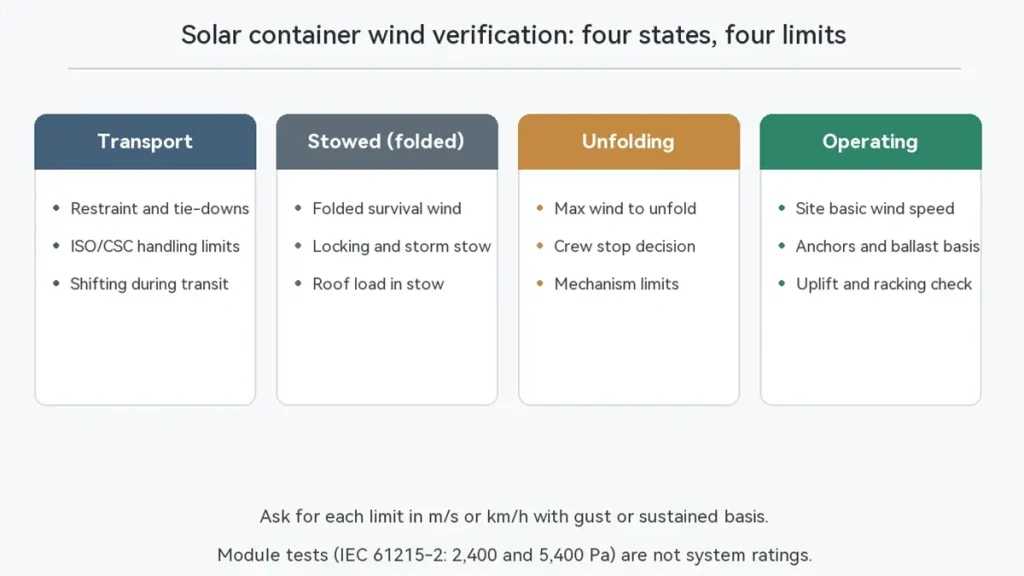
The most common buying mistake is comparing one “wind rating” against the site. A solar container exists in at least four states, and each carries different structural loads:
- Transport: where the shipped configuration is a valid CSC-approved freight container, transport and handling follow the applicable container documentation and securement requirements. Other sizes or modified transport frames need their own approved shipping and handling basis. In either case, the deployed-array wind rating is not the governing transport-state rating.
- Stowed or folded: the array is folded and locked, giving the smallest wind area and usually the highest survival wind speed.
- Unfolding or deploying: the structure is moving, so the allowed wind speed is typically the lowest, driven by mechanism limits and crew safety.
- Operating: define the maximum permitted deployed operating wind speed and the required storm-stow trigger. Where storm stow is part of the design basis, verify separately that the stowed configuration and its anchoring or restraint can resist the applicable site design wind actions.
Published examples show how wide the spread can be. LONGi’s BLOCK mobile station is stated at 21 m/s during operation, 34 m/s for the container body alone, and up to 56 m/s with optional ground anchors and thicker structural steel, per LONGi’s official June 2026 BLOCK launch announcement. Those are manufacturer-stated values for one design, not a universal limit; the point is that a responsible spec asks for each state separately.
Stowing is also an operational strategy. Scandvolt’s folding solar container can have the full module area folded back and secured on the container floor when high wind or snow is forecast, taking the array out of service quickly. Ask whether the same option exists on the unit you are evaluating, what the storm-stow procedure is, and who is allowed to decide that it should be used.
Snow, Ice and Roof Loads
Snow load is not one number either. The 5,400 Pa module test simulates heavy snow on the front face, but the container roof, the folded array and the deployed array each carry load differently. Ask for the roof snow-load rating with its ground snow-load basis, how the array sheds snow at its tilt angle, where that snow accumulates, and how falling snow or ice is kept away from people and equipment.
Start with the site ground snow load from the applicable code or authority, then have the structural design convert it into the relevant roof, deployed-array and local drift design actions using the required shape, exposure, thermal and other applicable coefficients. Do not directly compare a 5,400 Pa module test load with the site ground snow load. Confirm the storm-stow trigger, the maximum wind allowed during stowing, and whether deployment or folding is prohibited once snow or ice has accumulated on the array or mechanism. In cold climates, also check battery and electronics operating ranges, because a structure can survive winter while the energy system cannot run; that boundary is covered separately in cold-climate site reviews.
What to Ask the Supplier
Request a written weather-data sheet for the exact model and configuration, not the marketing summary. The table below lists the minimum inputs and why each matters.
| Input to request | Why it matters |
|---|---|
| Wind design basis: applicable standard, wind-speed metric, averaging time, reference height, terrain/exposure, topography and return-period or risk basis | Lets you compare the rating with your site’s design wind speed |
| Limits for each state: transport, stowed, unfolding, operating | Different states carry different loads; one number cannot cover all |
| Anchoring method: ballast or ground anchors, the calculation, and the uplift check | The operating rating is only valid with the anchoring it assumes |
| Snow load: site ground-snow-load basis, roof and deployed-array design loads, shape/drift assumptions, storm-stow trigger and accumulation restrictions | Winter survival depends on the folded and roof states as much as the array |
| Test basis: IEC 61215-2 module tests versus system-level analysis | Prevents a module number being presented as a system number |
| Factory acceptance and site evidence: what was tested, witnessed and recorded | Shows which claims have a traceable record |
Submit Your Site Conditions for an Environment Review
Before a quote is frozen, submit the site inputs that decide the weather design: coordinates and altitude, basic wind speed with its source, ground snow load, ground and soil conditions, whether the unit will be stowed for storms, and the intended operating schedule. HighJoule can then reconcile the selected configuration with those conditions through the technical consultation form. Site preparation and delivery are separate checks that must be completed in parallel; see the solar container site requirements guide and the delivery checklist for those steps.
Last Updated on 08/07/2026