A Container BESS Fire Is Managed in Layers
A container BESS fire is an uncommon but potentially high-consequence event that requires a layered response. A well-engineered system detects abnormal conditions early. It can isolate energy flow, limit propagation, notify responsible people, and give responders a usable site plan. No responsible supplier should claim that a lithium-ion battery energy storage system cannot burn. Nor can every incident be extinguished immediately.
The U.S. Environmental Protection Agency notes that lithium battery fires can be difficult to extinguish and may reignite hours or days later. Its guidance emphasizes planning, responder coordination, monitoring, isolation, and preventing fire spread. Read the EPA BESS installation and incident-response guidance.
For the equipment context behind this article, see our Container BESS Engineering Guide, liquid cooling versus air cooling guide, and UL 9540A and NFPA 855 buyer guide. Together, they explain why a container BESS fire cannot be reduced to one alarm, one extinguisher, or one certificate.
What Starts a Container BESS Fire?
Most serious lithium-ion battery incidents begin with abnormal heat inside a cell. Overcharge, a short circuit, a manufacturing defect, or mechanical damage can prevent heat from dissipating. An unmanaged temperature condition can do the same. The temperature then rises beyond normal operating limits. This chain reaction is called thermal runaway.
The Massachusetts BESS fire-safety FAQ describes thermal runaway in similar terms and explains that residual energy can contribute to reignition after an event. It also makes an important procurement point: risk reduction depends on design, installation, operation, maintenance, and the safeguards required for the particular project.
A cell event is not automatically a site-wide fire. A site-wide fire involves propagation through modules, racks, an enclosure, or adjacent equipment. Buyers should review battery chemistry, cell qualification, thermal design, enclosure arrangement, and the project response plan. Each affects that outcome.
The First Minutes: Detection, Alarm, and Energy Isolation
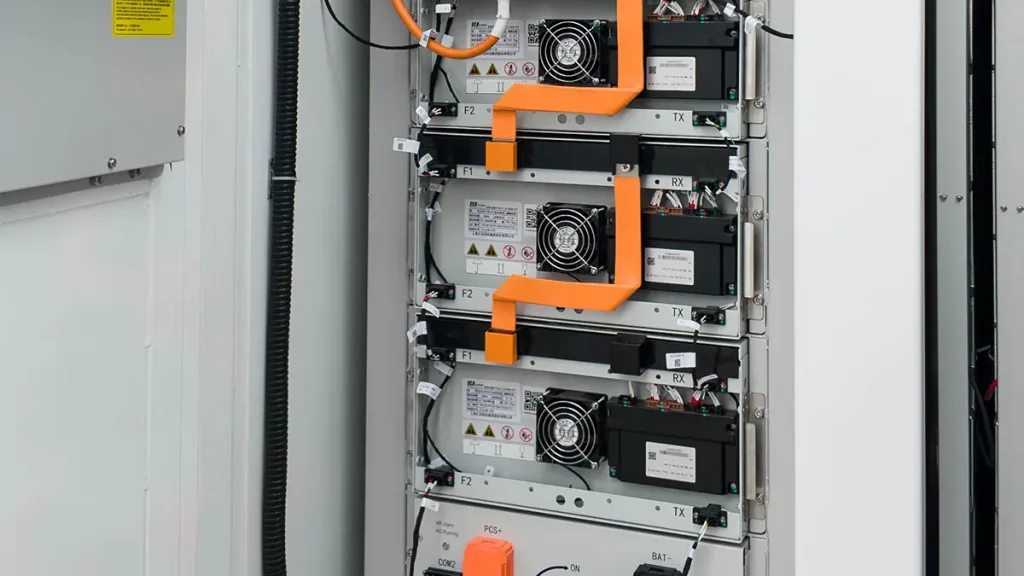
Recognition comes first. Battery management systems monitor electrical and thermal operating data at battery level. Container-level systems can add temperature, smoke, gas, or fire detection according to the selected design and project requirements. Remote monitoring can send an alarm before a person reaches the container. That matters at mines, islands, emergency bases, and other unattended sites.
Controlled isolation follows. Depending on the fault condition and system architecture, the BMS and protective devices can stop charging or discharging. They can open contactors, disconnect AC or DC circuits, and set the system to a defined safe state. Isolation reduces available electrical energy. It does not guarantee that a cell already in thermal runaway will stop producing heat. The remaining layers still matter.
At this stage, the operator should follow the site emergency response plan rather than improvise. The plan should identify alarm recipients and who calls the fire service. It should state who can access remote data, isolate circuits, and provide drawings and emergency contacts. The plan should also name an on-call technical contact. Good hardware can still create avoidable risk when roles are unclear.
How a Container BESS Fire Is Limited Rather Than “Solved”
| Safety layer | What it is intended to do | What buyers should verify |
| Cell and battery controls | Identify abnormal voltage, current, or temperature and support protective action. | BMS architecture, alarm thresholds, fault logging, and cell traceability. |
| Thermal management | Keep batteries within their designed operating range during normal use. | Cooling method, operating envelope, derating behavior, and maintenance requirements. |
| Container detection and mitigation | Provide event detection and support the design response for heat, smoke, gas, fire, or pressure. | Detection types, logic, ventilation or venting design, suppression/mitigation scope, and test evidence. |
| Electrical protection | Isolate equipment and reduce energy contribution from connected sources. | E-stop logic, AC/DC disconnects, inverter shutdown, PV isolation, and single-line diagram. |
| Site design and responders | Keep people and nearby assets safer while firefighters manage the incident. | Access, separation, signage, water/runoff planning, emergency plan, and pre-incident briefing. |
The word “suppression” needs care. An enclosure system may detect and manage a developing incident. The fire service decides the operational response from conditions on site. EPA guidance focuses on preventing fire spread. Responders may use water to protect nearby batteries or structures while the affected battery fire burns out. The appropriate action depends on the incident, local procedures, system design, and hazards observed at the scene.
The EPA’s incident-response section addresses self-contained breathing apparatus, isolation zones, upwind and uphill positioning, air monitoring, and runoff management. These are not optional marketing details. They should be addressed with local responders before commissioning.
Why Reignition, Gas, and Runoff Change the Response
A lithium-ion event can evolve after the first visible flame. Reignition is possible because affected batteries may retain energy and neighboring cells can heat later. Gas and smoke can create hazards for responders and nearby people, including within the responder exclusion zone. The response is not limited to opening a container door or applying a generic extinguishing agent.
The EPA recommends monitoring for hydrogen, carbon monoxide, hydrogen fluoride, hydrogen cyanide, and hydrogen chloride at the start of an extended incident. Sampling may be needed as the event develops. EPA guidance also recommends minimizing, containing, or redirecting water runoff where practicable. The actions must be designed for the actual site and coordinated with local authorities, not copied from a generic checklist.
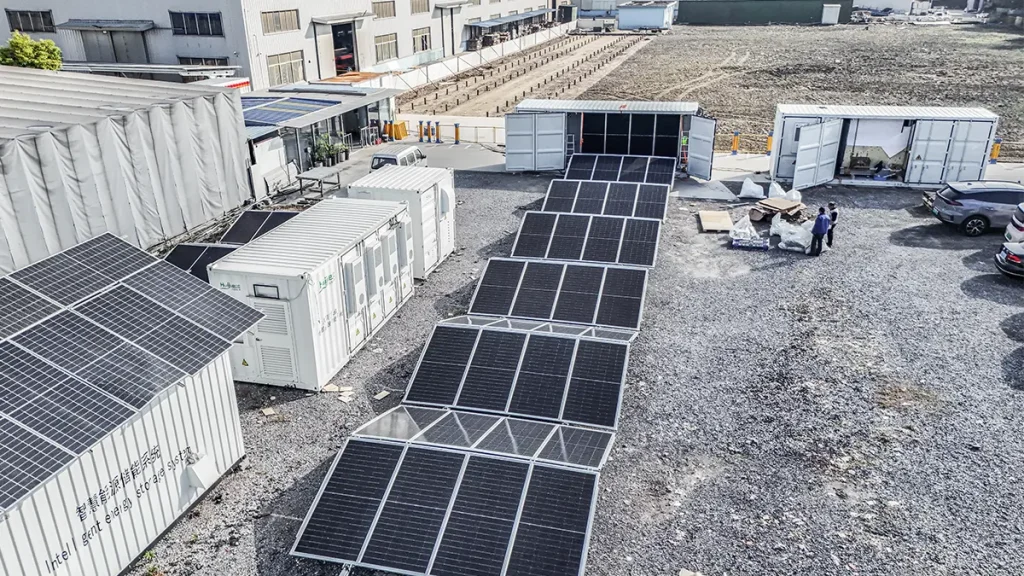
A modular container layout can help. Separating units, preserving responder access, and protecting nearby equipment can give firefighters more options. Required spacing and protective measures are project-specific. A supplier should not quote one separation distance as a universal global rule. Check the adopted local code, the authority having jurisdiction, the test evidence, and the site layout.
Codes and Tests: What They Do—and What They Do Not Do
In North America, buyers will often encounter UL 9540, UL 9540A, NFPA 855, local fire codes, and insurer requirements. They belong to different parts of the safety case. UL 9540 addresses energy storage systems and equipment. UL 9540A is a test method for evaluating thermal-runaway fire propagation and related hazards. NFPA 855 addresses stationary-system installation where it has been adopted or referenced by the applicable code path.
UL describes UL 9540A as a test method for evaluating thermal-runaway fire propagation in battery energy storage systems. A report should be reviewed for its exact configuration and test level. It is incorrect to say that a product “carries UL 9540A certification.” The accurate wording is that a relevant configuration was tested in accordance with UL 9540A, subject to the report scope.
The NFPA energy-storage safety resource explains the role of codes and standards in safer ESS deployment. Local adoption, amendments, the Authority Having Jurisdiction (AHJ), project size, occupancy, and installation type can all affect what a fire marshal or permitting authority requests.
Outside North America, the document pathway may include applicable IEC standards, GB/T requirements, CE-marking obligations, local regulations, and transport documentation. These systems are not interchangeable. A global supplier should provide a destination-market compliance matrix rather than imply that a single badge resolves every approval question.
What the Fire Marshal, EPC, and Insurer Need Before Commissioning
The practical question is not whether a brochure lists fire features. Instead, the project team should demonstrate how the selected equipment, installation, and response plan work together. That record should be complete before a container is energized.
| Document or action | Why it matters | Project owner |
| Configuration-specific technical package | Shows the battery, BMS, cooling, enclosure, PCS, and mitigation configuration actually proposed. | Supplier with EPC review |
| Single-line diagram and shutdown sequence | Lets operators and responders understand how PV, battery, grid, generator, and PCS are isolated. | EPC / electrical engineer |
| Test evidence and scope comparison | Prevents an unrelated test report from being used as proof for a different system. | Supplier / fire-protection engineer |
| Emergency response plan | Sets alarm escalation, contacts, evacuation, access, responder information, and post-event responsibilities. | Owner, operator, and local fire service |
| Pre-incident site walk-through | Allows responders to see access routes, signage, disconnect locations, and the information package before an emergency. | Owner / local fire service |
| FAT and SAT records | Verifies functions before shipment and after installation, including alarms, interlocks, communications, and E-stop logic. | Supplier, EPC, owner |
Factory acceptance testing (FAT) should verify the agreed functional logic before shipment. Site acceptance testing (SAT) should confirm that equipment, communications, alarms, shutdown sequences, access, and documentation work in the finished installation. Both reduce the chance that a critical interface is discovered only after an incident. Neither test replaces AHJ review.
Illustrative Alarm and Shutdown Sequence
The following is an illustrative review format for an RFQ or FAT checklist. It is not a HighJoule product logic diagram and must not be used as an operating procedure. Instead, use the approved project design, battery configuration, PCS, and local emergency plan to define alarm thresholds, actions, and interlocks.
| Example trigger | Illustrative equipment response | Project-team response |
| Cell-temperature warning | BMS records the trend; the control strategy may limit charge or discharge according to the approved logic. | Review remote trend data, confirm the alarm pathway, and follow the site procedure. |
| High-temperature or battery fault alarm | The defined logic may stop PCS operation and isolate battery circuits where appropriate. | Escalate under the emergency plan; keep the event record available to technical support. |
| Gas, smoke, or fire detection | The system follows its approved detection, notification, isolation, ventilation/mitigation, and E-stop logic. | Evacuate or establish an exclusion area as the plan requires; notify emergency responders. |
| Post-event recovery decision | Do not return equipment to service until the responsible technical and safety parties approve the process. | Preserve records, coordinate inspection, and manage damaged equipment and waste through the applicable process. |
The Buyer’s RFQ Checklist for Container BESS Fire Safety
- Ask what was tested. Request the exact test report scope, test level, cell and rack configuration, enclosure arrangement, and any assumed mitigation measures for the proposed container BESS fire scenario.
- Ask what happens on alarm. Request a cause-and-effect matrix showing monitoring, notifications, contactor action, inverter action, E-stop behavior, and remote-access responsibilities.
- Ask what is site-specific. The EPC or responsible engineer should identify spacing, access, ventilation, permitting, water/runoff, and emergency-plan issues that cannot be answered by a factory document.
- Ask who supports responders. Require named technical contacts, a responder information package, and a pre-commissioning handover process.
- Ask how changes are controlled. A change in cell source, battery capacity, rack layout, enclosure, cooling, or mitigation design can affect prior evidence. Require documented review before substitution.
For a broader procurement structure, use our RFQ guide for containerized solar BESS. It helps teams compare technical and commercial evidence before price becomes the only decision variable.
Where a Container BESS Is Not the Right Immediate Answer
A containerized solution may not be appropriate when the site cannot provide adequate responder access, required separation or protection, a workable emergency plan, or qualified local installation support. It may be unsuitable when the selected chemistry and enclosure do not match the site risk assessment.
In such cases, the right next step is not a forced equipment sale. It is a project-specific assessment with the owner, EPC, fire-protection professional, insurer, and AHJ. A different location, configuration, redundancy strategy, or power architecture may be safer and more practical.
How We Support a Safer Project Conversation
HighJoule engineers containerized solar and storage systems from Shanghai for projects across different climates, logistics routes, and approval environments. Our role is to supply configuration information, operating documentation, and technical input for the project team. The responsible project engineer, EPC, insurer, carrier, and AHJ remain responsible for decisions within their scope.
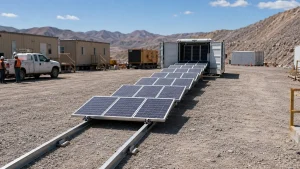
As one documented deployment example, the Romania project used four 46 kW foldable PV container systems and five 215 kWh storage cabinets. This case demonstrates a modular container deployment format. It should not be treated as evidence of fire testing, fire-service approval, or safety performance for another project; those points still require configuration-specific and site-specific documentation.
If you are planning an off-grid, emergency, or industrial project, review the HJ-FBESS solar container and our Emergency Energy Solution.
FAQ
Can a container BESS fire be extinguished immediately?
Not always. Lithium-ion battery fires can be difficult to extinguish and may reignite. Emergency response depends on the actual incident, system design, local fire-service procedures, and hazards at the scene.
Does UL 9540A mean a container cannot catch fire?
No. UL 9540A evaluates thermal-runaway fire propagation and related hazards for the tested configuration. It does not guarantee that no container BESS fire can occur or replace project-level approval.
What does a fire marshal usually require?
Requirements vary by adopted code, jurisdiction, project size, installation conditions, test evidence, and site design. Early AHJ engagement is more reliable than treating a supplier certificate as a permit.
Will fire spread from one container to the next?
Propagation risk depends on the affected equipment, mitigation design, spacing, site layout, and incident response. Use applicable code requirements and evidence for the proposed container BESS fire configuration rather than a generic claim.
Should an off-grid solar container have an emergency plan?
Yes. Remote sites may have longer responder travel times and fewer on-site personnel. The plan should define alarms, electrical isolation, communications, evacuation, site access, and technical contacts.
Who is responsible after an event?
Responsibilities should be set in the contract and emergency plan. They commonly involve the owner, operator, EPC, supplier, fire service, insurer, and environmental or waste-management authorities, depending on the location and event.
Source Notes and Disclaimer
Source note: EPA, Mass.gov, NFPA, and UL links appear beside the claims they support. They are authoritative guidance references, not proof that every HighJoule system has a particular certificate, test report, site approval, or fire-protection feature.
Disclaimer: This article provides general procurement and engineering information, not legal, fire-protection, emergency-response, insurance, or permitting advice. Standards, adopted codes, editions, and AHJ requirements change. If a container BESS fire occurs, follow the approved emergency plan and the direction of emergency responders. Before contracting, shipping, installing, or operating a container BESS project, confirm the applicable requirements with the responsible project engineer, fire-protection professional, EPC, insurer, carrier, and AHJ.
Last Updated on 07/30/2026