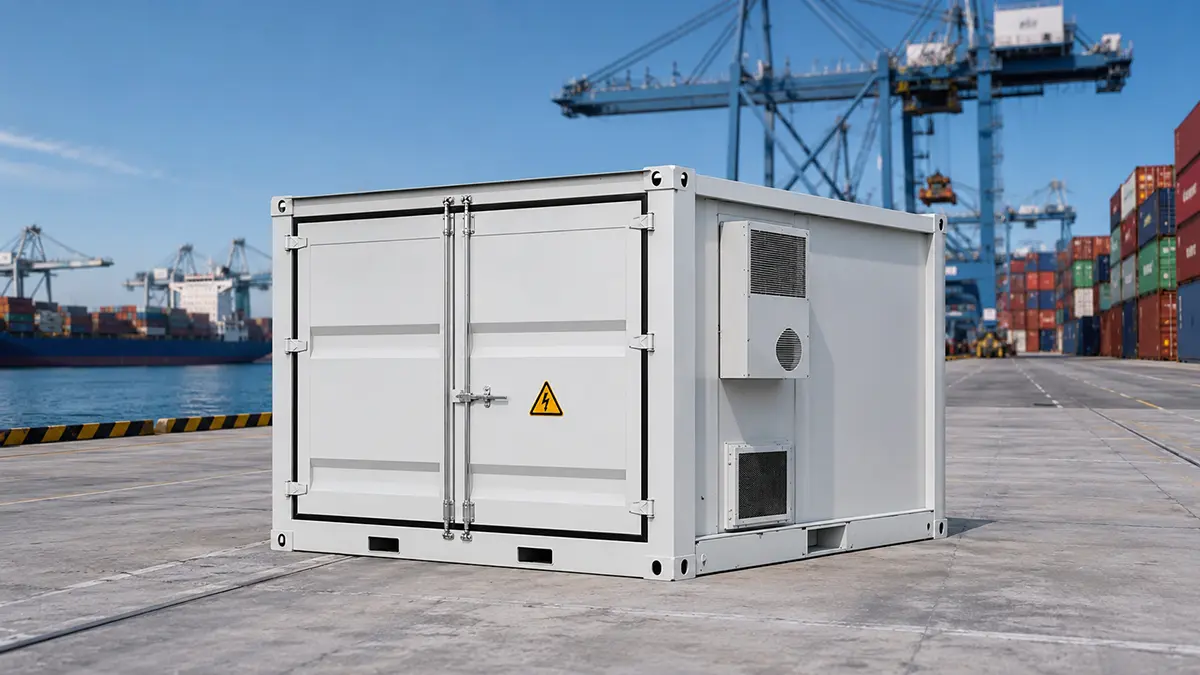
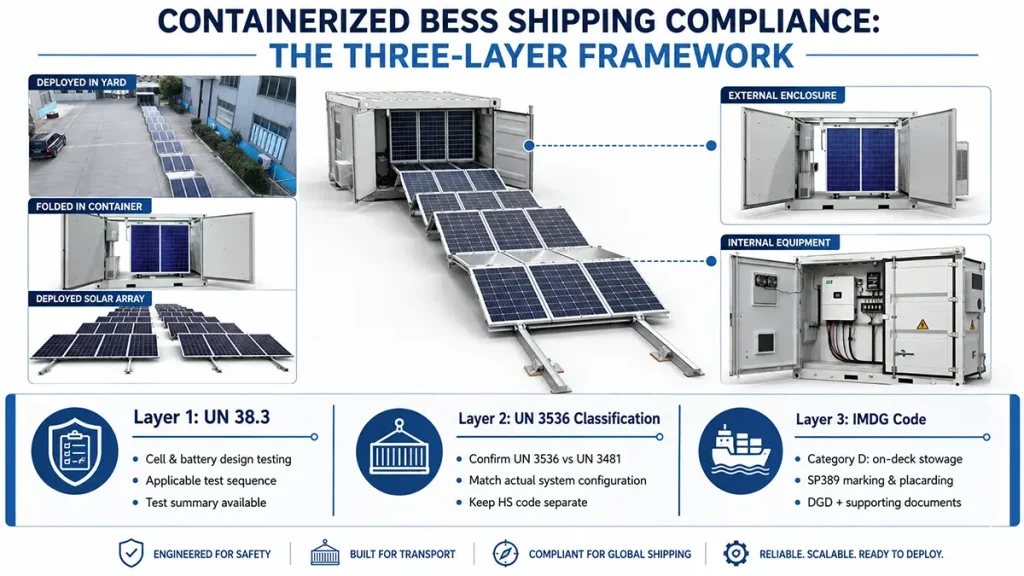
Shipping a containerized BESS internationally means navigating compliance across three layers: cell-level testing under UN 38.3, system-level classification under the UN Model Regulations, and transport-level documentation under the IMDG Code.
This guide walks through the full chain for anyone managing containerized BESS shipping compliance. We draw on our experience shipping containerized BESS and solar-plus-storage container systems from Shanghai to ports in Africa, Europe, Southeast Asia, and the Middle East — including projects where shipping documentation issues delayed delivery by weeks. For the broader procurement context, see our Solar Container Procurement & TCO Guide.
Containerized BESS Shipping Compliance: The Three-Layer Framework
Layer 1: UN 38.3 — Cell and Battery Testing
UN 38.3 is the starting point. Lithium cells and batteries must be of a design type that has successfully completed the applicable UN 38.3 tests in the UN Manual of Tests and Criteria, Section 38.3. The applicable test sequence differs between cells (typically T1 through T6 and T8), rechargeable batteries (typically T1 through T5 and T7), and battery assemblies. Before the batteries are offered for transport, the shipper should verify that the applicable cell and battery design types have passed UN 38.3 testing and that valid test summaries are available upon request. For containerized BESS shipping compliance, the supplier should provide UN 38.3 test summaries for the applicable cell, battery module, battery pack, and battery assembly design types used in the system — not documentation for unrelated or superseded designs. The U.S. PHMSA publishes a Lithium Battery Guide for Shippers that explains the UN 38.3 requirements across all transport modes.
Layer 2: UN Number Classification — UN 3536 vs. UN 3481
Getting the UN number right is the most common classification question for containerized BESS. Choosing the wrong UN number can lead to rejected or corrected dangerous-goods documentation. Separately, an incorrect HS code may affect customs clearance, tariff treatment, and import duty rates.
| UN Number | Description | When It Applies to Containerized BESS |
| UN 3536 | Lithium batteries installed in a cargo transport unit, powering equipment external to that unit | Integrated containerized BESS where batteries in the ISO container power external loads via PCS |
| UN 3481 | Lithium-ion batteries contained in equipment | Batteries inside equipment enclosures not themselves cargo transport units; may apply to smaller modular systems |
| UN 3171 | Battery-powered vehicle/equipment (wet, sodium, sodium-alloy batteries only in Amend. 42-24) | Not applicable to container BESS with lithium batteries; lithium vehicles use UN 3556/3557 |
Final classification must be confirmed with a dangerous-goods adviser familiar with the specific system configuration and the applicable IMDG Code edition. In our experience, most integrated containerized BESS configurations align with UN 3536, but we have seen cases where destination-country authorities applied a different classification — specifically, one African customs office initially classified a container as a “prefabricated building,” which triggered a completely different tariff line. Clarifying the correct HS code and UN number before shipment is worth the effort.
Layer 3: IMDG Code — Stowage, Marking, and Placarding
Published by the International Maritime Organization, the IMDG Code, 2024 Edition, incorporating Amendment 42-24, became mandatory on 1 January 2026. In the Dangerous Goods List, UN 3536 is assigned to Class 9, Special Provision 389, Stowage Category D, SW1, and SW2. For UN 3536 shipments, the key operational requirements are:
Stowage: Category D — on deck only on cargo ships and passenger ships within the applicable IMDG passenger threshold. Carriage is prohibited on passenger ships exceeding that threshold. Below-deck stowage is not permitted.
System protection under SP389: Special Provision 389 requires that the batteries include the necessary systems to prevent overcharge and overdischarge. They must also be securely attached inside the cargo transport unit to prevent short circuits, accidental operation, and significant movement under the shocks, loading forces, and vibration normally encountered during transport.
Thermal protection: SW1 (Protected from sources of heat) and SW2 (Clear of living quarters) provisions apply. These are stowage categories defined in the IMDG Code Dangerous Goods List for UN 3536.
Marking and placarding: Under Special Provision 389, the cargo transport unit must display the UN number in accordance with IMDG section 5.3.2.1.2 and must be placarded on two opposing sides — not all four sides. UN number characters must be at least 65 mm high. Confirm any additional terminal or carrier marking requirements before shipment. The CSC safety approval plate remains required for container handling but does not replace dangerous-goods placarding.
The Documentation Package
Based on our shipping experience, we recommend requesting the complete dangerous-goods documentation package at least two weeks before the scheduled shipment date. Incomplete paperwork is the most common delay trigger in our shipping experience — and it is entirely preventable.
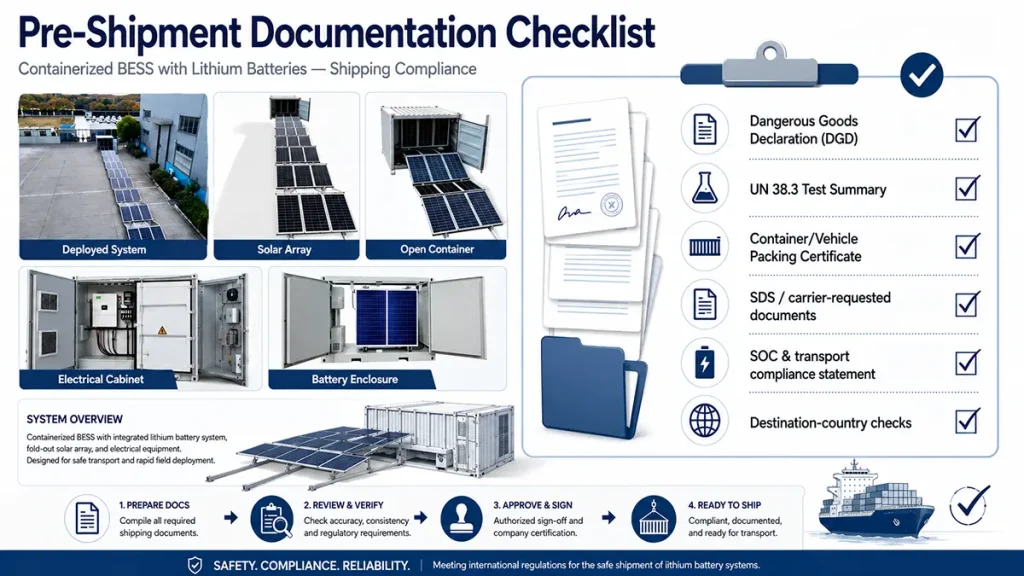
Dangerous Goods Declaration (DGD): Signed by a trained dangerous-goods signatory. The transport document must use the correct UN number, proper shipping name, class, and all other applicable entries. UN 3536 is not assigned a packing group — the DGL entry shows PG as “—”. Errors on the DGD, including an incorrect UN number or proper shipping name, may cause the booking or documentation to be rejected, corrected, or placed on hold.
UN 38.3 Test Summary: The test summary must contain all information required under UN Manual subsection 38.3.5, including manufacturer and test-laboratory details, product identification, test-report references, applicable test results, and the responsible signatory. This is a supporting document that must be made available upon request.
Additional documents (carrier, insurer, or project-specific): The Safety Data Sheet is typically provided by the cell or battery manufacturer and may be requested by carriers. A transport compliance statement confirming SOC at shipment, internal securing, and applicable transport requirements is often required by insurers and some carriers but is not a standardized IMDG document. Where applicable under IMDG section 5.4.2, the responsible packing party must provide a Container/Vehicle Packing Certificate. Confirm with the dangerous-goods adviser and carrier whether it should be submitted separately or incorporated into the Multimodal Dangerous Goods Form for the specific shipment.
Fire, Stowage, and Securing During Sea Transport
The maritime insurance industry has paid close attention to BESS shipments in recent years, and their guidance converges on a few practical points that directly affect how a containerized system should be prepared for sea transport.
Internal securing: Battery racks, PCS cabinets, and cable trays must be braced for the lateral and vertical forces experienced during ship loading and ocean transit. A container that is structurally sound can still arrive with damaged internal connections if the bracing was designed for road transport only.
State of charge at shipment: The IMDG Code does not currently prescribe a universal maximum SOC for UN 3536 marine shipments. A reduced SOC, sometimes around 30%, may be requested as a carrier-, insurer-, manufacturer-, or project-specific risk-control measure — not as a regulatory default. The applicable limit must be confirmed in writing for each shipment with the cell manufacturer, carrier, marine insurer, and dangerous-goods adviser.
Tilting and vibration: During heavy weather, container stacks on deck experience tilting angles and vibration frequencies that are difficult to replicate in factory testing. The supplier should confirm that the system’s internal mounting and connector design accounts for these conditions, and the transport compliance statement should reference the applicable securing standard.
Destination Country Requirements
Compliance does not end when the container arrives at the destination port. Each country may impose additional requirements that are not covered by the IMDG Code alone.
Customs classification: Confirm the correct Harmonized System (HS) code for an integrated containerized energy storage system before shipment. The HS code determines the import duty rate and is separate from the UN number, which governs dangerous-goods transport classification. Different countries may classify the same system under different HS headings, and the customs authority may apply a different classification than the one stated on the commercial invoice — as we learned when one destination country initially classified a containerized BESS as a prefabricated building rather than as renewable energy equipment. Clarify both the HS code and the UN number with the destination-country customs broker before the container departs.
Local dangerous-goods regulations: Some countries require additional approvals or notifications for lithium battery imports beyond the IMDG documentation. The buyer or their appointed agent should verify these requirements with the destination-country competent authority before the container departs.
Marine cargo insurance: Confirm that the marine cargo policy covers lithium battery shipments and specifically the system configuration being transported. Some policies contain thermal runaway exclusions or require the system to be shipped at a specified maximum SOC.
Containerized BESS Shipping Compliance Checklist
We have compiled a one-page lithium battery shipping compliance checklist covering UN 38.3, UN 3536 classification, IMDG documentation, stowage and securing, and destination-country requirements. It is designed as a pre-shipment gate review for lithium battery shipping compliance — every item must show Green before the container moves.
Get the checklist: Contact our engineering team at [email protected]. We send it as a free PDF.
Need Help With a Specific Shipment?
Our logistics and engineering teams have managed containerized BESS shipments to ports across Africa, Europe, Southeast Asia, and the Middle East. If you are preparing a shipment or reviewing a supplier’s transport documentation, reach out to our team. A documentation review now is considerably cheaper than port storage and demurrage charges later.
Frequently Asked Questions
What is the difference between UN 3536 and UN 3481 for containerized BESS?
UN 3536 applies to lithium batteries installed in a cargo transport unit — such as an ISO container — that supply power to equipment external to that unit. This covers most integrated containerized BESS. UN 3481 applies to lithium batteries contained in equipment, where the equipment and batteries are packed together but the enclosure is not itself a cargo transport unit. Which one applies depends on the system configuration and should be confirmed with a dangerous-goods adviser.
What UN 38.3 test summaries should a containerized BESS supplier provide?
For buyers, the key question is whether the supplier can provide valid UN 38.3 test summaries for every applicable cell and battery design type used in the system, including relevant module, pack, or assembly configurations where applicable. If the supplier cannot provide the required summaries, treat this as a major compliance red flag and pause shipment until the documentation gap is resolved.
Can a containerized BESS be shipped with batteries fully charged?
The IMDG Code does not currently mandate a specific SOC limit for UN 3536. However, a reduced SOC, sometimes around 30%, may be requested by carriers or insurers as a risk-control measure — not as a regulatory default. The applicable limit should be confirmed in writing with the carrier, the insurer, the cell manufacturer, and the dangerous-goods adviser.
What happens if the Dangerous Goods Declaration has an error?
The shipment may be rejected before loading. If the discrepancy is discovered after loading, the container may be offloaded or held until the documentation is corrected and re-submitted. Port storage charges and re-inspection fees can accumulate during the correction period. The simplest prevention is to have the DGD reviewed by a second person before submission.
About the Engineering Team
We are the engineering team at Shanghai HighJoule Energy Technologies Ltd. Our HJ-FBESS series of containerized solar BESS ships internationally under UN 3536, supported by UN 38.3 test summaries, IMDG-compliant documentation, and dangerous-goods declarations prepared by trained signatories. Our systems have been delivered to ports in Sudan, Romania, Ukraine, Cambodia, Bulgaria, Maldives, and other countries.
Learn more about the HJ-FBESS solar container.
Disclaimer
This guide is based on our experience shipping containerized BESS internationally. It does not replace the advice of a qualified dangerous-goods adviser, freight forwarder, marine insurer, or competent authority. Regulations referenced, including the IMDG Code (2024 Edition, Amendment 42-24), are current as of July 2026 and are subject to change. Final classification under UN 3536 or any other UN number must be confirmed for each specific shipment. Customer identities and specific shipment details have been anonymized where required by confidentiality agreements.
Last Updated on 07/30/2026