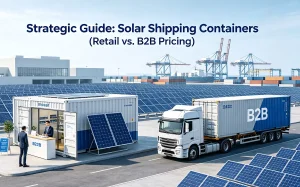
If you are pricing a solar container system for a mine, a construction site, or a remote facility, the number you are looking for does not exist. There is no list price for a containerized solar-battery system the way there is for a diesel generator. The cost depends on solar resource, storage duration, shipping distance, import duties, and whether you want pure solar or a diesel-hybrid configuration. This article does not give you a single price. It gives you a framework for solar container procurement — the one we wish every buyer had before opening a supplier conversation.
We are the engineering team behind the HJ-FBESS series, manufactured in Shanghai and deployed in over 20 countries across mining, construction, and humanitarian applications. We have been on both sides of the procurement table. As a manufacturer responding to RFQs — and as engineers helping buyers figure out what they actually need to ask for. This guide covers the five things that determine whether a solar container procurement succeeds or stalls: understanding the cost variables, reading the market benchmarks, building a TCO model, writing an RFQ that gets comparable bids, and choosing a financing structure.
Why There Is No List Price for a Solar Container
Walk into any equipment dealer and ask for the price of a 100 kW diesel generator. You will get a number — probably $25,000 to $45,000, depending on brand, enclosure, and trailer. Solar container procurement does not work this way. The reason is not that suppliers are being difficult — in our experience, it is usually the opposite. It is that six variables interact in ways that make every system configuration unique.
| Variable | Why It Changes the Price | Typical Range |
| Solar resource (peak sun hours) | A site with 6 PSH needs half the PV of a 3 PSH site for the same daily output | 3-7 PSH depending on latitude and climate |
| Storage duration (autonomy hours) | Overnight-only (4-6h) costs far less than multi-day autonomy (24-48h) | 4-48 hours depending on diesel backup availability |
| Power rating (kW) | Inverter and PCS costs scale roughly linearly; container size steps (10/20/40 ft) | 20-500 kW continuous |
| Shipping distance and mode | Sea freight Shanghai-to-Mombasa: ~$3,000-6,000 per 20 ft; air freight 5-10x | $3,000-50,000 depending on destination and urgency |
| Import duties and local taxes | Some countries exempt renewables; others apply 10-35% on electrical equipment | 0-35% of CIF value |
| Site readiness (civil works) | Gravel pad costs almost nothing; concrete foundation with fencing adds significantly | $1,000-50,000+ |
Same container. Different landed cost. A 50 kW solar-battery unit that costs $120,000 FOB Shanghai might land at $145,000 in Kenya, $155,000 in Chile, and $180,000 in a landlocked Central Asian country with high import duties. Any supplier who quotes a single number without asking about your site is either guessing or quoting a configuration that probably does not fit.
What These Systems Actually Cost: 2026 Market Benchmarks
Rather than theoretical price ranges, here are the numbers we see in the market as of mid-2026. These are benchmarks — use them to calibrate your expectations, not as final quotes.
| System Type | Capacity | FOB China ($/kWh) | Installed Abroad ($/kWh) | Notes |
| BESS-only container (LFP, 0.5C, 2h) | 1-2 MWh | $195-235 | $255-295 | Standard 20 ft, air-cooled. Excludes solar PV. Source: vendor data, Q2 2026. |
| BESS-only container (LFP, 1C, 1h) | 1-2 MWh | $245-285 | $305-355 | Enhanced cooling and higher-rated PCS. For frequency regulation and fast-cycling applications. |
| Solar-plus-storage container (LFP) | 50-200 kW / 200-500 kWh | $350-500 (total system) | $420-600 | Includes foldable PV array, DC-coupled storage, EMS. Our standard HJ-FBESS range. |
| Utility-scale BESS (LFP, 0.5C) | 4+ MWh (40 ft) | $180-215 | $240-280 | Scale benefits from shared auxiliaries. Multi-cluster configurations. |
Two things to notice in these numbers. First, the gap between FOB China and installed abroad is $60-100/kWh — logistics, duties, and local integration are real costs, not add-ons. Second, the solar-plus-storage premium over pure BESS reflects the cost of the PV array and the foldable deployment mechanism. That premium typically pays back in fuel savings within 12-18 months at remote-site diesel prices, which is the entire point of solar container procurement.
For context, LFP battery cell pricing has fallen from roughly $140/kWh in 2020 to $55-75/kWh at the cell level in 2026, according to industry data from BloombergNEF Energy Storage Survey and multiple cell manufacturers. This price decline has been the single largest driver of solar container affordability. The cells are now a smaller share of the total system cost than the integration, logistics, and power electronics.
What You Are Actually Paying For: The Seven-Layer Cost Stack
When you buy a containerized solar-battery system, you are paying for seven distinct things. Understanding this cost stack is the single most useful preparation for solar container procurement — because it tells you which line items compete on hardware cost and which compete on logistics efficiency.
| Cost Component | Share of Total | What Drives It | Negotiability |
| PV modules and mounting | 20-30% | Module efficiency, silicon type (TOPCon vs PERC), foldable mechanism complexity | Medium — module prices are commodity; foldable mechanism is proprietary |
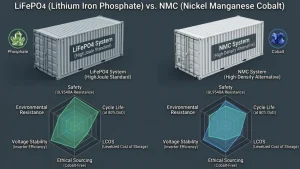
| Battery cells and BMS | 25-35% | Cell chemistry (LFP standard), cycle life rating, cooling type (air vs liquid) | Low — cell prices are global commodity; BMS configuration is engineering-driven |
| Inverters and PCS | 10-15% | Power rating, redundancy, grid-forming capability | Medium — standard inverter brands; PCS integration is proprietary |
| Container and integration | 10-15% | Container size, IP rating, fire suppression, internal harness, factory testing | Low — integration labor and testing are fixed costs |
| EMS and controls | 5-8% | Monitoring complexity, remote firmware update, grid interconnection logic | Low-medium — software is fixed; hardware add-ons are optional |
| Logistics and freight | 5-15% | Distance, transport mode, port handling, inland trucking, insurance | Medium — route optimization and consolidation reduce costs |
| Commissioning and warranty | 3-5% | On-site support scope, warranty duration, extended service agreements | High — this is where suppliers differentiate on service |
TCO: Why the Purchase Price Is the Wrong Number
The upfront price is misleading. A $120,000 solar container that eliminates 80% of diesel consumption costs more to buy than a $40,000 generator — but the five-year total cost of ownership usually tells the opposite story. We have seen solar container procurement decisions decided on upfront CAPEX, only for the buyer to spend three times the purchase price on fuel in the first two years. Compare five-year TCO, not purchase price.
Five-Year TCO: The Basic Comparison
For a site with an existing diesel baseline: Diesel TCO = generator CAPEX + (annual fuel × price per liter × 5) + 5-year maintenance. Solar TCO = container CAPEX + (residual diesel × fuel price × 5) + 5-year maintenance. For most sites with base loads above 30 kW, the solar container reaches payback within 12 to 24 months at 2026 remote-site diesel prices of $0.90 to $1.50 per liter, depending on region.
Three Costs Most TCO Models Miss
Fuel price escalation. In remote mining regions, diesel prices have risen 5-8% annually over the last decade — faster than general inflation. A TCO model using flat fuel prices understates savings. Maintenance escalation. A diesel generator’s maintenance cost per hour increases as the engine ages; by year five, it can be double the year-one rate. And downtime: when the generator fails and the drill stops turning, the lost production is almost never priced into procurement decisions, yet it is often the largest single cost in the comparison. If a three-day generator outage costs $50,000 in lost production at your site, the redundancy a solar-battery system provides justifies its cost on that basis alone.
How to Write an RFQ for Solar Container Procurement
The difference between a good RFQ and a bad one is not page count. It is whether the suppliers you invite can respond with comparable proposals. A bad RFQ says “solar container for a mine site” in solar container procurement and each supplier fills in different assumptions about solar resource, storage duration, and duty cycle. A good RFQ gives every supplier identical inputs and asks them to optimize within those constraints.
The Five Things Every Solar Container RFQ Must Specify
| Specify This | Why | Example |
| Site solar resource | PV sizing depends entirely on this. Without a specified value, each supplier uses a different assumption. | “5.2 peak sun hours (PSH). Source: NASA POWER, coordinates 12.4°S, 28.5°E.” |
| Load profile (base + peak) | 24-hour base load systems are fundamentally different from daytime-only systems. | “Continuous base: 45 kW. Peak: 120 kW (core drill + welding, 4-6h/day).” |
| Autonomy requirement | The largest single driver of battery sizing and therefore cost. | “Minimum 12 hours at base load without solar. Diesel generator available as backup.” |
| Site access and logistics | The supplier needs to know delivery constraints before quoting freight. | “40 ft flatbed truck year-round. Offloading by site forklift, 10-ton capacity.” |
| Applicable standards | Prevents suppliers from quoting uncertified equipment your AHJ will reject. | “UL 9540A tested. UN 38.3 on all battery modules. CE marking required. IEC 62933 preferred.” |
The Question Most RFQs Miss
Ask for the residual diesel model. Not just the solar container’s specs — ask each supplier to estimate the diesel consumption of the hybrid system they are proposing. A bid that says “50 kW solar container” without modeling how much diesel the site will still burn is incomplete. The suppliers who can model this accurately are the ones with real deployment data, not catalog engineering. If a supplier cannot or will not provide this estimate, that is a procurement red flag.
Real Procurement Scenarios: What These Systems Cost, Delivered
Three actual solar container procurement cases we have worked on. These are representative cost breakdowns for specific configurations delivered to specific regions. Use them as calibration points, not price lists.
Sudan — 40-Foot Foldable PV Container for Critical Infrastructure
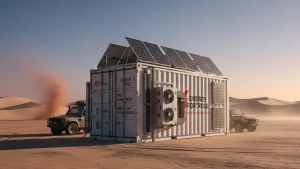
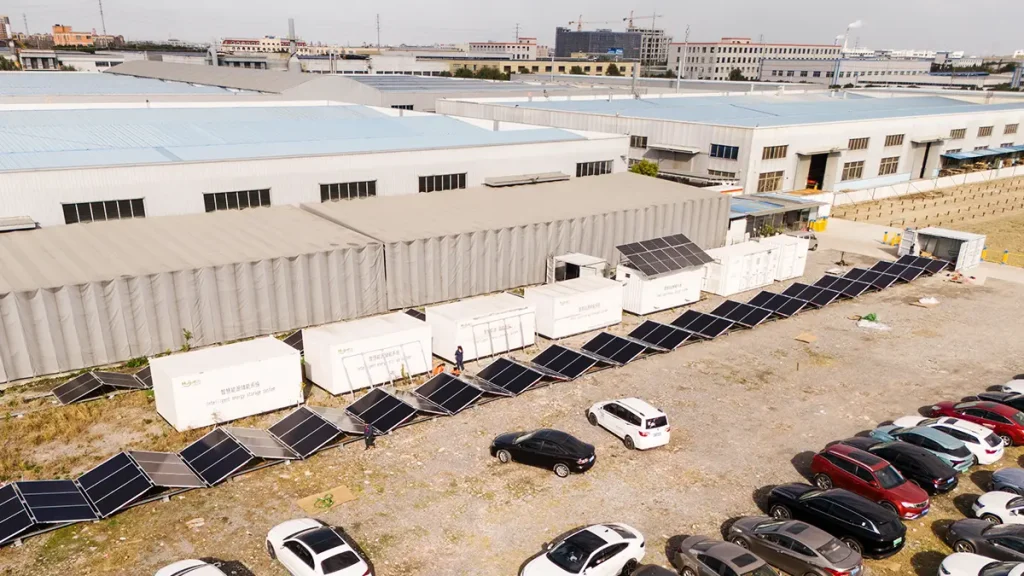
A 40-foot foldable photovoltaic energy storage container deployed in Sudan, where grid electricity supply is unstable or unreliable. The system serves critical local infrastructure — factories, mining sites, or telecommunications base stations — operating under a self-generation model with intelligent grid-connected and off-grid switching. Configuration: 40 ft container with integrated PV-storage, designed for high ambient temperatures and dusty conditions. This is a representative configuration of our larger containerized systems, which typically land in the $110,000-260,000 FOB range depending on PV and storage capacity. The key procurement lesson from this deployment: in regions with unreliable grid supply, the value of the system is not measured in fuel savings alone — it is measured in production hours not lost to grid outages.
Romania — Four 46 kW Foldable PV Container Systems
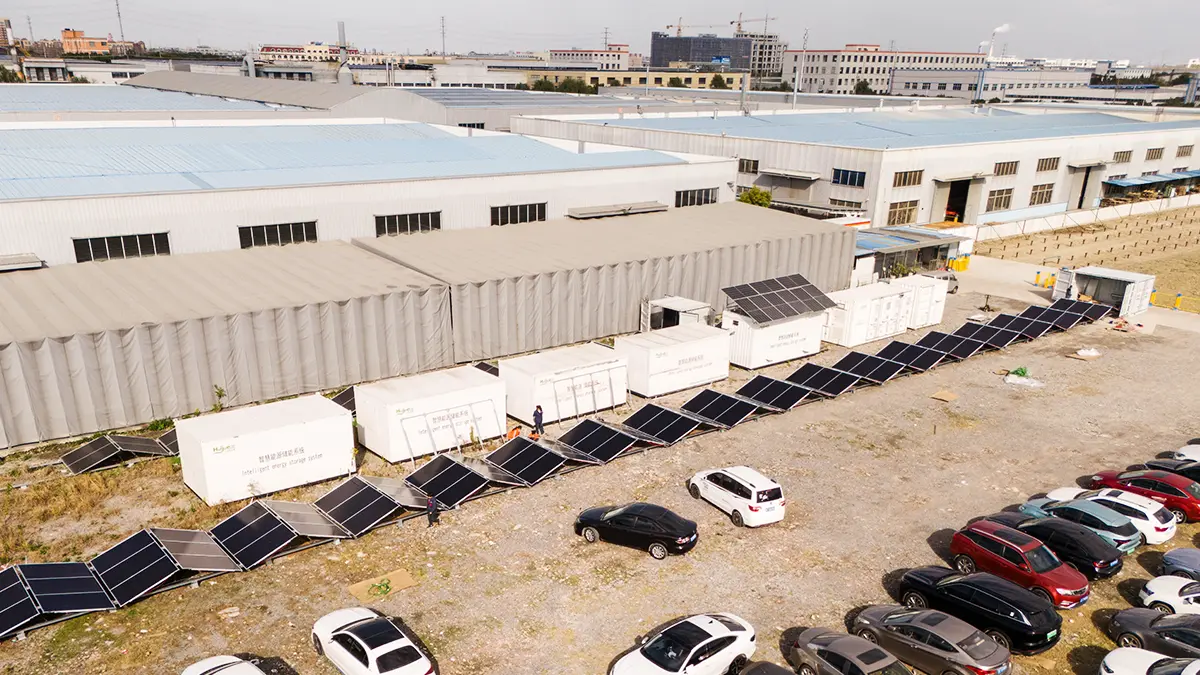
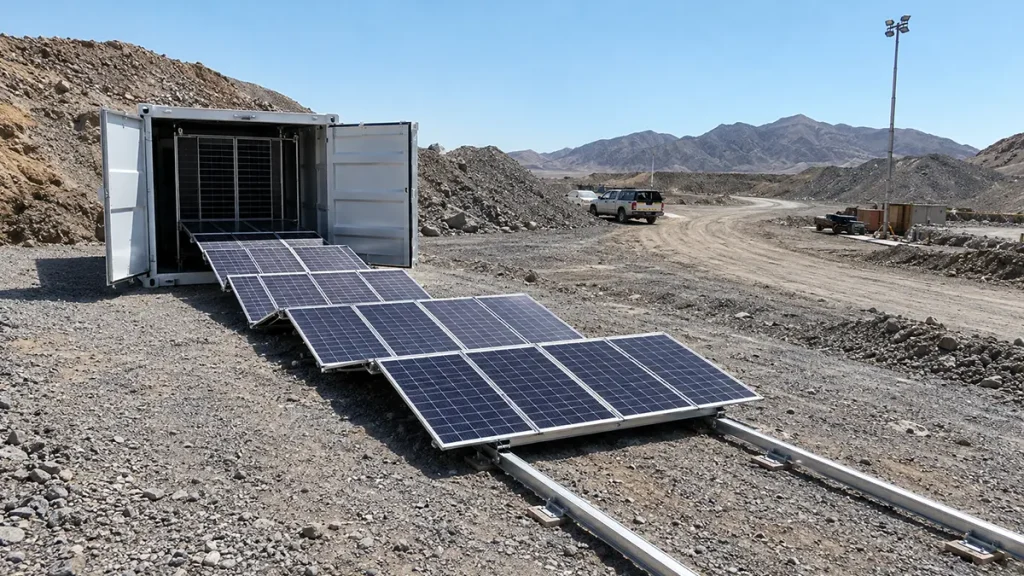
A multi-unit deployment of four 46 kW foldable photovoltaic container systems in Romania, representing one of our larger European procurement contracts. Each container includes foldable PV arrays, integrated battery storage, and factory pre-commissioning for rapid on-site deployment. Sea freight Shanghai to Constanta port — approximately 40 days door-to-door. Multi-unit procurement of this scale typically benefits from volume pricing: the per-unit cost for a four-container order is roughly 8-12% lower than a single-unit purchase due to shared freight, consolidated customs brokerage, and commissioning efficiencies. For buyers considering more than two units, this volume effect should be factored into the procurement model. Contact our team for multi-unit procurement quotes.
Ukraine — 46 kWp Foldable PV Container for Emergency Power
A 46 kWp foldable photovoltaic container system with 50 kWh of storage, deployed in Ukraine to provide resilient backup power for critical infrastructure. The system was configured for rapid deployment — factory pre-commissioned, shipped as a single ISO container unit, and operational within days of arrival. This deployment illustrates a procurement scenario where speed and simplicity outweigh cost optimization. When the priority is getting power to a site quickly — for emergency response, humanitarian operations, or critical infrastructure protection — the procurement path is different from a planned mining expansion. Standard configurations with shorter lead times take precedence over custom engineering.
Paying for It: Financing and Procurement Models
Most buyers do not pay cash for a solar container. The three most common solar container procurement models:
| Model | How It Works | Best For | Typical Terms |
| Outright purchase (CAPEX) | Buyer pays upfront and owns the asset. Full fuel savings from day one. | Well-capitalized mining companies, government agencies | 30% with order, 60% before shipment, 10% on commissioning |
| Lease / rental | Financier owns the asset. Buyer pays monthly. Option to purchase at end. | Construction projects (6-24 months), exploration camps that may relocate | 12-60 months, purchase option at 10-20% of original value |
| Power purchase agreement (PPA) | Third party finances, owns, operates. Buyer pays per kWh at a discount to diesel. | Large mines with predictable long-term load, zero operational responsibility desired | 5-15 years, per-kWh rate indexed to diesel or fixed with escalation |
One financing detail that is worth knowing about: several development finance institutions offer concessional financing for renewable energy in emerging markets. The African Development Bank, the Asian Infrastructure Investment Bank, and various European export credit agencies have programs that can reduce the effective cost of capital from commercial rates of 8-12% to concessional rates of 2-4%. This can lower the levelized cost of energy by 15-25% over the project lifetime. The paperwork is substantial. The economics are worth it. Ask your supplier whether they have experience with DFI-backed procurement.
Five Procurement Mistakes We See Repeatedly
First: buying a container without a generator input port. It costs roughly $2,000 to add during manufacturing. It costs five to ten times that to retrofit later — and in some configurations, it cannot be done at all without replacing the power conversion system. Specify the generator input from day one, even if you plan pure solar.
Second: ignoring commissioning scope. Factory pre-commissioning means the system is tested and ready — but someone still needs to connect it to your distribution board and confirm the EMS is communicating on your network. Clarify in the RFQ whether the supplier provides remote support, on-site support, or neither. Budget accordingly.
Third: accepting a quote without a residual diesel model. A supplier who cannot estimate your site’s remaining diesel consumption after installation is either inexperienced or avoiding a number that makes the comparison look worse. Either way, it is a red flag for solar container procurement.
Fourth: comparing quotes on upfront price alone. The price difference between the cheapest and most expensive bid is typically explained by battery quality, cooling design, and warranty terms — all of which affect TCO more than the upfront delta. A $15,000 gap on a $120,000 system is 12.5%. If the cheaper system’s batteries degrade faster, the TCO penalty exceeds the saving within two years.
Fifth: not specifying compliance documentation upfront. If your project needs UL 9540A test reports, IEC 62933 certificates, or GB/T 36276 for import clearance, state this in the RFQ. Suppliers who cannot provide these will drop out or submit non-compliant bids. Both outcomes save you time compared to discovering the gap when the container is already sitting at the port.
HJ-FBESS Procurement: Standard Configurations
The table below shows our standard solar container configurations with indicative FOB Shanghai price ranges as of mid-2026. Add freight, insurance, duties, and local handling for your landed cost. All include DC-coupled PV and storage, liquid-cooled LFP batteries, integrated EMS with satellite and cellular connectivity, generator input port, and factory pre-commissioning.
| Model | Container | PV | Storage | Inverter | Indicative FOB Range | Typical Application |
| HJ-10G-P024E040 | 10 ft | 24 kWp | 40 kWh | 20 kW | $60,000-80,000 | Small camp, comms hub, remote clinic |
| HJ-20G-P057E241 | 20 ft | 57 kWp | 241 kWh | 50 kW | $110,000-140,000 | Mining camp base load, construction complex |
| HJ-20H-P068E241 | 20 ft HC | 68 kWp | 241 kWh | 60 kW | $120,000-150,000 | Tropical mining, agri-processing |
| HJ-40H-P136E482 | 40 ft HC | 136 kWp | 482 kWh | 120 kW | $200,000-260,000 | Large mine camp, processing plant |
These ranges reflect mid-2026 component pricing, freight rates, and exchange rates. All three shift. Contact our team for a current proposal specific to your site.
For a detailed quotation and site-specific TCO analysis, visit our HJ-FBESS Solar Container.
Frequently Asked Questions
Why can’t you give me a price per kilowatt?
Two 50 kW systems can cost dramatically different amounts depending on storage duration, solar resource, and shipping destination. A 50 kW container with 4 hours of storage for a Chilean site costs less than the same power rating with 24 hours of storage for a Central Asian site. The per-kW metric works for diesel generators. It does not work for solar container procurement, where storage duration and solar resource are independent cost drivers.
How long from order to delivery?
Standard lead time is 8 to 12 weeks from order confirmation to FOB Shanghai, plus sea freight of 25 to 45 days depending on destination. Air freight compresses total delivery to 3-4 weeks at roughly 5-10x the sea freight cost. The longest lead time component is battery cell procurement, not container assembly.
What payment terms do you offer?
Standard international terms: 30% with purchase order, 60% prior to shipment, 10% on commissioning sign-off. For repeat buyers and government contracts, we can structure letter of credit terms. For lease and PPA models, the financier handles the capital payment directly.
What warranty comes with the system?
PV modules: 25-year linear power output warranty (minimum 87% at year 25). LFP batteries: 5-year or 6,000-cycle warranty, whichever comes first, to 70% capacity. Inverters and PCS: 5-year warranty. Container and integration: 2-year workmanship warranty. Extended warranties and service agreements for solar container procurement are available for all components.
Can I visit the factory before ordering?
Yes. We encourage it. Our Shanghai facility is open to buyers and their technical representatives. You can inspect the production line, review test reports for your specific configuration, and witness a factory acceptance test before your unit ships.
What if something breaks at a remote site?
The EMS transmits diagnostic data via satellite or cellular continuously. Most issues resolve remotely — a parameter adjustment, a firmware update, or a restart sequence from Shanghai. If hardware replacement is needed, we ship the component by air within 48 hours. For sites with extended service agreements, we deploy a technician. The reality of remote operations: you do not need a technician on standby. You need a supplier who knows which part to ship before the site crew opens the enclosure.
About the Engineering Team
Shanghai HighJoule Energy Technologies Ltd. has designed and manufactured distributed energy systems since 2005. Our procurement team has managed deliveries to over 20 countries across six continents, including landlocked sites in Central Asia and Central Africa where logistics coordination matters as much as hardware quality. We hold certifications across UL, CE, CCC, and GB/T frameworks.
Disclaimer
The FOB price ranges and market benchmarks in this article reflect mid-2026 conditions for LFP battery cells, PV modules, power electronics, and container fabrication. Actual quotations vary with component pricing, specification changes, and order volume. The procurement scenarios are representative of actual deployments but individual results depend on site-specific solar resource, load profile, fuel pricing, freight rates, and import duty structures. TCO calculations assume specific fuel price escalation rates and maintenance cost curves that may not apply to your site. External references are provided for informational purposes. This article is for educational purposes and does not constitute a binding offer, engineering advice, or procurement recommendation for any specific facility.
Last Updated on 07/30/2026