A temporary grid connection is usually the better route when the project has a controlled point of connection, a credible date for usable power, defined temporary electrical works, a clear authorization path, and a lower-risk commercial route after all temporary works are priced. A mobile microgrid is worth evaluating when those inputs remain uncertain, critical loads cannot wait, and its delivered, operated, and later-reused scope can be compared on the same project basis. The practical answer is often staged: use temporary generation and storage for construction or early operation, then change the operating arrangement only after permanent supply is available and accepted.
This is not a comparison between two products with one universal winner. A utility connection, a mobile microgrid, a diesel-led hybrid, and a permanent connection can all appear in one project at different times. The decision is whether each route has a controlled scope, owner, and acceptance gate for the phase it is meant to serve.
Start with the temporary-power route, not the equipment
A request for temporary power can conceal two different problems. One site needs a short construction supply while permanent electrical work proceeds. Another needs an operating bridge because the permanent supply date, utility conditions, or site interface is unresolved. The first may favor a temporary grid connection. The second requires a project-specific assessment of a mobile microgrid, a generator-supported hybrid, or a staged combination.
For U.S. projects, the U.S. Department of Energy’s Distributed Energy Interconnection Checklist provides a sequence of utility-facing tasks and questions. It is a useful planning reference, not a substitute for the applicable utility process, local design review, site testing, or permission to energize.
Use the Temporary-Power Route Gate
Do not call a temporary grid connection “available” because a nearby line, transformer, or utility contact exists. Before committing to that route, the owner and EPC should be able to answer the following questions using controlled project records.
| Decision input | What to establish | If it is not controlled | Typical accountable party |
|---|---|---|---|
| Connection boundary | Point of connection, voltage, ownership boundary, metering approach, and temporary distribution interface. | Do not finalize the temporary electrical architecture against an assumed connection point. | Owner or developer with EPC electrical lead; utility confirms inputs within its process. |
| Usable-power date | The date on which the site can actually use power, including prerequisites rather than a planning estimate alone. | Assess a bridge arrangement for loads that cannot wait; keep the date as an open project risk. | Owner or developer manages the utility relationship; EPC maps site prerequisites. |
| Temporary works | Switchgear, protection, earthing, cables, civil works, access, testing, and responsible installation scope. | Do not treat the supplier’s equipment scope as completion of the temporary connection. | EPC and assigned electrical contractor. |
| Critical-load boundary | Which loads must operate before permanent supply, their operating profile, and what interruption is acceptable. | Avoid sizing any temporary source from a single nameplate total or an unagreed operating assumption. | Owner or operator, with EPC load-study input. |
| Authorization and acceptance | Required utility, authority, owner, or site-acceptance decisions for the selected phase. | Keep the route provisional until the responsible party closes the required gate. | Utility and authorities decide within their scope; owner/EPC manage project closure. |
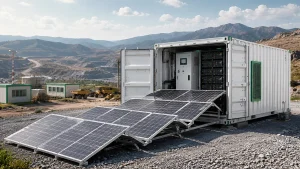
A mobile microgrid does not remove this discipline. It changes the power-source and interface question. The project still needs an agreed load boundary, electrical design, protection and earthing approach, operating responsibility, and site test plan. A mobile solar-container solution may be considered for emergency response and temporary critical loads, but the selected configuration and operating capability remain project-specific. The published HJ-FBESS solar container table, for example, shows eight PV-storage reference configurations from 9–136 kWp photovoltaic capacity and 15–482 kWh storage; it does not establish the required operating mode, grid interface, runtime, or acceptance outcome for a particular site.
Compare equivalent project conditions
The comparison becomes useful only when both routes are tested against the same phase, load boundary, site constraints, and acceptance standard. A temporary connection can be the lower-complexity choice where the utility route and site works are genuinely ready. A mobile microgrid can be a stronger bridge where a missed usable-power date would stop a defined critical activity. Neither conclusion follows from container size or the word “mobile.”
| Project condition | Temporary grid connection may fit when | Mobile microgrid may merit assessment when | Decision boundary to record |
|---|---|---|---|
| Construction power | The connection point, temporary distribution scope, installation sequence, and usable-power date are controlled. | Construction activities have critical loads that cannot wait for unresolved utility or site prerequisites. | Separate temporary works completion from permanent-system commissioning. |
| Early operation before permanent supply | The connection can support the agreed operating boundary and the authorization path is confirmed. | The project needs a defined bridge for selected critical loads while permanent supply remains pending. | Document which loads are bridged and what remains outside the temporary system scope. |
| Remote or disrupted site | Utility service is actually accessible under the relevant site and authority conditions. | Local generation, storage, or hybrid inputs can be engineered for the site’s defined temporary load and logistics constraints. | Do not convert a general emergency-use description into a commitment on deployment time or autonomy. |
| Permanent supply nearing completion | The project has a controlled transfer, testing, and authorization sequence. | The temporary asset has a defined retained role, relocation plan, or removal scope after transfer. | Make the handover decision explicit rather than assuming temporary equipment disappears at energization. |
Compare the commercial and operating burden, not only the connection risk
Once both routes are technically plausible, compare them using a common temporary-service period and the same critical-load boundary. Do not compare an assumed utility date with an advertised equipment deployment claim, or a connection charge with only the equipment price. The commercial decision changes when the project includes site works, temporary distribution, operating labor, fuel where a generator forms part of the bridge, logistics, removal, and the value or cost of retaining the temporary asset.
| Decision factor | Temporary grid connection: establish and price | Mobile microgrid: establish and price | Decision record |
|---|---|---|---|
| Usable-power date and deployment sequence | Confirm the date power can be used after utility, temporary works, testing, and site prerequisites—not only the application or estimated connection date. | Confirm the project-specific delivery, placement, interface, testing, and operating sequence. Do not substitute a supplier marketing deployment time for a site-ready date. | Compare the credible usable-power date for the same critical-load boundary and state who owns each prerequisite. |
| Upfront temporary-service cost | List connection, design, metering, protection, transformer or switchgear scope where applicable, cables, civil works, installation, testing, deposits, and removal or conversion work. | List equipment commercial terms, transport, placement, site interfaces, distribution, commissioning, required supporting generation, and removal or redeployment work. | Use a scope-controlled quote comparison; do not call either route lower CAPEX until inclusions, exclusions, ownership, and the temporary period match. |
| Operating cost and responsibility | Identify tariff, demand, standing, temporary-service, operator, and maintenance terms that actually apply to the temporary phase. | Identify monitoring, maintenance, operator, dispatch, and any supporting-generation inputs required by the proposed operating plan. | Record the commercial assumptions, their source, currency, date, and party carrying each operating-expenditure (OPEX) cost or risk. |
| Fuel and logistics dependency | Identify whether the selected connection route still requires backup or construction generators and who provides fuel, refueling access, and generator logistics. | Where a generator-supported hybrid is proposed, identify the fuel, refueling, access, storage, and operating assumptions. Do not assume that storage and solar inputs eliminate supporting fuel requirements. | Keep diesel support as an explicit architecture and operating-cost line, not an unspoken contingency. |
| Runtime and load autonomy | Define what the connection is expected to support, the interruption assumptions, and any required backup boundary. | Define the critical-load profile, operating window, solar-resource assumption where relevant, storage/discharge assumptions, generator support if any, and what interruption is acceptable. | Request a project duty-cycle and assumptions schedule; do not infer runtime from a battery capacity figure alone. |
| Noise, emissions, and operating constraints | Identify site, contract, or local restrictions that apply to temporary works and any backup generation. | Identify the same restrictions for proposed equipment and any supporting generator. Treat noise and emissions as configuration- and operating-plan questions, not generic system attributes. | Attach the applicable site or contractual requirement and the responsible compliance owner. |
| Site logistics and temporary works | Price access, cable route, trenching or surface protection, metering, protection, temporary distribution, service access, and removal or conversion. | Price transport route, lifting or placement, access, distribution interfaces, service access, and removal or relocation. | Compare logistics as a project scope, not as a generic advantage of a container or connection. |
| Asset after permanent supply | Define whether temporary connection assets are removed, converted, returned, or absorbed into permanent works, and who bears each cost. | Define whether the temporary asset is removed, retained for a specified role, or redeployed, plus the contractual and logistics implications. | Include the documented end-of-temporary state in the commercial comparison before award. |
Plan the transition before selecting the bridge
Temporary power often fails as a procurement plan because its end state is left undefined. A useful transition plan gives each phase a named purpose, evidence set, and decision owner.
- Construction and temporary works: define construction loads, temporary distribution, the expected connection route, and the site interfaces that must be completed before power is used.
- Early operation: state which critical loads require continuity, what the temporary source is designed to cover, and which operating assumptions remain open.
- Permanent-supply arrival: control the point of connection, protection, metering, communications where applicable, test sequence, and authorization path.
- Transfer or retention: decide whether the temporary asset is removed, retained for backup or peak use, or redeployed. This is an owner decision supported by the contracted project parties, not an automatic product feature.
Factory evidence, shipment release, site testing, utility permission to energize, and operational acceptance are separate decisions. A supplier can provide agreed equipment information and factory-scope evidence. The owner, EPC, electrical contractor, utility, and relevant authorities retain decisions within their own scopes. For the permanent interconnection preparation that follows a route decision, see our containerized BESS grid interconnection guide.
Do not turn a temporary decision into an unsupported permanent claim
A mobile microgrid should not be specified as a universal substitute for utility power. It may be unsuitable where the required load, operating duration, motor starting duty, site interface, fuel or solar resource, protection requirements, or authority conditions are not supported by the selected configuration. Likewise, a temporary grid connection should not be treated as the dependable route until its physical and authorization prerequisites are controlled.
For broader architecture choices once the temporary period has been defined, compare the supply route with our solar container versus grid extension guide. For a temporary system that may operate with an existing generator, use our solar container and diesel-generator integration guide. If the project needs portable or containerized power at a wider level, the industrial mobile power infrastructure overview provides the adjacent category context.
What to send before asking for a temporary-power configuration
Send a one-page project input pack with the site location, phase dates, and any date uncertainty. Add a load list separated into critical, flexible, and non-essential loads; the expected operating profile; existing generation and distribution; point-of-connection information; temporary and permanent single-line status; site access and lifting constraints; applicable utility or authority correspondence; and the intended transfer, retention, or relocation outcome. This enables an EPC or supplier discussion without representing an unverified configuration as site-ready.
Headquartered in Shanghai, HighJoule manufactures containerized solar and energy storage systems through its production facilities in Jiangsu Province. To compare a project-specific temporary-power route and its interface boundaries, Request an EPC Interface Review.
Last Updated on 08/14/2026