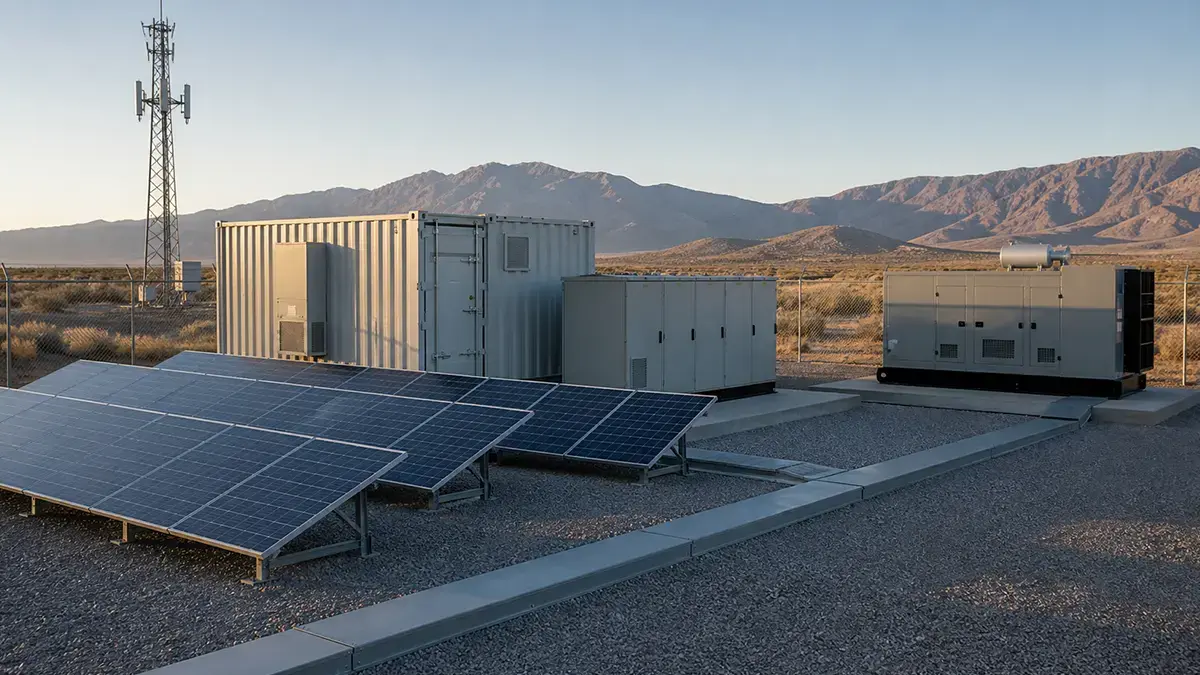
A solar container diesel hybrid should be designed as one controlled power system, not as three devices connected to the same bus. Start by defining the electrical boundary, the source that establishes voltage and frequency, the priority of each load, and the operating limits of the existing generator. Then write the generator start and stop sequence, protection interlocks, and failure responses before selecting final PV, battery, or genset ratings.
Battery state of charge can be one start signal, but it should not be the only signal. A reliable design also considers instantaneous load, available battery power, forecast energy deficit, equipment temperature or faults, generator readiness, and the reserve required for critical loads. This guide provides a practical framework for planning that coordination without assuming that every hybrid inverter or generator supports the same functions.
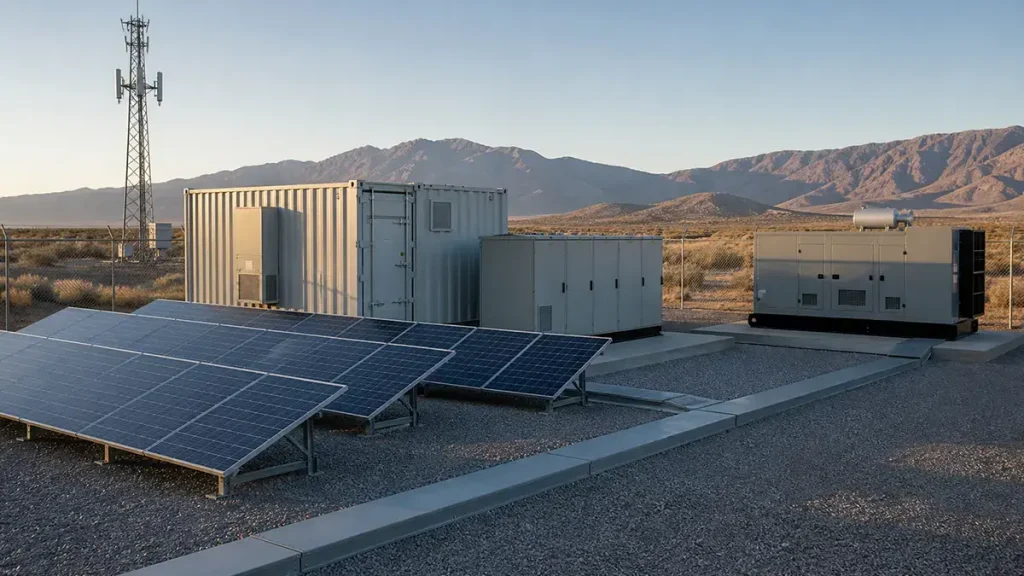
Start With the Electrical Boundary
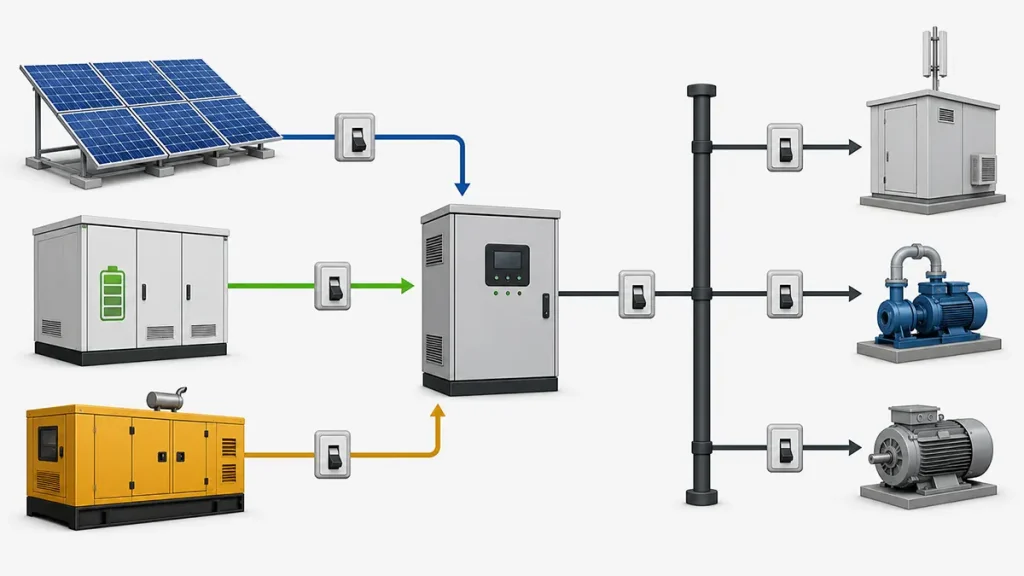
Draw a single-line diagram before discussing automatic generator start. Mark the utility connection if one exists, the point of common coupling, the critical-load bus, non-critical or deferrable loads, PV inverters, battery PCS, generator breaker, transfer equipment, and every source of control power. The diagram should show whether the generator and battery inverter may operate in parallel or whether an ATS keeps them electrically separated.
This distinction changes the whole project. In a transfer-only architecture, one source supplies the protected bus at a time. In a parallel hybrid, the generator and PCS may share real and reactive power, so synchronization, reverse-power protection, control modes, and load sharing become design requirements. A grid-connected site adds interconnection and anti-islanding obligations that a permanently isolated site does not have.
The US Department of Energy describes microgrids as localized systems that can disconnect and operate autonomously, while warning that uncontrolled islanding can damage equipment or endanger workers. Combining PV, batteries, and a generator therefore does not automatically create a functioning microgrid; the electrical boundary, controls, and protection must make the resources operate as one entity. See the DOE overview of distributed energy resources and microgrids.
Decide Which Source Forms the Local Grid
When the utility is unavailable, one resource must establish and regulate the local AC voltage and frequency. A conventional diesel generator can perform this role while it is online. A battery PCS can perform it during diesel-off operation only if the selected equipment, controls, protection, and project configuration explicitly support grid-forming operation.
Do not infer this capability from the words “hybrid,” “storage,” or “off-grid.” Also keep black start separate from normal islanded operation. Black start requires a documented sequence for energizing control power, starting the grid-forming source, picking up loads, and bringing other resources online. It should appear in the functional specification and test plan if the project requires it.
Power and Water Corporation’s Solar/Diesel Mini-Grid Handbook distinguishes diesel-on systems from diesel-off systems. Its diesel-off architecture uses a grid-forming BESS to provide services normally supplied by a running generator and requires integrated control of the PV, BESS, and diesel engines. This is a useful architecture principle, not proof that a particular product includes those functions.
Check Three Balances Before Selecting Equipment
1. Instantaneous Power Balance
List the continuous load, coincident peak, largest load step, motor starting method, power factor, and sensitive loads. Compare them with the inverter kW, inverter or generator kVA, overload duration, battery discharge limit, and generator load-acceptance capability. Daily kWh cannot show whether the system will start a pump or survive a sudden compressor load.
Keep AC and DC ratings separate. A PV array rating in kWp does not establish the AC output limit, and battery capacity in kWh does not establish the PCS power available for a load step. If a generator must serve the load and charge the battery simultaneously, its required operating power can exceed the site load alone.
2. Energy Balance
Build an hourly or finer load profile for the difficult operating season. Compare load energy with expected PV energy, usable battery energy, conversion losses, auxiliary consumption, reserve state of charge, and the fuel-backed energy available between deliveries. A 24-hour average hides cloud events, shift changes, overnight base loads, and high-load production windows.
Use the separate guide to solar container power output when converting PV kWp into time-based energy. If the project is still deciding how much storage it needs, the off-grid battery sizing guide covers usable energy, efficiency, reserve, temperature, and ageing.
3. Recovery and Reserve Balance
Define what the generator must accomplish after it starts. It may need to supply the current load, restore the battery to a target operating range, carry a forecast production event, and retain enough spinning or fast-response reserve for a load step. Charging too slowly creates long generator runs; charging too aggressively may exceed the generator, charger, battery, or thermal limit.
Consider an illustrative site with a 45 kW coincident load and a desired 25 kW battery charge rate. Before derating or reserve, the generator would face a 70 kW real-power demand if it supplied both simultaneously. The design must then check kVA, power factor, altitude and temperature derating, transient response, and the OEM’s permitted loading range. This example is a screening calculation, not a recommended genset size.
Write the Solar Container Diesel Hybrid Operating States
A sequence of operations is more useful than a vague instruction to “use solar first.” Define the permitted states, the source that controls the bus, the conditions for entering and leaving each state, and the response when an expected transition fails.
| Operating state | PV and battery role | Generator role | Control objective |
|---|---|---|---|
| Solar surplus | PV serves load and charges within limits | Off or available | Use available PV without overcharging |
| Solar deficit | Battery covers the permitted shortfall | Off but ready | Avoid an unnecessary start while protecting reserve |
| Start pending | Battery supports the bus during the start sequence | Preheat, crank, stabilize, and verify | Connect only after voltage and frequency are acceptable |
| Generator online | PV continues or curtails; BESS charges or buffers | Supplies load and approved charging power | Hold stable power and an acceptable genset load |
| Recovery and stop | Battery reaches the project recovery target | Unload, cool down, and stop | Prevent short cycling and preserve operating reserve |
| Fault or manual mode | Operates within the defined safe state | Starts, stops, or isolates per fault logic | Protect people, equipment, and critical loads |
Use More Than One Generator Start Condition
A robust start request can be triggered by sustained low SOC, insufficient forecast energy, load above the available PCS or battery power, a battery temperature or equipment derating condition, a scheduled maintenance run, or a resilience rule that preserves energy for critical loads. The controller should distinguish a real deficit from a momentary measurement spike.
Use time delays and hysteresis so the generator does not start and stop around one threshold. Define a minimum run time, minimum off time, maximum permitted starts, warm-up and cool-down periods, and the recovery target that must be met before stopping. Add an override for critical-load risk and a response for “failed to start,” “breaker failed to close,” and “generator unavailable.”
A fixed SOC pair copied from another project is not an engineering standard. The correct thresholds depend on usable battery energy, battery warranty conditions, forecast quality, load criticality, charging power, generator constraints, and the reserve policy. The operating logic also needs to leave room for expected solar. The National Laboratory of the Rockies reported that the Alcatraz hybrid system’s generators had been charging its battery too often, leaving less capacity for PV; an optimized dispatch strategy reduced curtailment and fuel use for that specific site. See the NLR Alcatraz dispatch analysis.
Verify the Existing Diesel Generator
Keeping an existing generator can reduce project scope, but only after its electrical and mechanical duty are checked. Request the model-specific data sheet, controller manual, alternator data, protection settings, maintenance history, and actual load log.
- Confirm voltage, frequency, phase, kW, kVA, power factor, rating class, and available fault current.
- Confirm the governor and AVR modes needed for transfer or parallel operation.
- Identify the start interface, preheat sequence, permissives, alarms, emergency stop, and communication protocol.
- Apply altitude, temperature, fuel, and ventilation derating for the site.
- Check step-load acceptance, nonlinear loads, harmonics, and motor starting.
- Confirm the OEM’s minimum loading, maximum loading, run-time, maintenance, and aftertreatment requirements.
Extended low-load operation can be harmful for some diesel generator sets. Caterpillar’s guidance, for example, discusses wet stacking and other effects when its diesel gensets operate below specified load levels for extended periods. Use this as a reason to check the relevant OEM manual, not as a universal 30% rule for every generator. See Caterpillar’s generator underloading guidance.
Specify Protection, Interlocks, and Failure Responses
The control narrative and single-line diagram should agree. Define breaker ownership, synchronization checks, reverse-power protection, anti-islanding behavior, overcurrent and earth-fault protection, voltage and frequency limits, neutral treatment, grounding, control power, and emergency shutdown. A grid-connected retrofit also needs the locally applicable utility and authority approvals.
Prevent uncontrolled export into a generator that cannot absorb power. Specify what happens when PV output exceeds load and battery charge capability: PV may need to curtail, loads may be scheduled, or the operating state may need to change. Loss of EMS communications should lead to a known safe mode rather than an undefined contest between local controllers.
Prepare a cause-and-effect matrix for at least these events: rapid PV loss, load step, low SOC, high battery temperature, generator start failure, generator trip, PCS trip, communication failure, breaker disagreement, emergency stop, and restoration after a complete shutdown.
Match the Design to HighJoule’s Published HJ-SG Range
HighJoule’s current HJ Solar Container product table lists two site-energy configurations and identifies photovoltaic, energy storage, and diesel power generation as their published scenario.
| Model | PV capacity | Energy storage | Published remark |
|---|---|---|---|
| HJ-SG-10 | 3.6 kWp | 30 kWh | DC power max. 24 kW |
| HJ-SG-20 | 7.2 kWp | 50 kWh | DC power max. 36 kW |
Test the Sequence, Not Only the Components
Factory and site acceptance should prove the operating states and failure responses. Agree which tests occur at the factory, which require the actual generator and site switchgear, and which settings remain provisional until commissioning.
- Verify PV-priority operation, battery charge limits, and PV curtailment.
- Trigger generator start through each approved condition and confirm time delays.
- Test start failure, breaker failure, generator trip, and communication loss.
- Apply representative load steps and motor starts while recording voltage and frequency.
- Confirm minimum run time, recovery target, unloading, cool-down, and stop.
- Test emergency stop, manual mode, alarms, and restoration from a safe shutdown.
- Test black start or closed-transition operation only when those functions are specified and supported.
Prepare the Data Package for a Hybrid-System Review
Send engineering inputs rather than a requested battery size. The minimum useful package includes the site location, interval load profile, critical and deferrable loads, largest motor starts, voltage and frequency, existing single-line diagram, generator model and controller documents, fuel-delivery window, environmental conditions, required reserve or autonomy, and the desired operating modes.
Also state whether the project permits generator-PCS parallel operation, whether diesel-off operation is required, and what interruption is acceptable during transitions. HighJoule can then review the preliminary power balance, energy balance, recovery duty, product fit, and missing interface data. Use the technical consultation form to request a hybrid-system solution review.
Frequently Asked Questions
Can a solar container work with an existing diesel generator?
Often, but compatibility must be verified. The generator’s voltage, frequency, controller interface, rating, grounding, protection, load acceptance, and permitted operating mode must match the proposed PCS, switchgear, and control sequence.
Should the generator start at a fixed battery SOC?
SOC can be one input, but use project-specific thresholds with time delay, hysteresis, minimum run time, and overrides for load, faults, temperature, and critical-load reserve. There is no universal SOC pair for every hybrid system.
Can the diesel generator be switched off while solar is operating?
Only when another resource is designed to establish and regulate the local grid, and the protection and controls support the transition. A diesel-off mode should be specified and tested; it should not be inferred from the presence of a battery.
Will a hybrid system always reduce diesel consumption?
Not automatically. The result depends on the load profile, solar resource, battery size and limits, generator efficiency, dispatch logic, curtailment, and fuel-backed reserve requirement. Model the project window and verify performance against metered data after commissioning.
Last Updated on 08/05/2026