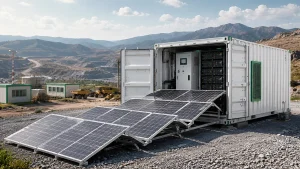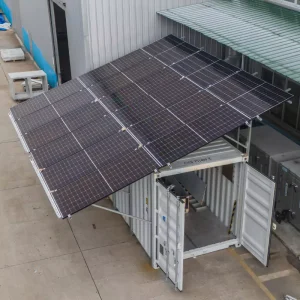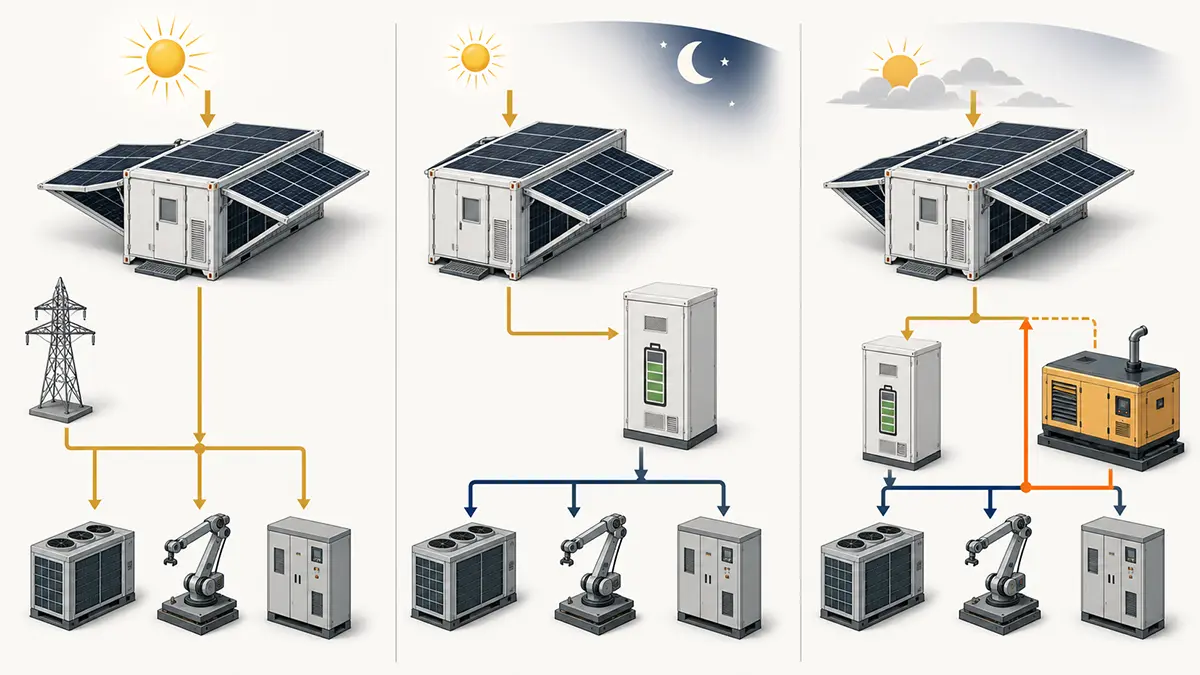
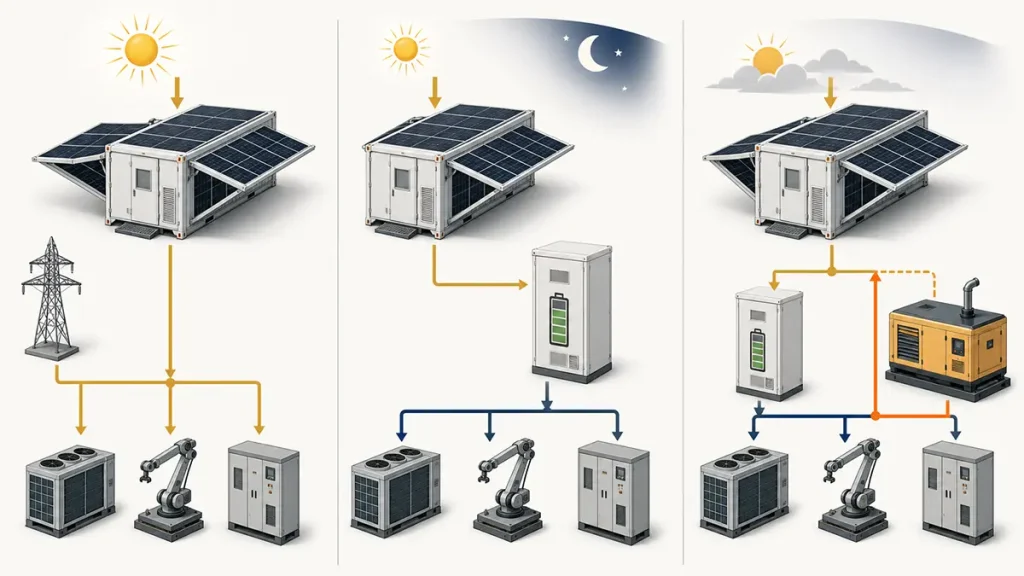
No, a solar container does not always need battery storage. A generation-only system can be the right choice when a stable grid or generator is available, the main loads run during daylight and exported or unused solar energy has an acceptable destination. Battery storage becomes necessary when the project must carry loads after sunset, ride through outages, smooth a variable supply or operate as part of an autonomous microgrid.
The decision should come before battery sizing. First define when the loads operate, what happens when solar output falls and which source establishes voltage and frequency. Then choose among PV-only, PV-plus-storage and PV-storage-generator architectures. If the container concept itself is still unfamiliar, this overview of solar powered shipping containers explains how fold-out generation, conversion equipment and optional storage fit into a transportable system.
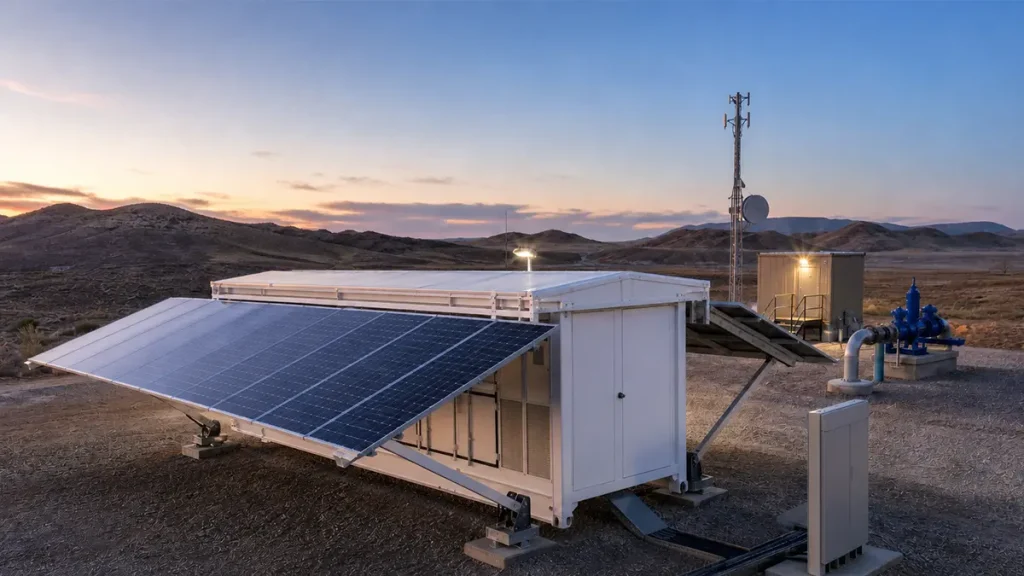
Start With the Job the Battery Must Perform
A battery is not a generic reliability upgrade. It is an energy-shifting and power-control component with a defined job. The same container project may need storage for one objective and not for another.
| Project objective | Is battery storage usually required? | Reason |
|---|---|---|
| Reduce grid purchases while serving daytime loads | Not necessarily | Solar can feed coincident loads directly if the interconnection and controls permit it |
| Operate pumps or batch equipment only when solar is available | Not necessarily | Flexible loads can follow the solar window, with another source covering exceptions |
| Serve evening or overnight loads from solar energy | Yes, unless another source runs | Energy must be stored during the day and released after generation falls |
| Keep critical loads on during a grid outage | Usually | Storage and a correctly designed inverter-control system can support islanded operation |
| Run a remote site continuously through variable weather | Yes, or use another dispatchable source | PV alone cannot guarantee nighttime or low-sun continuity |
| Reduce generator runtime and avoid running it for every small load | Often useful | The battery can carry lower loads and reserve the generator for charging or sustained deficits |
The word “backup” needs a number beside it. One buyer may need ten minutes for an orderly shutdown; another may need six hours of communications and pumping; a remote clinic may define continuity across a much longer event. Those are different storage duties and should not produce the same specification.
Choose Among Three Practical Architectures
PV-Only: Best for Coincident, Flexible Loads
A generation-only solar container supplies power while useful sunlight is available. A stable utility connection or generator can absorb the mismatch between PV output and the load, subject to the approved electrical design. This route suits grid-connected sites that want daytime energy, or operations that can deliberately schedule pumping, water treatment, charging or other batch work into the solar window.
Do not interpret “PV-only” as “power under every condition.” Solar output changes with irradiance, temperature, shading and weather. Grid-connected inverters also have interconnection and anti-islanding obligations. The US Department of Energy notes that conventional grid-dependent solar systems generally switch off when the grid fails; outage operation requires a properly configured inverter and storage system. The exact requirement varies by design and jurisdiction, but the buyer lesson is clear: grid-connected generation is not automatically backup power. See the DOE’s solar and resilience guidance.
PV Plus Battery: Best for Time Shifting and Shorter Interruptions
Add storage when solar energy must be used at a different time from when it is produced, or when the local system must bridge a defined interruption. The battery charges from available generation and later discharges through the power conversion system. It may also help manage short power imbalances, but only when the PCS, controls, protection and operating modes are designed for that function.
Keep two ratings separate. Battery energy capacity in kWh describes how much energy can be stored; battery power in kW describes how quickly it can be charged or discharged. DOE’s solar and storage basics makes the same distinction. A large kWh figure does not prove that the system can start a motor or serve a high coincident peak, while a large kW converter does not guarantee many hours of runtime.
PV, Battery and Generator: Best for Extended Low-Sun Risk
At a continuous remote site, designing batteries for every conceivable low-sun period can create a large and rarely used storage requirement. A hybrid architecture lets the battery cover normal daily shifting and shorter deficits while a generator handles prolonged poor weather, unusually high loads or recovery charging. The generator does not remove the need for energy management, load priorities or fuel planning; it changes the risk boundary.
This architecture is especially useful when fuel deliveries are possible but undesirable, and when the cost of lost load is higher than the cost of keeping a dispatchable source. NREL’s REopt framework evaluates solar, batteries and generators together because resilience depends on the critical load, solar resource, battery state of charge and outage timing rather than one nameplate value. See NREL’s explanation of REopt energy-system sizing and resilience analysis.
Run Five Decision Tests Before You Select Storage
1. Map the Load Against the Solar Window
Use an hourly or interval load profile, not only a monthly bill. Mark the continuous base load, shift schedule, large motors, starting events and loads that can move in time. A site that consumes 300 kWh entirely between 09:00 and 16:00 has a different storage need from one that consumes the same energy evenly over 24 hours.
Also identify which loads can be curtailed. If water pumping can pause during a cloud event without affecting operations, the design may tolerate less storage. If a communications rack, safety system or medical refrigerator cannot stop, isolate that critical tier instead of sizing backup for every non-essential load.
2. Define the Consequence of Losing the Grid
If the site has a strong grid and outages do not interrupt a critical process, generation-only solar may be sufficient. If an outage must be survived, specify the critical-load kW, required hours, acceptable interruption and recovery sequence. Do not assume a battery creates an island by itself. An autonomous system also needs a resource that can establish voltage and frequency, coordinated protection, controls, grounding and a tested transition strategy.
DOE defines a microgrid as interconnected loads and distributed resources within an electrical boundary that can be controlled as one entity and may operate connected to or disconnected from the larger grid. That means a collection of panels, batteries and a generator is not yet an operating microgrid. The DOE distributed energy and microgrid overview provides the broader system context.
3. Decide Whether a Generator Is Backup, Partner or Primary Source
Write the generator’s role into the operating philosophy. It may start only below a battery state-of-charge threshold, run during a scheduled high-load process, charge storage at an efficient operating point or remain reserved for emergency use. Those choices affect battery energy, converter power, fuel storage and control logic.
Check the electrical interface as well as fuel. The generator must be compatible with the inverter or PCS, protection scheme and transfer strategy. A generator sized only for the average load may not have enough margin to serve the load and recharge the battery simultaneously. A much larger generator may spend long periods at an undesirable loading level. Project modelling should evaluate the complete duty cycle.
4. Set the Required Autonomy in Hours
Use hours for the first decision screen. Suppose the critical load is 18 kW and must operate for six hours after sunset. The load requires 108 kWh. If the preliminary design assumes an 80% usable state-of-charge window and 92% discharge-path efficiency, the initial nameplate screen is:
108 kWh / 0.80 / 0.92 = 147 kWh
This is an illustrative screening result, not a final battery size. It excludes temperature effects, battery ageing, auxiliary loads, power limits, reserve policy, recharge energy and module increments. Once the architecture decision is made, use the dedicated guide to off-grid solar battery bank sizing for the next level of analysis.
5. Verify the Solar Array Can Refill the Battery
A battery can only shift energy that another source supplies. Compare expected PV production with simultaneous daytime consumption and the energy that must be restored to storage. If the array barely covers the daytime load, adding a large battery does not create charging surplus. The generator or grid will perform more charging than the buyer may expect.
Run the balance for the difficult relevant season, not only an annual average. The article on solar container power output separates PV kWp, inverter kW, battery kWh and daily energy so the recharge calculation starts with the correct units.
Match the Decision to the Verified HighJoule Product Routes
HighJoule publishes two distinct foldable-product routes in its product configuration tables. For this comparison, the individual model rows are the governing source; generic feature statements are not treated as specifications unless they are confirmed for a listed model.
The HJ-FESS Solar Container parameter table lists six generation configurations from 24 to 182 kWp with 20 to 200 kW string-inverter arrangements. Every listed battery-capacity field is marked with a slash, so HJ-FESS should be treated as the foldable PV-generation route unless separate project documentation explicitly defines an external storage interface.
The HJ-FBESS Solar Container parameter table lists eight PV-storage configurations spanning 9 to 136 kWp and 15 to 482 kWh of storage. Larger variants publish inverter and PCS converter ratings separately; those values should remain separate during comparison. The table is a reference range, not a substitute for confirming usable energy, voltage, grid interface, protection, operating mode and project deliverables.
| Selection route | Use it when | Verify before quotation |
|---|---|---|
| HJ-FESS generation route | Daytime PV generation is the main requirement and another source manages mismatch | Load coincidence, export rules, inverter functions and external source interface |
| HJ-FBESS PV-storage route | Energy must be shifted, critical loads bridged or storage coordinated with a microgrid | Usable kWh, PCS kW, operating modes, controls, thermal limits and safety evidence |
| Engineered hybrid route | A generator or grid must support longer deficits, recovery charging or exceptional peaks | Dispatch logic, generator compatibility, fuel strategy, protection and test plan |
Send the Operating Scenario, Not a Battery Guess
A useful technical review starts with the load and operating rules. Prepare:
- Site coordinates and operating season
- Hourly or interval load data in kW and kWh
- Critical, deferrable and interruptible load groups
- Largest motor starts and short-duration peaks
- Grid availability, export restrictions and outage history
- Required backup duration and acceptable interruption
- Existing or proposed generator size, fuel and start logic
- Voltage, frequency, phase, grounding and interconnection requirements
- Temperature, dust, altitude and other environmental conditions
- Expansion plans and relocation requirements
HighJoule can use those inputs to compare the generation-only, PV-storage and hybrid routes without treating battery capacity as the starting assumption. Submit the package through the technical consultation form and ask for the energy balance, power balance and operating-state assumptions to be shown separately.