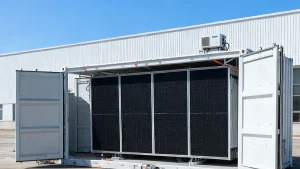
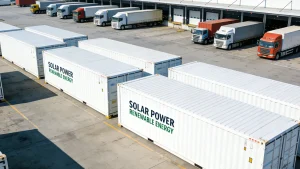
A foldable solar container does not arrive at the second site already commissioned. It arrives as a freight and placement package: folded, lifted, transported and tied down, with an array, a set of actuators and a set of restraints that have been through a move no factory acceptance test simulated. Treating the move as a transport booking is the usual reason a redeployment slips. A realistic allowance covers stowing, inspection, lifting, transport, receiving-site preparation, reconnection, testing and recommissioning; mobility removes some repeated construction and eliminates none of the logistics or engineering.
What follows is for owners and EPC teams running mine benches, quarry faces, camps and temporary industrial sites where the load centre moves with the operation. The unit may be an HJ-FESS foldable PV container or a storage-integrated configuration such as the HJ-FBESS PV-plus-storage container. The sequence is the same either way; the evidence list grows with batteries, power conversion and thermal management.
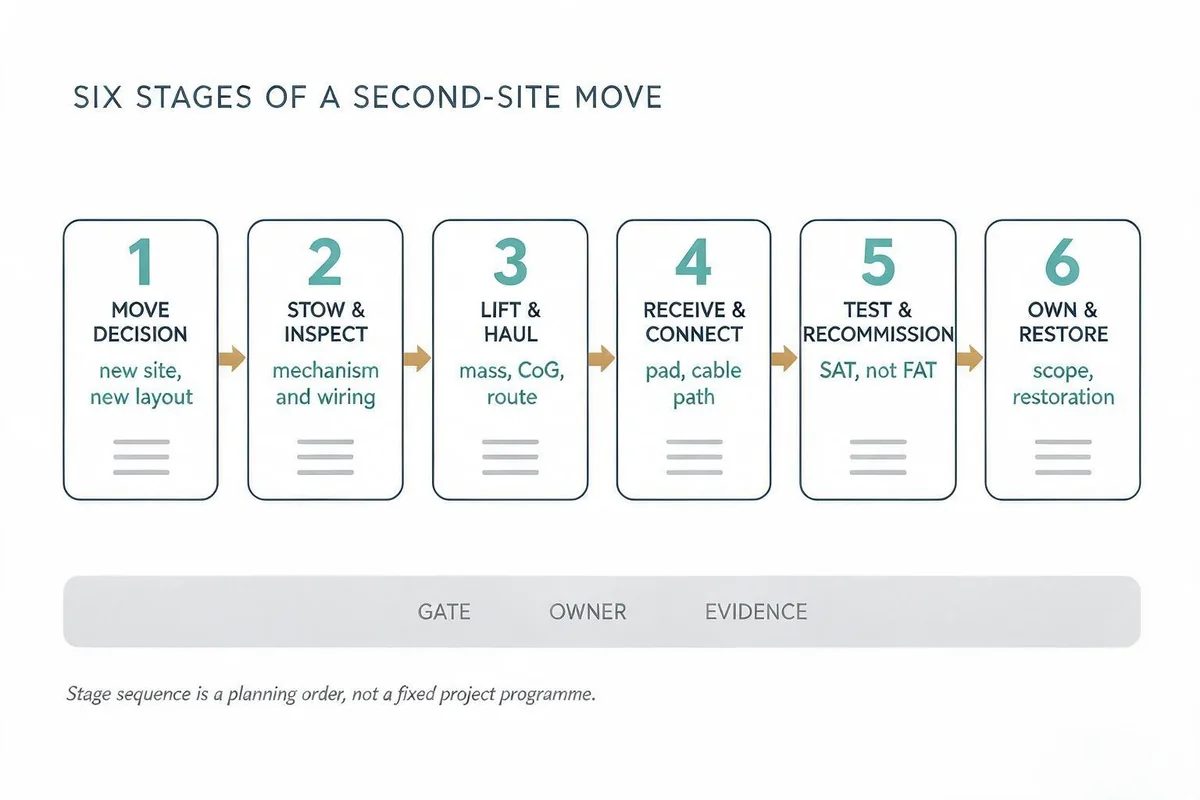
Three move patterns that need different preparation
A single placement, a seasonal redeployment on the same lease and repeated short-distance moves with the working face are not the same job, even when one unit performs all three.
The first placement is a delivery: one route survey, one lift plan, one commissioning campaign. A seasonal redeployment usually returns to a known position, so access and civil work can be reused if they were recorded and inspected. Repeated face moves fall between those two. Each hop repeats the lift, the tie-down and the connection, and the receiving ground is newly compacted or stripped rather than a pad built for the unit. Because the pattern repeats, the inspection and evidence procedure is what stops the second, fifth and tenth move from degrading the asset.
Frequency also shapes the right asset. A site reached through freight or mixed logistics, then occupied for a defined work phase, suits a foldable container managed through freight, lifting, placement and on-site integration workstreams. Managed this way, the container is planned as a package that arrives, sits for the work phase and later leaves, so the move calendar belongs in the power design rather than in the demobilisation plan.
A project that will relocate twice before its operating window closes should model the asset over the sequence of sites, not only the first one, and price the relocation scope into the purchase decision rather than meeting it at demobilisation.
Stage 1: decide on the move and match the asset to the new site
Every site brings its own support area, slope, drainage, access and lifting conditions. The layout has to be derived from the unit drawing rather than traced from the old site plan. A foldable container may cut some field assembly, but it still needs verified support conditions, level tolerances, drainage, access and anchoring or structural provisions defined for the actual design. Portable is not a licence to place it anywhere.
Work from the whole operating envelope, not the container length. A relocation survey separates five connected zones: the transport corridor from road or gate to the final position; the offloading zone for the crane or other approved handling method, including outrigger support and the exclusion area; the support footprint beneath the container and any deployed supports; the deployment envelope swept while the array unfolds and returns; and the operating envelope left for maintenance, ventilation, electrical equipment, cable routes, vegetation control and emergency access.
The support footprint needs its own check each time. A container frame transfers load through concentrated points, and a folding structure can add reactions once deployed. Soil type, fill or earlier excavation, soft areas, seasonal groundwater, frost where relevant, flood level, erosion and buried services belong in the record. Allowable bearing, settlement risk and the support design come from a civil or geotechnical professional. Support level must stay within the tolerances the supplier states for that exact configuration, which appear on the approved installation drawing rather than in a generic article.
Drainage is easy to inherit from the first site and wrong to inherit unchanged. Runoff from access roads, compacted pads, roofs and panel surfaces concentrates at the edge of the installation; ponding softens the subgrade, fast flow scours support zones, sediment blocks channels and standing water makes maintenance access unsafe. Grade the prepared area so water moves away from bearing points and electrical equipment toward an approved discharge path, and keep swales and drains outside lifting, deployment and vehicle-turning areas.
Access and lifting conditions belong in the same review. A route survey follows the intended vehicle from the handover point to the unloading position and records width, gradients, cambers, tight turns, weak verges, bridge restrictions, overhead services, reversing points and the combined vehicle-and-load height. The container footprint alone does not show whether the vehicle can enter. Ground that has been dry all summer deserves a second question about the wet season.
Each of these conditions can change layout, civil scope, delivery method or equipment choice: only the closed container length is known; the container is assumed to be its own foundation; the crane would stand on a drain, trench or unverified fill; deployment would cross a road, fence line, cable route or emergency path; water already ponds in the footprint; maintenance would take place inside the moving area; exact loads and lifting points are still unknown; or a battery is proposed without a documented fire and emergency-access review. Re-solving any of them before mobilisation is cheaper than solving it with the unit in transit.
Stage 2: shut the unit down and prepare it for transport
A foldable container changes state during deployment, operation, stowage and transport, which is why its mechanical parts belong in the equipment register listed beside the electrical equipment. Hinges, rails, actuators, locks, restraints and the cable-management path should be listed against the drawing and manual revision that governs them, so the person preparing the move knows which inspection applies.
Before movement, clear the movement path of obstructions and confirm that the permitted wind and site conditions are met. The supplier's operating envelope governs this check, not a general weather forecast, and the states are separate. Transport, deployment, normal operation and storm stow can each have different limits and different required actions as conditions approach them. Request the limit that applies to each state, plus the load assumptions behind it, at the pre-move review, and record which limit the unit was stowed against on the day.
Stowing is not the end-of-shift fold. The unit must be left in the secured transport state the supplier defines, restraints engaged, the array mechanically secured and electrically safe, and the cable path closed and protected rather than left for the haulier to manage. Photograph the stowed state; those photographs become the reference for checking that the unit arrived as it left.
Take a condition record before the move, with dated photographs of the enclosure, the array, the movement paths and the external interfaces. That record is the baseline for any transport damage discussion and for deciding which parts are reused, repaired or replaced at the second site.
Stage 3: lift it and haul it with data that matches the unit
Do not size a crane from container length or a catalogue family name. Two units with the same external length can carry different batteries, inverters, folded mechanisms and weight distribution. The lift planner needs the actual transport mass, centre of gravity, approved lifting points and final crane position, and those values must come from the supplier for the unit that will actually be moved.
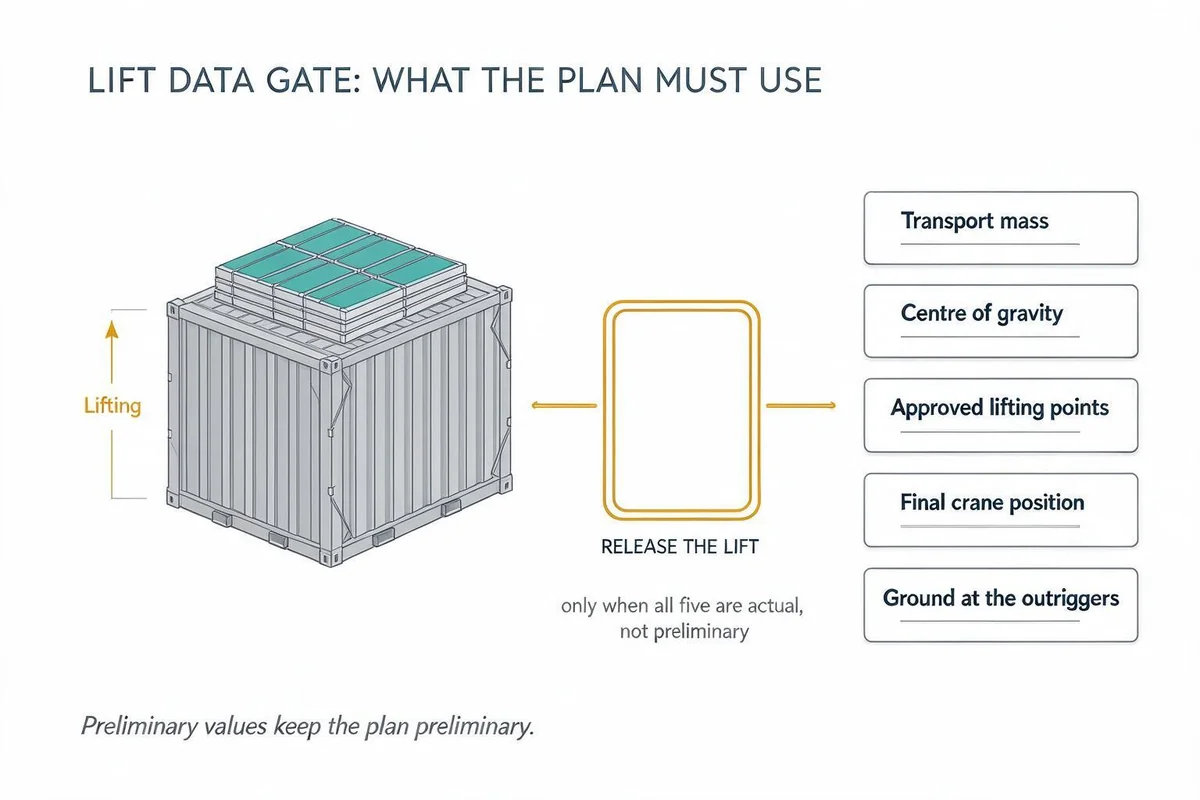
A delivery is ready only when route, vehicle, lifting method, landing position and responsible people have all been confirmed against the actual unit, and booking a truck and crane is not a delivery plan. The second site deserves the same treatment. If the mass or lifting drawing is still preliminary, mark the plan preliminary and do not release the lift for execution; a preliminary number that reaches site has become a safety decision made under time pressure.
Turning a crane quote into a lift plan takes these confirmations: crane configuration and rated capacity at the planned radius, including derating; the container mass, centre of gravity and approved lifting arrangement used in the calculation; slings, shackles, spreader or frame, connection method and inspection status; outrigger positions, calculated reactions, mat design and the ground information used; boom and load paths, overhead and underground hazards; weather and wind limits, plus the person authorised to stop work; the exclusion zone, signal method and named operator, rigger, signal person and supervisor; and the sequence for release, test lift, travel or slew, landing and restraint removal.
A visually dry surface is not evidence that it can carry an outrigger reaction. Crane ground must be firm, drained and graded to the equipment manufacturer's support and level requirements, with known voids and underground utilities communicated to the equipment user. The legal duty varies by jurisdiction; the ground check does not.
Five hold points make the checklist able to stop the job. Before dispatch, the final unit data, documents, route, permits, vehicle, offload plan and landing drawing must agree. The day before, weather, route, access, crane, crew, mats and site readiness are reconfirmed, and heavy rain that has changed the access or setup ground stops the sequence. At the gate, the load identity and condition match the pack, and seals, restraints and transport damage are checked before entry. Before the lift, the briefing is complete, the crane is set to plan and conditions remain within limits. After placement, position, orientation, support, level, damage status and accessories are recorded and accepted; a container twisted, misplaced or supported outside approved points is not accepted.
Battery-containing units add a parallel documentation route. A PV-only container and a container with installed lithium batteries may follow different transport documentation and control routes, and classification, state of charge, test summaries and emergency information depend on configuration, mode and jurisdiction. Confirm those items with the supplier and a qualified dangerous-goods logistics provider before the booking, not with the driver at the gate. The documents and loading sequence are set out in the guide to lithium battery shipping compliance for containerized systems.
Stage 4: prepare the receiving site and reconnect
Receiving-site work starts before the truck leaves the first site. The landing pad, support arrangement and final orientation belong on a drawing that matches the deployment: room for the array to unfold, doors and ventilation clear, and cable routes that do not cross the turning area. Fix the routes for load connection, earthing and bonding, communications, auxiliary supply and any trench or protected above-ground route before civil work. Locating the container first and routing afterwards produces long runs, sharp bends and conflicts with drainage. The solar container site requirements guide collects the ground, drainage, access and foundation inputs.
Placement is a checkpoint, not a switch-on. Once the unit is set down, the array stays folded and secured until placement has been inspected and accepted; deployment and energisation need their own inspection, electrical isolation, commissioning sequence and weather check. The person accepting the position should be the civil or electrical lead named in the relocation plan, not the crane operator signing off a successful landing.
Reconnection is where the second move is most often underestimated, because it looks like the first connection. It is not. Incoming supply, point of connection, protection settings, earthing arrangement and communications path can all differ. Record the connection voltage, frequency, phase arrangement, earthing concept, cable route and length, protection study inputs, metering, and the grid or generator interface, then confirm them against the site that now exists rather than the one in the first-site drawings.
Where the unit carries storage, treat the battery enclosure as a separate siting review: ventilation or thermal management, separation, fire-service access, emergency shutdown, signage, the documentation supplied for that configuration and the local authority's requirements. Where a fire or building code applies, the project's appointed engineer and the authority determine it. For the wider evidence question around storage fire safety, the site's review of storage fire-test and installation-standard evidence for container buyers explains what a test report does and does not establish; the applicable edition and authority still remain project-specific.
Stage 5: test the second site, not the first one
Factory acceptance testing is a shipment gate. It confirms agreed functions and documentation before the unit leaves, and it cannot prove that the pad has been built correctly, that a network will work or that the grid interface has been approved. A completed FAT does not demonstrate site communications, local protection settings, utility approval or operator readiness. None of that changes because the unit was tested once before; the second site is a new set of those conditions.
The first-site acceptance test is evidence for the first site. It proved the first connection, the first communications route and the first protection settings, which are precisely the items the move disturbs or replaces. Treat the first-site SAT record as a dated reference for what the unit can do, not as proof of what the second site has achieved.
Recommissioning separates five layers of evidence, and the exact order, tests and acceptance criteria come from the project documents.
| Recommissioning layer | Evidence the buyer should expect at the second site | What is at risk if it is assumed |
|---|---|---|
| Mechanical and safety readiness | Installed-condition checks, access and clearances, labelling, plus mechanism and wiring inspection after the move | Energisation attempted on a unit still in transport condition |
| Electrical readiness | Approved drawings, earthing and polarity checks as applicable, protection and settings verification, authorised energisation sequence | Equipment that connects but does not operate as designed |
| Controls and communications | BMS, PCS, EMS or SCADA signals, alarms, permissions, time synchronisation and the remote-support boundary | A system that is live but not operable or supportable |
| Integrated performance | Agreed charge and discharge where fitted, operating modes, fault response and site-interface tests | Contractual or operational capability left unproven |
| Turnover | Open-issue process, as-built records, training, warranty contacts, spares and operating documents | Hardware without an accountable operating handover |
Two records carry forward from the first site and need updating rather than replacing. The equipment register should hold as-built drawings, commissioning records, component manuals, warranty conditions, operating procedure and alarm matrix for the delivered configuration, because a checklist written for a PV-only unit cannot simply be carried over to a system that adds battery, PCS and dedicated thermal management. Operating handover is complete only when SAT evidence, issue closure, training, documents and responsibility transfer are done, and at the second site each of those is done again. The solar container deployment timeline explains how FAT, shipment, SAT, energisation and handover relate; the same gate logic applies to a redeployment.
Stage 6: assign responsibility and cost before the move, not after
Most relocation costs are knowable before the move starts, and the arguments begin where nobody wrote down who owns a line. A project-window view keeps them visible: equipment and integration, first-site civil and electrical work, transport and offloading, commissioning, every relocation, downtime cost, less recoverable asset value. The relocation line itself covers demobilisation, stowing, freight, permits where applicable, receiving-site preparation, redeployment, testing and recommissioning.
These are the lines that regularly go unassigned:
- Old-site restoration: removal of ballast, pads or hardstanding, reinstatement of surfaces, drainage restoration and any obligation in the land agreement, which should define removal, grading, restoration, roles and triggers as a planned activity rather than a closing argument.
- Stow and inspection labour: who clears the movement path, runs the pre-move inspection, restrains the unit and signs the condition record.
- Lifting: crane, rigging, mats, spotters, traffic control and exclusion barriers, plus who supplies the actual mass, centre of gravity and lifting drawing.
- Transport: vehicle, route permits, escorts, dangerous-goods documentation for battery-containing units, and cargo insurance across the move.
- Receiving site: survey, support preparation, drainage, cable route and any battery-related fire and emergency-access review.
- Reconnection, testing and recommissioning: who energises, who witnesses, who signs SAT and who trains the operator at the new site.
- Reuse decisions: which parts are inspected and reused, which are replaced, and how a replacement part is released for service.
A coordination baseline helps even where the contract splits duties differently. The supplier provides final transport data, lifting instructions, restraint status, delivery contents and handling limits. The haulier selects the vehicle, surveys the route and confirms permits. The site controller prepares access, discloses hazards and authorises hold-point release. The lifting contractor plans, supervises and executes the offload. The civil and electrical team accepts the position and controls deployment, connection and commissioning. Contract terms may allocate duties differently, and local law may impose duties that cannot be transferred, so the baseline is a starting point for the contract rather than a substitute for it.
Recoverable value deserves the same discipline. Keep it conservative unless a buyer, a lease or a verified reuse plan exists, and remember that a temporary asset still carries a future cost, ownership and disposal decision even when it moves again. Expecting equipment value to survive the move intact while leaving transport, inspection and recommissioning unpriced is the accounting version of the portability assumption.
Put the relocation scope into the quotation
The second-site obligation should be visible in the purchase documents while prices are still comparable. Ask each supplier to state, for the model offered, whether a second-site or repeat-move plan is included, and to answer in writing:
- The actual transport mass, centre of gravity, approved lifting points and restraint conditions for the quoted configuration.
- The per-state limits for transport, deployment, operation and storm stow, with the actions required as conditions approach them.
- The receiving-site drawings needed: support points, level tolerance, deployed envelope, access, cable route and clearances.
- The inspection and evidence list for a moved unit, including mechanism and external wiring checks after relocation, impact or emergency stow.
- The recommissioning scope and the second-site SAT criteria, plus the first-site FAT and SAT records, which serve as reference rather than as evidence for the new site.
- The responsibility split for restoration, lifting data, transport, receiving-site preparation, testing and operator training.
- For battery configurations, the transport documentation route and who owns the dangerous-goods confirmation.
Excluded items should be priced or explicitly excluded. A quotation that lists only the equipment and the first deployment leaves the move unpriced, and an unpriced move is decided by whoever is unlucky enough to be on site when it happens.
What to send for a second-site relocation review
A useful review starts from the actual move, not the equipment family. Send the quoted model and configuration with its mass, centre of gravity and lifting drawing; the location, coordinates and photographs of the new position, access and turning areas; the proposed support, drainage and cable route with any geotechnical information; the expected operating window and how often the unit is likely to move again; the electrical interface, protection and communications details for the new connection; and the intended split of restoration, transport, lifting, commissioning and training responsibilities.
HighJoule can reconcile that package with the transport, handling and recommissioning data for the configuration offered and identify missing inputs before mobilisation. The project's engineers, lifting contractor, carrier and authorities remain responsible for site-specific design, permits and acceptance. Submit the package through the technical consultation form and ask for a second-site relocation scope review rather than a generic delivery date.
Related references for this stage: the delivery checklist for route, crane and offloading, the maintenance checklist for remote sites and the deployment timeline. For the broader question of whether a movable asset belongs in the design at all, start with the solar container mining energy solution.
The package is what makes the review useful: without the quoted configuration and the new site information, the answer can only be generic.
Frequently asked questions
Does the first-site factory acceptance test cover the second site?
No. FAT confirms agreed functions and documentation before shipment; it cannot prove the receiving pad, the local network or the grid interface. A second-site acceptance test is needed for the connection and operating conditions that actually exist there.
Can the crane be booked from the container size?
No. Units of the same external length can differ in battery, power conversion, folded mechanism and weight distribution. The lift plan needs the actual transport mass, centre of gravity, lifting points and crane position, and a preliminary figure keeps the plan preliminary.
What must be checked after the unit is stowed and moved?
Inspect the hinges, rails, actuators, locks, restraints and cable-management path, and check the external wiring, before the next deployment. The same inspection applies after an impact or an emergency stow.
Who pays for restoration of the old site?
That depends on the land agreement and the contract. Put removal, grading, restoration, roles and triggers into both before the first placement, so the second move does not turn restoration into a dispute.
Does a battery change the move?
It can. Classification, state of charge, test summaries and emergency information depend on configuration, mode and jurisdiction, so battery-containing units should confirm the transport documentation route with the supplier and a qualified dangerous-goods provider.
Last Updated on 10/29/2026