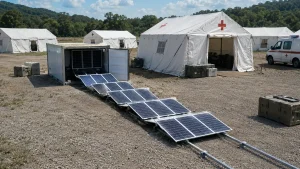
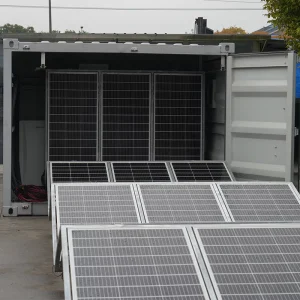
A quote that says "5 MWh" and a warranty that says "70% at year 10" describe two different quantities, and neither of them is the energy the asset will deliver in a day-ahead market in year six. Nameplate capacity is a nominal number attached to the battery block. Warranted usable energy is a contractual floor, measured at a defined point, under a defined duty, and only if the project stays inside a list of operating conditions. The annual degradation schedule is the path between the two. A procurement team that compares only the first number, or only the last one, is comparing a brochure with a legal instrument.
DNV frames the problem from the finance side: the capacity warranty is one of several performance guarantees that may be in place for a product or project, and storage warranties form the foundation on which supply, commissioning, operational, service and financial documents are built. Their public analysis also notes there is no industry standard yet, and that degradation curves vary widely across lithium-ion cell types. That absence of a standard is why a buyer cannot assume two bidders mean the same thing by "usable energy", by "one full discharge per day" or by "calendar degradation."
Three kWh figures that are routinely confused
A container BESS arrives with a nameplate rating such as 5 MWh or 5.0+ MWh capacity in a liquid-cooled 20 ft format, and that number usually refers to the installed cell capacity inside the battery block. How much of it reaches an AC busbar depends on the permitted state-of-charge window, conversion losses, operating reserve, temperature and power limits.
A nominal figure does not by itself prove usable energy at the project's duty cycle or site temperature. That is why a comparable specification separates nominal from usable energy, continuous from maximum power, point of delivery, auxiliary-load treatment and SOC window, each with its configuration-specific test conditions and derating assumptions.
Warranty schedules in DNV's analysis are written as a percentage of year-0 capacity, year by year, for the life of the term. Read that denominator carefully. If year 0 means the nameplate figure, a warranty can look generous while the project's delivered energy sits well below it. If year 0 means a measured commissioning test at an agreed point, the percentage applies to what the equipment actually produced on that day under those conditions. Neither convention is wrong, but the two are not interchangeable, and a buyer who does not ask which one applies will compare percentages calculated against different baselines.
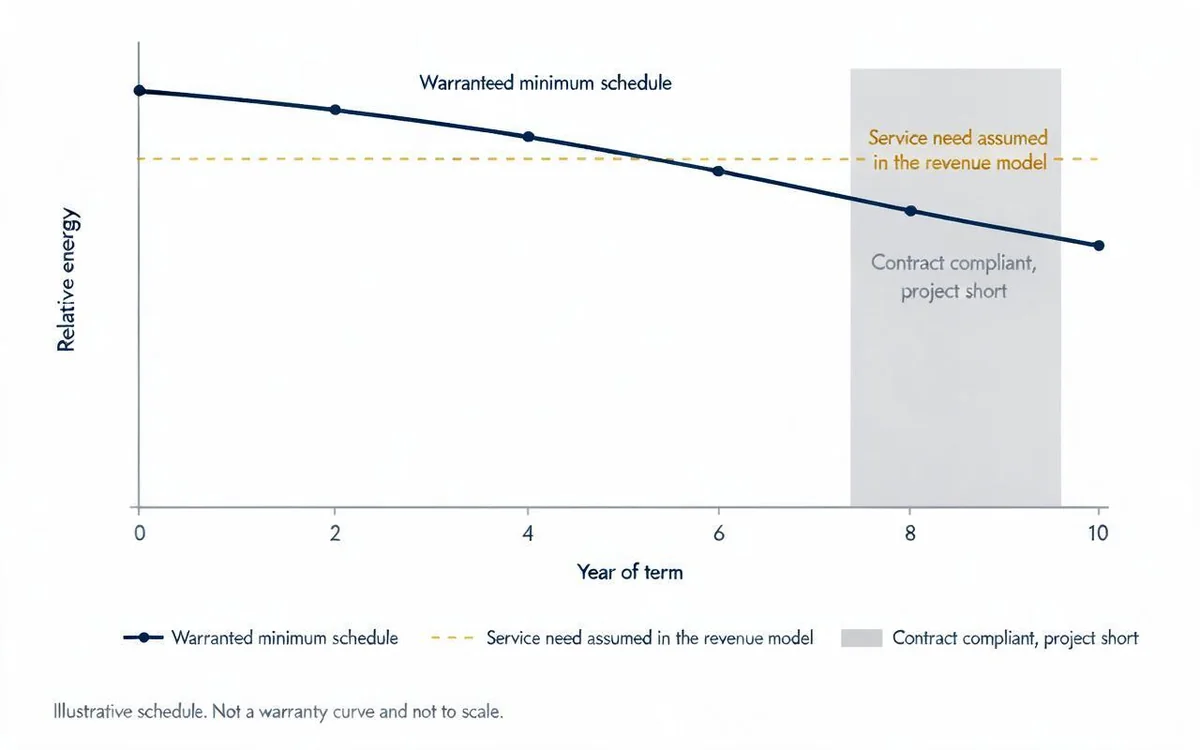
The gap between the three numbers is what a warranty claim is usually about. A supplier can point to the schedule and say the year-8 floor was met. The owner can point to the revenue model and say the asset no longer delivers the MWh the model assumed. Both statements can be true at once, because the model was built on beginning-of-life energy and the schedule was built on a different duty profile.
Where the capacity warranty sits among the other guarantees
A container BESS purchase typically involves several distinct guarantees, and they tend to sit in different documents with different testing rules. The capacity warranty covers retained energy. Product or defect warranties cover failed components, with their own exclusions and start dates. Throughput allowances set how much energy may be circulated before the degradation schedule is adjusted or coverage changes. Availability obligations define what counts as available, which is a separate question from whether the available energy is sufficient. Repair-time commitments set what happens after a claim is accepted.
Buyers who negotiate only the percentage number and skip the others often find the gap at the first shortfall. A capacity floor that is met, on a system whose repair took three months and whose availability clause excluded the outage, provides little financial protection. DNV's common mitigant list points in the same direction: liquidated damages for response and repair exceedances, on-site spares for common components, and dispatch modelling that carries the warranty restrictions as constraints rather than assumptions.
The eight restriction categories that decide whether the guarantee applies
DNV's published table of typical warranty operational restrictions is the most useful checklist available to a buyer without proprietary data. The terms below are third-party public examples, not an industry standard, and they say nothing about any specific supplier or model. Treat them as the questions to ask rather than the answers to accept.
| Restriction | What typical third-party terms specify | What it changes for the buyer |
|---|---|---|
| Capacity – usage/cycling degradation | Percentage of year-0 capacity in a schedule for each year of the term, often based on utilisation such as one average full discharge per day or discharged MWh | The schedule is tied to a duty. A revenue strategy that cycles more may leave the schedule behind. |
| Capacity – calendar degradation | Percentage of year-0 capacity per year or month regardless of utilisation; sometimes the lesser of the two curves applies | An underused battery still loses energy capacity, so idle capacity is not preserved energy. |
| Term of warranty | 10, 15 or 20 years | Cell capacity does not decline linearly; the term defines when the promise ends, not when the asset does. |
| Temperature | Maintain about 25 °C inside the container across all cells, across the expected outdoor temperature range | Measurement location, averaging window and exceedance trigger decide whether the condition was met. |
| Average state of charge | Below 50% annual average SOC | Holding that average can require revenue-suboptimal discharge, especially on standalone systems not charged by PV. |
| C-rate | 0.25 C, 0.5 C or 1 C, equivalent to 4-hour, 2-hour or 1-hour discharge | Exceeding the allowed rate can void the warranty or accelerate degradation. |
| Data storage | Second-by-second BMS data recorded and retained for a few months, then aggregated to minute or hourly data for longer storage | This data is what a warranty or safety dispute is decided on, and the retention process is rarely specified. |
| Response and repair time | 24 hours to a few days to respond; about a month for repairs | Revenue loss accrues during the repair window, which is why liquidated damages and site spares matter. |
The temperature row deserves more attention than it usually gets. "About 25 °C inside the container" is not a single measurement. DNV's own framing asks where the temperature is taken, whether that is in the container, in the racks or at each cell; how often it is averaged, whether yearly, daily, hourly or by the minute; and what counts as an exceedance, such as one reading at the hottest cell or an average over a timeframe. A hot afternoon on a desert site can breach one definition and pass another within the same hour.
That condition also has an engineering owner. Container thermal management should be sized from heat load, ambient temperature, battery density, duty cycle, dust and humidity exposure, and the maintenance capability actually available at the site, rather than from a cooling-technology label. The accompanying site checklist asks the same questions: charge-discharge duty and duration, available footprint, ambient temperature and dust, local maintenance capability, PCS and grid interface scope, and certification plus test evidence that applies to the specific configuration. If the warranty makes the operator responsible for keeping cells near 25 °C, then the cooling design, its auxiliary power supply and its service plan all carry warranty risk.
The measurement basis is the real point of dispute
A capacity test is a procedure, and the procedure decides the answer. DNV's analysis of capacity warranties looks beyond the annual curve to how capacity is measured, how performance is calculated and which operational restrictions keep the guarantee valid. That framing leaves the buyer to pin down the variables the test depends on: starting SOC and end SOC, C-rate, ambient temperature, rest period, auxiliary loads, and whether the reading is taken at the battery terminals, at the PCS output or at the point of common coupling. Each of those choices changes the number that comes out, and an unnamed variable is one the supplier's claim can fill in for itself.
Two tests can honestly produce different magnitudes from the same block. A test at 0.5 C from 90% to 10% SOC, with cell temperature near 25 °C, measures one thing. A test at 1 C from 100% to 0% SOC on a 40 °C afternoon measures another. If the contract does not name the first and the supplier's claim uses the second, the owner may never be able to reproduce the warranted figure.
The frequency rule matters for the same reason. An annual capacity test fixes one point on the curve each year. Continuous measurement against a monitored daily average flags a shortfall much earlier, but it is noisier. DNV's treatment of the temperature condition shows how to write this down: name the metric, the measurement point, the averaging period and the trigger, and state whether a single extreme reading or a sustained average counts as a breach.
When the warranty is tighter than the PPA or the financial model
The revenue assumption usually comes from engineering and the warranty from the supplier's legal template, and the two often meet for the first time in a due-diligence folder. DNV's warning is direct: revenue or PPA operational requirements may not take warranty limitations into account. A PPA that requires a minimum delivered capacity in a peak window, or a model that assumes one full cycle per day at 1 C, can describe an operating regime the warranty schedule was never written for.
A worked example makes the arithmetic visible. Take a 5 MWh nameplate container with a declared usable window of 92% and a warranty floor of 70% of year-0 measured capacity at year 10. Beginning-of-life delivered energy is 5 × 0.92 = 4.60 MWh. At the year-10 floor it is 4.60 × 0.70 = 3.22 MWh. If the service obligation for that year requires 4.0 MWh in a peak window, the contract is still fully compliant and the asset is 0.78 MWh short. Those numbers are illustrative assumptions, not a product value and not a warranty a supplier has offered; the point is that the shortfall shows up in a calculation instead of in a claim.
Run the same test on the rate limit. A 5 MWh block discharged at 1 C for one hour is a 5 MW event; the same block at 0.25 C stretches across four hours. If the warranty allows 0.5 C and the strategy needs 1 C for a handful of hours each month, the exceedance is small in energy terms and large in contract terms, because exceeding the allowed C-rate can void the warranty or accelerate degradation.
The term ends before the asset does
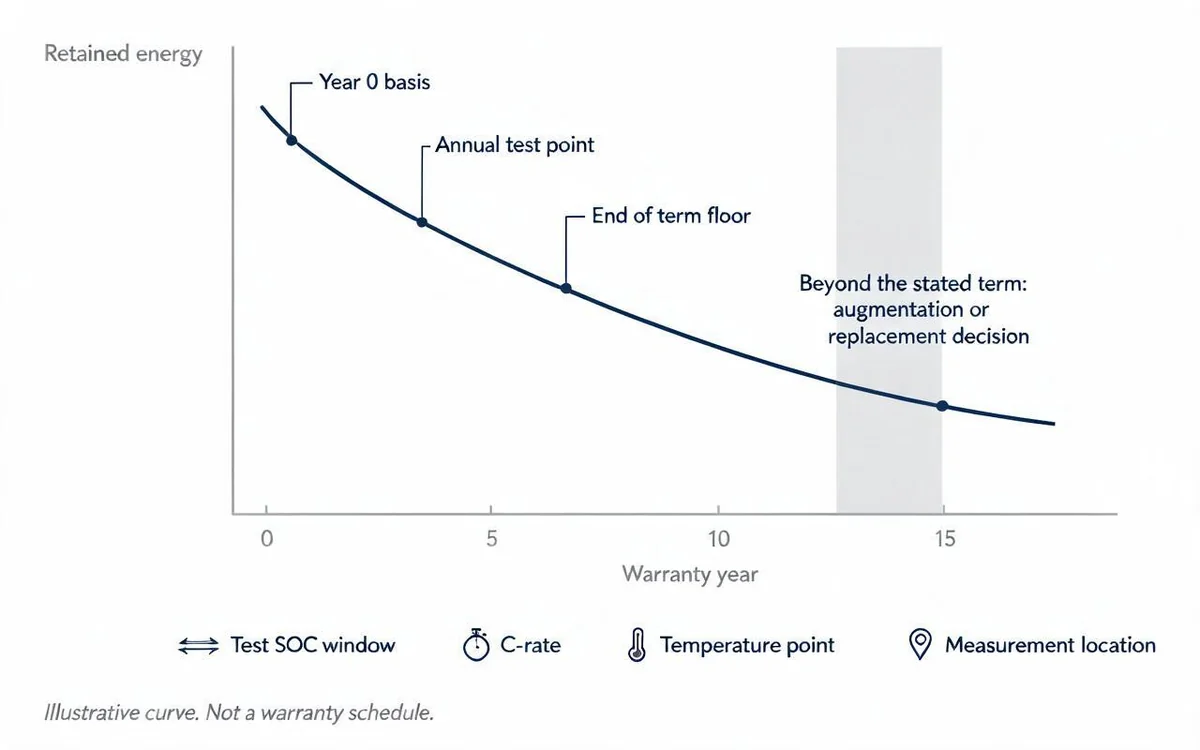
Typical warranty terms of 10, 15 or 20 years are shorter than many project lives, and cell capacity does not degrade linearly. DNV's recommended response is to add an augmentation or replacement strategy for the energy capacity expected to degrade, either in the service agreement or in the financial model. That decision belongs during specification, because the cheapest moment to reserve room for augmentation is before the layout, the DC bus and the PCS headroom are frozen.
Write the strategy as a set of commitments rather than an intention. Name the trigger: a year, a cumulative throughput or a measured capacity threshold. Name who pays for the added capacity, whether the site can accept another rack or another container, and whether the existing PCS can use it. Add what happens if the cells available in year eight are not the cells in the original approval. A replacement strategy with no trigger and no budget is a sentence in a brochure.
Flexible warranties: a formula instead of a table
Some providers have moved from a fixed table of retention values to a formula. In DNV's description, these flexible terms use operational metrics as inputs, such as cycles or throughput, and produce adjusted warranty curves for a given timeframe as outputs, within a range of allowable operating strategies. The owner or operator can then choose how hard to run the asset and accept the consequence in the adjusted curve.
The trade-off is transparent but the modelling burden moves to the buyer. A fixed table is easy to check and hard to tailor. A formula tracks the actual dispatch more closely and is harder to audit, because the buyer now has to verify the input metrics, the counting convention, the assumed relationship and the recalculation method. It also has to survive the operator's own choices: DNV describes a strategy built on one cycle per day meeting an extreme weather event that rewards 1.5 cycles per day. Under a fixed table that decision may breach a term; under a formula it prices the degradation instead.
Matching the quote to the acceptance records
Factory acceptance testing looks like warranty evidence and is not. FAT can confirm that the agreed functional logic, protection responses and control settings behave as specified before shipment. It does not prove that a remote site has adequate connectivity or local response capacity, and it cannot prove that the pad was built correctly, that the port will clear the cargo, that the local network will work or that the grid interface has been approved. Those are separate gates, and none of them establishes a year-0 capacity baseline.
What the contract needs is an agreed beginning-of-life measurement: taken at a named point, under a named procedure, with a named witness. Without it, supplier and owner can each compute a defensible year-0 number and disagree for the whole term. The commissioning test should also record the conditions the warranty will later require, meaning ambient temperature, auxiliary power state, SOC window and C-rate.
The quote itself has to carry the warranty scope, not a summary line. Battery, PCS and container structure are three different guarantees with different durations and exclusions, and an RFQ should request them separately rather than accept one blended figure. Nor should a cycle-life value from a datasheet be read as a warranty term. A cycle count without its depth of discharge, retained-capacity threshold, temperature and C-rate is a test result, not a promise, and a promise still needs a remedy attached.
Data custody belongs in the contract, not in the service brochure
The record that decides most capacity disputes is the BMS log, and the process that governs it is usually absent from the warranty text. DNV's observation is precise: second-by-second BMS data is typically recorded and stored for a few months, then aggregated into minute or hourly data for longer retention, and that data is what a warranty or safety dispute is decided on. The process is rarely specified in the warranty, but it should be stored by the owner or a neutral third party so that it is available and agreed by all parties as a source of truth.
Writing that into a contract means naming several things. The tag list that must be logged, the sampling interval, the retention period for raw and aggregated data, the export format, who may access it and on what notice, and what happens at the end of the service agreement. It also means deciding whose copy prevails in a dispute, and testing the export path before shipment, which is a functional test the factory can run and the site cannot easily repeat later without the vendor's platform.
Response and repair commitments sit alongside this. Typical terms allow 24 hours to a few days for a response and about a month for repair, and the revenue loss during that window lands on the owner. Liquidated damages for missed response or repair times, plus an agreed stock of common spares on site, turn the commitment into a number the lender can model. On remote sites the spares decision also has to survive customs, freight and local import rules, so it belongs in procurement rather than in an operations afterthought.
A warranty schedule request to attach to the RFQ
The fastest way to make two quotes comparable is to require one table from every bidder. Each row below is a field the buyer defines and the supplier answers for the offered configuration, not for a reference platform.
- Beginning-of-life baseline: nameplate, measured at commissioning, or another stated basis, with the date, test procedure, measurement point and witness.
- Capacity basis and delivery point: nominal DC, usable DC or usable AC, and whether it is measured at the battery terminals, the PCS output or the point of common coupling.
- Year-by-year retention schedule for the full term, with the assumed cycle count or discharged MWh per year and the treatment of the calendar curve if it differs.
- Allowed C-rate per year, and the effect on the schedule if the project needs a higher rate for a defined number of hours.
- Temperature condition: measurement location, averaging window, exceedance trigger, ambient envelope covered, and the auxiliary power arrangement for thermal management.
- Annual average SOC limit, and the discharge the operator must sustain to remain inside it.
- Data clause: logged tags, raw and aggregated retention periods, custodian, access rights, export format and end-of-agreement handover.
- Response and repair commitments: clock start, escalation, liquidated damages, and the on-site spares list.
- Remedy ladder: repair, rack replacement, augmentation, compensation, and who decides which applies.
- Augmentation and replacement plan for project life beyond the term, with trigger, budget owner and the reserved interface.
Send that table to every bidder and require deviations to be stated per row rather than summarised in a covering letter. A bidder who returns it complete and a bidder who returns a two-page warranty extract are not offering comparable risk, whatever their price points say.
For the wider comparison process, the BESS procurement checklist covers how to make RFP responses comparable before award, and the containerized BESS technical specification checklist shows how to tie each requirement to controlled configuration evidence. The warranty table sits on top of that structure: it turns the specification conversation into the operating envelope the supplier is willing to stand behind.
Closing the gap before signature
A capacity warranty is a narrow promise. It states what retained energy the equipment will produce, under a duty the contract defines, measured a way the contract defines, for a term the contract defines, provided the site stays inside conditions the contract defines. Everything outside those definitions belongs to the owner, and the owner's protection comes from designing the project to stay inside them, from scheduling deployment against the measured baseline, and from being able to prove the conditions were met.
The useful next step is not a longer warranty extract. It is a warranty schedule completed for the exact configuration on offer, then read against the duty the asset will actually run. Bring the load profile, the expected cycles per day and peak discharge rate, the delivery point, the site ambient envelope, the auxiliary power arrangement for thermal management and the intended project life into that conversation; a supplier can only commit to an envelope the project can actually hold.
Last Updated on 10/29/2026