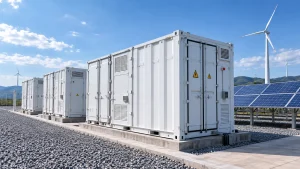
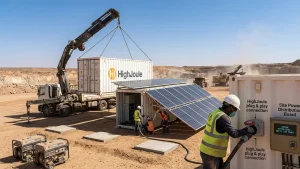
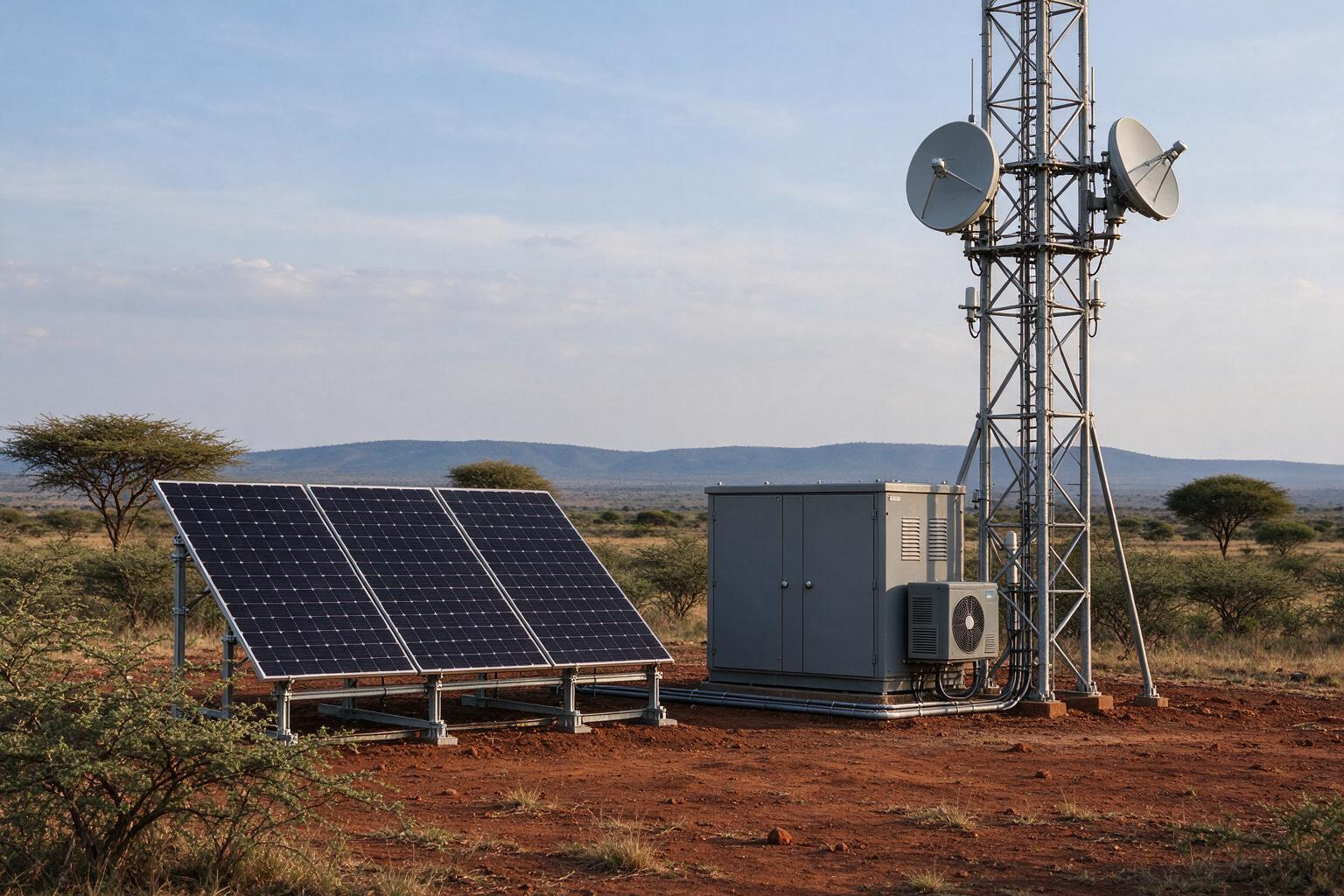
The 40 kWh figure in HighJoule's Kenya telecom off-grid solar-storage case is a starting point for a procurement conversation, not a sizing rule. According to the case record, the site runs a 40 kWh outdoor base-station energy cabinet, fully off-grid, with a LiFePO4 battery rated at more than 6,000 cycles, solar-priority dispatch, an FSU with web management and SNMP plus a 4G wireless sensor module, a 48 V DC compressor air conditioner on RS485, and an optional diesel generator for emergency use only. The project is listed as completed in 2025.
If you are writing the evaluation criteria now, read this alongside HighJoule's sizing guide for telecom base stations: the guide sizes a configuration, while this article tests whether a bidder's answer survives a no-grid site.
The record publishes no site load, no PV capacity, no measured fuel saving and no uptime. Its 3-year payback is a displayed vendor figure with no disclosed derivation. The page itself flags that its main-equipment table lists 200 kWh against the 40 kWh configuration value. That gap is where the procurement work begins: before any supplier number is comparable, ask what it is measured at, under which conditions, and who is accountable when the site runs short.
Diesel dependence is still the industry baseline. GSMA's ClimateTech programme on renewable energy for mobile towers reports that 88% of off-grid and bad-grid tower sites are still powered by non-renewable sources. That is a combined figure across both categories. Our reading is that the two settings differ in ways the number does not show: a bad-grid site keeps an expensive but available fallback that an off-grid site does not, so a quote written for one should never be accepted for the other. For any off-grid site in that majority, ask the bidder for current fuel litres per month and the modelled post-installation figure at the same load.
What the 40 kWh case establishes, and what it leaves open
Read the case as evidence of an operating approach rather than a design template. The battery chemistry, the monitoring stack, the cooling choice and the emergency-only diesel role are all named, which is more than many case pages disclose. What is missing matters more for a purchase decision.
| Item | Published in the case record | Procurement consequence |
|---|---|---|
| Energy storage | 40 kWh outdoor cabinet (a 200 kWh entry also appears in a main-equipment table) | Ask which figure is contractual, and at what usable depth |
| Site load | Not published | Cannot verify autonomy, generator hours or payback from the case |
| PV capacity | Not published; described as configured to local conditions | Ask for the array size, tilt, azimuth and design-month yield |
| Dispatch | Solar-priority: PV serves load in daylight, surplus charges, battery covers night | Ask for setpoints, reserve floor, generator threshold and changeover |
| Monitoring | FSU web plus SNMP; 4G sensor module | Ask which signals travel, who receives them and what happens when the link drops |
| Cooling | 48 V DC compressor air conditioner, RS485 | Ask for ambient rating, auxiliary consumption and derating |
| Result | Completed 2025; 3-year payback displayed | Treat as vendor-reported until the cost model and load data are shared |
Questions to ask about load and duty cycle
A base-station power system is sized against energy per day, not against the radio equipment's nameplate wattage. Cooling, backhaul, lighting, security and monitoring loads belong in the same measurement, and so does the duty cycle of everything that runs intermittently over a 24-hour period.
- What are the measured average and peak loads at the rectifier or DC bus, including cooling and auxiliary loads?
- Which loads are critical for the full outage window, and which may be shed or deferred?
- What does the hourly load profile look like in the lowest-traffic month, not only at busy hour?
- Is air-conditioning demand included, and what ambient temperature and setpoint does it assume?
- What expansion is planned at the site in the next five years, and which equipment will drive it?
A sizing review built on a monthly electricity bill carries less confidence than one built on interval data, and the two should not be compared as if they were equal. That is the first place a quotation stops being comparable.
A sizing screen you can reproduce before you request a quote
Use a short screen to test whether an offer is plausible, then make the supplier replace every assumption with site data. The example below is illustrative, not a Kenya measurement and not a product recommendation. The 80% state-of-charge window and 95% discharge-path efficiency are stated screen inputs, not product data for any model.
Assume a complete site averaging 1.5 kW over 24 hours with a 2.5 kW peak. Daily energy is 1.5 kW x 24 h = 36 kWh.
| Check | Calculation | Result | What it tells you |
|---|---|---|---|
| Usable energy, 40 kWh battery | 40 kWh x 0.80 SOC window x 0.95 discharge-path efficiency | 30.4 kWh | Nameplate and usable capacity differ by the window |
| Hours at the 1.5 kW average load, no PV input | 30.4 kWh / 1.5 kW | About 20.3 hours | Roughly one long night, before temperature and ageing effects |
| Design-month PV yield, 24 kWp | 24 kWp x 4.5 peak sun hours x 0.75 net-energy factor | 81 kWh | About 2.3 times the 36 kWh demand in that month |
| Small-array comparison, 7.2 kWp | 7.2 kWp x 5 peak sun hours x 0.80 = 28.8 kWh, then 36 – 28.8 | 7.2 kWh short per day | About 9 kWp would balance 36 kWh at 36 / (5 x 0.80) |
Two lessons from that table matter more than the specific numbers. First, a 40 kWh battery covers roughly one night at this load, and nothing about several consecutive sunless days. Second, a PV array comfortably ahead of average demand is not evidence that the battery recovers after a bad week. The array does not fix a storage shortfall, and storage does not fix a persistent generation deficit.
The same caution applies to whole-site efficiency. The European Commission's Joint Research Centre provides an off-grid calculator in PVGIS 5 that works hour by hour over multi-year radiation data, tracks when the battery is full or empty and reports energy missing. Its default whole-system performance ratio of 0.67 is used here as a screening default, and the manual describes it as possibly conservative; it is not a telecom-specific value. Its default consumption shape is household, so a telecom site must upload its own 24 hourly fractions. Ask every bidder to run that hourly model for the design month and for the worst stretch of low sun, and to show unmet demand rather than annual averages.
Efficiency figures arrive at very different boundaries. The HJ-FBESS product page states a family-level DC-coupled round-trip efficiency of 88-95%. That is a published platform figure rather than a site result, and it covers a narrower boundary than a whole-system performance ratio. Ask each bidder what its percentage includes – conversion stages, auxiliaries, cooling – before you compare it with anything.
Solar-priority dispatch: what to make a supplier define
"Solar priority" describes the order in which sources serve the load. It says nothing about how the site behaves when the battery approaches its reserve, or what happens at the moment solar returns. Those answers decide whether a dispatch mode is a documented control strategy or a label.
- At what state of charge does the battery stop serving the load, and what reserve is held for a second night?
- Where is the generator start threshold set relative to that reserve, and at what load will it also recharge the battery?
- What is the permitted changeover time, and does the inverter or converter ride through a load step when a large load starts?
- After a generator stop, does the site return to solar priority automatically, and what test proves it?
- What happens after a shutdown: is restart automatic, manual, or dependent on a site visit?
HighJoule's published sizing guidance makes the point directly: where diesel backup is included, the start threshold should sit above the battery's minimum operating state of charge. The generator plus charging equipment must support the combined site load and recharge. A backup connector on its own does not establish automatic start, safe changeover or fault recovery. Nor does the Kenya case record a generator at all – it lists diesel accessories as optional and emergency-only, so a reader cannot assume automated backup formed part of that installation.
Remote monitoring: the questions behind the dashboard
A dashboard that shows state of charge is not the same as a support arrangement that acts on what it shows. HighJoule's own remote-maintenance guidance is blunt about the boundary: telemetry can send data, alarms and event logs, but it cannot inspect a damaged cable, replace a failed fan, clear a blocked air path or carry out a physical isolation.
Start with the data set, then the route, then the owner of the next action.
- Which signals are logged, at what interval, and for how long – state of charge, battery temperature, PV power, load power, generator runtime, cooling status?
- Which protocols does the selected model expose? The liquid-cooled container page lists Modbus TCP/RTU, IEC 60870-5-104 and CAN where supported by the model, and treats site SCADA integration as project-defined.
- What is the primary communications route and the fallback, and is "no data" treated as an alarm?
- Are alarms buffered locally during an outage, how are event logs recovered afterwards, and who is notified when the link fails?
- Which alarms are informational, which are maintenance warnings, and which require an authorized person to change the operating state?
An alarm matrix without a named recipient, a review window and a defined action is a notification, not a service. Include a simulated loss-of-communications test in factory and site acceptance so the answer is demonstrated rather than described.
Site access, ambient range and altitude to confirm
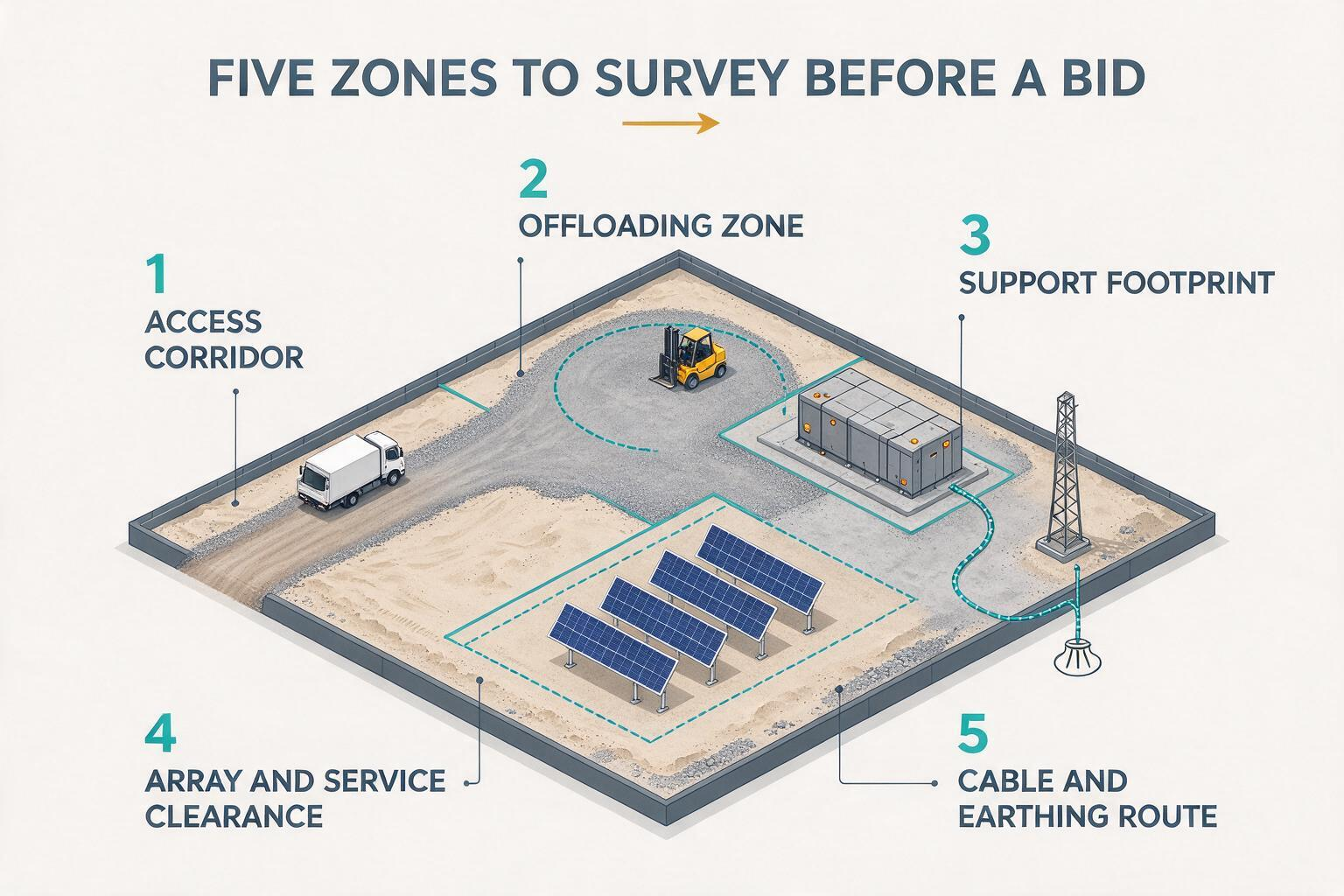
Container and cabinet formats both arrive with transport dimensions that say nothing about the space needed to work. A site is ready only when the unit can reach it, be lifted into position, deploy and stow without obstruction, and connect to the load. HighJoule's site-requirements checklist splits that into five zones: the transport corridor, the offloading zone, the support footprint, the deployed-array and service envelope, and the cable and earthing route. A concrete slab is not the automatic answer; the base depends on operating mass, support points, soil, drainage, wind design and local approval.
The commercial risk sits in the interfaces. A factory-built container does not remove foundation, trench, earthing, protection-coordination or access responsibilities, so each one needs a named owner before award. Request the transport mass, centre of gravity, lifting instructions and release conditions before anyone books a crane, and confirm the route for gates, gradients, overhead lines and axle limits.
Then convert climate words into numbers. "Hot", "dusty", "coastal" and "high" are not design inputs. Send minimum and maximum ambient temperature, altitude, humidity, dust and salt exposure, wind, flooding and seismic conditions, and mark which values are measured and which are provisional.
Altitude is not a cosmetic detail. HighJoule's plateau deployment article states that at 4,500 m relative air density falls to about 63.4% of its sea-level value, so convective cooling weakens and electronic equipment typically needs derating. Ask what derating applies to the offered model at your site's altitude, and ask for it in writing. For the DC interface to the radio equipment itself, ITU-T L.1200 (05/2012) covers DC power feeding up to 400 V at the equipment input, including normal and abnormal voltage ranges and immunity test levels. It defines that interface, not the battery autonomy or the site's energy balance.
Where the published HighJoule configurations fit
The published options only become readable once those questions are answered. HighJoule's HJ Solar Container page describes an integrated format for outdoor base-station sites with two reference models:
| Model | PV capacity | Storage | Container | "DC power max." as published (basis undefined) |
|---|---|---|---|---|
| HJ-SG-10 | 3.6 kW | 30 kWh | 10 ft | 24 kW |
| HJ-SG-20 | 7.2 kW | 50 kWh | 20 ft | 36 kW |
Two cautions before anyone reuses those rows in a comparison sheet. The page describes battery storage and intelligent management as optional configurations, so confirm what the quotation actually includes. And the "DC power max." value is not defined as PV output, as a bus voltage or as a guaranteed continuous battery-discharge rating; ask what it measures, at which voltage and for how long.
A 40 kWh-class container is a different product with a different footprint. The HJ-FBESS model matrix lists HJ-10G-P024E040: a 10 ft container with 24 kWp of PV, 40 kWh of storage, a 20 kW photovoltaic-storage integrated unit and 500 Wp modules. Fitting 24 kWp of PV to a 10 ft footprint raises civil, access and wind questions that a cabinet with separately mounted panels does not – worth confirming with the supplier rather than reading from the model table. No published table in this range should be read as autonomy, discharge duration or round-trip efficiency; those need the site-specific model described above.
The same screen applies here. A 20.3-hour battery-only runtime at 1.5 kW is close to a single overnight window. The design-month question is therefore not whether the array matches annual energy, but whether it recovers the battery after consecutive low-sun days at the load the site actually carries.
The answer table: accept, qualify or reject each supplier response
Run every bidder through one table and apply the same rule to each answer. The questions are easy; the discipline is in deciding when an answer is good enough. Two HighJoule guides carry the detail per row: the dust, heat and remote-site maintenance checklist for spares and service, and the technical specification checklist for evidence and deviations.
| Question | Accept when the answer | Qualify or reject when the answer |
|---|---|---|
| Usable energy | Gives kWh at the site's ambient temperature and duty, with the SOC window, discharge duration and auxiliary consumption stated | Quotes nameplate kWh only, or omits temperature and ageing effects |
| Design-month energy balance | Shows an hourly model with unmet demand and recovery time after the low-sun period | Shows annual average yield, or a single "sunny day" balance |
| Dispatch | States reserve floor, generator start and stop points, changeover time and restart logic, with test evidence | Describes "solar priority" without setpoints or a test sequence |
| Monitoring | Lists signals, protocols, local buffering, loss-of-communications behaviour and the named alarm owner | Offers a portal demonstration but no ownership or escalation route |
| Spares and service | Separates consumables, owner-held critical spares and supplier-held spares, with part numbers, revision control and import responsibility | Says only that spares are available on request |
| Site and access | Supplies transport mass, lifting data, deployed footprint and interface register with responsible parties | Treats the container as a drop-in with no civil, cabling or access scope |
| Environment | States altitude and ambient derating for the offered model, with filtration suited to the site | Shows a generic operating range with no derating curve |
| Documentation | Commits to the current model-specific O&M manual with inspection points and service intervals | Refers to a family brochure as the maintenance basis |
Red flags worth writing into the evaluation record: a quotation that answers with nameplate kWh only; a monitoring claim with no alarm ownership; a communications plan with no fallback or local log recovery; lifting or transport data that arrives after the delivery date is booked.
Certification needs the same treatment. The HJ-FBESS page lists UN38.3, ISO 9001, RoHS, CCC and CE, and a listing is a starting point for the evidence request rather than proof that a certificate applies to your configuration or market. Request the report or declaration tied to the offered model, revision and destination.
The O&M basis is model-specific and should stay that way. HighJoule's container guidance is to use the current model-specific manual to confirm inspection points, service intervals, spares and access requirements rather than carrying them across a product family. That manual, plus the alarm matrix, is the minimum operating document set a remote towerco site needs before handover.
What to send for a site-specific sizing review
A proposal you can compare starts with inputs, not with a target container size: site location and coordinates, daily consumption and hourly profile, peak demand, required DC or AC output, autonomy target, existing generator or grid arrangement, available PV space, and minimum and maximum operating temperatures. Add altitude, dust and salt exposure, access and lifting constraints, communications options and the service model you expect. HighJoule's sizing guide sets out the same inputs and states plainly that the Kenya case is not a battery-sizing benchmark.
With those inputs a supplier can state expected solar contribution, usable battery autonomy, backup behaviour and the equipment boundary, and you can hold the answer to the table above. That beats comparing two quotes that both cite 40 kWh for sites with entirely different loads.
To start that review, use the Solar Container Kit contact page and send the load, interface, site and service inputs listed here.
Last Updated on 10/20/2026