A solar container delivery is ready only when the route, vehicle, lifting method, landing position and responsible people have all been confirmed against the actual unit. Booking a truck and crane is not a delivery plan. The project team should issue one controlled delivery pack, stop the move when a critical input is missing and keep the fold-out array secured until the container has been placed and accepted.
This checklist covers the last mile from dispatch information to placement sign-off. It applies to containerized photovoltaic and PV-storage systems, but the supplier, carrier, crane contractor and site controller must replace every generic check with project-specific dimensions, mass, lifting instructions and local requirements. For an overview of the equipment being moved, start with how solar powered shipping containers combine a transportable enclosure with fold-out generation and, in some configurations, battery storage.
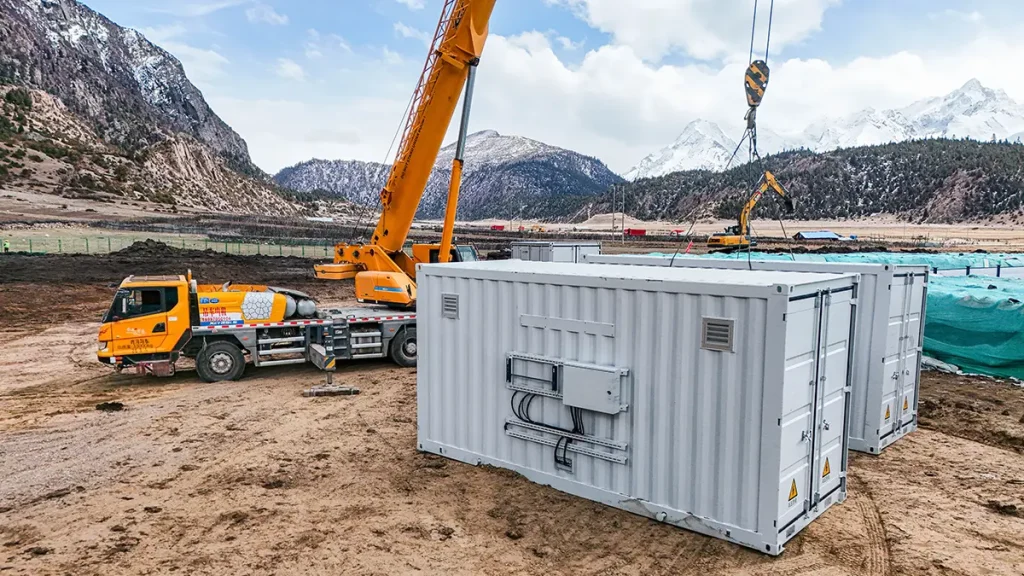
Build the Delivery Pack Before You Book the Last Mile
The most useful delivery document is not a generic checklist. It is a short, controlled pack that gives every contractor the same load and site information. Issue it early enough for the haulier and lifting contractor to challenge the plan, then record revisions so an old drawing does not reach the driver or crane operator.
| Delivery-pack section | Minimum project input | Who should confirm it |
|---|---|---|
| Transported unit | Model, serial or package ID, transport dimensions, actual shipping mass, centre of gravity, approved lifting points, folded-state restraints and loose accessories | Solar container supplier |
| Vehicle and route | Trailer type, combined height and mass, axle arrangement, access route, bridge and road limits, gate dimensions, turning points and permit status | Haulier with site representative |
| Offloading method | Crane or other approved equipment, lift radius, rigging arrangement, load chart basis, outrigger reactions, mats and exclusion zone | Competent lifting contractor |
| Landing position | Set-out drawing, support points, level tolerance, bearing capacity, drainage, orientation, service clearances and post-placement access | Site civil and electrical leads |
| Control and handover | Named coordinator, arrival window, communications, weather limits, emergency arrangements, hold points, inspection record and damage-report process | Site controller |
Do not size a crane from container length or a catalogue family name. Two units with the same external length can have different batteries, inverters, folded mechanisms and weight distribution. The lift planner needs the actual transport mass, centre of gravity, lifting interface and final crane position. If those values are preliminary, mark the plan preliminary and do not release the lift for execution.
Survey the Complete Route, Not Just the Site Gate
A route survey should follow the intended vehicle from the agreed handover point to the exact unloading position. Record road width, gradients, cambers, tight turns, weak verges, bridge restrictions, overhead services, trees, security barriers and locations where the vehicle must reverse. Include the combined vehicle-and-load height and the trailer’s swept path; the container footprint alone does not show whether the vehicle can enter.
Confirm who owns permits, escorts, temporary traffic control and removal of obstacles. Rules vary by jurisdiction and by the vehicle-load combination, so the haulier should determine whether the move is standard or abnormal for the selected route. Where a crane or delivery vehicle occupies a public road, a lane closure or separate authority approval may be required. Treat permit approval as a hold point, not an action to finish after dispatch.
- Drive or digitally survey the final route using the proposed vehicle envelope.
- Photograph every gate, turn, gradient, overhead obstruction and reversing area.
- Verify seasonal changes such as mud, snow, flooding, market traffic or construction closures.
- Choose a safe waiting location so an early truck does not block the road or site entrance.
- Give the driver a route map, site contact and instruction not to improvise an alternative entrance.
If the unit travels by sea before the last mile, the shipping documentation also needs the verified gross mass required by SOLAS for packed containers. The International Maritime Organization’s verified gross mass guidance explains that the shipper is responsible for providing the verified mass and that it is a condition for vessel loading. That value is important for shipping, but the lift plan should still use the supplier’s approved lifting data for the delivered configuration.
Separate the Arrival Area, Crane Setup Area and Landing Pad
Projects often mark one rectangle called the delivery area. That hides three different functions. The arrival area must let the truck stop without blocking traffic. The crane setup area must support the crane, outriggers and mats at the planned radius. The landing pad must support the solar container at its designated points and leave the correct orientation for array deployment, doors, ventilation and cables.
Check the ground for slope, compaction, drainage and known underground hazards. In the United States, OSHA’s construction crane rule requires crane ground conditions to be firm, drained and graded enough to meet the equipment manufacturer’s support and level requirements, with known voids and underground utilities communicated to the equipment user. The exact legal duty depends on the project, but the engineering lesson is portable: a visually dry surface is not evidence that it can carry an outrigger reaction. See OSHA 29 CFR 1926.1402 on crane ground conditions.
The landing-pad requirements belong in the civil package. Confirm support locations and allowable level tolerance with the supplier rather than assuming the container can rest anywhere along its bottom rails. Drainage, flood exposure, cable routes and the deployed array envelope are covered in more detail in the solar container site requirements guide. Complete that work before the delivery team mobilizes.
Turn the Crane Quote Into a Lift Plan
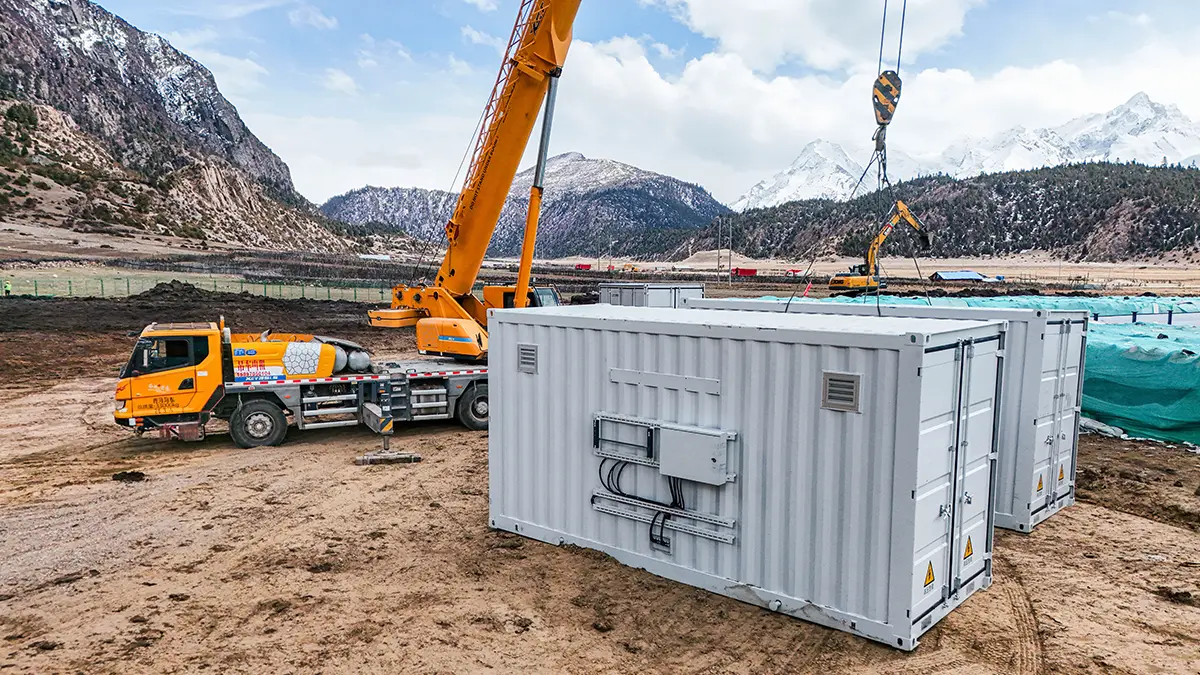
A crane quote normally describes commercial scope; it does not by itself prove the lift is executable. The appointed competent person should plan the operation for the actual load, radius, rigging, ground conditions, wind limits, obstructions and people involved. The UK’s Health and Safety Executive summarizes the core principle clearly: lifting operations should be planned by a competent person, appropriately supervised and carried out safely. Its lifting-operation planning guidance also calls for foreseeable risks, resources and responsibilities to be addressed in the plan.
Ask the lifting contractor to confirm, in its jurisdiction-appropriate method statement or lift plan:
- The crane configuration and rated capacity at the planned working radius, including any required derating.
- The container mass, centre of gravity and approved lifting arrangement used in the calculation.
- The slings, shackles, spreader or lifting frame, connection method and inspection status.
- Outrigger positions, calculated reactions, mat design and the ground information used.
- Boom and load paths, overhead and underground hazards, adjacent structures and public interfaces.
- Weather and wind limits from the equipment, rigging and load instructions, plus the person authorized to stop work.
- The exclusion zone, tag-line strategy where approved, signal method and named operator, rigger, signal person and supervisor.
- The sequence for trailer release, test lift, travel or slew, landing, de-rigging and container restraint removal.
No one should stand under a suspended container. Keep non-essential personnel and the public outside the controlled lift zone, and position the signal person where the load path and operator can be managed. If the approved lifting points, actual mass or ground conditions differ from the plan, lower or retain the load in a safe state and stop. Delivery pressure is not authority to redesign the lift at the truck.
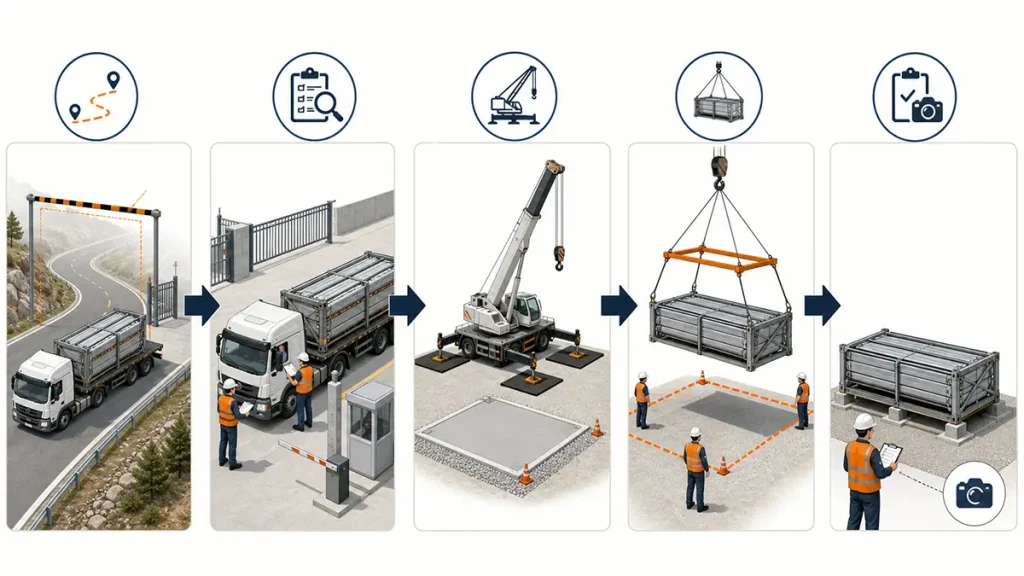
Use Five Go or No-Go Checks
A checklist becomes useful when it can stop the job. Assign one approver to each hold point and record the result in the delivery pack.
| Hold point | Release only when | Typical stop condition |
|---|---|---|
| Before dispatch | Final unit data, shipping documents, route, permits, vehicle, offload plan and landing drawing agree | Mass or lifting drawing is preliminary |
| Day-before confirmation | Weather, route status, access, crane, crew, mats and site readiness are reconfirmed | Heavy rain has changed the access or setup ground |
| At the gate | Load ID and condition match the pack; seals, restraints and transport damage are checked before entry | Wrong unit, visible damage or unplanned vehicle |
| Before the lift | Briefing is complete, crane is set to plan, exclusion zone is controlled and actual conditions remain within limits | Unknown underground hazard, excessive wind or unauthorized people in the zone |
| After placement | Position, orientation, support, level, damage status and delivered accessories are recorded and accepted | Container is twisted, misplaced or supported outside approved points |
The array should remain folded, mechanically secured and electrically safe during transport and lifting in accordance with the supplier’s instructions. Placement does not automatically authorize deployment or energization. Those actions need their own inspection, electrical isolation, commissioning sequence and weather check.
Add Battery Transport Requirements Where They Apply
A PV-only container and a container with installed lithium batteries may follow different transport documentation and control routes. Classification, marking, packaging-equivalent provisions, state of charge, test summaries and emergency information depend on configuration, mode and jurisdiction. Confirm them with the supplier and a qualified dangerous-goods logistics provider before booking.
For example, US PHMSA has published an interpretation for an energy storage system classified as UN 3536, “Lithium batteries installed in cargo transport unit.” That interpretation addresses specific US marking and driver questions; it is not a universal classification decision for every solar container. Use it to see why exact configuration and jurisdiction matter, then obtain project-specific advice from the responsible parties. See PHMSA interpretation 21-0099.
On the HighJoule product range, the verified HJ-FBESS Solar Container combines foldable PV with energy storage, while the HJ-FESS Solar Container is the relevant foldable PV route where the project architecture does not require integrated storage. Request the shipping data and documentation for the exact quoted model; do not transfer paperwork or mass values between configurations.
Make Responsibilities Explicit
| Party | Primary delivery responsibility | Evidence handed to the next party |
|---|---|---|
| Solar container supplier | Provide final transport data, lifting instructions, restraint status, delivery contents and handling limits | Approved drawings, mass data, packing list and handling documents |
| Haulier or freight coordinator | Select vehicle, survey route, confirm permits and deliver without changing the agreed approach | Route plan, vehicle details, permit record and arrival confirmation |
| Site controller | Prepare access, manage interfaces, disclose hazards and authorize hold-point release | Site-readiness record, hazard information and accepted delivery window |
| Lifting contractor | Plan, supervise and execute the offload with suitable people and equipment | Lift plan, equipment and accessory records, briefing and completion record |
| Civil and electrical team | Accept position and supports, then control deployment, connection and commissioning | Placement survey, inspection record and authorization for the next work phase |
Contract terms may allocate duties differently, and local law may impose duties that cannot be transferred. The table is a coordination baseline, not a substitute for a project contract or competent safety planning. Its purpose is to prevent the common failure in which each party assumes another party checked the same critical input.
Send These Files for a Logistics Technical Review
Before requesting final delivery approval, submit one package containing:
- Exact model and configuration, including whether batteries are installed
- Final transport dimensions, mass, centre of gravity and lifting drawing
- Site coordinates, delivery address and named site contact
- Route survey with gate, turn, slope and overhead-clearance photos
- Vehicle and crane proposals with planned setup positions
- Ground and underground-service information for crane setup
- Landing-pad drawing, support arrangement and final orientation
- Permit, traffic, security, weather and emergency constraints
- Target delivery date and the people authorized to release each hold point
HighJoule can use those inputs to reconcile the proposed logistics method with the selected product’s transport and handling data. Send the pack through the technical consultation form. If the energy configuration has not yet been selected, include the site’s load profile and required operating window, then review delivery constraints before the quote is frozen.
Last Updated on 08/04/2026