Writing a containerized solar BESS RFQ does not require an electrical engineering degree. It does require answering four questions before you type the first specification: what will the system actually do, where will it operate, how will it get there, and how will you verify what arrives. Get these four right, and suppliers can return comparable, technically responsive proposals. Skip any of them, and you will spend weeks clarifying specification gaps after bids come in.
We have seen this pattern across dozens of containerized solar BESS RFQ processes — from a 40-foot foldable PV system shipped to a Sudanese mining site to four 46 kW container units delivered to Romania for an EU-backed energy project. In every case, the project moved faster and the proposals were sharper when the RFQ was built around these four pillars. This guide focuses on the RFQ writing process itself. For the full procurement lifecycle — pricing models, financing, ROI, and contract strategy — see our Solar Container Procurement & TCO guide, which covers the commercial and financial dimensions in depth.
Do You Need an RFQ, an RFP, or a Tender?
Before you start writing, clarify which procurement instrument you actually need. The three terms are often used interchangeably, but they imply different levels of specification maturity.
| Instrument | When to Use | What Suppliers Provide |
| RFQ (Request for Quotation) | Your technical specification is locked and you primarily want comparable pricing. | Price against your defined spec. Limited technical variance allowed. |
| RFP (Request for Proposal) | You know the outcome you need but are open to different technical approaches. | Technical solution proposal + pricing. Suppliers may propose alternative architectures. |
| Tender | Formal competitive bidding, typically required by government and utility procurement rules. | Binding bid in a prescribed format, often with bid bonds and strict compliance requirements. |
For most containerized solar BESS projects, we recommend starting with an RFP unless your specifications are already extremely precise — which they rarely are at the first stage. A well-structured containerized solar BESS RFQ is the goal you work toward, but the RFP stage lets you learn from supplier proposals before locking in every parameter. The framework below works for both RFQ and RFP documents.
The Four-Step Containerized Solar BESS RFQ Framework
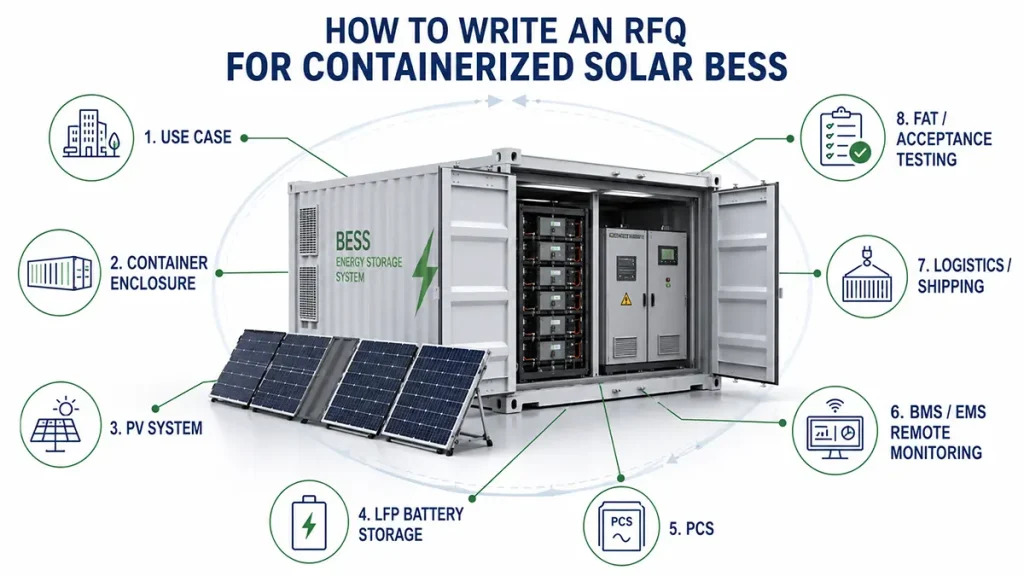
Step 1: Define the Use Case and Procurement Boundary
Before writing a single specification line, pin down what the system needs to do. A containerized BESS configured for peak shaving at a grid-connected factory has fundamentally different discharge requirements than one designed for 24/7 off-grid power at a remote mine. The C-rate, cycle frequency, and depth of discharge all shift depending on the answer.
Four use cases cover most containerized solar BESS deployments. Each drives different technical requirements:
| Use Case | Typical C-Rate | Key RFQ Driver |
| Diesel generator replacement | 0.25C – 0.5C | Fuel savings model, autonomy hours |
| Off-grid primary power | 0.5C – 1C | Continuous load profile, battery sizing methodology |
| Peak shaving / demand charge reduction | 1C – 2C | Tariff structure, peak demand patterns |
| Emergency backup / disaster relief | 0.5C – 1C | Rapid deployment, transportability, no-fuel operation |
It is equally vital to lock in clear procurement scope boundaries. Confirm who takes charge of customs clearance, site concrete base construction, grid interconnection, and commissioning oversight. Detailed scope demarcation avoids the top post-bid negotiation roadblock: suppliers quote prices under conflicting presumptions about the split between supplier and buyer liabilities.
Site conditions matter here too. When we shipped the Sudan foldable container system, the RFQ specified operating temperatures up to 50°C. It also required dust ingress protection at IP55. The Romania deployment — four 46 kW foldable PV containers operating through Eastern European winters — needed a different thermal design altogether. Both systems worked because the RFQ described the actual environment, not a generic one.
Step 2: Write the Technical Specifications
This is the section where most procurement teams over-specify things they do not understand and under-specify the container-specific details that actually drive cost and performance. Here is what to focus on in your containerized solar BESS RFQ. For a deeper dive into battery chemistry, thermal management, and hardware specifications, see our Container BESS Engineering Guide, which covers the technical architecture in detail.
Container enclosure
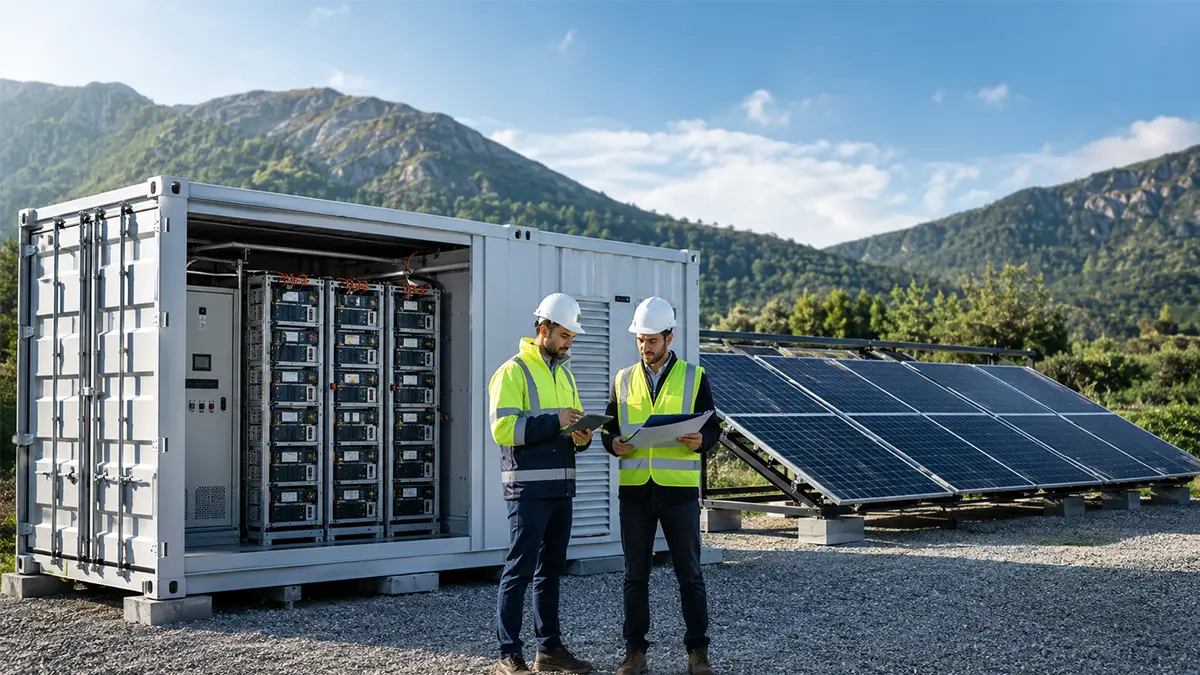
Specify dimensions (10 ft, 20 ft, or 40 ft ISO), CSC safety approval plate, and ingress protection rating. IP55 is a common starting point for outdoor enclosures, but the required rating should be based on the actual dust, rainfall, ventilation design, and maintenance conditions at the site. For corrosion protection, specify the required category based on the project environment: C4 is commonly considered for demanding inland environments, while coastal or high-salinity sites may require C5-level protection. The container is both the transport unit and the permanent enclosure — structural integrity during multi-modal shipping is non-negotiable.
PV system
If you are procuring an integrated solar-plus-storage container, specify the PV module type, total DC capacity, and whether a foldable mechanism is required. Deployment time varies with system size and configuration — our smaller foldable units (10-20 ft) typically deploy within 30 minutes to 2 hours, while larger 40 ft systems with multiple PV wings may require up to 4 hours. Fixed-mount systems require on-site assembly and a crane. The deployment time requirement should be explicit in the RFQ — do not leave the supplier to guess your operational tempo.
Energy storage
State the battery chemistry preference (LiFePO4 is dominant for container applications due to thermal stability and cycle life), usable energy capacity in kWh, and continuous power rating in kW. Require the supplier to declare round-trip efficiency at the system level — not cell-level marketing numbers. Thermal management approach (liquid cooling vs. forced air) has large cost and performance implications; ask the supplier to explain their choice rather than prescribing one. Treat technical specifications as verification criteria — each line in the spec should answer the question “how will I confirm the supplier met this requirement?”
Controls and monitoring
Require BMS and EMS with remote access. In our experience, the ability to monitor system state via satellite or cellular connection eliminates most of the anxiety buyers have about operating equipment in remote locations. However, this feature only works if you specify your connectivity requirements in the containerized solar BESS RFQ — do not assume the supplier will include remote monitoring by default. Also specify whether integration with existing SCADA or third-party EMS is needed.
Step 3: Address Logistics and Shipping
This is the section that every generic BESS RFP guide skips. It is also the one that causes the most expensive surprises for buyers importing containerized systems across borders. A good RFQ for a containerized system gives logistics the space it deserves — a full section, not a footnote.
Incoterms
Choose FOB manufacturer’s port to manage all shipping logistics independently. Select CIF if the supplier shall arrange ocean freight to your destination port. DAP places full transit responsibility on the supplier through to your job site. All Incoterms reallocate costs and risks between both parties; ensure your contract specifies the applicable term.
Lithium battery shipping
Containerized BESS ships with lithium batteries installed, which triggers UN 3536 requirements under the IMDG Code for sea freight. Ask the supplier to provide the UN 38.3 test summary for the cells, the Dangerous Goods declaration, and evidence that their packaging meets the applicable transport requirements for the battery state of charge at shipment. This documentation often takes longer to prepare than the equipment itself — do not leave it to the week before shipping.
Delivery timeline
Based on our recent export projects, a typical timeline for a containerized system from a Chinese manufacturing base looks roughly like this. Production and factory testing: 30 to 45 days. Ocean freight: 20 to 40 days, depending on route and port congestion. Customs clearance and inland transport: 5 to 10 days, varies significantly by destination country. On-site commissioning: 3 to 7 days. These are indicative ranges — actual lead times depend on system capacity, certification scope, shipping route, and site readiness. Ask the supplier to submit a milestone schedule with buffer. Be sceptical of timelines that seem too short — a 60-day door-to-door from Shanghai to a landlocked African capital would be exceptional even with air freight and pre-cleared customs.
Step 4: Set Acceptance and Evaluation Criteria
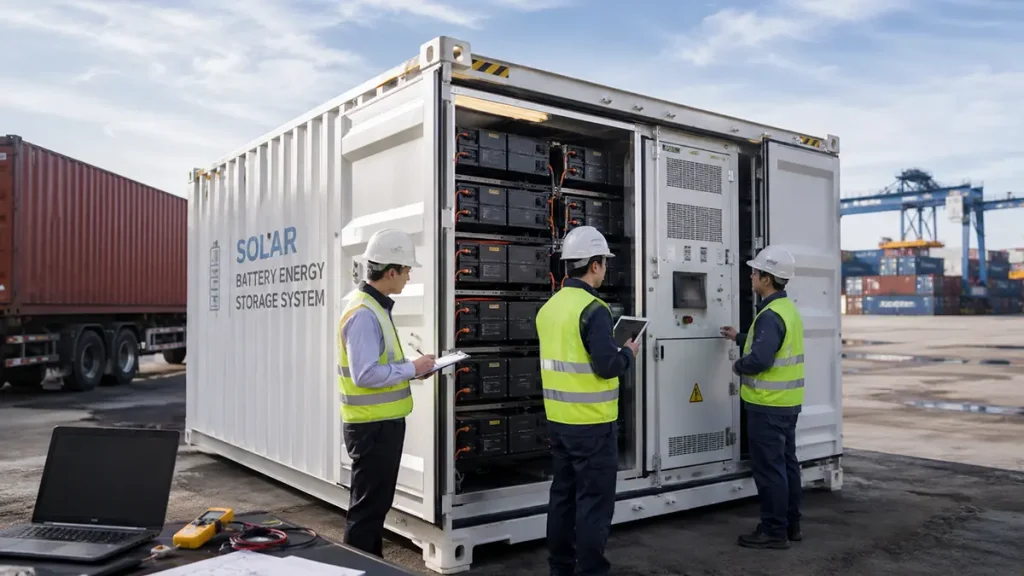
Factory Acceptance Testing gives you leverage. Require the supplier to submit a FAT plan before production starts. For a containerized system, the FAT should cover at minimum: fold/unfold cycle testing for deployable PV mechanisms, battery capacity testing at rated power, BMS and EMS functional verification, thermal management system validation, and fire suppression system testing. You can attend in person, watch via video, or require a signed test report. Specify which option you expect in the RFQ.
For pricing, require an itemized breakdown: container structure, PV modules and folding mechanism, battery racks and cells, PCS and electrical balance-of-system, transportation, and commissioning. A lump-sum bid tells you nothing about where value sits. For warranty, ask for the battery cycle life warranty — for example, 6,000 cycles at 80% DoD or 10 years, whichever comes first. Also request PCS warranty terms (many suppliers offer 5 years as a baseline; verify against your project requirements) and structural warranty for the container itself.
Evaluation criteria should be transparent. Our recommended weighting, based on evaluating dozens of procurement processes: technical compliance 40%, price 25%, delivery capability and track record 20%, after-sales support and warranty terms 15%. Specifically, avoid the trap of awarding purely on lowest price. A container BESS is typically a 10- to 15-year operational asset; saving a modest percentage on upfront equipment cost at the expense of performance, serviceability, or warranty coverage rarely produces a lower total cost of ownership.
Sample RFQ Language for Your Containerized Solar BESS RFQ
The sections above tell you what to ask for. Below is sample language you can adapt directly into your containerized solar BESS RFQ. These clauses are written as supplier obligations — the supplier either confirms compliance or proposes an alternative with justification. Copy them, adjust the values to your project, and paste them into your technical requirements section.
Guaranteed system capacity
“The Supplier shall state the guaranteed usable AC energy capacity at beginning of life, at end of warranty period, at rated ambient temperature, and at rated continuous power. Nameplate DC capacity alone will not be accepted as the guaranteed system capacity. The Supplier shall describe the testing methodology used to verify this capacity during Factory Acceptance Testing.”
Container structural and transport compliance
“The container enclosure shall hold a valid CSC safety approval plate in accordance with the International Convention for Safe Containers. The integrated system, with batteries installed, shall be transported in compliance with UN 3536 as defined in the IMDG Code, 2024 Edition (Amendment 42-24). The Supplier shall provide the Dangerous Goods declaration, UN 38.3 test summaries for the cells, and a transport compliance statement at least 14 days before the scheduled shipment date.”
Technical deviation tracking
“The Supplier shall submit a compliance matrix listing every technical requirement in this RFQ and stating, for each, one of the following: Fully Compliant, Compliant with Minor Deviation (describe), or Non-Compliant (describe and propose alternative). Any requirement left unaddressed in the compliance matrix will be treated as Non-Compliant during technical evaluation.”
Operational environment declaration
“The Supplier shall declare the system’s full operational envelope: minimum and maximum ambient temperature without derating, maximum altitude without derating, maximum relative humidity, and the IP rating of each major subsystem (enclosure, PV mechanism, PCS compartment, battery compartment). Where performance derating begins before the stated limit, the Supplier shall provide the derating curve.”
Key Standards and Regulatory Requirements to Reference
Referencing the right standards does two things: it gives suppliers a precise technical language to respond against, and it signals to your own stakeholders that the procurement process is grounded in recognized industry benchmarks. For a containerized solar BESS RFQ in particular, the standards appendix is where you show you understand the multi-jurisdiction reality of importing energy systems. Below are the standards that matter, organized by jurisdiction. All version references are current as of July 2026.
| Jurisdiction | Standard / Regulatory Requirement | What It Covers |
| North America | UL 9540A, 6th Ed. (2026), or edition required by applicable AHJ and adopted code | Battery thermal runaway fire propagation testing method |
| North America | NFPA 855:2026 | Installation requirements for stationary energy storage systems |
| North America | IEEE 1547 / UL 1741 | Grid interconnection of distributed energy resources |
| International / EU projects | IEC 62933-1:2024 (terminology) | Electrical energy storage systems — vocabulary |
| International / EU projects | IEC 62933-5-1:2024 | Grid-connected EESS — general safety considerations |
| International / EU projects | IEC 62933-5-2:2025 | Electrochemical-based EESS — safety requirements |
| International / EU projects | IEC 62933-5-4:2026 | Safety test methods and procedures for grid-integrated lithium-ion BESS — where applicable |
| European Union | Applicable CE directives (LVD, EMC) | EU regulatory conformity — manufacturer declaration of compliance |
| China | GB/T 36276 | Lithium-ion battery for electrical energy storage |
| China | GB/T 34131 | Battery management system for electrical energy storage |
| International shipping | IMDG Code, 2024 Ed. (Amend. 42-24) | UN 3536 — lithium batteries installed in cargo transport units; mandatory from 1 Jan 2026 |
| International | ISO 1496 / CSC | Container structural safety and certification |
| International | IEC 62619:2022 | Safety requirements for secondary lithium cells and batteries for industrial applications |
Do not just copy this table into your RFQ. Ask the supplier to list which standards their system has been tested against and to provide the relevant test reports or certificates. For UL 9540A, the correct phrasing is “tested in accordance with UL 9540A” rather than “UL 9540A certified” — the distinction matters to procurement readers who know the certification landscape.
The U.S. Department of Energy maintains a lithium-ion BESS technical specifications template — see the DOE Federal BESS Procurement Template — which provides a useful starting point for general BESS requirements, though it does not cover the container-specific sections described above.
For the logistics and lithium battery transport requirements, the IMDG Code, 2024 Edition published by the International Maritime Organization incorporates Amendment 42-24 and has been mandatory since 1 January 2026. It is the governing reference for UN 3536 compliance when shipping containerized systems with installed batteries.
Download the RFQ Checklist
We have distilled the key specification points from this guide into a one-page Container BESS RFQ Checklist. It covers every item a supplier needs to see: use case definition, container specs, PV and battery parameters, logistics and shipping requirements, FAT expectations, pricing format, and evaluation criteria.
Get the checklist: Visit our Download Center at solarcontainerkit.com or contact our engineering team at [email protected]. We send it as a free PDF — no email gate for the checklist. Use it as your RFQ cover sheet and you will catch the gaps before they become change orders.
Need a Second Opinion on Your RFQ Draft?
Our engineering team routinely reviews draft containerized solar BESS RFQ documents — from single-unit off-grid deployments to multi-container microgrids. We flag specification gaps, identify conflicting requirements, and help you structure the commercial terms so that supplier responses are genuinely comparable. If you have a draft RFQ in progress, reach out to our team. No obligation — we would rather help you write a better containerized solar BESS RFQ now than answer clarification questions about a bad one later.
Frequently Asked Questions
What’s the difference between an RFQ, RFP, and tender?
An RFQ (Request for Quotation) is for pricing against a well-defined specification. An RFP (Request for Proposal) asks suppliers to propose both a technical solution and a price — typically used when you know what you need but not exactly how to achieve it. A tender is the formal competitive bidding process, common in government and utility procurement. See the decision table at the top of this guide for more detail on when to use each.
How long does a containerized BESS RFQ process take from issue to contract?
Plan 8 to 12 weeks. That breaks down roughly as: 3 to 4 weeks for suppliers to prepare proposals, 2 to 3 weeks for technical evaluation and clarification rounds, 1 to 2 weeks for commercial negotiation, and 2 to 3 weeks for internal approvals and contract finalization. Rushing this timeline usually means cutting corners on technical evaluation — and that is where the expensive mistakes hide.
Can I use the same RFQ template for different countries?
The technical core — battery specs, PV requirements, container standards — transfers across jurisdictions. The certification requirements, grid code references, and shipping logistics do not. A system destined for a European grid-tied application needs IEC 62933 compliance and CE marking. The same system sent to a North American off-grid mine may need UL 9540A test evidence and NFPA 855 compliance, depending on the adopted code, insurer requirements, and the local authority having jurisdiction. For a containerized solar BESS RFQ that will be used across regions, keep the technical template and swap the standards appendix — that approach has served our multi-jurisdiction buyers well.
Should I specify a battery chemistry in the RFQ?
Yes — but with flexibility. LiFePO4 (LFP) has become the default for containerized applications because of its thermal stability, longer cycle life, and lower fire risk compared to NMC. But instead of writing ‘LFP only,’ write the performance requirement: minimum 6,000 cycles at the specified DoD, a declared operating temperature range with guaranteed output conditions, auxiliary energy consumption data, and complete temperature derating curves — and tested in accordance with UL 9540A for thermal runaway propagation. This gives suppliers room to meet your requirement with their best available technology while giving you the data to compare proposals on performance, not just chemistry.
What are the most common mistakes in BESS RFQs?
Three mistakes keep coming up. First, specifying a capacity in MWh without defining whether it is nameplate or usable — suppliers will bid against different numbers. Second, ignoring the logistics section entirely and then being surprised by logistics-related costs that, in some of our recent international projects, added approximately 12 to 18% to the landed equipment price — although the figure varies substantially by destination, Incoterm, and shipment size. Third, asking for ‘best-in-class’ or ‘industry-leading’ without defining what that means in measurable terms. If you cannot measure it, you cannot evaluate bids against it.
About the Engineering Team
We are the engineering team at Shanghai HighJoule Energy Technologies Ltd., designing and manufacturing containerized solar BESS in Shanghai and deploying them globally. Our HJ-FBESS series uses a DC-coupled architecture with N-Type TOPCon PV modules, liquid-cooled LFP batteries, and integrated EMS with satellite and cellular connectivity. Systems are factory pre-fabricated in ISO/CSC-certified containers and tested in accordance with UL 9540A, with certifications spanning GB/T standards for the Chinese market, IEC for international projects, and CE marking for European deployments.
Our deployments include foldable PV container systems in Sudan, Ukraine, Romania, Cambodia, Bulgaria, and the Maldives — covering desert mining, Eastern European grid support, tropical island microgrids, and humanitarian emergency power. Learn more about the HJ-FBESS solar container product line or read our
full procurement and TCO guide at Solar Container Procurement & Total Cost of Ownership.
Disclaimer
This guide is based on our experience designing and delivering containerized solar BESS for international buyers. Standards and regulatory references are current as of July 2026, including the IMDG Code, 2024 Edition (Amendment 42-24), NFPA 855:2026, and the IEC 62933 series editions cited above. Certification requirements and shipping regulations vary by jurisdiction and are subject to change. Always verify the applicable standards with your local authority having jurisdiction and your freight forwarder before issuing an RFQ or RFP. Deployment timelines and cost estimates are indicative and based on our project experience; actual figures depend on system configuration, destination country, and site conditions.
Last Updated on 07/30/2026