A landed-cost quote for a solar container or containerized battery energy storage system (BESS) cannot be built from equipment price and freight alone. It depends on the importing jurisdiction, commodity classification, origin, contract delivery term, named place, customs valuation basis, transport route, dangerous-goods treatment where applicable, taxes, brokerage, port charges, and site delivery scope. A supplier should not present a single “all-in” import cost as a project fact before those inputs are controlled.
This checklist helps an owner, EPC, importer of record, or procurement team identify what must be confirmed before comparing landed-cost assumptions. It is not customs, tax, or legal advice, and it does not replace the destination-country customs authority, broker, tax adviser, carrier, or contract review.

Start by separating equipment price from landed cost
The equipment price may cover only the supplied configuration. Landed cost is the project-specific cost of bringing the agreed goods to the named delivery point under the agreed commercial and logistics arrangements. Whether a charge sits in the supplier price, the freight quote, the importer’s cost, or the EPC budget depends on the agreed contract and delivery term.
The U.S. International Trade Administration’s Know Your Incoterms guidance explains that Incoterms® rules allocate tasks, costs, and risks between buyer and seller. They do not by themselves determine the customs classification, duty rate, tax treatment, project shipment-release authority, or every obligation in the purchase contract.
The landed-cost assumption ledger
Use this ledger during bid review. Each line should identify the source, assumption, owner, and condition that could change the number. It is designed for clarification logs and award recommendations, not as a substitute for an import declaration.
| Cost or decision area | What must be confirmed | Typical accountable party | Evidence or controlled input | What it does not prove |
|---|---|---|---|---|
| Goods and configuration | Controlled equipment schedule, quantity, battery inclusion, solar modules, PCS, transformer, spares, accessories, packing arrangement, and actual import form: assembled, disassembled, separate consignments, separately invoiced spares or services, temporary import, or permanent import. | Buyer / EPC for the ordered scope; supplier for its offered configuration. | Purchase specification, quotation revision, packing list assumptions, commercial-invoice plan, bill of materials, and deviation log. | Do not assume that the treatment of one shipping arrangement transfers automatically to another. |
| Classification and origin | Commodity classification proposed or confirmed for each material item, country of origin, origin rules, and whether different parts of the system are classified separately. The World Customs Organization explains the Harmonized System at six digits; importing jurisdictions may add national tariff digits and apply their own legal notes and subdivisions. | Importer of record with customs broker or destination-country adviser. | Broker classification advice, bill of materials, origin evidence, and authority guidance where available. | Do not treat a six-digit HS code, supplier code, or code used in another country as the final destination-country tariff classification. |
| Duties, tariffs, and trade remedies | Applicable ordinary duty, preferential treatment, anti-dumping or countervailing measures, safeguard measures, tariff changes, exclusions, effective dates, written product scope, origin, components, assembly route, and any relevant scope or circumvention decision. | Importer of record with customs and trade advisers. | Destination-country official tariff schedule, customs ruling where obtained, current trade-remedy notices, and the applicable written scope. For U.S. trade remedies, consult the International Trade Administration’s AD/CVD guidance. | Do not rely on the tariff code alone for anti-dumping or countervailing measures; a duty rate from another country, product, origin, or date does not establish the project rate. |
| Valuation and taxes | Customs valuation basis; freight and insurance treatment; packing; assists such as buyer-supplied designs, tools, moulds, or materials; royalties or licence fees; sales commissions; seller proceeds; related-party pricing; bundled software, engineering, commissioning, training, or extended-warranty services; import VAT / GST or similar taxes; exemptions; recoverability; and local registration requirements. | Importer of record with tax adviser and broker. | Contract price, Incoterms® 2020 rule and named place, broker valuation guidance, tax advice, and relevant commercial-invoice detail. | A commercial quote or invoice does not prove the authority’s valuation or tax decision. |
| Transport and port costs | Route, carrier, freight, insurance, dangerous-goods handling where applicable, terminal charges, fuel or congestion surcharges, inspection charges, demurrage and detention exposure and free-time terms, inland haulage, crane / offloading scope, local permits, bond or security, banking or letter-of-credit charges, quotation currency, exchange-rate basis, and revalidation-risk owner. | Party named in the contract for each task; logistics lead manages execution. | Freight quotation, route plan, packing details, port and carrier terms, delivery plan, currency assumption, and validity schedule. | A freight quote is not a fixed total unless its exclusions, validity, surcharge mechanism, and operational conditions are controlled. |
| Delivery and release control | Selected Incoterms® 2020 rule, named place, risk-transfer point, import-clearance party, document handover, shipment-release authority, and site acceptance boundary. | Parties expressly named in the contract or shipment-release procedure. | Executed contract, delivery schedule, shipment-release procedure, and project quality plan. | Incoterms® allocation alone does not determine technical shipment release or site acceptance. |
Do not start with a tariff percentage
For a containerized energy system, the question “What tariff applies?” is incomplete until the importer identifies the importing country, the import date, the goods and their final configuration, origin, classification, valuation method, and any applicable trade measure. Solar modules, lithium batteries, power-conversion equipment, container structure, transformers, and accessories may not share one classification or one trade-treatment outcome.
That is why a global article should not publish a single duty percentage for “solar containers” or “BESS imports.” The applicable result may change with jurisdiction, origin, classification, tariff schedule revision, exemption or program eligibility, and customs authority decision. Obtain destination-specific confirmation before using a rate in a budget, tender, or customer quote.
For antidumping or countervailing measures, the tariff code is a search aid, not a complete scope determination. Review the written product scope, origin, components, assembly route, exclusions, effective dates, and any applicable scope or circumvention decision with destination-country trade advisers. This matters especially where a project combines solar modules, batteries, power electronics, and separately shipped parts, but the conclusion remains jurisdiction- and product-specific.
Review customs value separately from the commercial invoice
The commercial invoice is an input to customs valuation, not automatic proof of the final customs value. The World Customs Organization’s guide to the Customs Valuation Code describes transaction value as the primary method subject to specified conditions and adjustments. Under destination law, review required additions, exclusions, related-party pricing, bundled services, software, royalties, assists, packing, and freight treatment before using a commercial-invoice amount as a customs-value assumption.
Specify the Incoterms® rule with its named place
Do not write only “DAP,” “CIP,” or “FCA” in a bid comparison. State the selected Incoterms® 2020 rule and its named place, then separately record project-specific shipment-release and site-delivery requirements. For example:
DAP Project Site, Accra, Ghana, Incoterms® 2020
The named place matters because it makes the delivery point operationally intelligible. Under DAP, the seller generally arranges transport to the named destination and bears transit risk to that point, while the buyer normally handles and pays for import clearance and unloading unless the contract separately allocates particular costs. The ICC Academy’s DAP and DDP explanation is a useful rule-level reference. The project should still define who approves shipping documents, confirms route and offloading readiness, and accepts the goods at each handover point. Before agreeing DDP, confirm that the foreign seller can legally act as importer or otherwise complete import formalities and any required tax registration in the destination country.

Use a tariff-and-trade trigger matrix
Before asking a supplier to include any duty or trade-remedy figure, run the following trigger test with the importer of record and qualified destination advisers.
| Trigger question | Why it changes the estimate | Required next action |
|---|---|---|
| Is the importer of record named and able to make the declaration? | It determines who can obtain broker advice, pay assessed charges, claim available treatment, and receive any authority correspondence. | Assign the entity in the contract and confirm its registration and broker path. |
| Are the equipment configuration and bill of materials controlled? | Classification, origin, transport treatment, and valuation inputs can change when the final scope changes. | Freeze a quotation revision for the estimate and maintain a change log. |
| Has destination-specific classification and origin review occurred? | Trade measures are typically product-, origin-, and jurisdiction-specific. | Obtain broker or adviser review and preserve the supporting basis. |
| Is there a pending trade action, tariff change, exclusion, or effective-date issue? | A rate can change between bid, shipment, entry, and final assessment. | Record the rate date, source, contingency owner, and revalidation point. |
| Does the delivery term include the named place and required project handovers? | Freight, risk, import clearance, route planning, and offloading obligations may otherwise be assumed differently by each party. | Align the contract, logistics plan, and shipment-release procedure before booking transport. |
Keep shipping compliance separate from import cost
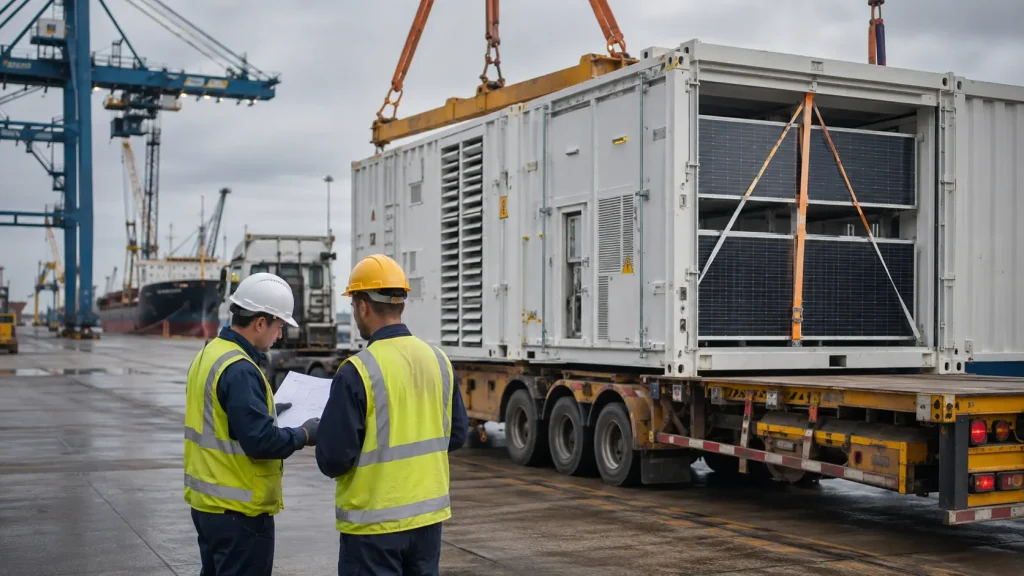
Dangerous-goods classification, packaging, documentation, carrier acceptance, and shipment routing may affect the logistics budget for a battery-containing system. They are not, however, a substitute for customs classification, duty, tax, or trade-remedy analysis. For the transport-documentation boundary, see our lithium battery shipping compliance guide.
Likewise, the project’s shipment release, site acceptance, utility approval, and operational acceptance remain separate events. An item cleared through customs has not necessarily passed commissioning, utility authorization, or contractual acceptance.
How to present a defensible budget figure
A useful preliminary budget separates confirmed amounts from allowances, contingencies, exclusions, and open items. It names the quotation revision, assumed origin, assumed classification source, selected Incoterms® 2020 rule and named place, quotation currency, exchange-rate basis, freight validity, surcharge mechanism, tax assumption, date of tariff review, and party responsible for revalidation. If those inputs are not available, the correct output is an open item—not an invented all-in total.
| Amount type | Definition | Example |
|---|---|---|
| Confirmed | Supported by a formal quotation, executed contract, or applicable official basis at the recorded date. | Equipment contract price or an in-validity ocean-freight quotation. |
| Allowance | Has a stated calculation basis but is not finally confirmed. | Import VAT / GST, inland transport, or brokerage based on stated destination assumptions. |
| Contingency | Reserved for a defined, identified uncertainty rather than hidden in another cost line. | Tariff change, port delay, inspection, exchange-rate movement, or freight surcharge exposure. |
| Excluded | Explicitly outside the quoted commercial scope. | Crane work, utility construction, site foundations, or destination taxes not included by contract. |
| Open item | Cannot yet be costed because a necessary input is not controlled. | Unconfirmed classification, unnamed importer of record, or unspecified final destination. |
Separate tax cost from tax cash flow
| Tax or fee item | Budget treatment |
|---|---|
| Customs duty | Normally treat as a nonrecoverable project cost unless destination-specific advice establishes a different treatment. |
| Import VAT / GST — recoverable | Show separately as cash-flow and recovery-cycle exposure, subject to registration and recovery eligibility. |
| Import VAT / GST — nonrecoverable | Include as project cost. |
| Brokerage and clearance fees | Include as logistics or import cost, with validity and exclusions recorded. |
| Bond, security, or deposit | Show separately as cash tied up or a potentially recoverable amount; do not net it against duty or tax without evidence. |
For a controlled supplier scope before this commercial review, use our containerized BESS technical specification checklist. For route, crane, and offloading readiness after the delivery boundary is agreed, use our solar container delivery checklist.
Headquartered in Shanghai, HighJoule manufactures containerized solar and energy storage systems through its production facilities in Jiangsu Province. We can provide controlled configuration, packing, and factory-scope information within an agreed commercial scope. The importer of record, customs broker, tax adviser, carrier, EPC, and project owner retain decisions in their respective scopes.