Choose a solar container when relocation, schedule, limited field labor or land-restoration obligations outweigh the benefits of a purpose-built fixed array—and only when the site can safely accommodate the deployed footprint, access route, electrical connections and environmental limits. Choose ground-mounted solar when the site and load are stable enough to justify dedicated civil works, optimized array geometry and a permanent commissioning package. A hybrid layout can be the better answer when permanent and movable loads share one project.
This solar container vs ground-mounted solar comparison is not a contest between two panel types. It is a project-architecture decision. The fair comparison holds the required load, PV capacity, operating window and reliability target constant, then tests how land, logistics, construction, energy yield and expected moves change the result. If the container architecture is new to your team, start with the guide to solar powered shipping containers.
Start With the Same Project Boundary
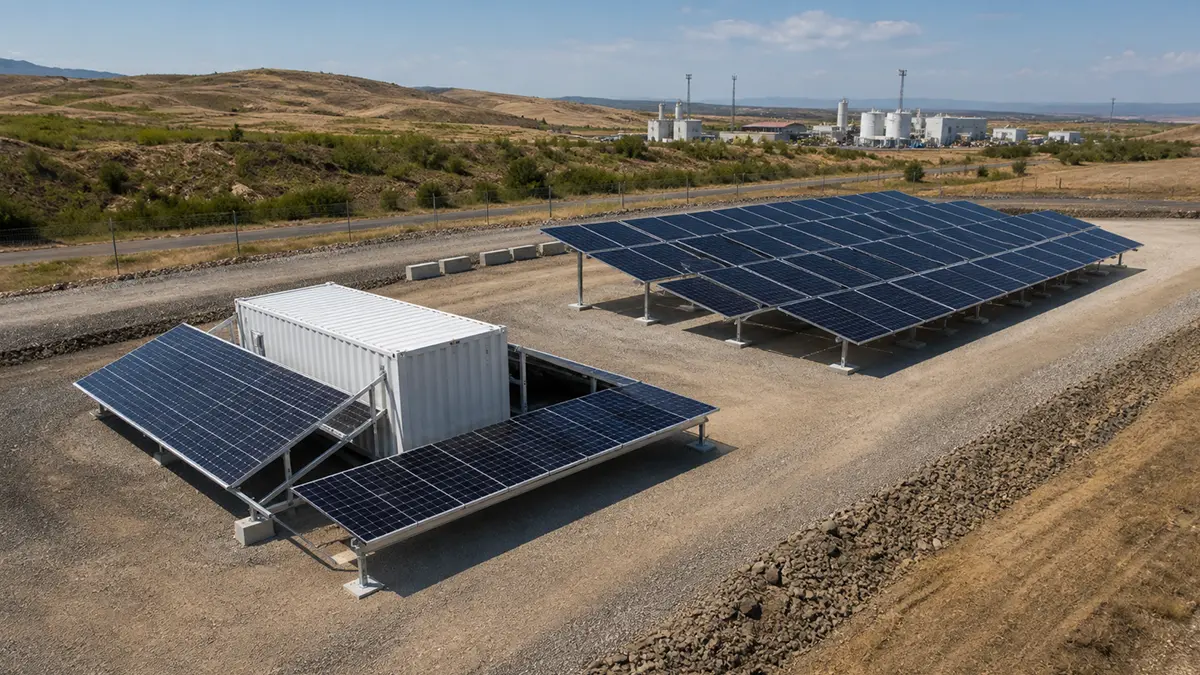
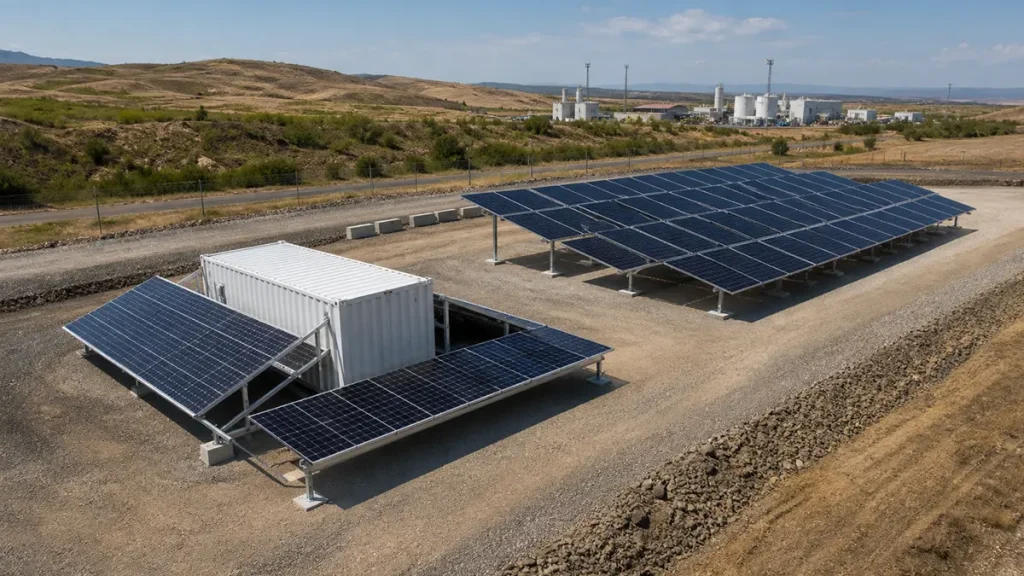
A solar container packages a transportable enclosure, deployable PV structure and project-specific power equipment into a compact shipping configuration. A ground-mounted system brings modules, racking, foundations or ballast, cable routes and power-conversion equipment together as a site-built asset. Either route may connect to a grid, battery or generator. “Containerized” does not prove that storage is included, and “fixed” does not mean that every component must be assembled outdoors.
Normalize the comparison before asking for prices. Give both suppliers the same site coordinates, hourly load profile, required AC output, PV capacity, operating months, acceptable outage risk and expansion plan. Then separate four quantities: PV capacity in kWp, inverter or converter power in kW, battery energy in kWh and expected energy production in kWh. Comparing a PV-only ground array with a solar container that includes storage would otherwise mix mounting, generation and resilience into one misleading number.
Energy yield also needs equivalent inputs. The PVWatts V8 model from the National Laboratory of the Rockies, formerly NREL, treats location, array type, tilt, azimuth, system losses, DC-to-AC ratio and other parameters as explicit inputs. Run both architectures at the same DC capacity and location, using the actual proposed geometry and losses. Do not assume that either the container or ground mount has a universal yield advantage.
Eight Inputs Decide Which Architecture Fits
1. Site life and expected relocations
A stable operating site gives dedicated civil works more time to deliver value. A project that may move must count demobilization and the next installation before the first purchase decision is made. Do not use a universal cutoff such as two or five years. A move across the same industrial property is different from a cross-border shipment, and a leased site with strict restoration terms is different from owned land.
2. Deployed area, traffic and cable routes
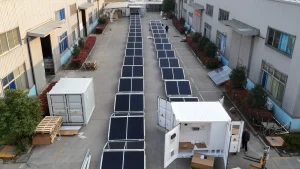
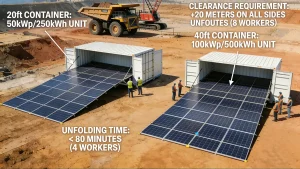
The container’s transport footprint is not its operating footprint. Record the fully deployed array envelope, maintenance clearances, truck and crane access, exclusion zones, drainage paths and the route from the power system to the load. On a busy construction site, a technically suitable array can still be a poor choice if haul trucks cross its cable route or if work fronts repeatedly occupy the same open ground.
3. Ground conditions and civil work
Ground-mounted PV may require grading, geotechnical inputs, foundations or ballast, drainage, roads, fencing and trenches. A foldable container may reduce some field assembly, but it still needs verified support conditions, level tolerances, drainage, access and anchoring or structural provisions defined for the actual design. Review the solar container site requirements before treating “portable” as “place anywhere.”
4. Local labor, equipment and commissioning
Factory integration changes where work occurs; it does not remove project acceptance. Ask each supplier to identify factory-completed work, site terminations, lifting equipment, deployment crew, inspection points and functional tests. DOE’s Federal Distributed Energy Project Implementation Process Phase 5 guidance treats final design, construction, commissioning and acceptance as distinct project activities. It also calls for installed components, tests and structural and electrical safety to be checked before acceptance. Local requirements will differ, but the sequence is a useful procurement discipline.
5. PV yield and usable project-window energy
Ground-mounted racking can be designed around site-specific tilt, azimuth, row spacing and maintenance access. A container’s deployable geometry is constrained by transport and mechanical packaging. Yet annual energy is not always the right denominator. A seasonal project should compare energy available during its actual operating months, including deployment delay, planned stow periods, shading, soiling and downtime.
6. Battery, generator and grid interfaces
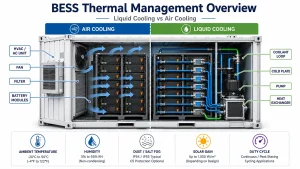
Mounting architecture does not determine nighttime autonomy. A battery’s kWh rating describes stored energy, while its converter power, controls, reserve policy and usable operating window determine what loads it can serve. Define normal daylight operation, low-solar operation, night load, generator support, grid loss and restart behavior separately. If storage is still undecided, use the guide on whether a solar container needs battery storage before comparing complete system quotations.
7. Wind, stow and environmental limits
A deployable array may have different limits in transport, deployment, normal operation and storm-stow conditions. Ask for each state, its governing load assumptions and the actions required when conditions approach a limit. A fixed array also needs site-specific structural design. Portability is not a substitute for wind, snow, flood, corrosion, temperature or soil review.
8. Decommissioning, restoration and reuse
Put the end state into the land agreement and cost model. The DOE photovoltaic installation and decommissioning guidance recommends planning removal, grading, land restoration, roles and triggers before construction. For a mobile asset, also define the inspection, transport preparation and recommissioning needed before reuse. Relocation is an engineering activity, not free residual value.
Compare Project-Window Cost, Not Container Price vs Module Price
Use a project-window worksheet rather than a headline price-per-watt comparison. The calculation below is a procurement framework, not a market price claim:
Total deployed cost = equipment and integration + first-site civil and electrical work + transport and offloading + commissioning + all relocation costs + downtime cost − recoverable asset value.
This is a simplified project-window screening metric, not a levelized cost of energy calculation. A financial comparison should also account for financing, operations and maintenance, degradation, equipment and battery replacement, insurance, taxes, decommissioning and the discounted value of future costs and residual value.
For each expected move, include demobilization, packing or stowing, freight, permits where applicable, the receiving site, redeployment, testing and recommissioning. Keep recoverable value conservative unless a buyer, lease or verified reuse plan exists.
| Cost or value input | Ground-mounted solar | Solar container | Evidence to request |
|---|---|---|---|
| First-site work | Ground preparation, racking, cable routes, installation and commissioning | Support area, access, offloading, deployment, connections and commissioning | Scope split, drawings, method statement and priced exclusions |
| Operating-window energy | Modelled with proposed geometry, availability and losses | Modelled with deployed geometry, stow periods, availability and losses | Monthly or hourly model with matching assumptions |
| Move or closeout | Removal, packing, restoration, new design and recommissioning | Stowing, inspection, freight, receiving-site preparation and recommissioning | Demobilization plan and second-site scope |
| Residual value | Reusable equipment less removal and reinstallation cost | Reusable system less inspection, transport and redeployment cost | Documented reuse, lease or resale basis |
After the cost boundary is complete, divide by the usable energy expected during the actual project windows. This avoids giving a short-duration project credit for decades of energy it will never use, while preventing a mobile system from claiming relocation value without paying for transport and recommissioning.
When Ground-Mounted Solar Is the Stronger Starting Point
- The site, land rights and load location are stable.
- The project can justify dedicated civil, structural and electrical work.
- PV capacity must scale beyond the practical deployed envelope of the shortlisted containers.
- Site-specific tilt, spacing, maintenance access or land layout materially improves the design.
- The owner has local installation and long-term maintenance capability.
Ground-mounted solar is not automatically cheaper or higher yielding; those outcomes depend on the quoted scope and modelled design. Its advantage is design freedom for a stable site.
When a Solar Container Deserves the First Review
- The asset is expected to serve more than one prepared site.
- Field labor, construction coordination or material security is a major delivery constraint.
- The land agreement penalizes permanent disturbance or requires restoration.
- The project needs a defined transport package and repeatable deployment procedure.
- The required PV and power equipment fit a published container configuration without forcing unsafe clearances or traffic conflicts.
A solar container still loses the comparison when the deployed area is unavailable, access is poor, environmental limits cannot be met, or the system is undersized for the load. Fast mechanical unfolding cannot compensate for an incomplete electrical or operating design.
When a Hybrid Layout Is Better Than Either Extreme
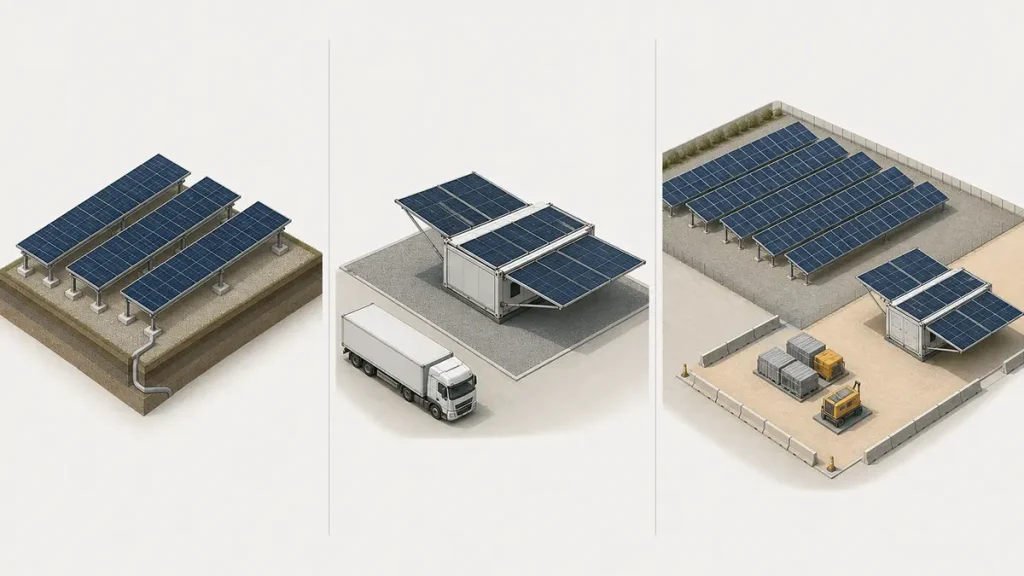
A hybrid site can assign fixed PV to permanent base loads and solar containers to temporary, seasonal or moving loads. The two assets do not need identical mounting, but the electrical design must still coordinate voltage, protection, controls, storage and any generator or grid interface. This route is useful when one procurement decision would otherwise force permanent loads into a mobile architecture or temporary loads into permanent civil work.
Keep the business cases separate. Model the fixed array over its stable service boundary and the movable asset over its expected sequence of sites. Then evaluate shared equipment only where the operating design actually permits it.
Match the Architecture to HighJoule’s Published Product Routes
The published HJ-FESS Solar Container configuration table lists six foldable-PV variants from 24 to 182 kWp with string-inverter configurations from 20 to 200 kW.
The published HJ-FBESS Solar Container table lists eight PV-storage reference configurations covering 9 to 136 kWp of PV and 15 to 482 kWh of storage.
Send These Inputs for an Architecture Comparison
- Site coordinates, usable area, slope, drainage and ground information.
- Hourly or interval load data, peak loads, motor starts and critical-load priorities.
- Required operating months, project duration and every credible relocation.
- Access route, offloading method, lifting resources and traffic plan.
- Grid, battery and generator interfaces, including required operating states.
- Wind, snow, flood, dust, temperature, corrosion and stow requirements.
- Local permitting, electrical, structural, environmental and restoration obligations.
- A scope table showing what must be completed in the factory and at each site.
Submit that package through the HighJoule technical consultation form. Ask for fixed, containerized and hybrid routes to use the same load, project window and reliability target, with assumptions and exclusions shown beside the recommendation.
Frequently Asked Questions
Does a solar container need foundations?
Do not assume either “yes” or “no.” The supplier must define support points, bearing conditions, level tolerance, anchoring or restraint, drainage and structural limits for the exact configuration. A prepared hardstand is still site work even when conventional pile foundations are unnecessary.
Does every solar container include battery storage?
No. Product architecture and published configuration determine whether storage is included. HJ-FESS does not publish battery capacity in its configuration table, while HJ-FBESS publishes PV-storage configurations.
Which option produces more energy from the same PV capacity?
There is no universal answer. Compare the actual tilt, azimuth, array type, temperature behavior, shading, soiling, electrical losses, availability and stow schedule using the same location and DC capacity.
Is relocating a solar container free?
No. A credible relocation allowance includes stowing, inspection, lifting, transport, receiving-site preparation, reconnection, testing and recommissioning. Mobility can reduce repeated construction, but it does not eliminate logistics or engineering.
Can a solar container replace a fixed solar farm?
Only when its published capacity, deployed footprint, operating limits and system architecture fit the project. Permanent or larger loads may favor ground-mounted PV, while mixed sites may favor a hybrid layout.
Last Updated on 08/05/2026