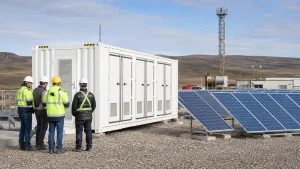
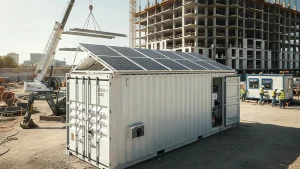
Choosing between an air-cooled and a liquid-cooled battery energy storage (BESS) container platform is usually a procurement decision as much as an engineering one. The two published platforms have different published energy ranges and container sizes, which affects site layout, transport and how many units a block needs. This article summarises only the published platform information available today and lists the questions buyers should confirm before a platform is selected.
Published platform ranges: air-cooled vs liquid-cooled
The published container platforms are:
- Air-cooled platform: published energy range 2.0–5.0 MWh, primarily 40 ft containers.
- Liquid-cooled platform: published energy range 2.5–6.25 MWh, 20 ft containers.
For the liquid-cooled container specifically, the published configuration list is:
- Energy: 2.5 MWh, 4.0 MWh, 5.0 MWh, 6.25 MWh
- Rated power as published: 1.25 MW, 2.0 MW, 2.5 MW, 1.725 MW, 3.45 MW
- Cell type: LFP, 3.2 V / 314 Ah and 3.2 V / 587 Ah
- Series / parallel configurations: 6P416S, 12P416S, 8P416S
- DC voltage: 1164.8–1497.6 V
- Ingress protection: IP55
- Operating temperature: −30 °C to 55 °C, with derating above 45 °C
Energy and rated power are published as option lists. The exact pairing of energy, power, cell format and series/parallel configuration for a given unit should be confirmed on the model datasheet rather than assumed. Source: Liquid-Cooled Energy Storage Container and Energy Storage Containers.
Footprint and site layout implications
The published difference that most directly affects procurement is container size relative to published energy. The liquid-cooled platform is published as a 20 ft container carrying up to 6.25 MWh. The air-cooled platform is published as mostly 40 ft, with a range of 2.0–5.0 MWh. Higher energy per container can mean fewer units, fewer DC interfaces and a smaller overall footprint for the same block energy — but that is a planning conclusion that must be verified against the actual layout, not taken as a specification.
Before fixing a platform, confirm the following against the site:
- Available plot area, container spacing and maintenance access routes for the selected unit size.
- Transport access, delivery route restrictions and lifting/crane capacity for the container size chosen.
- Any site-specific separation, fire-safety or approval requirements imposed by the authority having jurisdiction — these are project- and market-specific and are not part of the published platform data.
Cooling method and ambient conditions to confirm
For the liquid-cooled container, the published operating range is −30 °C to 55 °C with derating above 45 °C, and IP55 ingress protection. Whether these figures suit a given site depends on the actual ambient profile, including peak temperatures, diurnal swing, altitude, humidity, dust and any coastal or corrosive environment.
The published material notes that the exact coolant, circuit, redundancy and service procedure are model-specific and should not be generalised across a series. Buyers should therefore request the cooling documentation for the specific model under consideration, not for the platform family as a whole. For the air-cooled platform, cooling-related limits and ambient ratings are not stated in the published information available for this article and remain to be confirmed per model.
What the container scope includes — and what it does not
The published container scope covers the battery system, BMS, thermal management, fire detection and suppression, and container auxiliaries.
The following are listed as items to confirm per configuration or project, not as included scope: PCS, transformer, switchgear, EMS / site controller, grid interface, and installation and commissioning. This boundary matters in procurement because two quotations can look comparable on energy while covering different equipment. Confirm in writing what is inside the container scope and what is supplied separately for the project.
Controls and communications
The published BMS, system control and site communication interfaces can support Modbus TCP/RTU, IEC 60870-5-104 and CAN, depending on the selected model. Protocol support should be confirmed against the site SCADA or EMS interface list, together with point lists and the mapping required for the selected model.
Safety evidence: how to read UL 9540A statements
The published note on UL 9540A is worth repeating in procurement terms: UL 9540A is a test method, and results apply to the specific model, configuration and market — it is not a blanket certification claim. Buyers should request the current safety evidence package for the exact configuration and market being procured, rather than accepting a platform-level statement.
Procurement questions before platform selection
- What usable energy and rated power are required per unit and per block, and which published configuration matches that requirement?
- Which container size — 20 ft liquid-cooled or primarily 40 ft air-cooled — fits the site layout, transport route and lifting plan?
- What is the actual site ambient profile, including maximum temperature, duration above 45 °C, altitude, humidity and dust exposure?
- For the liquid-cooled option, can the model-specific documentation for coolant, circuit, redundancy and service procedure be provided?
- For the air-cooled option, what are the model-specific cooling and ambient ratings? (To be confirmed — not stated in the published information used here.)
- Is PCS, transformer, switchgear, EMS / site controller and grid interface inside or outside the supply scope, and who performs installation and commissioning?
- What fire detection and suppression scope is included, and what does the local authority require for this site and market?
- Which communication protocols are supported on the selected model, and how do they map to the site SCADA or EMS?
- What is the current safety evidence package for the exact model, configuration and market?
- What spares, service access provisions and warranty terms apply to the selected model? (To confirm per project.)
Reference application
A published application example is a liquid-cooled ESS cabinet in Denmark rated 125 kW / 261 kWh, used for peak shaving, frequency regulation and peak-valley arbitrage. It is an ESS cabinet rather than a container platform, so it is cited here as an application reference, not as a specification for the container platforms discussed above. Source: Solar Container project references.
Next step
Air-cooled and liquid-cooled containers are not interchangeable on paper alone. A platform decision should be made against confirmed model-level data: the energy/power pairing, container footprint, cooling documentation, scope boundary, communication mapping and the safety evidence package for the market of installation. Request the current datasheet and configuration confirmation for the specific model before comparing commercial offers.
Note: figures in this article are the published platform ranges and options available at the time of writing. Specifications, options and scope are model- and project-specific and must be confirmed for each project.
Last Updated on 10/11/2026