For most of human history, if you wanted clean water, you needed a grid connection or a diesel truck. That link—between water and the fossil fuel economy—has been one of the most expensive, fragile relationships in remote industry.
In 2026, that link is finally breaking.
Across mining camps in Chile, disaster zones in Southeast Asia, and off-grid farms in sub-Saharan Africa, solar-powered water purification (SPWP) has moved from experimental gadget to critical infrastructure. But here’s what the glossy brochures won’t tell you: the real challenge isn’t just generating power. It’s integrating power and water so that one bad cloud doesn’t destroy a $10,000 membrane.
At Highjoule (Huijue Group) , we’ve spent the last five years solving exactly that problem. This blog walks you through the engineering, the economics, and the unexpected breakthroughs that make 2026 the year solar water finally works.
Part 1: The Water-Energy Knot (And Why It Matters)
Let’s start with a number: 40%. That’s how much of the Earth’s land surface is arid or semi-arid. In those places, the grid either doesn’t exist or fails weekly.
Traditional thinking says: if you need water, bring diesel. But diesel in a place like the Atacama Desert or inland Australia costs $1.50–$3.00 per liter after transport. And that’s before the generator rebuilds, the oil changes, and the theft.
Solar changes the math. But only if you solve the integration problem.
A solar panel without storage is useless at night. A reverse osmosis (RO) pump without soft-start will trip your battery bank every time it kicks on. A membrane without stable pressure will foul in weeks instead of years.
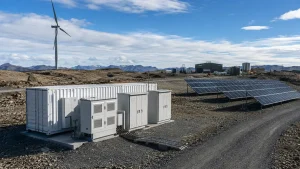
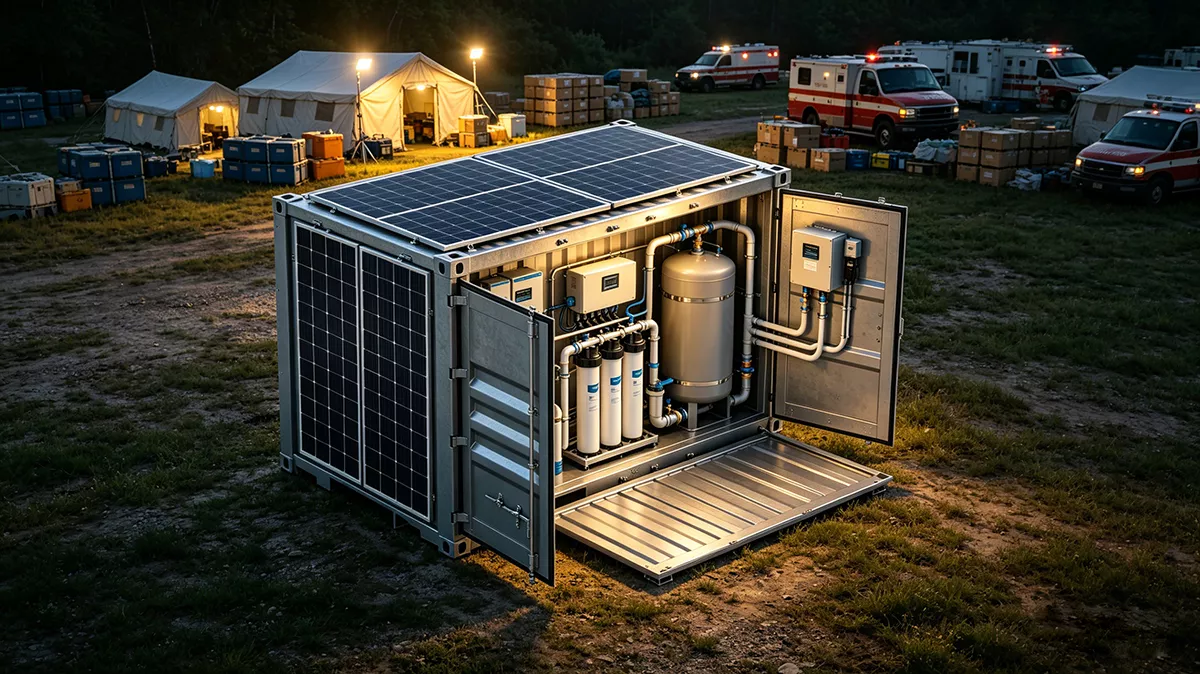
This is why Highjoule doesn’t sell “a solar panel” or “a water filter.” We sell solar containerized microgrids that manage both electrons and water molecules as a single system.
Part 2: The Three Ways Sunlight Makes Clean Water
Not all solar water treatment is the same. Depending on your source water and application, you’ll use one—or a hybrid—of three physical paths.
2.1 Photovoltaic-Driven (The Workhorse)
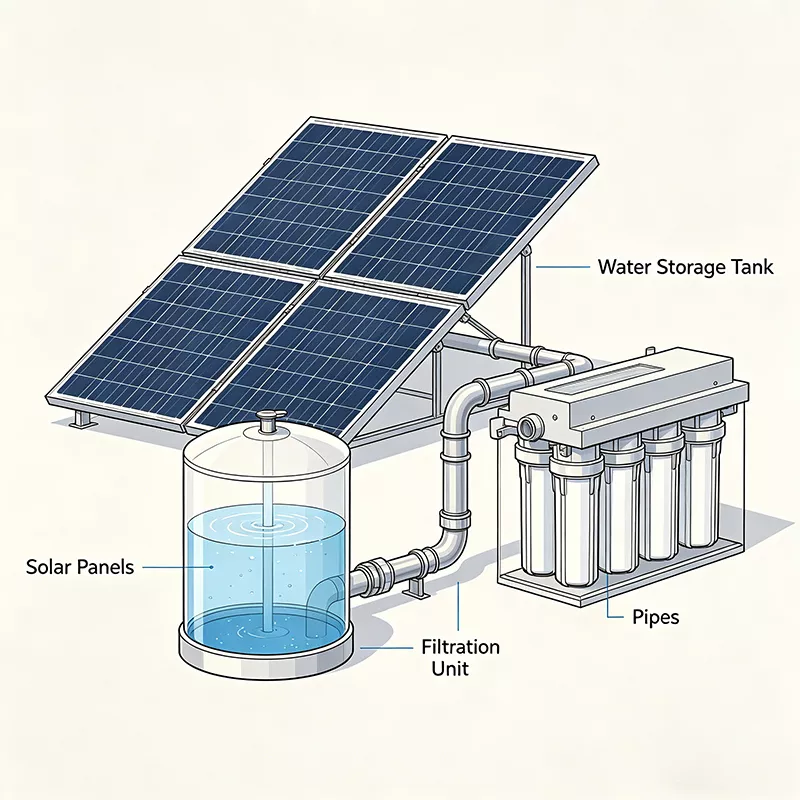
This is what most people imagine: solar panels → batteries → pump → filter. It works for:
- High-pressure RO (seawater or brackish water)
- Low-pressure UF (lakes and rivers)
- Electrodialysis (specific industrial brines)
The catch: Pumps—especially high-pressure RO pumps—draw 3 to 5 times their running current during startup. Without proper engineering, that surge trips your entire system.
Highjoule’s fix: Every one of our SolarContainerKit systems includes integrated Variable Frequency Drives (VFDs) . They ramp pressure up slowly, over 3–5 seconds, eliminating the startup spike. Combined with our liquid-cooled battery cabinets (which hold steady at 25°C even when ambient hits 50°C), you get rock-solid voltage to your membranes.
2.2 Solar Thermal-Driven (Old Tech, New Tricks)
Instead of making electricity, you use sunlight directly as heat. Think of it as a solar-powered still.
- Multi-Effect Distillation (MED) : Reuses latent heat across multiple chambers.
- Membrane Distillation (MD) : A hot side and a cold side separated by a hydrophobic membrane.
Best for: High-salinity brines or industrial wastewater where RO would foul too quickly.
2.3 Photochemical & Advanced Oxidation (The Cleanup Crew)
UV light from the sun breaks down chemical bonds. Add a titanium dioxide (TiO₂) catalyst, and you generate hydroxyl radicals—nature’s most aggressive cleaning agents.
Best for: Emergency scenarios where water is contaminated with pesticides, pharmaceuticals, or chemical spills.
For most off-grid sites, the right answer is a hybrid RO-UF system that lets you switch between river water and saline wells without changing hardware. Highjoule offers exactly that in our modular container units.
Part 3: Real-World Economics – Why Diesel Loses Every Time
Let’s talk money. Because environmental arguments are nice, but project managers care about the bottom line.
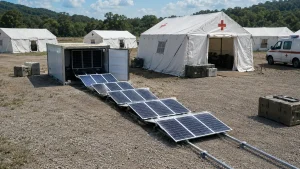
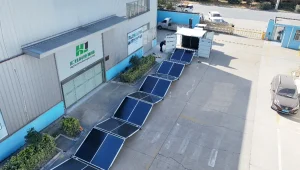
We benchmarked a standard diesel-powered RO system against a Highjoule Foldable Solar Storage Container Kit with PV. Both produce 10,000 liters per day of clean water. Both run for 5 years.
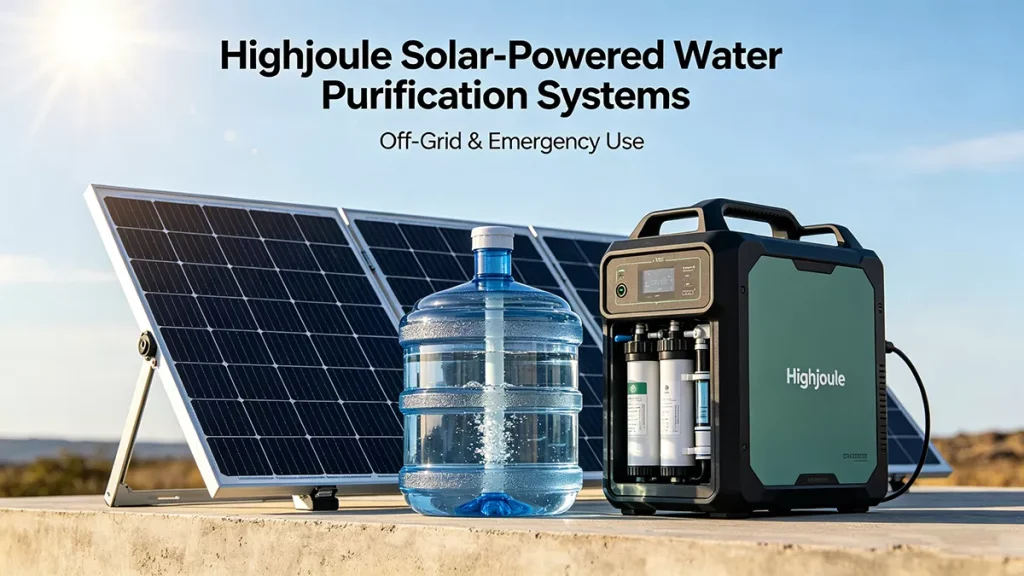
The 5-Year Total Cost of Ownership (TCO)
| Cost Component | Diesel RO | Highjoule Solar + BESS |
|---|---|---|
| Fuel (incl. transport) | $75,000 | $0 |
| Generator maintenance / rebuilds | $25,000 | $0 |
| Membranes & filters (both systems) | $12,000 | $12,000 |
| Initial hardware (CapEx) | $8,000 | $33,000 |
| 5-Year Total | $120,000 | $45,000 |
Break-even point: 14 to 18 months.
That’s not a “green premium.” That’s just better math.
And here’s something most vendors won’t tell you: the Levelized Cost of Energy (LCOE) for diesel gensets in remote areas ranges from $0.45–$0.74/kWh. Solar+storage hybrids now run $0.12–$0.375/kWh. That delta pays for a lot of membranes.
Part 4: The Engineering Deep Dive – Keeping Membranes Alive Off-Grid
The most expensive part of any RO system isn’t the pump—it’s the membrane. And membranes are surprisingly fragile.
4.1 Pressure Stability Is Everything
A 10% fluctuation in feed pressure can cause a 50% fluctuation in salt passage (TDS). That means one cloudy minute can send brackish water into your clean tank.
Most solar-only systems (no battery, just direct DC to pump) are pressure nightmares. Highjoule’s battery-buffered architecture acts as a shock absorber. The sun fluctuates; your pump sees a flat line.
4.2 Energy Recovery for Seawater
If you’re desalinating seawater (35,000+ ppm TDS), you’re running at 800–1,000 PSI. Without an energy recovery device (ERD), 60% of your energy goes straight out the drain as high-pressure brine.
Highjoule’s Off Grid Solar Desalination Plants integrate isobaric pressure exchangers that recover up to 98% of that energy. The result: your solar array can be 40% smaller for the same output.
4.3 Thermal Management in Extreme Heat
In places like the Sahara or inland Australia, air temperatures regularly hit 50°C. Air-cooled VFDs and battery packs derate (lose capacity) above 40°C.
Our liquid-cooled battery cabinets maintain 25°C internally regardless of outside heat. That’s not a luxury—it’s the difference between running and tripping.
Part 5: 2026’s Breakthrough Technologies (Already Shipping)
The industry doesn’t stand still. Here are four advances that make this year’s systems radically better than anything from 2023.
5.1 AI-Powered Energy Budgeting
Your system now knows tomorrow’s weather. Seriously.
Via satellite link, Highjoule’s Energy Management System (EMS) pulls a 72-hour forecast. If it sees three cloudy days ahead, it automatically slows production and fills the storage tank early. No human intervention required.
This turns “intermittent renewable” into “predictable utility.”
5.2 Biomimetic Self-Cleaning Membranes
Inspired by lotus leaves and pitcher plants, the latest membrane coatings are nano-engineered to repel organics and bacteria.
The real-world result: Cleaning cycles drop from every 3 months to once a year. For a remote mine site 500 km from the nearest technician, that’s a game-changer.
5.3 Micro Zero-Liquid Discharge (ZLD)
Historically, ZLD was for giant factories with billion-dollar budgets. In 2026, Highjoule offers containerized ZLD for high-salinity brines.
Using solar thermal evaporators, we concentrate your waste brine into solid salt blocks. 100% water recovery. Zero liquid discharge. Perfect for inland sites where you can’t dump brine.
5.4 VFD + ERD Synergy
Most energy recovery devices work best at 100% load. Our VFD allows the ERD to stay efficient even at 40% load, extending productive hours into late afternoon and early morning.
Part 6: Matching the System to the Source (A Practical Guide)
Not every site needs a seawater RO plant. Here’s how Highjoule categorizes solutions in 2026.
| Source Water | TDS Range | Recommended Tech | Highjoule Product |
|---|---|---|---|
| Lakes, rivers, floodwater | < 500 ppm | Ultrafiltration + UV | Surface Water Unit (mobile trailer) |
| Wells, saline groundwater | 500–10,000 ppm | Low-energy RO | Brackish Water RO + BESS |
| Seawater, coastal | > 35,000 ppm | High-pressure SWRO + ERD | Off Grid Solar Desalination Plant (container) |
| Industrial brine | > 50,000 ppm | Thermal MD + ZLD | Custom ZLD container |
For most emergency scenarios, the RO-UF hybrid modular unit is the sweet spot. You can switch between river mode and well mode without tools.
Part 7: Smart Monitoring – Because You Can’t Be There
Remote sites kill equipment. Not because the equipment is bad, but because no one notices a problem until it’s too late.
Highjoule’s Water-Link Module (integrated into our EMS) monitors:
- Transmembrane Pressure (TMP) : Spikes mean clogging.
- Total Dissolved Solids (TDS) : Spikes mean membrane damage.
- Flow rate, temperature, and energy use .
If TMP rises above a threshold, the system automatically triggers a backwash cycle—no technician required. If that doesn’t work, it sends an alert via satellite to your maintenance team.
We call it “set it and forget it, but with a safety net.”
Part 8: The Honest Challenges (No Hype)
You deserve straight talk. Here’s what’s still hard.
8.1 Brine Disposal
In coastal areas, you can discharge RO brine back to the sea with proper diffusion. Inland? That’s harder. Our micro-ZLD solves it but adds cost. For low-budget emergency deployment, you still need an evaporation pond or a permitted disposal agreement.
8.2 Filter Supply Chains
A solar RO system without replacement PP sediment filters or activated carbon blocks is a very expensive boat anchor.
Our rule for customers: Always keep two full sets of consumables on site. Plan your resupply at the same time you plan your fuel (even if you don’t use fuel anymore).
8.3 Extreme Low Light
In an Arctic winter or a week of monsoon clouds, even a big battery bank will eventually run low. For mission-critical applications, we recommend a hybrid solar + small diesel backup—not because solar fails, but because water can’t wait.
Part 9: Policy and Market Trends (Quick Look)
- UN SDG 6 continues to drive subsidies and low-interest loans for off-grid water.
- Tariff-free imports for solar water equipment now exist in Saudi Arabia, Nigeria, Chile, and Vietnam.
- Carbon credits for diesel displacement are becoming real revenue. A 10,000 L/day solar RO system displaces roughly 15,000 liters of diesel per year—that’s ~40 metric tons of CO₂.
Where the Sun Reaches, Water Follows
Solar-powered water purification in 2026 is no longer a niche technology for environmentalists. It’s a mainstream engineering solution for miners, disaster responders, off-grid farmers, and coastal communities.
But only if the system is built right. Only if the storage talks to the pump. Only if the VFD soft-start protects the battery, and the energy recovery device shrinks the solar array, and the AI watches the weather.
That’s what Highjoule delivers. Not a box of parts. An integrated power-and-water ecosystem that works where the grid ends.
Whether you need a portable unit for emergency response or a 500 m³/day desalination plant for a mining concession, we’ve got a configuration that makes economic and engineering sense.
Because sunlight should mean water. Every time.
Quick Checklist Before You Buy
- Test your source water TDS (above 2,000 ppm? You need RO).
- Size PV at 1.5–2x pump nameplate power.
- Ensure battery buffer for pressure stability (no direct DC-to-pump).
- Confirm VFD soft-start on all high-pressure pumps.
- Check thermal management for your max ambient temp.
- Stock two full sets of consumable filters.
- Verify remote monitoring (satellite or 4G) is included.
For technical specifications, project quotes, or to talk to an engineer:
👉 highjoule.com
👉 solarcontainerkit.com
Highjoule (Shanghai Huijue Technology Group) – Infrastructure where the grid ends.
Last Updated on 05/28/2026