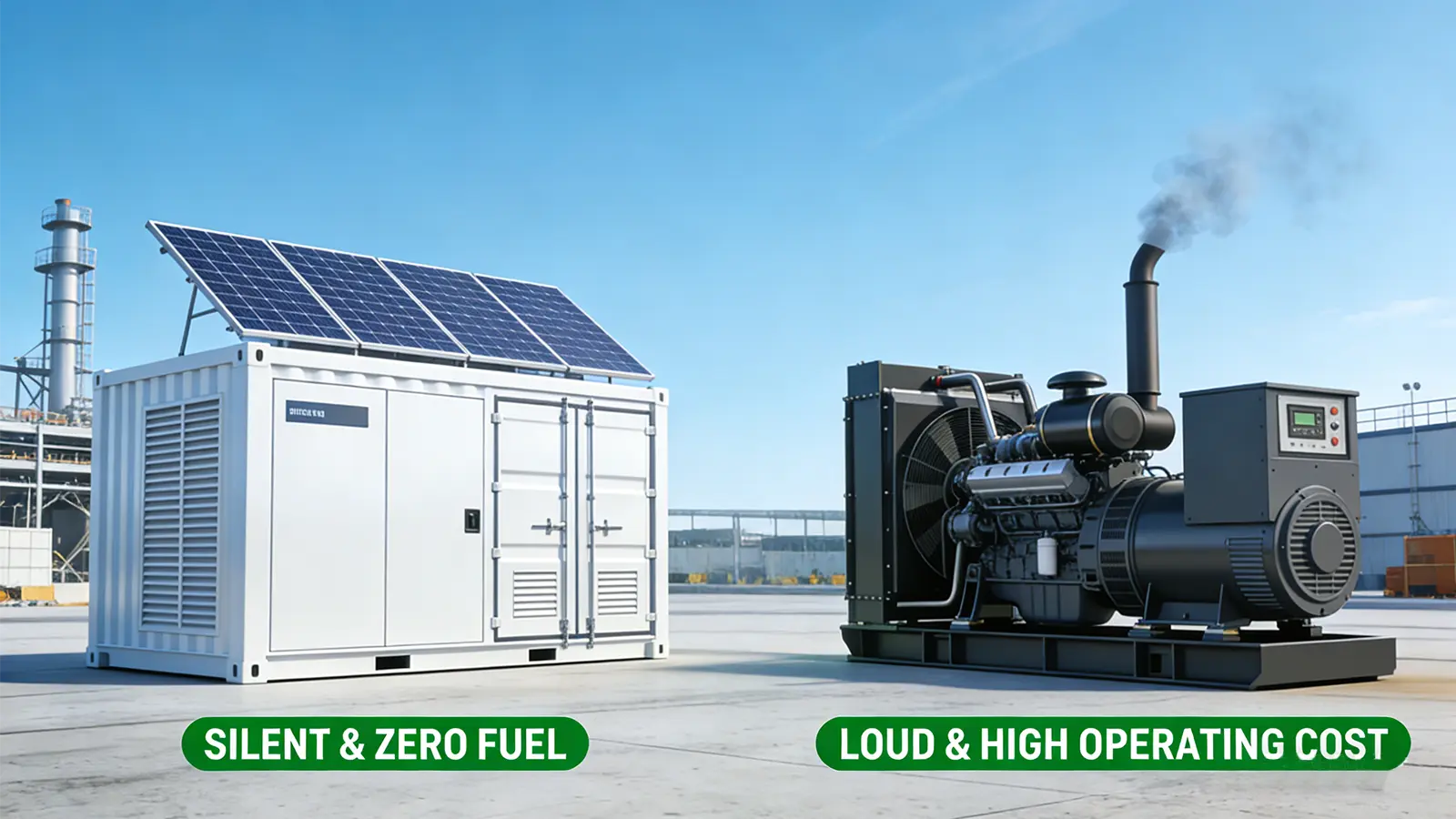
A diesel generator can be the better commercial choice when the assignment is short, the solar resource is poor or seasonal, fuel can be delivered reliably, and the site needs a simple standby or temporary-power solution. A solar container or solar-diesel hybrid can be worth evaluating when the load is sustained, diesel delivery is expensive or unreliable, usable solar production aligns with the operating profile, and the owner can accept a higher initial capital commitment. Neither conclusion follows from equipment price alone.
The comparison must use the same required load, reliability target, operating period, delivery point, civil scope, maintenance responsibility, and end-of-life assumptions. If the generator price excludes fuel logistics and servicing while the solar offer includes batteries, controls, transport, installation, or a different power boundary, the apparent cost gap is a scope mismatch—not a technology decision.
For the broader buying process, start with our solar container procurement guide. This page addresses the targeted project decision: how to compare diesel-only, solar-storage, and solar-diesel hybrid proposals before a purchase order converts unvalidated assumptions into formal project costs.

Begin with an equivalent operating basis
Define the service that each option must provide before comparing costs. Record average and peak load separately, hours of operation, critical-load requirement, allowable outage duration, seasonal demand, generator backup policy, operating life, planned relocation, and the boundary between supplied equipment and site work. A daytime construction load, a 24-hour remote mine load, and an emergency clinic standby load are not comparable use cases even when their nameplate power appears similar.
For a solar-storage or hybrid option, identify the photovoltaic generation, storage, power-conversion, controls, and generator functions actually included in the proposed configuration. For a diesel option, identify generator duty rating, tank size, transfer or synchronizing equipment, fuel storage, cable and distribution scope, and the maintenance plan. The owner or EPC should control this comparison basis; otherwise each bidder can optimize a different project.
The TCO assumption ledger
Use the following ledger in a bid review. It is designed to make missing inputs visible before a team compares totals. It does not calculate a universal payback period.
| Cost area | Inputs that must be comparable | Typical evidence | Budget status to record |
|---|---|---|---|
| Equipment scope | Power and energy duty, generator rating, PV, battery, inverter or power conversion system, controls, switchgear, cables, enclosure, auxiliary systems, spares, and supplied documentation. | Controlled quotation revision, bill of materials, single-line diagram, and exclusions list. | Confirmed when the offered configuration and its exclusions are frozen; otherwise open. |
| Fuel and generation | Generator load profile, fuel-consumption curve for the proposed duty, hours run, fuel price basis, delivery route, storage losses, tax treatment, and contingency for supply interruption. | Generator manufacturer data, local fuel quotation, route plan, and agreed operating assumptions. | Allowance or contingency until the local fuel basis and runtime model are reviewed. |
| Solar and storage contribution | Location, seasonal resource, shading, PV orientation or deployment constraints, battery operating window, load timing, curtailment, degradation assumptions, and residual generator runtime. | Site coordinates, load data, design model, and stated simulation assumptions. | Allowance until the model inputs and operating strategy are agreed. |
| Maintenance and replacement | Scheduled service, filters and fluids, travel, labor, remote monitoring, wear parts, battery augmentation or replacement assumptions, and response responsibilities. | Maintenance schedule, service-scope quotation, warranty scope, and spares list. | Confirmed only where the commercial service boundary is explicit. |
| Logistics and site work | Incoterms® 2020 rule and named place, inland delivery, crane or lifting plan, foundations, drainage, fencing, distribution works, fuel infrastructure, permits, and commissioning access. | Logistics quotation, site layout, civil scope, interface register, and project programme. | Separate confirmed items from site allowances and owner-held contingencies. |
| Risk and end of life | Downtime exposure, critical-load backup, insurance conditions, battery disposal or recycling path, generator removal, relocation, residual value, and decommissioning responsibility. | Owner risk register, insurer requirements, contract terms, and end-of-life plan. | Open item unless the risk owner and basis are recorded. |
Do not hide unresolved items inside a single “all-in” number. Label each line as confirmed, allowance, contingency, excluded, or open. That distinction makes an early budget useful without implying that it is a final commercial commitment.
Illustrative example — not a project quotation
The following five-year example shows how the ledger can be populated. It uses deliberately simplified illustrative USD inputs for two options serving the same defined load and critical-load requirement. It is not a HighJoule quotation, supplier price, fuel forecast, performance model, engineering design, or a claim that either option will cost the same amount at another site. The comparison is undiscounted. In the sensitivity test below, only the delivered-fuel line changes; all other illustrative inputs remain fixed so that the effect of that assumption is visible.
| Five-year TCO line | Diesel-only case | Hybrid case | What the project team would replace with real evidence |
|---|---|---|---|
| Equipment | USD 40,000 | USD 140,000 for PV, battery energy storage system (BESS), controls, and generator interface | Controlled quotation, equipment schedule, power and energy duty, and exclusions. |
| Delivered fuel or residual diesel | USD 150,000 | USD 45,000 | Generator duty model, delivered-fuel quotation, route, tax basis, operating hours, and hybrid dispatch assumptions. |
| Service and consumables | USD 24,000 | USD 15,000 | Maintenance interval, travel, labor, filters and fluids, remote monitoring, spares, and service responsibility. |
| Replacement allowance | USD 10,000 | USD 15,000 for the stated battery replacement or augmentation assumption | Warranty boundary, expected operating window, replacement trigger, and end-of-life responsibility. |
| Site works and interfaces | USD 15,000 | USD 20,000 | Foundation, lifting, cabling, distribution, fuel infrastructure, commissioning, and owner/EPC/supplier interface register. |
| End of life | USD 5,000 | USD 7,000 | Removal, transport, recycling or disposal, residual-value treatment, and responsible party. |
| Illustrative five-year TCO | USD 244,000 | USD 242,000 | Sum only after the same scope, timing, and cost boundary have been applied. |
In this constructed example, the hybrid case is USD 2,000 lower over five years: USD 242,000 versus USD 244,000. That is not a payback conclusion. The difference is small enough that an unresolved route cost, duty-cycle change, battery scope change, or fuel assumption could reverse it.
| Illustrative sensitivity: delivered-fuel line only | Diesel-only TCO | Hybrid TCO | What changes |
|---|---|---|---|
| Base ledger above | USD 244,000 | USD 242,000 | Uses the illustrative fuel inputs above. |
| Delivered fuel 20% below the base assumption | USD 214,000 | USD 233,000 | Diesel-only becomes lower in this simplified comparison. |
| Delivered fuel 20% above the base assumption | USD 274,000 | USD 251,000 | Hybrid becomes lower in this simplified comparison. |
That sensitivity is the point of the worked example: the team should not ask whether solar or diesel “wins” in general. It should identify which inputs control its specific result, assign an owner to validate each one, and compare supplier proposals against the same ledger. Once those inputs are controlled, use the project’s actual location and load profile in the calculation process described below.
What changes the diesel-only answer
Diesel-only power can be sensible when a project needs a short-duration solution, a predictable equipment package, straightforward refueling, or emergency standby capacity that will operate infrequently. It can also remain an important resilience layer in a hybrid design. The question is not whether diesel is outdated; it is whether continuous fuel transport, operating hours, maintenance visits, and exposure to fuel-price changes fit the owner’s risk and budget model.
For a remote site, a fuel price at the depot is not necessarily the delivered fuel cost. The project should separately model delivery distance, route restrictions, storage, site access, security, weather disruption, and the party responsible when fuel cannot arrive as planned. A generator’s hourly fuel curve also needs to match the expected operating load. A catalog rating alone is not a runtime model.
What changes the solar-container or hybrid answer
A containerized solar system combines selected generation, storage, conversion, control, protection, and auxiliary equipment into a transportable or modular assembly. It can shift some equipment integration into the factory, but it does not remove the need for transport planning, foundations, electrical connection, site approval, commissioning, and long-term maintenance. The project must still define which work remains at the site.
A hybrid proposal deserves particular attention where solar energy can reduce generator runtime but cannot credibly carry every condition alone. The relevant questions are how the controls prioritize PV, battery, and generator operation; what load remains during poor solar periods; what starts the generator; how much battery reserve is protected for critical loads; and who approves changes to these settings. A hybrid system should be evaluated as an operating strategy with an explicit residual-diesel model, not as a generic promise of fuel savings.

Use the architecture-fit test instead of a generic payback claim
| Project condition | Diesel-only may remain the better starting point when | Solar-storage or hybrid deserves deeper evaluation when | Decision evidence to request |
|---|---|---|---|
| Project duration and load | The assignment is brief, intermittent, or mainly standby, so fuel use and maintenance exposure are limited. | The site has a sustained or repeatable load that can be modelled across seasons and operating hours. | Time-stamped load data, critical-load definition, and planned project life. |
| Fuel logistics | Fuel delivery is dependable, locally available, and commercially acceptable under the risk plan. | Fuel transport, storage, route access, or supply disruption materially changes the cost or operating risk. | Delivered-fuel quotations, route plan, storage responsibility, and supply contingency. |
| Solar contribution | Seasonal resource, shading, operating pattern, or site layout gives little usable PV contribution. | Usable solar production aligns with load timing and a project-specific model can state the residual generator requirement. | Location, resource basis, shading review, PV layout, and stated model assumptions. |
| Reliability requirement | A conventional generator and its fuel system meet the specified standby or prime-power duty with an acceptable backup plan. | Battery reserve, PV, and generator backup can be coordinated to protect the defined critical load. | Operating modes, transfer logic, generator-start conditions, and outage scenario review. |
| Site and interface scope | The project has simple temporary distribution and a practical fuel, service, and removal plan. | Factory integration can reduce a defined portion of field work without creating transport, lifting, access, or approval constraints. | Interface register, route and lifting plan, civil scope, and commissioning responsibilities. |
| Capital and commercial structure | The owner has a short decision horizon or cannot support a higher initial investment. | The owner can evaluate life-cycle cost, phased investment, fuel-risk exposure, and replacement assumptions rather than CAPEX alone. | Budget horizon, finance assumptions, discount-rate owner, and change-control process. |
This is not a points system. One non-negotiable condition—such as lack of fuel access, no viable transport route, an unmodelled critical load, or an unapproved site interface—can override several secondary advantages.
Do not compare a generator quote with a solar-container price
Compare two complete project cases. In each case, write the equipment boundary, delivery rule and named place, site works, installation, distribution connection, commissioning, acceptance, operating model, maintenance scope, and end-of-life assumption. Keep shipment release, site acceptance, utility authorization, and operational acceptance as separate project gates. A system being delivered or energized does not establish that every cost or acceptance condition has closed.
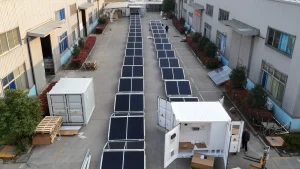
The same discipline applies to published project examples. Our Romania case publishes a project-specific configuration of four 46 kWp foldable PV containers and five 100 kW / 215 kWh energy-storage cabinets, totalling 184 kWp PV and 1,075 kWh storage. It is useful evidence that such a multi-unit project configuration has been published, but it does not prove the cost, savings, payback, operating data, approval path, or suitability of another project.
Turn the ledger into a project model
Once the owner has controlled the inputs, use our solar container ROI calculator to organize a preliminary comparison. Enter the actual location and load profile, then treat the result as an estimate for discussion—not as a binding quote, engineering design, savings guarantee, or substitute for the project’s fuel, logistics, and acceptance review.
Before a contract award, require the shortlisted supplier to identify the quotation revision, operating assumptions, residual-diesel basis, equipment deviations, exclusions, validity dates, and the person responsible for revalidation. The most useful supplier response does not claim the lowest universal TCO. It shows which conditions would change the answer.
When neither simple option is ready for award
Pause the comparison when the load profile is unknown, the final site is not selected, fuel availability is assumed rather than quoted, the solar resource has not been evaluated, or the responsibility for civil works and electrical interfaces is not assigned. A preliminary budget can still be useful, but it should contain open items rather than a claimed payback period.
A purely solar-storage configuration may also be the wrong immediate fit where the critical-load requirement exceeds the supported autonomy plan, prolonged low-solar periods are material, or backup generation and fuel arrangements have not been resolved. Conversely, diesel-only may be the wrong starting assumption where fuel logistics, hours run, or emissions and operating constraints dominate the project risk. The correct next step is a controlled comparison, not a forced choice.

What to request from each bidder
- a controlled equipment schedule and single-line diagram that identify what is included and excluded;
- the same time-basis load profile, peak-load requirement, critical-load definition, and operating-life assumption;
- for diesel or hybrid proposals, the fuel-consumption and residual-generator-runtime model with stated inputs;
- for solar or hybrid proposals, the location, resource basis, PV layout, battery operating assumptions, and seasonal limitations;
- a delivery, civil-work, lifting, connection, commissioning, and acceptance interface register;
- maintenance, spares, replacement, warranty, and end-of-life assumptions with their responsible party; and
- a list of confirmed amounts, allowances, contingencies, exclusions, and open items.
Headquartered in Shanghai, HighJoule manufactures containerized solar and energy-storage systems through production facilities in Jiangsu Province. We can provide controlled configuration and interface information for an agreed equipment scope. Final site design, local approvals, fuel arrangements, installation, commissioning, and acceptance remain responsibilities that must be assigned in the project contract and procedures.
Request a Solar-Diesel TCO Assumption Review
Last Updated on 08/10/2026