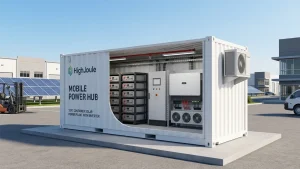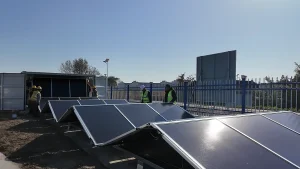
Lithium-ion batteries are the engine of the global energy transition. However, as the scale of deployments grows, the industry is facing a harsh reality: thermal runaway isn’t just a technical glitch—it’s a balance-sheet killer.
In the world of solar BESS containers, a fire is rarely just a “safety incident.” It is usually a complete financial write-off. This is why a sophisticated integrated fire suppression system for solar bess containers has moved from an “optional upgrade” to the single most critical factor for project bankability and insurance approval.
What “Integrated” Actually Means in 2026
Traditional fire safety is reactive. If you’re waiting for a smoke detector to trip or a human to pull a manual pin, you’ve already lost the container. In a high-voltage, sealed environment, every second is the difference between a minor module swap and a multi-million dollar disaster.
At HighJoule, we define an “integrated” system as the autonomous nervous system of the container. It doesn’t just wait for flames; it manages the high-risk window before ignition even occurs.
Key Components of a Bankable System:
-
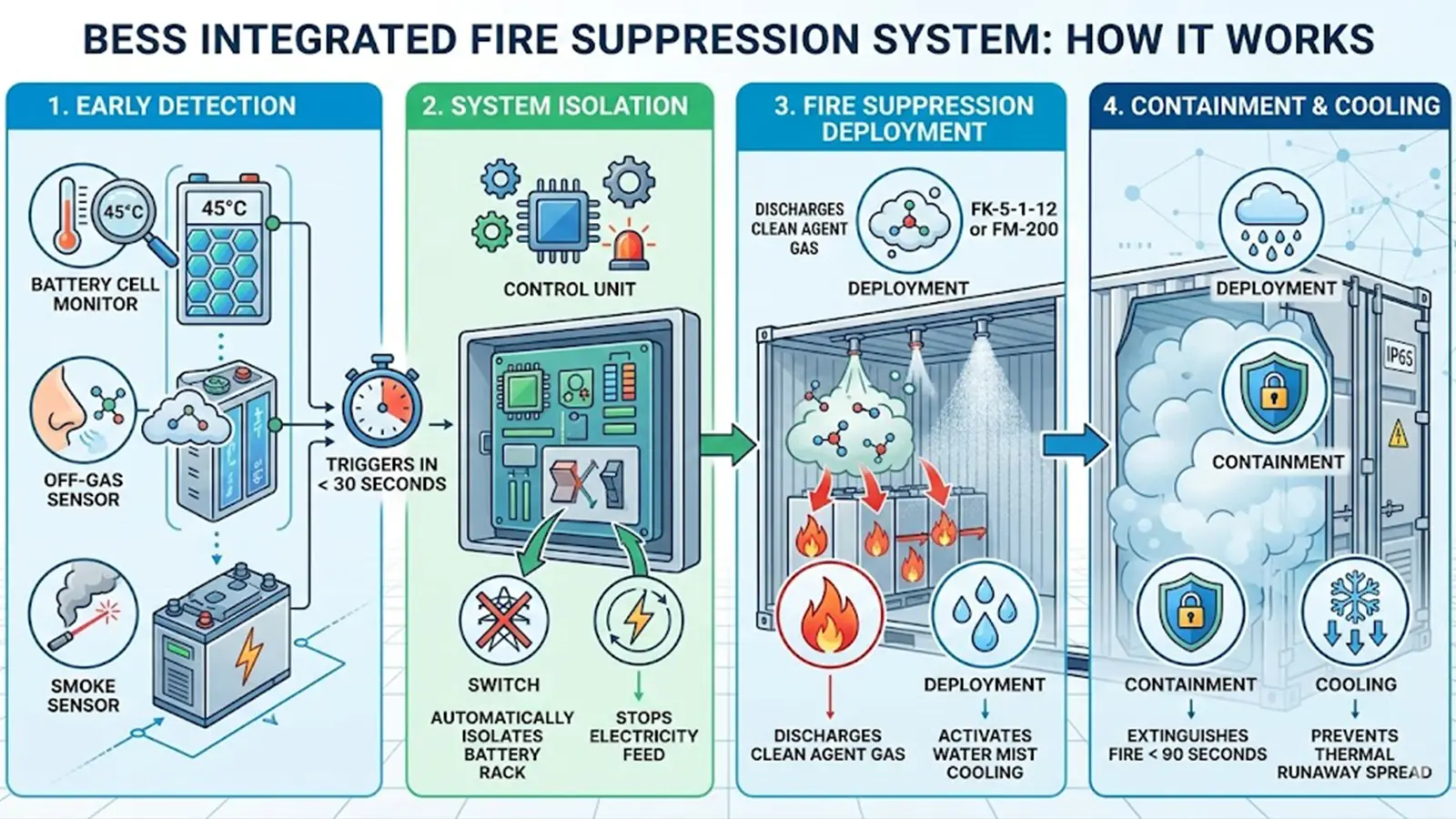
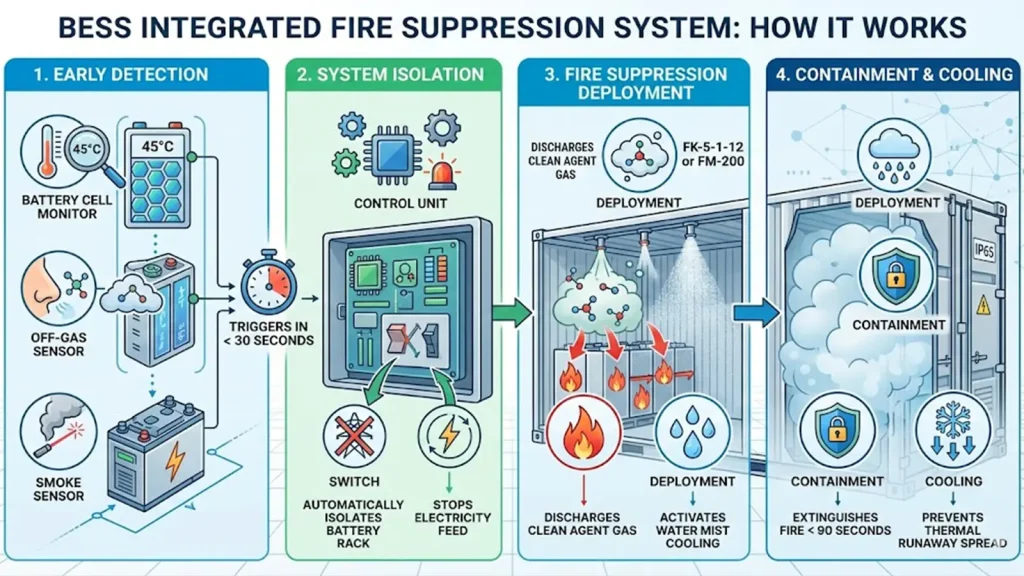
Off-Gas Monitoring (The Early Warning): Before a cell catches fire, it vents trace gases like Carbon Monoxide (CO) and Hydrogen (H2). Our systems use sensors calibrated to ppm-level sensitivity, flagging a failing cell up to 6 minutes before a thermal spike.
-
BMS Logic Tie-in: True integration means the fire system talks to the Battery Management System. When an anomaly is detected, the system triggers an immediate electrical isolation to stop the current that fuels thermal runaway.
-
Two-Phase Attack: We use a “Knockdown & Cool” approach. First, a clean agent (like FK-5-1-12) suppresses open flames. Second, a cooling mechanism—often water mist or specialized thermal barriers—strips heat from surrounding cells to prevent thermal propagation.
The Business Case: From Cost Center to ROI
People often look at fire suppression as a sunk cost. That is a mistake. In reality, it’s a tool for capital preservation.
-
Insurance Leverage: Global carriers like Munich Re and Travelers now have strict requirements. Projects using an integrated fire suppression system for solar bess containers that meets the 2026 NFPA 855 or UL 9540A standards can see insurance premiums drop by as much as 25-40%. In many jurisdictions, you simply cannot get coverage without a certified active system.
-
Asset Salvageability: Without suppression, a container fire is a 100% loss. With a rack-level integrated system, damage is often confined to the faulty module (less than 5% of the total asset). Replacing a few cells is a maintenance task; replacing a whole container is a bankruptcy event.
Regulatory Resilience: No More “Wiggle Room”
The regulatory landscape is tightening. Standards like EN 50600 and the updated NFPA 855 (2026 edition) now make active suppression and “Hazard Mitigation Analysis” (HMA) the default expectation for grid-scale permits. Relying on passive safety alone is no longer enough to satisfy the “Authorities Having Jurisdiction” (AHJs).
Choosing the Right Shield
Three Questions for Your Supplier
Before signing an RFP, ask these “hard” questions to ensure your system is truly bankable:
-
“Is your monitoring at the module level or just the container level?” (If it’s container-level, walk away).
-
“Can I see the full UL 9540A test report for runaway propagation?” (Don’t just take the certificate; check the actual performance data).
-
“What is the discharge latency?” (In a lithium fire, if it takes more than 10 seconds to flood the area, the window of opportunity is closed).
Final
In the energy sector, reputation is built on uptime. An integrated fire suppression system for solar bess containers is not an “extra”—it is the foundation of a resilient, insurable, and sustainable asset. It’s what makes a project bankable in the eyes of the people who sign the checks.
Would you like HighJoule to conduct a fire risk assessment for your next containerized project? Contact our engineering team today.
Last Updated on 07/30/2026