Published on March 13, 2026, the sixth edition of UL 9540A moves the decisive evidence in a container BESS quote up to the installation level. What a buyer should hold before an authority having jurisdiction (AHJ) review has changed accordingly: a 2023 report and a 2026 report are not the same evidence, even when both arrive with the same product brochure. UL 9540A remains a test method. A configuration is tested in accordance with it, and the evidence travels only as far as the similarity between what was tested and what is being quoted. No container carries UL 9540A certification; what exists is a tested configuration and a bounded report.
A procurement team comparing quotes is not settling a single question of whether a supplier "has UL". It needs the edition, the test levels, the tested build, the suppression and venting assumptions that were live during the test, and a clear line between what the report covers and what the project must still prove. Those five fields are set out below, together with the places in an RFQ and a factory acceptance test index where each one belongs.
Why a 2023 or 2025 Report and a 2026 Report Are Different Evidence
Per the ANSI standards record for ANSI/CAN/UL 9540A:2026, the edition was published on March 13, 2026 and revises the 2025 edition. The listing also publishes the scope statement without requiring a purchase.
Cell, module and unit data from earlier editions remains useful, yet the sixth edition puts large-scale fire test results at the centre of the fire-safety case. Testing organizations that work with manufacturers describe the revision as a shift from component-level validation toward full-system behaviour under fire and explosion conditions. When a jurisdiction, an insurer or your own fire protection engineer asks for current evidence, an older report can still be technically valid for its own edition, yet it answers a narrower question than the review now asks. That is the reason for a gap analysis rather than an automatic rejection.
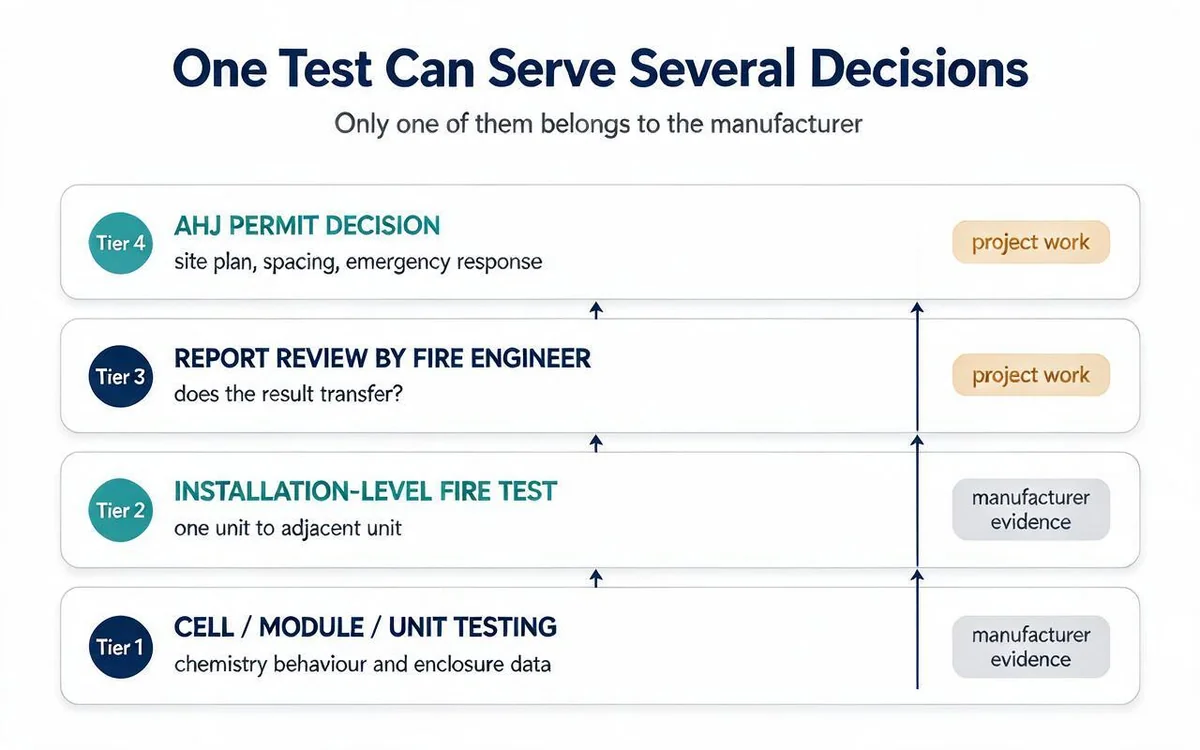
UL 9540A testing is organised by level — cell, module, unit and installation — and the scope statement notes that unit-level testing may not be required when installation-level testing is conducted, with some chemistries exempted from installation-level testing. During quote review, that structure is where two suppliers can each send a document titled "UL 9540A report" while one holds only cell and module data and the other holds installation-level results.
What the Sixth Edition Changed in the Evidence Requirements
Independent summaries from a testing body, a certification body and a standards owner describe the same direction of change. The Intertek technical summary of the 2026 update organises the changes into large-scale fire testing, explosion and gas hazard evaluation, method repeatability, and code alignment. UL Solutions describes the installation-level changes in its guide for code authorities.
Installation-level fire testing with harder ignition and spread questions
Large-scale fire testing (LSFT) in this edition rests on more representative ignition scenarios, including open-flame conditions, and on evaluation of fire spread between units and between enclosures. Worst-case conditions that reflect how installations actually fail now carry more weight. The objective, as testing and certification bodies describe it, is to show that a thermal runaway event in one unit does not propagate to adjacent units at the manufacturer's recommended spacing.
UL Solutions separates the objective from a simple pass mark: the test ignites vented battery gases during thermal runaway to reach a developed fire condition, then monitors flame spread and, in some tests, heat release, gas emissions and suppression performance. Those measurements are used to evaluate the prescribed separation distances and the propagation potential to other containers. A report built on that test says something about container-to-container behaviour that a cell-level test cannot.
Gas, deflagration and overpressure
The 2026 edition strengthens provisions on flammable gas generation and accumulation, on deflagration and overpressure risk characterization, and on interpreting off-gassing behaviour, according to the testing-body summary. Annex C covers large-scale deflagration testing for BESS enclosures, including enclosures without deflagration vents. UL describes that testing as a route to define credible ventilation conditions for the large-scale fire test, because ignition of thermal runaway gases before a fire develops can open relief panels and, in some cases, doors, changing the air supply available for the fire itself. It is not a blanket test that every container must pass regardless of design or jurisdiction. Ask the supplier whether the deflagration evaluation applies to the quoted enclosure, which ventilation and pressure-relief state was assumed during the large-scale fire test, and what the report states about the enclosures that were tested with and without vents.
Gas composition and generation data from the test now feed the explosion analyses the project runs under the adopted code; the test itself still does not replace those analyses. A quote that summarises a report as "passed explosive gas testing" without stating the venting configuration that was assumed should be treated as incomplete.
Repeatability, instrumentation and a tighter relationship to the codes
Criteria for initiating thermal runaway and for propagation, the criteria for starting a developed fire condition, instrumentation and sensor placement, and test-setup consistency between laboratories all receive further refinement. The stated aim is reproducibility and confidence in data used for permitting. The edition is also described as aligned more closely with NFPA 855, including the 2026 edition, the International Fire Code (IFC) and increasingly stringent local AHJ expectations, connecting test data more directly to installation approvals and spacing decisions.
Instrumentation detail changes what the reviewer can do with the report: a visible sensor layout and documented test criteria support an analysis, while a result stated without either leaves only an assertion.
Where NFPA 855:2026 Fits, and Where UL 9540A Stops
NFPA 855 governs installation of stationary energy storage systems where it has been adopted or referenced by the applicable code path. UL Solutions describes the 2026 edition as introducing more explicit fire and explosion hazard requirements for lithium-ion BESS, including analyses consistent with NFPA 68 for pressure relief venting and NFPA 69 for combustible concentration reduction, and requiring large-scale fire testing. Publication alone does not bind a project; the requirements apply through code adoption and AHJ interpretation.
Misreading that boundary is where quotes get over-sold. The UL 9540A scope statement frames the data as support for manufacturer installation instructions on separation between units and for determining the fire and explosion protection an installation needs under NFPA 855, NFPA 70, NFPA 1, UL 9540, the IFC and related codes. Approval of the installation appears nowhere in that sentence. UL Solutions' own framing points the same way: the test protocols support installation and commissioning instructions and inform whether a system can contain or minimise fire spread, not whether a particular site is acceptable.
Nor does the sixth edition fully characterise every dynamic an AHJ or fire protection engineer may need. CSA Group makes that point in a sponsored technical article: UL 9540A is not intended to replace performance-based engineering analysis, and data such as heat release rate, heat flux, detection system response and battery management system behaviour may still be requested to support defensible spacing, ventilation and hazard-mitigation decisions. CSA Group further describes NFPA 855-2026 9.2.2.2 as requiring results to be interpreted by a registered fire protection engineer. A request for such data is a normal part of the AHJ conversation, not evidence that the report is inadequate.
The Five Fields to Request at Quote Stage
A short, consistent request turns several quotes into comparable evidence. Ask every bidder for the same five items, in writing, attached to the technical response rather than to a marketing brochure.
| Field | What to ask for | Why it decides the comparison |
|---|---|---|
| Test level | Which levels were run — cell, module, unit, installation — and which levels the quote relies on. | Installation-level evidence addresses unit-to-unit propagation; cell and module data do not. |
| Tested configuration versus quoted configuration | A line-by-line comparison of cell and capacity, module and rack arrangement, rack spacing, container dimensions, cooling layout, ventilation openings, pressure relief, fire detection and suppression, and PCS placement. | The report scope limits how far the result travels; the comparison shows the differences. |
| Mitigation assumptions | Which detection, suppression, ventilation, shutoff and gas-control measures were active during the test, which were disabled or simulated, and what the report's stated assumptions say about each. | A result obtained with suppression active does not demonstrate what a passive-only design does, and vice versa. |
| Edition, date and issuing organization | Standard edition and publication date, report date and revision history, laboratory or body that issued it, and whether it is a full report or a summary letter. | Edition dates now carry technical weight, and a summary letter usually omits the assumptions you need. |
| Work still owned by the project | The supplier's own statement of what the report leaves open: site spacing, gas and deflagration analysis under the adopted code, hazard mitigation analysis where required, detection and emergency response design, and fire protection engineer review. | It separates product evidence from the submittal work the EPC, fire protection engineer and AHJ will still require. |
Certification bodies describe the sixth-edition large-scale test data as centring on target-unit temperatures — cells, modules and interior surfaces, or instrumented walls where those replace target enclosures — plus heat flux where applicable. The presence or absence of those measurements tells a reviewer whether the report can support a spacing argument or only a pass summary, which is why questions about them are worth more than questions about the cover page.
Few quotations match a report exactly. A different cell supplier, a longer rack, an added vent, a swapped suppression agent or a new cooling arrangement can each change how far the result reaches. For every such difference, the supplier should state it and give the engineering conclusion behind it rather than assert that the platform is "based on" a tested design. Where a difference affects propagation or gas behaviour and no conclusion is offered, the evidence is incomplete.
Reading a Passive-First Result Honestly
Reports differ in whether active suppression was disabled so that enclosure geometry, barriers and venting carry the result, or left fully functioning. Both kinds are valid and they answer different design questions. A system that relies on compartmentalisation and fire barriers needs the passive-only result, because it shows what the enclosure does without the agent. A site whose protection philosophy depends on suppression response needs the opposite: a test with systems disabled does not demonstrate that dependency.
Ask which case the report actually represents, and then ask whether your quoted configuration and your operating philosophy match it. A supplier able to explain both variants, and which one its report covers, is giving you a decision rather than a slogan.
Write the Evidence Into the RFQ and the FAT Index
An evidence request that lives only in an email thread tends to vanish before the purchase order is written. Name it as a document set in the RFQ, then carry the same identifiers into the factory acceptance test file index so the shipped unit can be tied to the evidence reviewed at award.
- RFQ. Require the report edition and date, test levels, the configuration comparison table, the mitigation state of each measure, the issuing body, and the supplier's statement of remaining project work. Ask that any substitution after award triggers a documented review against the same evidence set.
- FAT document index. List the report identifier and revision, the configuration lock reviewed at award, the as-built comparison, and the specific controls whose behaviour the factory test records — detection, alarm routing, gas detection, ventilation and interlock paths. The BESS factory acceptance testing guide shows how FAT and SAT records should be separated.
- Scope boundary. A FAT record confirms that the agreed factory configuration exists and behaves as specified. It does not substitute for the AHJ permit, the fire protection engineer's review or the insurer's decision.
- Submittal package. Keep the report, the code analysis, the emergency response plan and the spacing drawing in one indexed package so a reviewer can see which claim each document supports.
The RFQ guide for containerized solar BESS and the technical specification checklist give the surrounding structure for standards, interfaces and comparable responses; the UL 9540A fields slot into those sections rather than sitting in a separate appendix.
Gap Analysis for Systems Holding Reports to an Earlier Edition
Existing fleets and near-award projects often hold reports to earlier editions. Start from the configuration rather than the calendar: list each installed or quoted build, the edition and levels of the evidence that exists, and the questions the new review raises. Then sort each gap into one of three outcomes.
- Covered: the existing report addresses the question for that configuration, with the mitigation assumptions documented.
- Needs testing or re-testing: the installation-level, deflagration or instrumentation question is not answered by the existing report, and the supplier or testing body must run or witness the work.
- Needs project work: the question belongs to the site submittal — spacing, gas and explosion analysis under the adopted code, emergency response — and no re-test resolves it.
The sorting has a commercial consequence. Buyers sometimes pay for a re-test the project does not need, and sometimes accept an older report on the assumption that any UL 9540A evidence satisfies the new review. Neither shortcut usually survives follow-up questions from a certification body or an AHJ. The right question for each line is whether the new evidence requirement applies to this configuration and this site at all, and where it does, who is responsible for closing the gap.
The edition accepted or required for a project can depend on the adopted code path, the AHJ, the certification strategy, the insurer and the schedule. Settle that through the project's code analysis before anyone sets a testing deadline, and record the decision in the procurement file instead of assuming a fixed enforcement date.
FAQ
Is a UL 9540A report the same as a product certification?
No. It is a test report for a configuration under a stated method and edition, and it does not establish approval for a site or a jurisdiction. Product certification under UL 9540, AHJ permits and insurer acceptance are separate steps.
Should I reject a fifth-edition or earlier report outright?
Not automatically. Compare the existing evidence with the questions your submittal now raises, then decide per configuration whether the item is covered, needs testing, or belongs to project work. A blanket rejection can add cost without closing real gaps, and blanket acceptance can hide them.
Which report should a supplier send — the full report or a summary letter?
Request the full report with its assumptions and measurement set, plus the configuration comparison for your build. A summary letter is useful for a quick read but rarely carries the detail a fire protection engineer needs.
What if the quoted container is slightly different from the tested one?
Ask for the differences and the engineering reasoning for each. Small changes in cell, rack spacing, venting, cooling or suppression design can alter propagation and gas behaviour; a documented conclusion is what makes the evidence usable.
Does a sixth-edition report remove the need for AHJ review?
No. The report is one input to the safety case. Spacing, fire and explosion protection, emergency response and site-specific analysis remain part of the installation approval.
Using This Checklist on Your Next Quote Comparison
The request can go to bidders as written: five fields, one configuration comparison, one statement of remaining project work. Add the intended AHJ jurisdiction, the system size and the site type, because those determine which edition and which code analysis a supplier should reference. If you want the document set reviewed against your own submittal outline before the RFQ closes, or a configuration comparison prepared for a specific container build, send the project parameters and we will map them to the evidence fields above.
For the wider standards context, the companion article on UL 9540A testing and NFPA 855 for BESS container buyers explains how test evidence, code analysis and site approval fit together, and the container BESS fire safety guide covers what happens during an incident and why compartmentalisation matters.
Sources consulted include the ANSI/CAN/UL 9540A:2026 standard record, Intertek's 2026 update summary, UL Solutions' guidance on BESS compliance and code requirements and large-scale fire testing, and International Fire & Safety Journal coverage of the sixth edition.
Last Updated on 10/30/2026