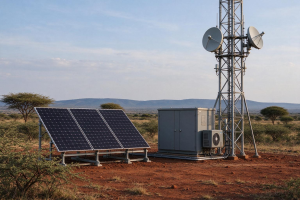
A shipping container power station is not one product category in any useful sense of the word. The same phrase describes a battery enclosure with no generator, a container that houses batteries and a standby generator beside a solar array, a single box that combines diesel generation, PV inverters, storage, switchgear and a control system, and a container built around a deployed PV array. Two quotes can use identical wording and contain none of the same equipment.
At least four different power configurations appear under this name on pages that are public today. The separating question is simple and it comes before price: where does the electricity come from, and is storage inside the delivery?
Four Power Configurations Behind One Name
Each row below comes from one company's description of what it sells. None of these is an industry definition, and none settles what another supplier means by the same words.
| Configuration | What the source describes | What the buyer is really purchasing |
|---|---|---|
| Battery-only enclosure | A supplier's integrated outdoor battery cabinet with battery modules, PCS, an optional MPPT PV controller, control, fire-control, temperature-control and monitoring systems, published in 100 kWh to 1000 kWh | Stored energy and a converter, with no generation source of its own |
| Battery plus standby generator | A 2024 hospital project in South Sudan described by an Australian installer as a 20-foot shipping container power station integrated with a 200 kWh lithium battery, a 100 kVA backup generator and a 120 kW ground-mounted solar array, delivering fully off-grid three-phase power to a 160-bed hospital | Storage, a backup generator and the control that switches between them; the PV array may sit outside the container |
| Hybrid station in one container | A supplier states that each unit includes diesel generators, solar inverters, battery storage, switchgear and SCADA, and publishes 10 ft, 20 ft and 40 ft sizes, 50 kW to 2 MW per container, 100 kWh to 5 MWh of battery capacity, solar integration up to 1 MWp and diesel or gas generation up to 2000 kVA | A complete microgrid core, where the delivered scope already contains generation, storage, conversion and protection |
| PV-array-led container | Marketing in circulation shows containers whose PV array unfolds or extends, with claims about deployment time and diesel-free operation | Generation first; storage, if present at all, is a separate line in the configuration |
The third column is where quotes diverge. A battery enclosure and a hybrid station both arrive in an ISO frame and both may be called a power station, yet the enclosure cannot generate a kWh by itself. Our own architecture guide makes the same point from the other direction: "containerized" does not prove that storage is included, and which components sit inside depends on the product configuration rather than the enclosure (Solar container vs ground-mounted solar).
One supplier blog shows the spread inside a single company. It describes compact all-in-one hybrid stations at 10–120 kVA with 20.4–112.5 kWh of storage as one route, and containerized generator sets paired with 261–2,170 kWh of battery storage as another, then says the deciding factor is usually total load and the number of sites served. Read that as a supplier's stated rule, not a market standard.
Why the Word Cannot Be Priced As One Unit
Price comparisons break down because the equipment boundary moves. A quote for a battery enclosure covers cells, racks, a converter, thermal management and controls, but not a prime mover. A hybrid quote covers a generator set, its fuel system, PV inputs, storage, switchgear and a control layer. A PV-led container quote may cover modules and mounting, leaving storage to your own integrator.
Five scope questions decide whether two totals can be read side by side. Grouping them, a bid can move the enclosure, the storage, the generator set, the distribution and protection, and the operating obligation in or out of its price, so a total tells you nothing until each of those five is pinned down. Ask them of every bidder before the first number reaches the comparison sheet.
Is the enclosure part of the delivery? A supplier may quote an equipment set destined for a container you already own, or a new container with the equipment installed. Our own product range splits along that line, and the answer changes freight, customs treatment and who carries responsibility for structural modification.
Is storage inside? Public pages use "containerized" for PV-only and PV-plus-battery products alike. The battery may be the largest single cost item in the bill, so its presence or absence is the first field to fix.
Is a generator set included? Some pages publish generator capacity ranges, some offer a generator as an option inside the container, and some expect the customer's existing generator to be connected. Each version makes the price mean something different.
Are distribution and switchgear inside? This is the item most easily assumed and most often excluded. One hybrid page lists an AC distribution panel, a generator changeover switch, surge protection and an optional medium-voltage transformer among its contents. That is one published list, not a default for the category.
Who owns fuel and operations? A container with a diesel generator hands the site a fuel supply chain and a service schedule; a battery enclosure hands it a charging dependency. A price does not show either obligation.
Our own quote guidance applies the same discipline: PV kWp, inverter kW, PCS kW, battery power and usable kWh belong in separate request fields, because a delivered or installed boundary is rarely stated unless it is written down (Solar container cost: what changes the project quote).
Split kW, kVA and kWh Before You Compare
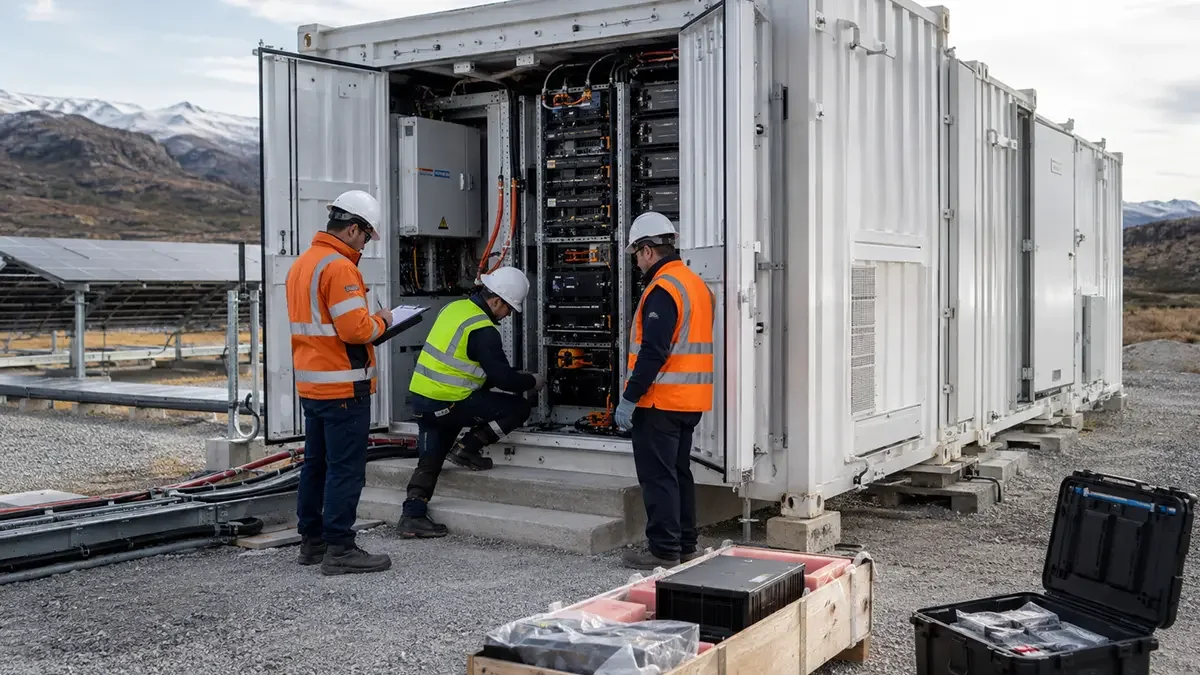
Capacity numbers are not interchangeable. Four figures describe four different things, and most bids publish only two of them.
Generator rating in kVA
Generators are sized in apparent power. The U.S. Energy Information Administration defines power as the rate of producing or using energy, measured in watts, and puts apparent power in voltamperes. It defines power factor as the ratio of real power in kilowatts to apparent power in kilovolt-amperes for a given load and time (EIA glossary: power). A 100 kVA set therefore supplies 100 kW only at unity power factor; below that, the real power available is lower. Motor-heavy loads such as pumps, crushers and hoists pull the factor down. When a page quotes generator capacity in kVA, ask which power factor it assumed and for the prime and standby ratings separately, since those are different limits on the same machine.
PV array rating in kWp
The kWp figure describes module output under standard test conditions. It is not the AC power the site receives. Temperature, soiling, shading, wiring and conversion sit between the two, and array orientation and tilt decide how much of the nameplate arrives during the hours the site needs it. A large kWp figure beside a small converter rating tells you the array is deliberately oversized relative to conversion, which suits low-light or partial-day operation but limits peak AC output.
Converter or PCS power in kW
The power conversion system sets the maximum AC power the storage side can deliver or absorb, and it may be a separate stage from the PV inverter. One hybrid page publishes a 20 ft reference layout with 100–300 kWp of PV input, 200–500 kWh of battery, 100–500 kVA of diesel and 100–250 kW of PCS. Those four bands do not scale together.
Battery energy in kWh: nameplate and usable
Nameplate kWh is not delivered energy. Usable energy depends on the permitted state-of-charge window, conversion losses, operating reserve, temperature and power limits. A 200 kWh pack run with a deliberately conservative window delivers materially less than 200 kWh to the load. Asked instead for its full power rating, the same pack delivers that power for a proportionally shorter time.
Take a worked example. Assume 200 kWh of nominal storage, a 50% usable state-of-charge window and 90% conversion from the battery to the load. That leaves 90 kWh delivered, or 4.5 hours at a 20 kW load. All three factors are assumptions to be agreed with the supplier, not values to read off a datasheet, and the same 200 kWh label supports a different duration at every different combination.
| Figure | What it bounds | What it does not tell you |
|---|---|---|
| Generator kVA | Apparent power the set can supply | Real kW available at the site's power factor; fuel consumption; start and stop sequence |
| PV kWp | Module output at standard test conditions | Delivered AC energy; behaviour on the worst day of the season |
| PCS or inverter kW | Maximum conversion power | Energy duration; overload capability; standalone (grid-forming) behaviour |
| Battery kWh | Stored energy at nameplate | Usable energy under the offered operating window; acceptable cycle depth |
Our own 20 ft reference project shows why these cannot be collapsed into a single "system power" number. That unit carries 9 kWp of roof-mounted modules, an 8 kW system power rating and 20 kWh of storage (USA 8 kW / 20 kWh solar shipping container). The module figure exceeds the system figure because the array is rated at standard test conditions while delivered AC power is bounded by conversion and site conditions. A quote that reported that module rating alone would leave you unable to tell which of the two figures it meant.
Backup needs a duration and an interruption allowance
"Backup included" is not a specification. Ask for the load in kW that must be carried, the duration in hours required at that load, and the longest interruption the critical load can tolerate before the other source takes over. A hospital operating theatre and a site office tolerate very different gaps, and the transfer time depends on the changeover equipment, not on the battery. In a battery-and-generator arrangement, the generator start threshold also has to sit above the battery's minimum operating state of charge. A connector alone does not establish automatic start, safe changeover or fault recovery.
Who Supplies Fuel and Who Runs the Site
The responsibility map changes with the route, and it is usually the item missing from a comparison sheet.
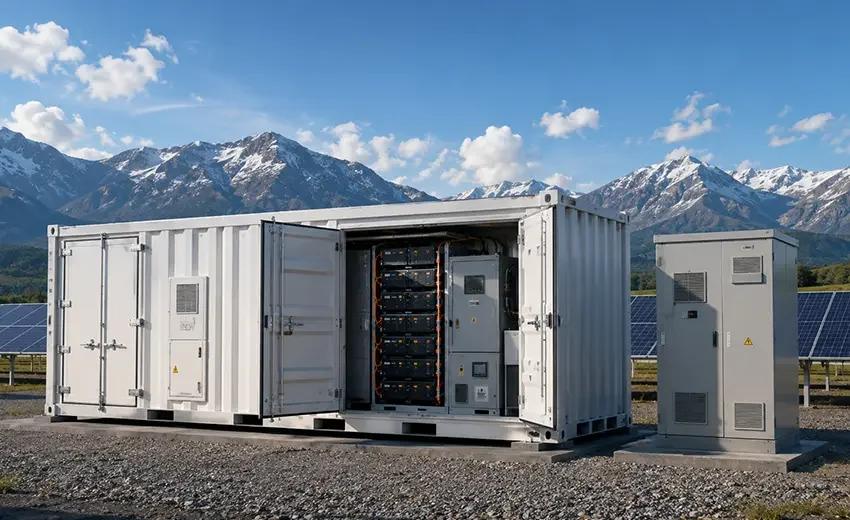
Diesel or gas generation. The site owns a fuel supply chain: delivery interval, storage capacity and containment, fuel quality over long storage, refuelling labour, and a service interval for the engine and alternator. Noise and exhaust emissions become siting constraints, and in some jurisdictions permitting constraints. Ask who sets the service intervals, who holds spare filters and belts, and what happens when the fuel truck is late because a road washed out.
PV with storage only. Fuel disappears, and a different dependency appears. The system is now sized by the worst weather window rather than the average. Ask for the longest period without adequate solar input the design was checked against, what state of charge the system is expected to hold at the end of that period, and whether a non-solar source is available if the window runs longer. A storage shortfall is not fixed by a larger array, and a larger array is not fixed by more storage.
In the South Sudan hospital example, the container carried the battery and the backup generator while the 120 kW array was ground-mounted and separate. That arrangement puts daily cycling on the battery and keeps the generator in a standby role, which makes fuel logistics a hospital supply decision rather than a power-equipment decision. The split is that installer's project design, described on its own page.
Hybrid. The questions multiply at the control layer. Ask under what condition the generator starts, who sets and changes that threshold, whether it is a state-of-charge, load or time-of-day trigger, and whether the site can override it. Then ask who owns the fuel chain, who performs generator maintenance, who monitors the battery, and who is accountable when the two disagree. A control system that supervises both sources concentrates these decisions in one place, which helps only if the operating responsibility is written down beside it.
Where the Container Stops Making Sense
Containerisation solves a site problem rather than an equipment problem. A supplier's own site-fit table frames it that way: it describes containerisation as fitting sites reached by sea, barge or long road, loads that grow in phases, a defined project period, scarce local electrical labour, and extreme climates. It names a permanent plant room with space and local contractors as the case where a stick-built arrangement may fit better. That is one supplier's stated position, and it works as a screen rather than a rule.
Three questions turn the screen into a decision. Can the unit reach the site, be lifted into position and be serviced where it lands? A transport corridor and a crane window are site work; container dimensions do not remove them. Does the load grow in steps you can serve by adding another unit, or does it grow continuously past what parallel units can follow? And will the asset move at the end of the project, or stay long enough that a permanent installation becomes cheaper to operate?
The Portable-Power Confusion
The same phrase appears in consumer forums, where it means something entirely different. In a public group post, a member with a 40 ft container, six LED shop lights and three motorcycle battery tenders asked whether a portable power station unit was worth buying or whether an electrician should simply run wire 150 ft (public group post). Portable-station threads on other consumer forums use the same vocabulary for home and vehicle backup.
Those products are appliances measured in watts and watt-hours, sized to a few circuits. Container power stations in the sense used here are project equipment measured in kilowatts and kilowatt-hours, with switchgear, protection, thermal management and a connection to site distribution. A portable unit's price is not a low anchor for an industrial quote, and a portable unit cannot stand in for a container system's protective and control functions. If a search brought you here looking for a backup box, the question is a different one.
Where Our Published Configurations Sit
HighJoule's HJ-FBESS Solar Container is a foldable PV generation and energy storage system. Its published reference configurations cover 9–136 kWp of PV and 15–482 kWh of storage across 8 ft, 10 ft, 20 ft and 40 ft forms, with inverter, PCS, grid interface and protection configured per model and project. In the taxonomy above it sits in the PV-plus-storage configuration: generation and storage are both published as part of the product.
HJ-FESS is the foldable PV generation route, published at 24–182 kWp with string-inverter configurations at 20–200 kW. Its published configuration table does not list a battery capacity. Read that precisely: the table is silent on storage, which is not the same as a statement that no storage can be provided. Grid connection, voltage and site-specific electrical requirements are settled during project engineering.
We do not manufacture diesel generator sets, and neither configuration above should be read as including one. Where a project needs a generator in the architecture, it is specified as part of the project rather than as standard content of our container.
The Field Sheet to Attach Before You Compare Quotes
Start with the first row yourself. Before the request goes out, tick one of the four configurations below, so the question of what is being sold stays on your side of the table rather than being answered by the bidder. Then send every row as a question the supplier answers item by item, and ask each one to state any deviation from the configuration you ticked rather than leaving the field blank.
| Field | What to require in the answer |
|---|---|
| Power configuration type — buyer ticks one before issue: battery-only enclosure / battery plus standby generator / hybrid station in one container / PV-array-led container | Supplier confirms the ticked route or states its deviation, names the prime energy source explicitly, and identifies which of the other three routes it is not offering |
| Enclosure | Container supplied, or equipment for a container the buyer provides; size, and any structural modification in scope |
| Storage | Included or excluded; if included, nominal kWh, chemistry, usable energy and the operating window used for that figure |
| Generator set | Included, optional, or buyer-supplied; kVA rating, power factor assumed, prime and standby ratings, fuel type |
| Distribution and switchgear | Which panels, changeover equipment, protection and transformer, if any, are inside the delivery, and which are site-side |
| PV array | kWp nameplate, module type, mounting (roof, ground, deployed), and whether the array is part of the delivery |
| Converter power | PCS and inverter kW stated separately, with overload rating and standalone capability |
| Backup duration | Critical load in kW, required duration in hours at that load, longest tolerated interruption |
| Fuel and operations | Fuel supply owner, storage capacity, refuelling responsibility, service intervals, monitoring and remote diagnostics owner |
| Generator start condition | Trigger type, threshold value, who sets it, who can change it, and what happens on fuel or start failure |
| Site interface and grid | Connection point, voltage and frequency, grid-tied or islanded operation, protection coordination, and who handles the utility or permitting process |
| Climate and solar resource | Design ambient range, altitude, dust and salt exposure, and the longest no-solar period the design is checked against |
Two answers to the same field rarely match exactly, and that is the point. Where a bidder leaves a field blank, or answers a row for a configuration you did not tick, the comparison sheet shows the gap before the price does.
Last Updated on 11/25/2026