A supplier’s brochure calls it a foldable solar container, and the word “foldable” sounds like the answer to every site question you have. It is not. In published material the same term covers a pure-generation unit whose array folds out of a shipping container and an integrated PV-plus-battery system, and suppliers also describe folding arrays paired with a diesel genset. It describes at least four different unfolding mechanisms. It says nothing about how much ground the deployed array needs. And the deployment times attached to it range from a couple of minutes to several hours, measured from different starting points by different crews.
So treat the term as a starting condition, not a specification. The decision points that follow are narrow and checkable: which product class the supplier is actually quoting, what the array occupies once it is open, how a deployment time was measured, and whether an energy storage system is part of the delivery. Get those four right at shortlist stage and you avoid the expensive version of the mistake, which is discovering at site mobilisation that the “solar container” in your budget has no batteries and needs several hundred square metres of ground once it opens.
One phrase, two published product routes
HighJoule publishes two separate foldable container ranges, and the published configuration tables are the clearest evidence that the label does not settle the architecture. The HJ-FESS Solar Container is a foldable PV power system offered in 8 ft, 10 ft, 20 ft and 40 ft configurations across six variants, with a published range of 24 to 182 kWp and string-inverter configurations from 20 kW to 200 kW. The HJ-FBESS Solar Container is a foldable PV plus energy storage system with eight published reference configurations spanning 9 to 136 kWp and 15 to 482 kWh, across modular rooftop, 8 ft, 10 ft, 20 ft and 40 ft container designs including high-cube variants.
The difference is not marketing language. It shows up in how the table is built. On larger HJ-FBESS variants the published table lists an inverter rating and a PCS converter rating as separate figures: the 20 ft HJ-20G-P057E241 configuration, for example, publishes a 50 kW inverter, a 100 kW PCS converter and 241 kWh of storage. Two conversion ratings and a kWh figure describe a system built to charge and discharge a battery. A generation-only table has no such row structure to fill.
What a slash in the storage column actually means
Every variant in the published HJ-FESS table carries a slash in its energy-storage-capacity cell. Read that precisely: the table publishes no battery capacity for those configurations. A slash is a record that no value was entered. It is not a declaration that the product has no provision for a battery, cannot be connected to external storage, or ships without packs in every configuration. Those are different statements, and only the first is what the table supports.
The practical consequence for a buyer is simple. You cannot read “foldable solar container” and conclude that storage is included, and you cannot read a blank cell and conclude that storage is impossible. You have to ask which published model and configuration the quote refers to, and what the deliverable bill of materials contains. A supplier who answers only with the category name has not answered the question.
Four ways an array can leave the box
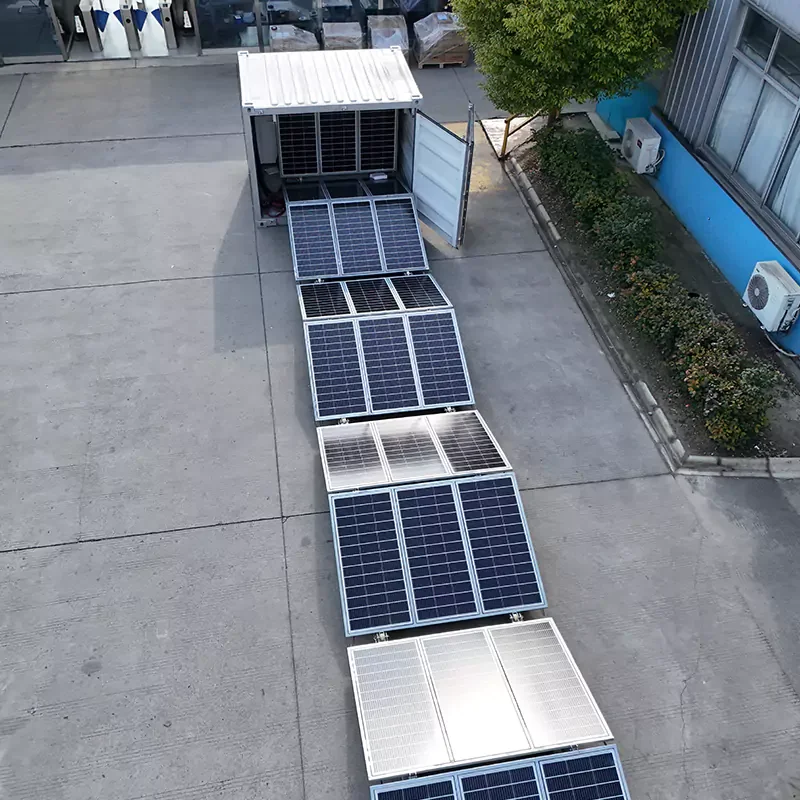
Published descriptions do not converge on one mechanism. They describe at least four families of motion, and each one changes the ground it sweeps, the crew it needs and the parts a maintenance programme has to track.
Accordion rails inside the container
One published trade description of a containerized foldable photovoltaic power station covers the array mounted on a galvanized frame joined by hinges, unfolded and folded like an accordion through a track-pulley system with a winding mechanism, the track able to follow uneven ground. In that design the module rows travel along the container axis, so the deployed array forms a long strip in line with the box, and the ground beneath it has to tolerate the rail path.
Hydraulic or electric frame extension
Our own guide to off-grid container systems describes the array as mounted on a hydraulically or electrically actuated frame that folds flat for transport and extends section by section from a control panel until it reaches the site tilt angle. The published Ukraine 46 kWp foldable case takes a related route, recording foldable wheeled sliding racks that unfold to at least 15 degrees, carrying 92 × 500 Wp modules with 50 kWh of off-grid storage.
Fold-out and side-extending wings
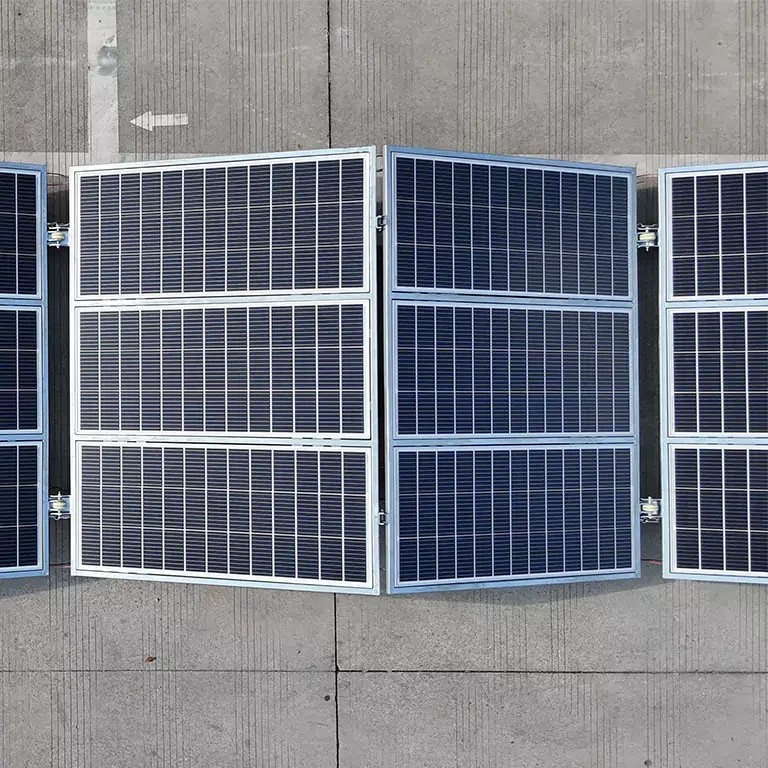
Other published material shows arrays that deploy outward rather than along the container, including a design whose panels slide out on rails and suppliers describing foldable wing configurations extending from a container side. Our own published field sequence describes foldable PV wings extended with hydraulic assist, 10 to 15 minutes per wing, inside a two-hour truck-to-operation narrative.
Mixed and multi-wing layouts
Larger configurations can combine several of the above, with multiple PV wings on a 40 ft body. That is one reason a single “40 ft” label cannot carry a single deployment time or a single ground requirement.
Four states, four different structural questions
A foldable container is not one object with one set of limits. It exists in at least four states, and each has its own load case: transport, folded or stowed, deploying, and operating. Wind, snow and restraint questions belong to the specific state, which is why a single “wind rating” on a datasheet is not a usable answer for a project. The wind, snow and weather limits guidance sets out how to verify each state separately.
The state most often skipped at shortlist stage is transport. A 20 ft or 40 ft container has a well-understood transport envelope, and that envelope is the reason the foldable form exists at all. What matters for your site is the other one: transport footprint is not operating footprint.
How much ground does the deployed array actually take?
The published extent can surprise buyers who budgeted for a container pad. One public description of a containerized foldable station states that some models reach a total unfolded array length of up to 116 m with approximately 720 m² of effective light-receiving area. That is one published description of some models, not a standard and not a figure to design any other product against, but it establishes the order of magnitude: a single container can put several hundred square metres of modules on the ground when it opens.
Two consequences follow. First, the site plan you send to suppliers should show the proposed container position, the array orientation, the clear operating envelope and the maintenance and emergency access, not just the box. Second, the deployed envelope is constrained by transport and mechanical packaging in ways a ground-mount design is not, so the array geometry is a property of the product you chose, not something the site can negotiate after award.
Before you treat a site as feasible, the deployed state has to survive contact with six things: ground bearing capacity and level tolerance under the loaded array; drainage and standing water along the array path; the support, base or anchoring arrangement the design actually requires; lifting and maintenance clearance for the crew; shading from buildings, terrain, fences and overhead lines; and the cable route from array to container and from container to load. The site requirements guidance covers the ground, access, drainage and foundation detail behind each of them.
How to read a deployment-time claim
Published claims for the same category run from minutes to hours, and most of the gap is definitional rather than technical. A supplier video for a mobile solar plant housed in a customized 20 GP maritime container advertises 2-minute, one-touch unfolding and folding using an automatic hydraulic system. A public trade account describes a trained team of six deploying a large array of roughly 102 m in approximately two hours. Both numbers can be accurate and still be useless to you, because neither tells you what was measured.
Our own published figures for the same task were issued under different scopes and have not been reconciled into one controlled statement. Different HighJoule pages give, for the same nominal container size, roughly 30 minutes versus about one hour for a 10 ft unit; 1 to 2 hours versus about 2 hours for a 20 ft unit; and 2 to 4 hours versus about 4 hours for a 40 ft unit. Another page states 120 minutes for a 20 ft 100 kW unit with six workers, while a separate article describes about two hours with two technicians for a comparable size. This article therefore does not offer a single house number. The honest reading is that the category has no cross-comparable benchmark yet.
What you can do is force comparability at the quote. Ask every supplier to state the same fields: the start point (truck arrival, offload, positioning or foundation complete); the end point (array fully deployed, electrical connection made, or system energised and tested); the crew size and the handling equipment assumed; the site preparation assumed, including level, access and drainage; the weather window assumed; and whether electrical testing, commissioning and grid or load interface work are inside the time or excluded from it. A claim that cannot answer those fields is a marketing line, not a schedule input.
The mechanical layer outlives the demonstration
Every mechanism above adds moving parts to the equipment register. Hinges, rails, actuators, locks, restraints and cable management are all maintenance items that a fixed rack does not have, and their condition determines whether the array still deploys cleanly three relocations later.
The items that decide complaints in the field are the ones you can name before award: the rated folding-cycle count and what is counted; the inspection interval and what is inspected at each one; what must be re-checked after transport, after an impact, and after an emergency stowage; and the spare parts you hold on site for rails and actuators. If storage is in scope, the mechanical layer sits alongside batteries, a converter and thermal management, which is another reason a maintenance plan written for a generation-only unit cannot simply be carried over to a PV-plus-storage configuration. The maintenance checklist turns these into a condition-based programme, and the pieces needed for a site move are covered in the second-site relocation checklist.
Form fields to attach to your RFQ
These fields convert the label into comparable, checkable inputs. They are narrow by design: the ones that change the answer, not a full procurement data set.
| Field | What to require in the response | Why it changes the outcome |
|---|---|---|
| Product route and storage status | The exact published model and configuration, plus a bill of materials stating whether an energy storage system is included and, if so, its published kWh capacity and converter rating | Separates a foldable PV generator from a foldable PV-plus-storage system without inferring from the category name or from a blank table cell |
| Unfolding mechanism | The mechanism family (accordion rail, hydraulic or electric frame, wheeled slide, fold-out wing, or mixed), the actuation source and whether the crew performs any manual lifting | Sets the crew, the swept path, the maintenance items and the personnel requirements |
| Deployed envelope | Maximum deployed length, width and area, the operating envelope, maintenance clearances and the exclusion zone | Transport footprint is not operating footprint; this field is the one that fails sites |
| Limits by state | Permitted wind, snow and stow limits for transport, stowed, deploying and operating states, each stated separately | One figure cannot cover four states, and the deploying state is often the most sensitive |
| Ground and support requirements | Allowed ground bearing pressure, level tolerance, drainage requirements, and the base, pad or anchoring arrangement the design requires | Determines civil scope and whether the chosen position is usable at all |
| Deployment-time basis | Time with start point, end point, crew size, handling equipment, site preparation, weather window, and whether testing and commissioning are included | Makes claims comparable across suppliers instead of relying on headline minutes |
| Mechanical duty and inspection | Rated folding-cycle count, what counts as a cycle, inspection interval and items, post-transport and post-impact checks, and recommended on-site spares | Turns the folding mechanism into a maintainable asset with a defined spare strategy |
| Transport and re-deployment state | Stowed configuration, restraints, lifting points, transport mass, and the checks required before energising again at a second site | Prevents treating a relocated unit as ready to run on arrival |
Where this question stops and the next one starts
This article deliberately stops at the form, the ground and the claim, because four adjacent decisions belong to other pages and taking them in the right order keeps the shortlist honest. Whether a foldable container or a trailer-mounted system is the better form for your site is a separate form comparison. The project-level schedule gates, from factory acceptance through freight to commissioning, belong to the deployment timeline guidance. The broader data set a supplier needs before it can quote is covered by the quote checklist. And if storage is genuinely undecided, whether a solar container needs battery storage at all is its own architecture question.
Once those are read in that order, “foldable solar container” stops being a category you buy against and becomes a set of conditions you can test. The four questions worth carrying into every supplier conversation are the ones this page opened with: which product class, how much ground once open, what a stated deployment time actually measured, and whether storage is in the delivery.
Frequently asked questions
Does every foldable solar container include batteries?
No. Published ranges include a foldable PV power route whose configuration table carries no published battery capacity, and a separate foldable PV-plus-storage route that publishes both PV capacity and storage capacity. Storage inclusion has to be established from the specific model and configuration in the quote.
Can I size the system from the container size alone?
Not reliably. Container length constrains transport and packaging, but the published foldable ranges show the same nominal size supporting different PV and storage combinations, and multiple PV wings on a longer body. Sizing follows the load and the storage decision, not the box.
Are supplier deployment times directly comparable?
Usually not, because start points, crew sizes, site preparation and whether testing and commissioning are included differ. Two claims can both be true and still not describe the same work. The record fields above are what makes a comparison meaningful.
Does a foldable array need support or foundations?
A foldable container reduces field assembly, but it does not make support conditions optional. The design still has ground bearing, level tolerance, drainage and anchoring or structural requirements that must be stated for the exact model before the site is judged feasible.
Last Updated on 11/09/2026