Headlines are a poor place to compare this product category. Two offers may share the words "container solar kit" and still describe two different purchases. One is a bare electrical kit: a single all-in-one power unit, a stack of bifacial modules, container-specific racks, a weatherproof cable gland and branch connectors. The other bundles modules and battery storage into a broader off-grid living package with water filtration, a composting toilet and low-power fixtures, sized for a range of container boxes.
For an owner adding power to a container home, cabin, work shed, jobsite office or storage unit, that ambiguity is the risk that decides whether the project works. What a kit label hides are the four items that determine the outcome: where the array is fixed, how the cable leaves the steel shell, whether anything stores energy overnight, and which party owns each of those tasks. The checks below turn those items into questions for whichever quotation is in front of you.
What a bare electrical kit actually contains
The electrical type of kit works as a shopping list for part of a job, and each line maps to one scope decision an owner will otherwise inherit:
- An all-in-one power unit that combines inverter, charge control and solar-direct power management, or, in other kits, a separate inverter and charge controller
- A quantity of bifacial modules, whose count and wattage set the daytime ceiling rather than the storage capacity
- Container-specific racks or rails that mount the modules on the shell, with a stated maximum panel count
- A weatherproof cable entry gland with a short MC4 extension run, sized for the distance the supplier assumes
- Branch connectors (a Y pair) for combining strings at the module end
Read the exclusions as carefully as the contents. In the electrical kit pattern the container is a separate purchase, and the all-in-one unit is designed to run without a battery until the buyer adds storage or a grid connection for the night. Delivery brings modules, racks, one gland and a fixed-length cable run; the shell, the route through it, the battery and the commissioning stay with whoever is standing on the roof.
The other type inverts the logic. It treats modules and battery storage as two parts of a broader off-grid living package, alongside water filtration, composting toilets and efficient fixtures, and presents the result as a conversion rather than a power supply. Owners fitting out a container to live in may find it genuinely useful; buyers shopping for kilowatts are also paying for a toilet. Neither type is wrong, but a price comparison across them measures nothing.
Six boundaries every quote should draw
Six questions separate a kit that arrives ready to install from one that leaves you sourcing parts and labour. Put each to the actual listing or quotation, and settle the answer before comparing prices.
| Boundary field | Why it changes the job | What the answer should be |
|---|---|---|
| Is the container included? | The kit either ships the steel box or assumes you already own one | "No container" or the specific box supplied |
| Which electrical parts are in the box? | Panels, inverter or all-in-one, charge controller, battery, racking, cable entry and connectors may be split between kit and site | Itemised list with quantities and ratings |
| Who fixes the array? | Fixing method, roof or wall, carried load and wind exposure all interact | Named responsible party and fixing method |
| Who makes the shell watertight? | Cable entry, vent changes and condensate drains each pass through the shell | Entry method, sealing responsibility, drainage detail |
| What happens after dark? | Without storage, output stops with the sun unless a grid or generator takes over | Battery capacity and duty, or the alternative supply |
| Who signs off the electrical work? | Approval and inspection are local decisions, and the kit does not carry them | Named authority path and installer competence |
None of these fields is exotic, yet each is routinely missing from a two-paragraph product description — which is how two unrelated offers end up sharing one search phrase.
The work that starts when the pallet arrives
A published first-hand account of turning a shipping container into a solar charging station shows how much of the job happens after delivery. The author chose an all-in-one system partly because it shipped with the adapters and wiring to connect the panels, and still built the mounting structure himself.
His sequence is the useful part. He built two mounts from pressure-treated 2x4s, each carrying three 200W panels, and lashed the frames to the container. The run from panels to power unit exceeded the supplied cables, so he bought a separate 20 ft MC4 extension set. To bring the cable inside he enlarged an existing vent hole in the wall and formed a small drip loop, so rainwater runs off the cable instead of following it into the opening.
None of that is electrical engineering; it is carpentry, weatherproofing and route planning, and it all sits outside a kit that stops at connectors and racks. The author also notes that his folding panels were never intended for long-term permanent installation and had no rigid frames, so the wooden mounts did the structural work. Even mounted flat to cut the surface area that gusts can push against, the assembly still behaved as a wind sail. Anyone assuming a folding panel belongs on a fixed container roof should weigh that trade-off first.
The rest of the build repeats the pattern. Batteries weighing about 180 lb went onto a hanging shelf of galvanised C-channel and chains, clear of the floor. A portable air conditioner needed its own hole in the side wall for exhaust, plus a smaller one for the condensate drain. Total storage came to roughly 8 kWh, and close to 1,000 W of output came from an estimated 1,200 W of panels in direct Florida sun. Those figures describe one person's setup, but the shape of the work is general: anything that touches the shell is a penetration, a fixing or a load path that someone has to design and execute.
Fixing and water are one decision on a steel shell
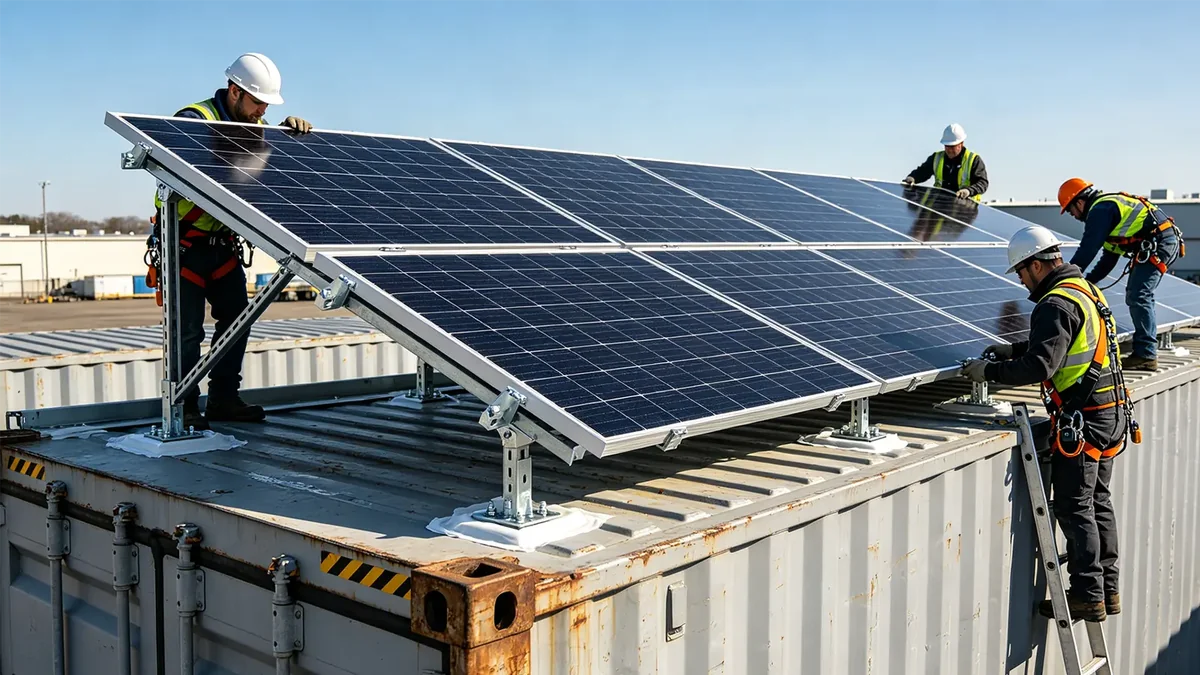
Container work diverges from house work here. A container roof is corrugated steel built to stack and shed water, not to carry heavy concentrated weight. HighJoule's 40ft container-home guide carries two installation conditions for this: mount brackets only on factory reinforced roof rails, and seal all bolt holes with waterproof sealant. An unplanned hole in that shell is both a load interruption and a future leak, so our own position is that every fixing and every penetration has to be designed rather than improvised.
That leaves a few defensible mounting paths. Brackets can attach to reinforced rails or to the container's structural edges, holding the panel frames above the ribbed surface. The array can instead live outside the shell on ground-mounted or ballasted racking, with only a cable route running back to the equipment, which removes roof load altogether. A third route fixes panels to a side wall or a dedicated frame. Each path reassigns responsibility for load, wind and sealing, and none is automatically right for a 20ft cabin, a 40ft workshop and a jobsite storage box at the same time.
Water follows the same logic. A cable gland, an enlarged vent and an air-conditioner exhaust each need their own sealing method and a drainage detail, usually a drip loop that sends water off the cable before it reaches the opening. The gland in a typical electrical kit covers the cable entry alone: it seals nothing you enlarged, no exhaust duct and no second hole for condensate. Ask a quote to name every opening and the party who seals it, because the supplied gland never covers the whole shell.
Night, cloud cover and the battery question
Panels make power only while light falls on them, and whether that matters depends on what the container does after sundown. The electrical kit pattern is explicit about this: its all-in-one unit runs without a battery, and storage or a grid connection is required for nighttime power. Reading only the headline output tends to produce a plan built around daytime charging, which works until the first evening load arrives.
HighJoule makes the general point in its container-versus-ground-mount comparison: “containerized” does not prove storage is included, and either arrangement may connect to a grid, a battery or a generator. The same caution applies to a kit label. Storage is a separate line item with its own engineering question, and that question is not what capacity is printed on the box but what load must run for how long without sun.
Build the answer from a 24-hour load profile rather than a power bill. HighJoule's output guidance recommends recording steady demand, motor starts, power factor, phase, voltage and the loads that cannot be interrupted, because a monthly total hides the ten-minute peaks that size an inverter. Two containers with identical annual consumption can need very different storage. A monitoring box that runs a radio and a sensor overnight draws little, while a cabin with a refrigerator and a pump has a duty cycle that will not tolerate an empty battery by morning. Take that profile to the supplier and ask what usable energy and discharge power the proposed battery delivers under those conditions — not what the nameplate says.
Daytime load, storage and grid supply are three different systems
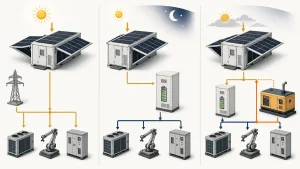
The storage question gets easier once you write down what the container must do and when. Three patterns cover most small projects, and each places the remaining responsibility somewhere different.
| Operating pattern | What the kit must contain beyond panels | What still has to be arranged |
|---|---|---|
| Daytime only: tools, pumps or chargers used while the sun is up | An inverter or all-in-one sized for starting surges, plus an array large enough for the duty cycle | Shutdown and restart routine so nothing depends on stored energy |
| Day and night off-grid: lighting, refrigeration, communications | A battery sized from usable energy and night duty, with charge control | Low-temperature behaviour, ventilation and a safe battery location inside the steel shell |
| Grid or generator supported: solar offsets an existing supply | An inverter or all-in-one able to accept an external AC source | Interconnection method, metering arrangement and approval of the local supply authority |
Approval is local, so read the last column as an input to resolve for your site, not as a rule this article settles. At kit level the decisive point is that the quotation says which pattern it sells: a battery-free inverter, a battery bank and a grid-interactive hybrid are not interchangeable, and the accessories around them differ too.
When the container is part of the system
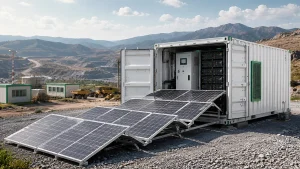
Some buyers stop asking what a kit contains because the container is part of the system. HighJoule publishes two relevant routes. HJ-FESS is a foldable photovoltaic container offered in 8ft, 10ft, 20ft and 40ft configurations, covering 24-182 kWp of PV with string-inverter configurations from 20 kW to 200 kW; its published configuration table does not list a battery energy storage capacity. HJ-FBESS is the foldable PV-and-storage route, with eight published reference configurations spanning 9 kWp to 136 kWp of PV and 15 kWh to 482 kWh of storage.
The contrast mirrors the kit problem. Two containers from one manufacturer answer the battery question differently, and the configuration table — not the family description — says which one you are buying. It also shows what happens when the kit boundary disappears: a pre-integrated unit moves fixing, cable routing and commissioning into factory scope, which is why foundation, access and deliverability, rather than brackets and glands, become the dominant site questions.
Eight fields to paste into the RFQ
The table above frames what to ask. This version goes straight into a request for quotation, one answered line per field, so both respond to one identical scope.
1. Itemised contents. List every component with quantity, rating and model where given: modules and their wattage, inverter or all-in-one, charge controller, battery and nominal capacity, racking and brackets, cable entry, connectors, cable length and gauge. Accept "as listed above" only when the list is actually above.
2. Container status. State whether the container is supplied, already owned by you, or priced separately.
3. Fixing and load. Name the fixing method, the structure it attaches to, and the party responsible for verifying roof or wall capacity and wind exposure. Include whether the array is on the shell or on separate ground racking.
4. Water entry. List every penetration with its sealing method and the party who seals it, including vent modifications and drainage or exhaust openings.
5. Day and night duty. Give continuous load, peak and starting loads, daily energy in kWh, and the required runtime without sun. For battery options, ask for usable energy, discharge power and any reserve or depth-of-discharge assumption.
6. Supply mode. State whether the system is off-grid, grid-connected or hybrid with an existing generator, and what the external AC source must look like.
7. Approval path. Name the authority, the inspection requirement and the installer competence expected for your jurisdiction, and state who prepares the documentation.
8. Commissioning scope. Identify who configures the inverter or charge controller, tests the array and hands over records. A kit that ships with all the adapters still leaves this step to someone.
Send the completed fields with the load profile and site photographs. Suppliers who answer the same boundary produce comparable quotes; suppliers who answer only the wattage produce a number you cannot act on.
Where this guide stops
The scope here is what sits inside a kit and who owns the rest. Choosing between a foldable container and a trailer-mounted system is a form decision, covered in the comparison of foldable solar containers and trailer-mounted systems. Ground preparation, drainage, crane access and the base type belong to solar container site requirements, which explains why a concrete slab is not the universal default and why the base depends on operating mass, support points, soil, frost and flood exposure, and wind design. Project gates and durations sit in the deployment timeline, and the recurring work after commissioning belongs to the maintenance checklist.
For the wider quotation exercise, the solar container quote checklist sets out the eight input groups a supplier needs, including the supply boundary and quotation format these fields feed into. Use it once the boundary is settled; a quote built on an unclear boundary only moves the ambiguity into the contract.
Questions buyers ask before signing
Does a container solar kit come with a battery?
Not by default. The electrical kit pattern runs without a battery and needs a battery or grid supply for night use, the conversion pattern bundles storage, and HighJoule publishes one foldable family whose table lists storage capacity and one whose table does not. Confirm the battery as a line item rather than assuming it.
Can panels go straight onto the container roof?
They can, subject to two conditions HighJoule's 40ft container-home guide sets out: brackets land on factory reinforced roof rails rather than arbitrary points, and every bolt hole is sealed with waterproof sealant. Unplanned holes are both a load interruption and a future leak, so an improvised fixing tends to fail twice. Rails, structural edges, side walls and separate ground racking are all usable bases, each carrying its own fixing and sealing responsibility.
Do I have to open the shell at all?
Not necessarily. Ground-mounted or ballasted racking keeps the array off the container and leaves only a cable route back to the equipment, while roof or wall fixing usually adds at least one penetration for cable. Some builds avoid new openings by reusing an existing vent, as the build account above does, but that route still needs sealing and a drip loop. The decision is which penetrations you accept and who is accountable for keeping them watertight.
Does container size determine the kit?
Length changes the available roof area and where the array can sit, not the electrical size. Load profile and duty set array, inverter and storage. A 20ft work shed running a sensor and a 40ft workshop running tools may need the same inverter class and very different storage, so read the component list instead of inferring from dimensions.
Does a kit move with the container?
Some of it can, and the splitting matters. Modules, racking and the all-in-one unit are portable hardware, but the cable entry, any vent or exhaust modification and every sealing detail belong to the shell. Moving the box means reopening the route, resealing the penetration and re-checking the fixing on a different roof. Treat the shell work as site-specific rather than as part of the kit.
Last Updated on 11/13/2026