Two suppliers can both describe their product as a solar powered shipping container and still be selling different things. One sells a rack of panels that readies a container you already own. Another supplies the box with power inside. A third uses the phrase for a container building with rooftop panels. A fourth ships a plant-sized unit that is craned in, unfolded and connected. The name does not separate them, so a quote on one cannot be read beside a quote on another.
Five fields, taken from vendor pages that are public now, are enough to show where a quote can stop and where your own site work starts. Each is one supplier's description of what it sells, not a standard the whole market follows.
One phrase, at least five forms
Across those public pages the term covers at least five products. A retailer's product page lists three build-out levels side by side on the same page. A container builder's sales page describes panels, battery storage and inverters packed into one container. A container retailer and fabricator publishes an article about attaching rooftop PV to container buildings as a commercial and environmental upgrade. An integrator's public post describes a mobile solar-storage container built into a 20GP, with 20 kWp of PV, 21.2 kWh of battery and inverter, protection and a communication module inside. A listing for a small solar light marketed to containers uses the same phrase.
So a quote can reasonably be for power hardware alone, for the container with power inside it, for a building with panels on the roof, or for an enclosure that leaves every connection to your electrician. Those are different bills of material, not variations on one price.
Build level decides what a container quote actually covers
The three levels on that retail page spell out why. BYO-Container is a retrofit kit: solar, inverter, battery bank and roof panel mounting for a container the buyer supplies. Quick Deploy, also called Bare Bones, adds the container plus a basic build-out with outlets and exterior paint. Move In Ready adds framed windows, insulation, interior and exterior paint, a door, flooring, overhead lighting and a mini-split. The page's own inclusion matrix marks exterior paint, interior paint, air conditioning and interior modifications as absent from the BYO tier and present or optional on Move In Ready.
A container's contents are an open question until the level is fixed. When a seller says "container included," the box may arrive with doors and an open interior, or as a workspace with lighting and air conditioning. An RFQ that does not separate them will collect quotes for both and call them comparable.
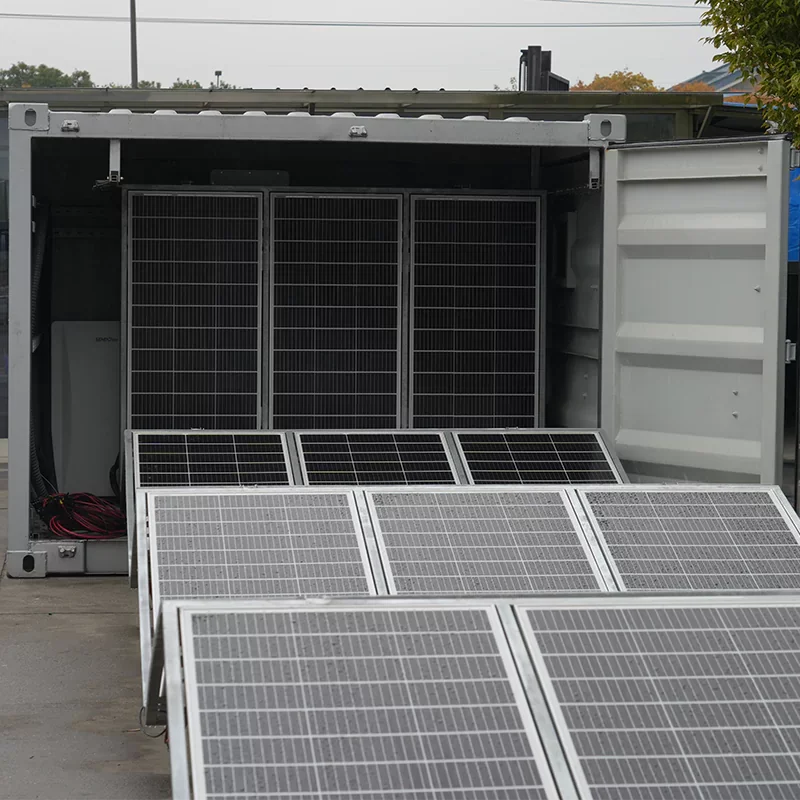
That photograph shows the split plainly: the box, the panels stacked inside it and the modules laid out in front are separate items in one shipment. Whether the invoice covers all of them, and whether anyone has framed a window, insulated the interior or fitted an air conditioner, is exactly what a build level tells you.
For a container that is itself part of the product, such as our HJ-FBESS foldable PV-plus-storage container, what sits inside is published configuration by configuration rather than left to the name.
Field 1: Who owns the box, and who alters it
Bring-your-own-container moves the enclosure, and everything done to it, back to the buyer. A vendor kit is designed around a container the field team supplies, so every opening, seal, vent, cable route or corrosion protection put through the steel is drawn, executed and signed off on your side of the contract.
The mounting description on one build-tier page shows how much of that work stays with the field. Roof brackets are welded to the container, but 2-inch pipe ships inside the container and is cut to the tilt angle of the installation site; the customer assembles the mount and places the panels on the roof with included hardware. The vendor calls the arrangement a secure field-tested mount and rates it for up to 81 mph of sustained wind.
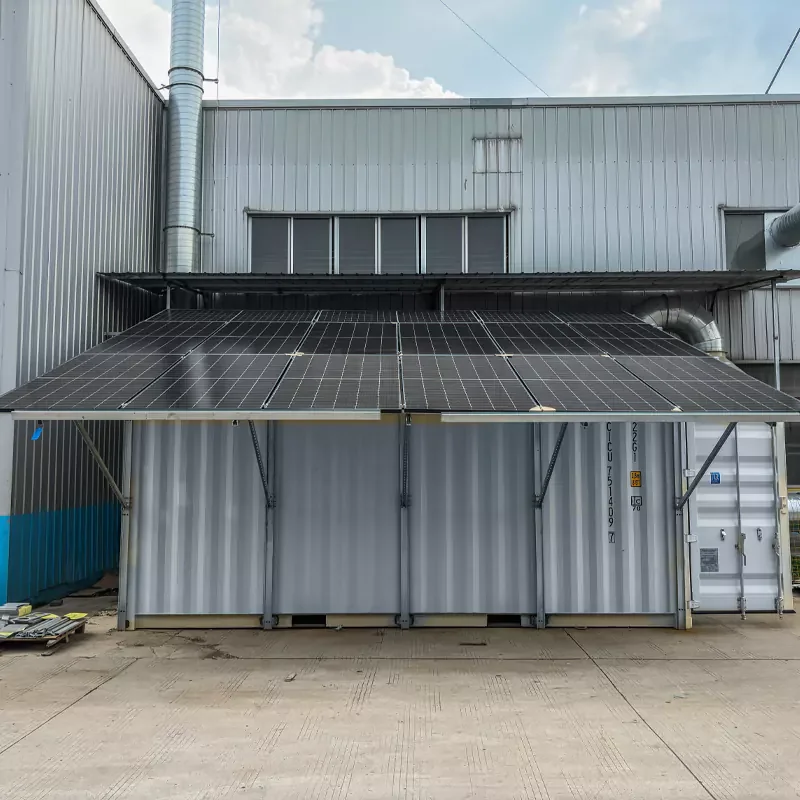
On the roof mount pictured here, the frame and panels are separate from the enclosure below and rest on it. Wind only carries when the site matches the basis behind the number. HighJoule's own guidance on wind, snow and weather limits is that transport, stowed, unfolding and operating states each need their own limit, and that a module's test load proves the module rather than the container or its mount. A welded bracket transfers panel loads into the roof; no page above states the roof's load capacity or whether it is reinforced. The record of who designed and accepted that connection belongs in the quote, not the brochure.
Field 2: Is storage in the delivery, or in a footnote
Storage is genuinely optional across the category. HighJoule's own project boundary note puts it plainly: containerized does not prove that storage is included, and either a ground-mounted or a container system may connect to a battery. Within our catalogue, the HJ-FESS foldable solar container publishes 24 to 182 kWp of PV across six variants, 20 to 200 kW of string-inverter configurations, and no battery capacity in its configuration table. The HJ-FBESS route publishes 9 to 136 kWp of PV and 15 to 482 kWh of storage. Both are published configurations; what a specific unit ships with is settled in the quotation.
For a daytime-only site, the PV-only route is a real option rather than a defective one. For overnight load, the figures that matter are battery power, nominal energy and usable energy, and a unit quoted without storage has to be priced against a separate storage purchase instead of a bundled total.
The retail page shows how storage changes inside one tier. Its 20 ft build table pairs 3,000 W of array with eight 160 Ah GEL batteries at 15,360 Wh nominal, or one 100 Ah lithium battery at 5,100 Wh, and doubles the GEL count at 6,000 W. Those are nominal figures printed on the table. Usable energy, depth of discharge and expected cycle life will be lower for GEL than for lithium, and a quote should say which bank it prices.
Field 3: Three power numbers, not one
PV nameplate, system output and stored energy describe three different capabilities, and a single generous number usually collapses them. Our own USA 20 ft case is a clean example: the record lists 9 kWp of module capacity, 8 kW of system power and 20 kWh of storage, supplied by 15 modules of 600 W each.
The gap between 9 kWp and 8 kW is normal. At test irradiance of 1 kW/m2 a 9 kWp array produces roughly 9 kW, and soiling, cell temperature and conversion losses reduce what arrives at the terminals; the 8 kW figure describes what the conversion equipment has to handle. Neither number gives the daily energy a site receives, which needs local irradiance and a loss estimate.
In your own RFQ, ask separately for module kWp, inverter or PCS kW, battery kW, nominal kWh and usable kWh. On larger HighJoule variants these appear as separate entries rather than one summed rating, which is easier to compare than a headline number. A quote that names only "system power" leaves the reader unable to tell whether it charges a 9 kWp array, carries an 8 kW load, or simply restates the largest of the three.
Field 4: What has been assembled before shipping
Mounting and connection are where one word, "quick," loses its meaning. The rooftop route on the retail page assembles in the field: brackets are welded at the factory, pipe is cut on site, and the crew places the array. A neighboring deployment post describes a different route, where an array unfolds in about 25 minutes to a deployed length of 120 to 130 m using 4 to 6 people and a tractor, described by its author as semi-automated. Both may be called fast; one measures mounting and the other measures unfolding, and neither covers the crane, the pad or the AC connection.
Our own deployment statement separates the two halves. Units are assembled and tested at the factory, then craned into position and connected on site. The architecture page puts 8 to 10 ft units at roughly 30 minutes from truck-off to power-on, 20 ft at about 1 to 2 hours and 40 ft at about 2 to 4 hours. That clock starts at the truck, not at the factory gate, and assumes the site is ready and the array is already pointed. Read any supplied number against its start and end points before accepting it as a schedule line.
Two areas usually carry more preparation than an unfolded length suggests. Our site requirements guide separates the transport corridor, offloading zone, support footprint, deployment envelope and operating clearance, because a folded unit and an operating array occupy different areas. Our delivery and offloading checklist sets out the lift plan, landing position and responsibility split to agree before a crane is booked.
Field 5: Operating mode, and who connects it
Off-grid, grid-tied and generator-coordinated configurations share hardware but not protection settings, interface documents or approvals. Whether a unit runs islanded, stays in step with a utility, or hands over to a diesel generator decides what appears at the point of connection and what the local authority will want to see. None of that can be inferred from the product name.
The electrical boundary follows the same logic. A factory pre-wired enclosure delivers connections at its terminals; the distribution board, earthing, external cabling, transformer or switchgear and commissioning sign-off usually sit on the purchaser's side unless the quote says otherwise. The integrator post above is useful for what it leaves unsaid: with no statement of who terminates the AC side, a buyer building its own scope should ask for that line rather than assume it.
Cold storage belongs in the same conversation but is a different product. A refrigerated or freezer unit has to hold a temperature, and that duty adds a continuous cooling load and a temperature setpoint to the energy budget. HighJoule's published material on its solar ice-block machines and cold-storage units describes customer segments, including hospital and pharmacy, produce, fish, dairy and poultry, and grain buyers, with no temperature, cooling-load or backup-duration figures. A cold-room RFQ therefore needs those inputs from the buyer, and it should not be priced against a plain solar container quote.
A field sheet to attach before you compare quotes
Send the same sheet to every seller and require an answer in every row. Blanks are the information a total price would otherwise hide.
| Field | What to ask | Why it changes the comparison |
|---|---|---|
| Box and build level | Is the container supplied, or do we supply it? Which interior items are included: door, windows, insulation, lighting, air conditioning? | Separates a power kit from a workspace and exposes any openings or sealing left to the buyer. |
| Storage ownership | Is a battery included? Battery kW, nominal kWh, usable kWh, chemistry, expected cycle life. | A PV-only offer and a bundled system are different products with different totals. |
| Three power numbers | Module kWp, inverter or PCS kW, battery kW and usable kWh, each stated separately. | A single "system power" figure cannot be checked against the load or the array. |
| Mount, fix and load basis | Who assembles the mount? At what tilt? What design wind speed, and on which basis (gust or sustained, reference height, return period)? Who accepts the roof connection? | The same array can be fully assembled by the seller or assembled on site by your crew. |
| Mode and connection | Off-grid, grid-tied or generator-coordinated? Who does the external cabling, distribution board, earthing and commissioning? Which interface documents are supplied? | Determines approvals, protection settings and the labour on your side. |
| Start and end points | What is included between truck-off and power-on? Whose numbers cover the crane, pad, array pointing and first test? | Turns a deployment claim into a schedule line you can hold someone to. |
A storage-included unit and a PV-only unit can sit in the same tender. Our published routes cover both. The HJ-FESS route, 24 to 182 kWp with no battery capacity in the configuration table, suits daytime generation or a separately procured battery. HJ-FBESS, 9 to 136 kWp with 15 to 482 kWh, suits overnight loads. Neither is better until the load profile decides, and a quote checklist that starts from load, site and interface data will return answers to the sheet above that can be compared across sellers.
What the name cannot tell you is which of those five forms a seller means, what a total includes, and who finishes the job. One round of specific questions answers all three, and a quotation that leaves a field blank has already told you something useful about the offer.
Last Updated on 11/18/2026